
5G-Powered Smart Factories: Real-Time Industrial Automation
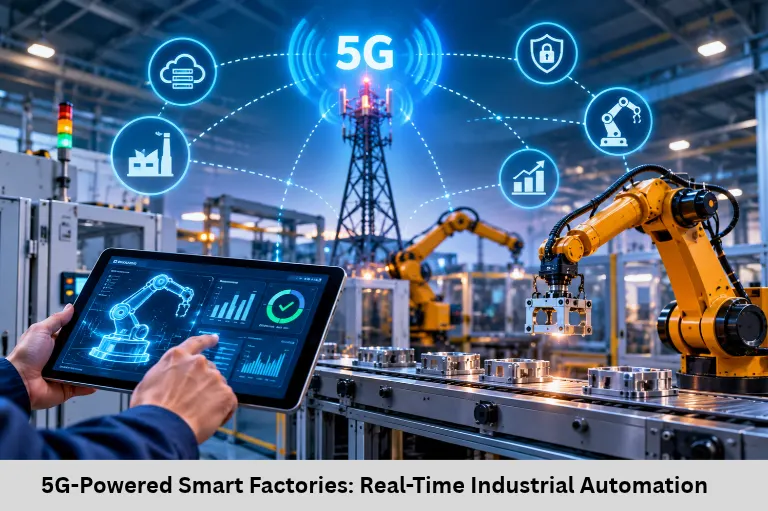
Explore how 5G enables smart factories through real-time monitoring, industrial Internet of Things (IoT), robotics, edge computing, predictive maintenance, and automation. Embedded Tech Development Academy (ETDA).
- 5G-Powered Smart Factories: Real-Time Industrial Automation
-
5G-Powered Smart Factories: Real-Time Management and Monitoring
- Introduction
- Important 5G Characteristics for Smart Factories
- Real-Time Monitoring in Smart Factories
- Real-Time Control in 5G Smart Factories
- Industrial Applications of 5G Technology
- Edge Computing, Embedded Systems, and Industrial IoT
- Security and Reliability in 5G Smart Factories
- Business Benefits of 5G-Powered Manufacturing
- Future Trends in Smart Factory Technology
- Technical Training for Industrial Embedded Development
- Frequently Asked Questions
- Conclusion
5G-Powered Smart Factories: Real-Time Management and Monitoring
Introduction
The manufacturing industry is undergoing a major transformation through Industry 4.0, Industrial Internet of Things (IoT), artificial intelligence, robotics, and advanced wireless communication. Traditional factories increasingly use connected machines, intelligent sensors, automated production lines, and cloud-based analytics to improve operational efficiency. However, conventional industrial networks may face limitations when handling massive device connectivity, high-speed data transmission, and time-sensitive communication. 5G technology addresses many of these requirements by providing high bandwidth, low latency, network slicing, and support for large numbers of connected devices.
A 5G-powered smart factory combines industrial Embedded Systems, Internet of Things (IoT) sensors, programmable logic controllers (PLCs), supervisory control and data acquisition (SCADA), autonomous mobile robots (AMRs), and edge computing platforms. These technologies enable real-time machine monitoring, predictive maintenance, automated quality inspection, and flexible production management. Understanding industrial communication protocols, wireless networking, sensor integration, and real-time control is increasingly important for embedded engineers. Embedded Tech Development Academy (ETDA) supports technical learning in Embedded Systems and Internet of Things (IoT), while learners evaluating a Top Embedded Training Institute in Bangalore can explore practical industrial automation projects. Its advertised assured placement support is another feature learners can review when considering technical training.
Important 5G Characteristics for Smart Factories
Low Latency Communication
5G is designed to support low-latency communication, particularly through Ultra-Reliable Low-Latency Communication (URLLC) capabilities. Depending on deployment conditions and service configuration, latency can be significantly reduced for time-sensitive industrial applications.
High Data Bandwidth
5G can support peak data rates of up to 10 Gbps or more under certain conditions. High bandwidth is useful for transmitting machine-vision images, industrial video, sensor information, and digital-twin data.
Massive Device Connectivity
Massive Machine-Type Communications (mMTC) supports large-scale device connectivity. A commonly cited target is up to one million devices per square kilometre under suitable conditions, making it relevant to industrial Internet of Things (IoT) deployments.
Network Slicing and Reliability
Network slicing allows operators to create logically separated network services with different performance and security requirements. Industrial applications can use dedicated configurations for monitoring, machine communication, and operational data.
Real-Time Monitoring in Smart Factories
Industrial IoT Sensor Monitoring
Real-time monitoring involves continuously collecting information from machinery, production lines, and factory environments. Industrial Internet of Things (IoT) sensors measure parameters such as temperature, humidity, vibration, pressure, and motor current.
Machine Vision and Edge Computing
Machine-vision cameras inspect products for dimensional defects, surface damage, and assembly errors. Edge computing processes data close to the production equipment, reducing the need to transmit every measurement to a remote cloud server.
Cloud Analytics and Predictive Insights
Cloud platforms store historical production information and support analytics. Machine-learning models can identify patterns associated with equipment degradation, production inefficiencies, and quality variations.
Real-Time Control in 5G Smart Factories
PLC and SCADA Communication
Programmable Logic Controllers manage industrial equipment using programmed control logic. SCADA systems supervise production processes, display operational information, and support operator control.
5G connectivity can provide communication between industrial controllers, monitoring systems, and mobile equipment. However, safety-critical control loops may still require deterministic wired networks or locally executed control rather than relying entirely on wireless communication.
Industrial Robotics and Autonomous Vehicles
5G can support communication for robotic arms, automated guided vehicles (AGVs), and autonomous mobile robots (AMRs). These systems use sensor information, cameras, and LiDAR to navigate factory environments and coordinate movement.
Example of Real-Time Operation
When a robot detects an obstacle through its sensors, its local controller processes the detection and initiates a safe response. A 5G network can communicate status information and coordinate other factory systems, while safety functions should remain dependable even if wireless connectivity is interrupted.
Industrial Applications of 5G Technology
Predictive Maintenance
Temperature and vibration sensors continuously monitor motors, pumps, and industrial machines. Edge systems analyse incoming measurements and identify abnormal operating patterns. Maintenance teams can receive alerts before equipment failure causes unplanned downtime.
AGVs and AMRs
AGVs and AMRs transport materials between production areas. 5G can support fleet coordination, location updates, and communication with factory management systems. Onboard navigation and obstacle-avoidance systems remain important for immediate safety decisions.
Augmented Reality and Remote Assistance
Technicians can use augmented reality headsets to view machine information, maintenance instructions, and live video. 5G provides bandwidth for high-resolution video and communication between remote experts and factory personnel.
Flexible Manufacturing
Software-controlled production lines can be reconfigured according to product demand. Connected machines and industrial Internet of Things (IoT) platforms exchange production information to coordinate equipment settings, material movement, and manufacturing schedules.
Edge Computing, Embedded Systems, and Industrial IoT
Role of Edge Processing
Edge computing processes data near the machines generating it. This reduces network traffic and supports faster local decisions. It is particularly useful when factories generate large volumes of sensor readings and machine-vision data.
Embedded Controllers and Communication Interfaces
Industrial Embedded Systems use microcontrollers, processors, sensors, and communication interfaces to collect and process equipment data. Interfaces such as CAN, Ethernet, UART, SPI, and I²C connect different hardware components.
Edge-to-Cloud Architecture
A smart factory can use embedded controllers for equipment-level operations, edge gateways for local analytics, and cloud platforms for long-term storage and production analysis. 5G connects distributed systems where wireless mobility and high-bandwidth communication are required.
Security and Reliability in 5G Smart Factories
Private 5G Networks
Private 5G networks provide manufacturers with greater control over network configuration, access policies, and operational traffic. Network slicing can logically separate services with different communication requirements.
Industrial Cybersecurity
Smart factories must protect connected controllers, gateways, sensors, and cloud services. Security measures include device authentication, encryption, access control, network segmentation, secure firmware updates, and continuous monitoring.
Reliability and Network Redundancy
Industrial networks must consider interference, coverage gaps, congestion, and connection failures. Critical equipment should have local control capabilities and appropriate fallback mechanisms so that essential operations do not depend exclusively on wireless connectivity.
Business Benefits of 5G-Powered Manufacturing
5G-enabled manufacturing can improve operational visibility and support more flexible production processes.
Key benefits include:
Reduced unplanned downtime through predictive maintenance.
Improved production monitoring and quality inspection.
Faster communication between connected industrial devices.
Better coordination of robotic systems and mobile equipment.
Greater flexibility when reconfiguring production lines.
Improved access to manufacturing data for operational decisions.
These benefits depend on network deployment, system integration, cybersecurity, and the actual industrial application.
Future Trends in Smart Factory Technology
AI, 5G, and Digital Twins
Digital twins create virtual representations of physical machines or production systems. By combining sensor data, edge computing, and AI analytics, manufacturers can simulate operating conditions and identify potential problems.
6G and Next-Generation Industrial Networks
Future 6G research aims to improve communication capabilities, sensing integration, and network intelligence. These developments may support more advanced industrial automation, although commercial capabilities and deployment timelines remain evolving.
Sustainable Manufacturing
Smart factories can use real-time energy monitoring to identify inefficient equipment and optimize power consumption. Connected sensors can also monitor emissions, temperature, and environmental conditions to support sustainable production.
Technical Training for Industrial Embedded Development
Embedded Tech Development Academy (ETDA) is an option for learners interested in Embedded Systems, Internet of Things (IoT), microcontroller programming, and industrial communication technologies. When comparing a Top Embedded Training Institute in Bangalore, examine practical exposure to sensors, communication protocols, embedded programming, and real-time industrial applications. Learners should also verify the scope and conditions of its advertised assured placement support.
Frequently Asked Questions
What is a 5G-powered smart factory?
A 5G-powered smart factory uses wireless 5G connectivity, industrial IoT sensors, automation systems, robotics, and data analytics to monitor and coordinate manufacturing operations.
How does 5G improve industrial automation?
5G provides high bandwidth, low-latency communication capabilities, and support for large numbers of connected devices. These features can improve machine monitoring, mobile robotics coordination, and industrial data exchange.
What is the role of IoT in smart factories?
IoT connects industrial sensors, machines, controllers, and monitoring platforms. It enables continuous collection of operational data for predictive maintenance, quality control, and production analysis.
What is the difference between AGV and AMR?
AGVs generally follow predefined routes or guidance systems, while AMRs use onboard sensors and navigation algorithms to adapt their routes and avoid obstacles.
Why is edge computing important in 5G smart factories?
Edge computing processes industrial data close to the equipment. It reduces communication overhead, supports faster local analytics, and avoids sending every measurement to a remote cloud platform.
What skills are useful for developing 5G-enabled smart factory systems?
Useful skills include Embedded C, microcontroller programming, RTOS, industrial communication protocols, Internet of Things (IoT) architecture, sensor interfacing, edge computing, networking, and industrial cybersecurity.
Conclusion
5G technology is transforming manufacturing by supporting high-speed communication, low-latency networking, massive device connectivity, and flexible industrial automation. When combined with Industrial Internet of Things (IoT), edge computing, artificial intelligence, robotics, and digital twins, it enables smart factories to improve monitoring, predictive maintenance, quality inspection, and production coordination.
Successful implementation requires more than wireless connectivity. Manufacturers must integrate reliable Embedded Systems, industrial controllers, secure communication protocols, local processing, and appropriate safety mechanisms. Understanding these technologies is valuable for engineers working in industrial automation, robotics, and Internet of Things (IoT) development. Embedded Tech Development Academy (ETDA) can be explored by learners seeking practical technical training in these areas. Those considering a Top Embedded Training Institute in Bangalore should assess the depth of hands-on projects and verify the details of its assured placement support. Combining embedded programming, industrial networking, and Internet of Things (IoT) knowledge can help prepare engineers for the evolving smart manufacturing industry.
Author: ETDA Trainers
Experience: 10+ Years of Industry Experience in Embedded Systems, IoT, and Embedded C Programming