
5G Smart Factories: Real-Time Control and Monitoring
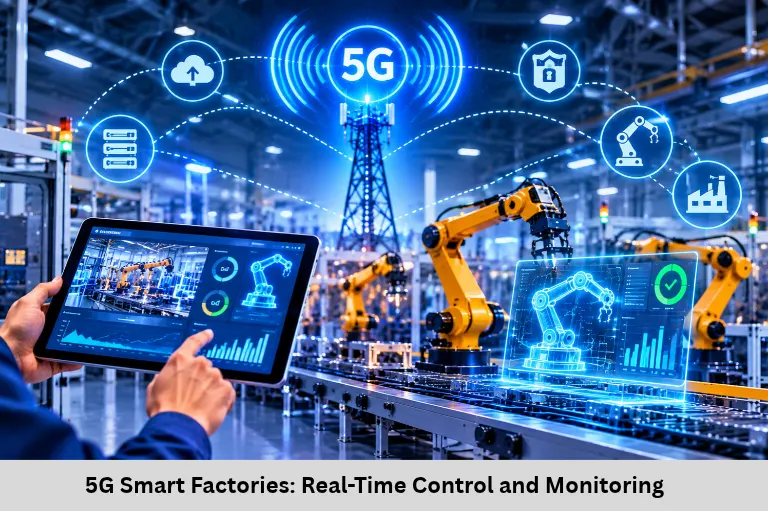
Explore how 5G enables smart factories through real-time monitoring, industrial automation, Internet of Things (IoT) connectivity, predictive maintenance, and intelligent manufacturing. Embedded Tech Development Academy (ETDA).
- 5G Smart Factories: Real-Time Control and Monitoring
-
5G-Powered Smart Factories: Instantaneous Management and Surveillance
- Introduction
- Understanding 5G Technology in Smart Factories
- Real-Time Monitoring in Smart Manufacturing
- Real-Time Control in 5G Smart Factories
- Major 5G Smart Factory Use Cases
- Security and Reliability in Industrial 5G
- Business Benefits of 5G Smart Factories
- Future Trends in Smart Manufacturing
- Frequently Asked Questions
- Conclusion
5G-Powered Smart Factories: Instantaneous Management and Surveillance
Introduction
The manufacturing industry is rapidly transitioning toward intelligent production environments where machines, sensors, robots, and industrial control systems communicate continuously. 5G-powered smart factories represent an important advancement in industrial automation by enabling real-time monitoring, intelligent machine control, predictive maintenance, and flexible manufacturing through high-speed wireless communication. Unlike conventional industrial networks, 5G provides advanced connectivity, reduced communication latency, massive device connectivity, and configurable network capabilities that support modern industrial applications.
The integration of 5G, Embedded Systems, Internet of Things (IoT), edge computing, artificial intelligence, and industrial robotics enables manufacturers to develop connected production environments. These technologies improve operational visibility, equipment utilization, production quality, and manufacturing flexibility. Industrial sensors can continuously collect machine parameters, while edge computing systems analyze information locally and communicate control decisions efficiently.
For aspiring embedded engineers, understanding industrial communication, wireless networking, real-time systems, and Internet of Things (IoT) architecture is increasingly valuable. Embedded Tech Development Academy (ETDA), recognized in its promotional positioning as a Top Embedded Training Institute in Bangalore, helps learners explore practical Embedded Systems concepts, industrial Internet of Things (IoT) applications, and automation technologies with assured placement support. Its technical learning approach connects foundational programming with industry-oriented embedded development.
Understanding 5G Technology in Smart Factories
5G is the fifth generation of cellular communication technology. Its capabilities support industrial applications requiring reliable communication, high data throughput, and responsive machine interaction.
Important 5G Characteristics
Ultra-low latency: 5G can support very low latency, potentially approaching 1 millisecond in specialized configurations. Actual end-to-end latency depends on network deployment and application requirements.
High bandwidth: Enhanced mobile broadband can provide multi-gigabit data rates under suitable conditions.
Massive connectivity: 5G supports large numbers of connected devices, including industrial Internet of Things (IoT) sensors.
Network slicing: Logical network segments can be configured for different service requirements.
Reliability: Industrial deployments can use specialized configurations to improve communication availability and reliability.
Why These Features Matter
Manufacturing environments require communication between programmable logic controllers (PLCs), supervisory control and data acquisition (SCADA) systems, industrial robots, and sensor networks. 5G can support high-speed data exchange while reducing dependence on traditional wired connections in suitable applications.
Industrial Communication Example
A connected production line can transmit vibration measurements, camera images, and machine status through a 5G network to edge computing infrastructure. The processing system identifies abnormal operating conditions and sends appropriate notifications to maintenance personnel.
Real-Time Monitoring in Smart Manufacturing
Real-time monitoring involves continuously observing machinery, production processes, and environmental parameters using connected sensors, cameras, and Internet of Things (IoT) devices.
Components of Industrial Monitoring
Internet of Things (IoT) sensors: Temperature, humidity, pressure, vibration, and current sensors measure machine operating conditions.
Machine vision: Industrial cameras inspect components, detect defects, and monitor assembly quality.
Edge computing: Local processing reduces unnecessary cloud communication and supports faster analysis.
Cloud analytics: Historical datasets help identify trends, generate predictive insights, and optimize production schedules.
Benefits of Monitoring
Early detection of equipment abnormalities.
Reduced unplanned downtime.
Improved quality assurance.
Better production visibility.
Efficient energy consumption analysis.
Sensor Data Processing
For example, an accelerometer installed on a motor can measure vibration continuously. Edge software evaluates vibration patterns against predefined thresholds. Abnormal readings generate alerts, allowing technicians to investigate before equipment failure affects production.
Real-Time Control in 5G Smart Factories
Real-time control involves adjusting machines, robotic systems, and production equipment according to sensor feedback and control commands.
Industrial Control Architecture
A typical architecture includes sensors, PLCs, industrial controllers, 5G communication infrastructure, edge computers, and actuators.
The controller processes input signals and generates output commands. Depending on the application, communication may connect supervisory systems, mobile robots, or remote monitoring platforms.
Applications of Real-Time Control
Automated guided vehicles (AGVs).
Autonomous mobile robots (AMRs).
Industrial robotic arms.
CNC machines with connected monitoring systems.
Remote equipment supervision.
Adaptive manufacturing lines.
5G supports wireless connectivity for these systems, although safety-critical motion control often requires deterministic industrial networks or carefully validated private 5G configurations.
Major 5G Smart Factory Use Cases
Predictive Maintenance
Machine temperature and vibration sensors continuously transmit operational information. Edge analytics evaluates the measurements and identifies deviations from normal operating conditions.
When a threshold is exceeded, maintenance alerts are generated. Predictive maintenance reduces unexpected failures and helps manufacturers schedule servicing efficiently.
Autonomous Guided Vehicles
AGVs and AMRs transport materials between production stations. Cameras, LiDAR sensors, and positioning systems provide environmental information.
5G connectivity supports fleet coordination, status monitoring, and communication with centralized management systems. Collision avoidance still depends on onboard sensing and validated safety mechanisms.
Augmented Reality and Remote Assistance
Technicians can use AR devices to access equipment information, maintenance instructions, and live video.
5G supports high-resolution video transmission and responsive remote assistance. Engineers can guide technicians through troubleshooting procedures without being physically present.
Flexible Manufacturing
Software-configurable production lines can adapt to changing product requirements.
Connected equipment receives configuration updates, production instructions, and scheduling information through industrial communication networks. 5G improves wireless connectivity for flexible manufacturing environments.
Security and Reliability in Industrial 5G
Industrial communication security is essential because connected manufacturing systems may contain sensitive production information and operational control functions.
Network Slicing and Private 5G
Network slicing can separate communication services according to operational requirements. Private 5G networks provide manufacturers with greater control over network deployment, access policies, and industrial traffic.
Cybersecurity Measures
Device authentication and authorization.
Encryption of communication channels.
Network segmentation.
Continuous traffic monitoring.
Secure firmware updates.
Industrial intrusion detection.
assured placement support in technical training should complement practical understanding of these security concepts, including embedded device protection and industrial Internet of Things (IoT) communication.
Business Benefits of 5G Smart Factories
5G-powered manufacturing improves industrial efficiency by supporting connected operations and data-driven decision-making.
Major advantages include:
Reduced downtime through predictive maintenance.
Improved production quality through automated inspection.
Increased flexibility in manufacturing operations.
Better visibility into machine performance.
Faster coordination between industrial devices.
Improved resource and energy management.
Embedded Systems and Internet of Things (IoT) technologies are essential components of these benefits because they connect physical equipment with digital control and analytics platforms.
Future Trends in Smart Manufacturing
The future of industrial automation involves combining 5G, artificial intelligence, edge computing, and digital twins.
Digital twins create virtual representations of physical machines or production processes. They use sensor data to monitor operating conditions and evaluate possible changes.
AI-enabled edge systems can analyze production information locally, helping factories optimize operations. Future 6G technologies may provide additional capabilities for sensing, communication, and intelligent connectivity, although their industrial applications remain under development.
Sustainable manufacturing will also become increasingly important through energy monitoring, adaptive production scheduling, and real-time environmental sensing.
Frequently Asked Questions
What is a 5G-powered smart factory?
A 5G-powered smart factory uses high-speed wireless connectivity to connect industrial machines, sensors, robots, and monitoring systems for intelligent manufacturing.
How does 5G improve industrial automation?
5G supports high-bandwidth communication, reduced latency, and large-scale device connectivity, improving monitoring, coordination, and flexible manufacturing.
What is the role of IoT in smart factories?
IoT sensors collect machine and environmental data, enabling monitoring, predictive maintenance, quality inspection, and automated decision-making.
Can 5G support predictive maintenance?
Yes. 5G transmits sensor information to edge or cloud analytics systems, which identify abnormal operating conditions and generate maintenance alerts.
What is network slicing in industrial 5G?
Network slicing creates logical network segments with different service characteristics, allowing industrial communication requirements to be addressed separately.
Why should embedded engineers learn smart factory technologies?
Knowledge of Embedded Systems, IoT, industrial communication, and real-time control helps engineers understand modern automation architectures and connected manufacturing applications.
Conclusion
5G-powered smart factories are transforming industrial automation through connected machinery, real-time monitoring, intelligent control, and predictive maintenance. By combining wireless communication with Embedded Systems, Internet of Things (IoT), edge computing, machine vision, and industrial robotics, manufacturers can create flexible production environments that respond efficiently to operational changes.
Understanding industrial communication protocols, embedded firmware, real-time systems, sensor integration, and wireless connectivity is valuable for engineers entering modern manufacturing. Embedded Tech Development Academy (ETDA), positioned as a Top Embedded Training Institute in Bangalore, supports learners in developing practical Embedded Systems and Internet of Things (IoT) knowledge relevant to industrial automation. Its technical learning approach and assured placement support help aspiring engineers prepare for embedded development opportunities.
As smart manufacturing continues evolving, engineers with expertise in 5G integration, industrial Internet of Things (IoT), firmware development, and automation will contribute to building intelligent and connected production systems.
Author: ETDA Trainers
Experience: 10+ Years of Industry Experience in Embedded Systems, IoT, and Embedded C Programming