
8-Bit vs 32-Bit Microcontrollers: Key Differences
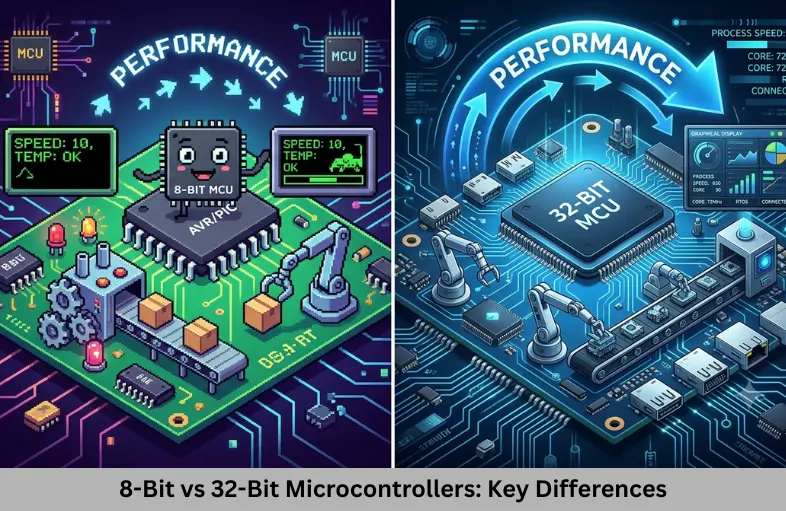
Understand 8-bit vs 32-bit microcontrollers, architecture, memory, speed, applications, and how to choose the right MCU for embedded systems. Embedded Tech Development Academy (ETDA).
- 8-Bit vs 32-Bit Microcontrollers: Key Differences
- 8-Bit vs 32-Bit Microcontrollers: Understanding the Key Differences
8-Bit vs 32-Bit Microcontrollers: Understanding the Key Differences
Microcontrollers are the backbone of modern embedded systems, controlling everything from household appliances and industrial machines to automotive electronics and Internet of Things (IoT) devices. Choosing the right microcontroller is an important decision because it directly affects processing performance, memory usage, power consumption, development complexity, and overall system cost.
One of the most common questions among electronics and embedded engineering students is the difference between 8-bit and 32-bit microcontrollers. Both architectures are widely used, but they are designed to handle different computational requirements. Understanding their differences helps students develop better firmware and select suitable hardware for real-world projects.
For aspiring embedded developers, learning both architectures provides a strong foundation. At a Top Embedded Training Institute in Bangalore, students can strengthen their understanding of microcontroller architecture through practical programming, peripheral interfacing, and project-based learning. Embedded Tech Development Academy (ETDA) supports students with technical training and assured placement support.
What Is an 8-Bit Microcontroller?
An 8-bit microcontroller is a processor whose core is designed to handle 8-bit data efficiently in its native operations. It generally contains 8-bit registers and an arithmetic logic unit (ALU) optimized for operations on 8-bit values.
A typical example is the 8051 microcontroller, which is widely used in embedded systems education and basic control applications. Other examples include AVR-based ATmega microcontrollers and PIC 8-bit families.
Architecture of an 8-Bit MCU
An 8-bit MCU generally contains a CPU, program memory, RAM, GPIO ports, timers, serial communication interfaces, and interrupt controllers. Its architecture is relatively simple, making it easier for beginners to understand registers, memory organization, and peripheral operation.
For example, an 8-bit register can directly represent unsigned values from 0 to 255. Larger values can still be processed using multiple bytes, although additional instructions and processing cycles may be required.
Applications of 8-Bit Microcontrollers
8-bit microcontrollers are suitable for applications where simple control operations are sufficient. Examples include digital clocks, basic home appliances, remote controls, simple sensor monitoring, and relay-based automation.
Practical Example
Consider a temperature monitoring system that reads a sensor and switches ON a cooling fan when the temperature exceeds a predefined threshold. An 8-bit MCU can efficiently handle sensor reading, threshold comparison, and GPIO control without requiring advanced processing capabilities.
What Is a 32-Bit Microcontroller?
A 32-bit microcontroller is designed around a processor core that efficiently handles 32-bit data operations. Its registers and ALU typically support 32-bit arithmetic, allowing it to process larger values and perform complex calculations more efficiently.
Popular examples include ARM Cortex-M-based microcontrollers such as STM32, LPC1768, and other 32-bit MCU families. These devices are widely used in automotive electronics, industrial automation, robotics, and connected embedded applications.
Architecture of a 32-Bit MCU
A typical 32-bit MCU includes a processor core, Flash memory, SRAM, GPIO, timers, ADCs, communication interfaces, and interrupt controllers. Depending on the device, it may also provide DMA, floating-point processing, advanced security features, and sophisticated peripheral controllers.
The larger register width allows the processor to manipulate 32-bit values efficiently. Many 32-bit MCUs also provide larger memory capacities and more advanced peripheral integration, although the exact capabilities depend on the specific device.
Applications of 32-Bit Microcontrollers
32-bit MCUs are useful for applications involving multiple communication interfaces, complex calculations, real-time control, and advanced firmware functionality. Examples include automotive ECUs, motor control systems, robotics, industrial monitoring, and Internet of Things (IoT) gateways.
Practical Example
A robotic system may require motor control, encoder processing, sensor fusion, communication, and real-time decision-making. A 32-bit MCU can handle these operations more efficiently, especially when the firmware includes complex algorithms or an RTOS.
8-Bit vs 32-Bit Microcontrollers: Key Differences
The major difference between 8-bit and 32-bit microcontrollers is their native data-processing capability. However, engineers must also consider memory, peripherals, power consumption, programming complexity, and application requirements.
| Feature | 8-Bit MCU | 32-Bit MCU |
|---|---|---|
| Native data width | 8 bits | 32 bits |
| Arithmetic | Efficient for smaller values | Efficient for larger values |
| Processing capability | Suitable for simple control | Suitable for complex computation |
| Memory capacity | Generally smaller | Often larger |
| Firmware complexity | Usually simpler | Supports complex firmware |
| RTOS suitability | Limited by resources | Commonly suitable |
| Applications | Basic control systems | Automotive, robotics, Internet of Things (IoT) |
| Examples | 8051, ATmega328P | STM32, LPC1768 |
Processing Speed and Performance
32-bit MCUs generally provide higher processing performance, but actual speed depends on clock frequency, instruction execution time, architecture, memory access, and compiler optimization. A 32-bit processor can perform many arithmetic operations with fewer instructions than an 8-bit processor.
For example, calculating a 32-bit counter value may require multiple operations on an 8-bit MCU, whereas a 32-bit MCU can often manipulate it directly. This becomes important in signal processing, motor control, and real-time applications.
Memory and Addressing
8-bit MCUs commonly have limited Flash and RAM, making them suitable for compact firmware. 32-bit MCUs frequently provide larger memory resources, supporting more complex applications, buffers, communication stacks, and multitasking.
However, bit width alone does not determine memory capacity. A particular 8-bit MCU may have more memory than another MCU with a different architecture, so engineers must check the datasheet.
Power Consumption and Cost
8-bit MCUs are often economical for simple designs and may offer excellent low-power operation. They are particularly useful when the system performs basic tasks and spends most of its time in sleep mode.
32-bit MCUs may consume more power during active processing, but modern devices offer advanced sleep modes and energy-efficient architectures. The actual power consumption depends on clock frequency, peripheral activity, workload, and operating conditions.
Which Microcontroller Should Beginners Learn?
Students entering embedded systems development should understand both architectures instead of treating one as universally superior. Learning an 8-bit MCU first helps develop fundamentals, while moving to a 32-bit MCU introduces professional firmware development concepts.
Learning 8051 Embedded C
The 8051 is useful for understanding GPIO programming, timers, interrupts, UART communication, and register-level programming. These concepts help students understand how software interacts directly with hardware.
Learning ARM Cortex-M Programming
ARM Cortex-M development introduces students to advanced peripherals, interrupt handling, memory organization, debugging, and real-time firmware development. Platforms such as LPC1768 and STM32 provide practical opportunities to work with modern embedded applications.
Learn Microcontroller Programming at Embedded Tech Development Academy
Embedded Tech Development Academy (ETDA) helps students build technical skills required for embedded firmware development through structured learning and practical exposure. Students can strengthen their understanding of Embedded C, microcontroller architecture, peripheral programming, and hardware-software interaction.
A practical learning pathway includes:
Understanding C programming and Embedded C concepts.
Programming 8051 microcontrollers using registers and peripherals.
Learning ARM Cortex-M architecture and interrupt handling.
Interfacing UART, SPI, I2C, ADC, timers, and GPIO.
Developing embedded projects using sensors and communication modules.
Exploring RTOS concepts and Internet of Things (IoT) applications.
Practicing debugging and firmware development techniques.
Students searching for a Top Embedded Training Institute in Bangalore should evaluate practical curriculum, laboratory experience, trainer expertise, project exposure, and career guidance. Embedded Tech Development Academy (ETDA) combines technical learning with assured placement support to help learners prepare for embedded engineering opportunities.
Frequently Asked Questions
What is the main difference between 8-bit and 32-bit microcontrollers?
The primary difference is native data-processing width. An 8-bit MCU handles 8-bit operations efficiently, while a 32-bit MCU supports native 32-bit arithmetic and generally offers greater processing capability.
Is an 8-bit microcontroller suitable for beginners?
Yes. 8-bit MCUs such as 8051 are excellent for learning GPIO, timers, interrupts, UART, and basic Embedded C programming.
Which is better for IoT applications, 8-bit or 32-bit?
32-bit MCUs are generally better suited for Internet of Things (IoT) applications involving wireless stacks, security, multiple sensors, and complex processing. Simple sensor nodes can still use 8-bit MCUs.
Is ARM Cortex-M a 32-bit microcontroller architecture?
ARM Cortex-M is a processor family widely used in 32-bit microcontrollers. Cortex-M-based MCUs are popular for embedded firmware, industrial control, and automotive applications.
Should embedded engineering students learn both 8051 and ARM?
Yes. 8051 helps students understand fundamental microcontroller programming, while ARM Cortex-M provides experience with modern embedded architecture and professional firmware development.
Conclusion
Understanding 8-bit vs 32-bit microcontrollers helps students make informed decisions while designing embedded systems. 8-bit MCUs remain valuable for simple, cost-effective control applications, while 32-bit MCUs support advanced processing, communication, and real-time firmware development.
For students planning an embedded engineering career, learning both 8051 and ARM Cortex-M programming creates a strong technical foundation. Choosing a Top Embedded Training Institute in Bangalore such as Embedded Tech Development Academy (ETDA) can help learners develop practical Embedded systems and Internet of Things (IoT) skills through structured training, project experience, and assured placement support.
Author: ETDA Trainers
Experience: 10+ Years of Industry Experience in Embedded Systems, IoT, and Embedded C Programming