
Difference Between Embedded Systems and IoT | Complete Guide
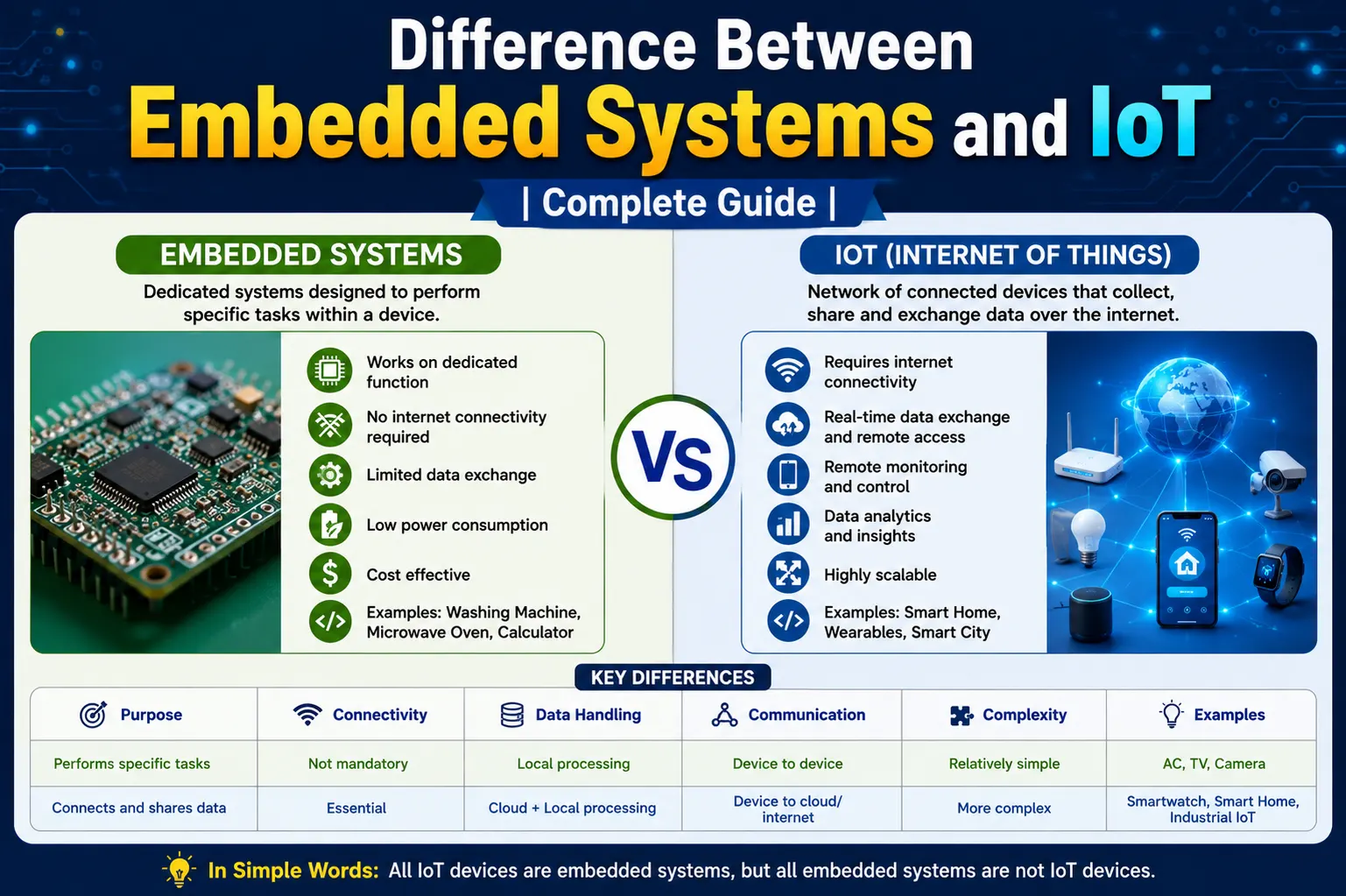
Learn the difference between Embedded Systems and IoT with examples, features, applications, advantages, FAQs, and career opportunities in this beginner-friendly guide.
- Difference Between Embedded Systems and IoT | Complete Guide
- Difference Between Embedded Systems and IoT
- What is IoT (Internet of Things)?
- Relationship Between Embedded Systems and IoT
- Key Components of IoT Systems
- Advantages of Embedded Systems
- Advantages of IoT
- Applications of Embedded Systems
- Applications of IoT
- Embedded Systems vs IoT: Which One Should You Learn?
- Career Opportunities in Embedded Systems and IoT
- Future of Embedded Systems and IoT
- Conclusion
Difference Between Embedded Systems and IoT
The world is becoming increasingly connected, and technologies like Embedded Systems and the Internet of Things (IoT) are driving this transformation. While these terms are often used together, many students, beginners, and even professionals confuse embedded systems with IoT. Understanding the difference between Embedded Systems and IoT is important for anyone interested in electronics, automation, robotics, or smart technologies. Although IoT devices often contain embedded systems, the two concepts are not the same. In this comprehensive guide, we will explore the key differences between embedded systems and IoT, their features, applications, advantages, and career opportunities. By the end of this article, you will clearly understand how these technologies work and where they are used.
What is an Embedded System?
An Embedded System is a dedicated computer system designed to perform a specific task within a larger device or machine. It combines hardware and software to carry out predefined functions efficiently. Unlike general-purpose computers, embedded systems are built for a particular application and operate with limited resources such as memory, processing power, and storage.
Examples of Embedded Systems
- Washing machines
- Microwave ovens
- Traffic light controllers
- Digital cameras
- Air conditioners
- Automotive engine control units
- Medical monitoring devices
An embedded system may or may not be connected to the internet. Its primary goal is to perform a specific function reliably and efficiently.
What is IoT (Internet of Things)?
The Internet of Things (IoT) refers to a network of physical devices connected to the internet that can collect, share, and exchange data. IoT devices use sensors, communication modules, cloud platforms, and software applications to enable remote monitoring and control. Unlike traditional embedded systems, IoT devices are designed to communicate with other devices and systems over the internet.
Examples of IoT Devices
- Smart home automation systems
- Smart thermostats
- Smart door locks
- Wearable fitness trackers
- Smart agriculture monitoring systems
- Connected healthcare devices
- Smart city infrastructure
IoT extends the capabilities of embedded systems by enabling connectivity and data sharing.
Relationship Between Embedded Systems and IoT
One of the most common misconceptions is that embedded systems and IoT are completely different technologies.
In reality:
- Every IoT device contains an embedded system.
- Not every embedded system is an IoT device.
An embedded system becomes part of an IoT solution when internet connectivity and communication capabilities are added.
For example:
Embedded System Example
A traditional washing machine that performs washing operations automatically.
IoT Example
A smart washing machine that can be monitored and controlled through a mobile application via the internet. The core control system remains embedded, but internet connectivity transforms it into an IoT device.
Difference Between Embedded Systems and IoT
The following table highlights the major differences:
Difference Between Embedded Systems and IoT
| Feature | Embedded Systems | IoT |
|---|---|---|
| Definition | Dedicated computing system for specific tasks | Network of connected smart devices |
| Internet Connectivity | Not required | Essential |
| Data Sharing | Limited or none | Continuous data exchange |
| Communication | Local operation | Cloud and internet communication |
| Monitoring | Manual or local | Remote monitoring possible |
| Complexity | Relatively simple | More complex |
| Components | Microcontroller, sensors, software | Embedded system + internet + cloud |
| Scalability | Limited | Highly scalable |
| Examples | Microwave, calculator | Smart thermostat, smart home |
This comparison clearly shows that IoT is an evolution of embedded systems rather than a replacement. While embedded systems are designed to perform specific tasks independently, IoT enhances their capabilities by enabling internet connectivity, remote monitoring, data sharing, and intelligent automation.
Key Components of Embedded Systems
Understanding the components of embedded systems helps explain their role in IoT.
Microcontroller or Microprocessor
Acts as the brain of the system and executes instructions.
Memory
- Stores program code and data.
Input Devices
Examples include:
- Sensors
- Switches
- Keypads
Output Devices
Examples include:
- LEDs
- Displays
- Motors
- Relays
Embedded Software
Software written using Embedded C, C++, or other programming languages controls system operation.
Key Components of IoT Systems
IoT systems contain all the components of embedded systems along with additional technologies.
Sensors
Collect environmental data such as temperature, humidity, motion, and pressure.
Connectivity Module
Provides communication through:
- Wi-Fi
- Bluetooth
- Zigbee
- LoRaWAN
- Cellular networks
Cloud Platform
Stores and processes collected data.
Mobile or Web Application
Allows users to monitor and control devices remotely.
Data Analytics
Analyzes collected information to provide useful insights.
Advantages of Embedded Systems
Embedded systems offer several benefits.
High Reliability
- Designed for dedicated tasks with predictable performance.
Low Power Consumption
Optimized for efficient energy usage.
Cost Effective
Typically require fewer hardware resources.
Fast Performance
Perform specific operations quickly and efficiently.
Compact Design
Can be integrated into small electronic devices.
Advantages of IoT
IoT provides benefits beyond traditional embedded systems.
Remote Monitoring
Users can monitor devices from anywhere.
Real-Time Data Collection
Continuous monitoring helps improve decision-making.
Automation
Devices can automatically perform tasks based on collected data.
Improved Efficiency
Businesses can optimize operations using IoT insights.
Predictive Maintenance
IoT systems can detect issues before failures occur.
Applications of Embedded Systems
Embedded systems are used across many industries.
Consumer Electronics
- Televisions
- Washing machines
- Cameras
Automotive Industry
- Airbag systems
- Engine control units
- ABS braking systems
Medical Equipment
- ECG machines
- Blood pressure monitors
Industrial Automation
- PLC systems
- Robotics
Applications of IoT
IoT is transforming industries worldwide.
Smart Homes
- Smart lighting
- Smart security systems
- Smart appliances
Healthcare
- Remote patient monitoring
- Wearable health devices
Agriculture
- Smart irrigation systems
- Soil monitoring solutions
Smart Cities
- Traffic management
- Smart parking
- Waste management
Industrial IoT (IIoT)
- Predictive maintenance
- Equipment monitoring
- Factory automation
Embedded Systems vs IoT: Which One Should You Learn?
This is a common question among students and professionals.
Learn Embedded Systems If:
- You want to work with hardware design.
- You enjoy microcontroller programming.
- You are interested in firmware development.
- You want a strong foundation in electronics.
Learn IoT If:
- You are interested in connected devices.
- You enjoy cloud computing and networking.
- You want to build smart applications.
- You are interested in Industry 4.0 technologies.
Best Approach
The most valuable approach is learning both. Since IoT devices are built on embedded systems, understanding embedded programming makes learning IoT much easier.
Career Opportunities in Embedded Systems and IoT
The demand for professionals in both fields continues to grow rapidly.
Embedded Systems Career Roles
- Embedded Software Engineer
- Firmware Engineer
- Embedded Design Engineer
- Hardware Engineer
- Automotive Embedded Developer
IoT Career Roles
- IoT Developer
- IoT Solution Architect
- Cloud Engineer
- IoT Security Specialist
- Industrial IoT Engineer
With the growth of smart devices and connected technologies, both career paths offer excellent opportunities.
Future of Embedded Systems and IoT
The future of these technologies is extremely promising.
Artificial Intelligence Integration
AI-powered embedded and IoT systems are becoming more common.
Smart Manufacturing
Industries are adopting intelligent automation solutions.
Smart Healthcare
Connected medical devices are improving patient care.
Electric Vehicles
Modern vehicles rely heavily on embedded and IoT technologies.
Edge Computing
Data processing is moving closer to devices for faster performance. These trends are creating new opportunities for engineers and technology professionals.
Frequently Asked Questions (FAQs)
Is IoT the same as an embedded system?
No. An embedded system is a dedicated computing device, while IoT refers to connected devices that communicate over the internet.
Can an embedded system work without the internet?
Yes. Most traditional embedded systems operate independently without internet connectivity.
Does every IoT device contain an embedded system?
Yes. Every IoT device uses an embedded system as its core processing unit.
Which is better: Embedded Systems or IoT?
Neither is better. IoT builds upon embedded systems, and both are important technologies with different purposes.
Is Embedded C required for IoT?
Yes. Embedded C is commonly used for programming microcontrollers that form the foundation of IoT devices.
What are examples of embedded systems and IoT?
Embedded systems include microwave ovens and washing machines. IoT examples include smart thermostats, smart locks, and wearable fitness trackers.
Conclusion
Although Embedded Systems and IoT are closely related, they serve different purposes. Embedded systems focus on performing dedicated tasks within electronic devices, while IoT extends those capabilities by enabling internet connectivity, remote monitoring, and data sharing.
Understanding the difference between embedded systems and IoT is essential for students, engineers, and technology enthusiasts looking to build careers in electronics, automation, robotics, and smart technologies. As industries continue adopting connected solutions, expertise in both embedded systems and IoT will become increasingly valuable.
At Embedded Tech Development Academy (ETDA), students gain hands-on experience in Embedded C, microcontrollers, embedded systems, and IoT technologies through practical projects and industry-focused training, helping them build successful careers in the rapidly evolving world of smart technology.
Author: ETDA Trainers
Experience: 10+ Years of Industry Experience in Embedded Systems, IoT, and Embedded C Programming