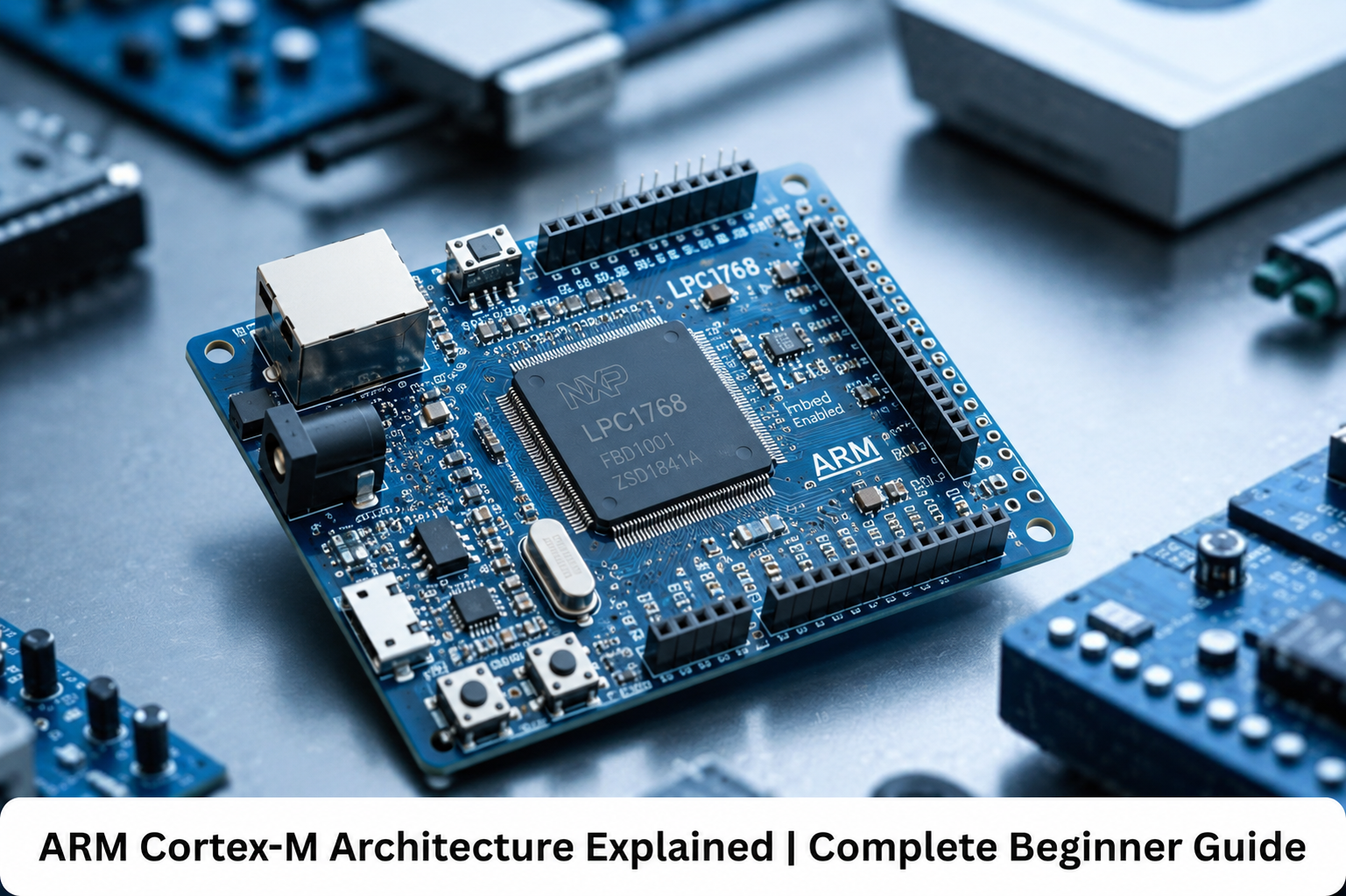
ARM Cortex-M Architecture Explained | Complete Beginner Guide
Learn ARM Cortex-M Architecture with its core components, registers, memory model, interrupt handling, applications, and advantages in embedded systems.
The ARM Cortex-M family has become the backbone of modern embedded systems. From smart home devices and wearable technology to automotive electronics and industrial automation, Cortex-M microcontrollers power millions of devices worldwide. For students and embedded engineers, understanding ARM Cortex-M Architecture is essential because it forms the foundation of many popular microcontrollers such as STM32, NXP LPC, Nordic nRF, TI Tiva, and many IoT development boards. In this guide, we’ll explore the ARM Cortex-M architecture, its key components, features, working principles, and why it is widely used in embedded systems development.
What is ARM Cortex-M?
ARM Cortex-M is a family of 32-bit RISC (Reduced Instruction Set Computing) processors designed specifically for embedded applications.
These processors are developed by ARM Holdings and are optimized for:
Low power consumption
High performance
Real-time processing
Cost-effective embedded solutions
The Cortex-M series is widely used in:
Consumer electronics
Medical devices
Industrial automation
IoT products
Automotive systems
Robotics
Unlike general-purpose processors, Cortex-M processors are specifically designed to efficiently handle embedded tasks.
Why ARM Cortex-M is Popular
Several factors contribute to the widespread adoption of Cortex-M processors.
Low Power Consumption
Battery-operated devices require energy-efficient processors. ARM Cortex-M processors are designed to minimize power usage while maintaining performance.
High Performance
The architecture provides fast instruction execution suitable for real-time applications.
Easy Development
A large ecosystem of development tools, libraries, and documentation makes Cortex-M development easier.
Scalability
The Cortex-M family includes multiple processor variants for different performance requirements.
Cost Effectiveness
Manufacturers can integrate Cortex-M cores into affordable microcontrollers.
ARM Cortex-M Family Overview
The Cortex-M family consists of several processor variants.
Cortex-M0
Entry-level processor designed for low-cost applications.
Features
Low power consumption
Small silicon area
Basic processing capabilities
Applications
Simple IoT devices
Consumer electronics
Basic control systems
Cortex-M0+
Enhanced version of Cortex-M0 with improved energy efficiency.
Applications
Wearable devices
Battery-powered systems
Cortex-M3
Designed for higher performance embedded applications.
Features
Improved interrupt handling
Better performance
Enhanced debugging support
Applications
Industrial control systems
Medical devices
Cortex-M4
Adds Digital Signal Processing (DSP) capabilities.
Features
DSP instructions
Floating Point Unit (FPU) support
Applications
Audio processing
Motor control
Advanced IoT systems
Cortex-M7
High-performance processor for demanding embedded applications.
Applications
Automotive systems
Industrial automation
Advanced robotics
Cortex-M33
Designed with enhanced security features.
Features
ARM TrustZone technology
Improved security
Efficient power management
Applications
Secure IoT devices
Smart home systems
ARM Cortex-M Architecture Overview
The Cortex-M architecture consists of several important components working together to execute embedded applications efficiently.
Core Processor
The processor core executes instructions and controls overall system operation.
The core contains:
Arithmetic Logic Unit (ALU)
Registers
Program Counter
Control Logic
It serves as the brain of the microcontroller.
RISC Architecture
ARM Cortex-M follows the RISC architecture principle.
Characteristics of RISC
Simple instructions
Faster execution
Reduced complexity
Efficient performance
RISC processors execute most instructions in a single clock cycle, making them highly efficient for embedded systems.
ARM Cortex-M Register Set
Registers are small, high-speed memory locations inside the processor. The Cortex-M architecture provides multiple registers.
General Purpose Registers
The processor includes:
R0 to R12
These registers store temporary data during program execution.
Stack Pointer (SP)
The stack pointer manages stack memory.
It stores:
Local variables
Function call information
Return addresses
Applications
Firmware development
Prototype systems
EPROM was widely used before Flash memory became popular.
Link Register (LR)
Stores the return address when a function is called.
Program Counter (PC)
Contains the address of the next instruction to execute. The program counter automatically updates as instructions are processed.
Program Status Register (PSR)
Stores processor status information such as:
Zero flag
Carry flag
Overflow flag
Negative flag
These flags help the processor make decisions during execution.
ARM Cortex-M Memory Architecture
Flash Memory
Used to store:
Firmware
Application code
Bootloader
Flash memory is non-volatile and retains data without power.
SRAM
Used for:
Variables
Stack
Heap
Runtime data
SRAM provides fast read and write operations.
Peripheral Memory
Stores hardware peripheral registers.
Examples:
GPIO
UART
SPI
I2C
Timers
The CPU accesses these registers to control hardware devices.
ARM Cortex-M Bus Architecture
The Cortex-M processor communicates with memory and peripherals using buses.
System Bus
Connects the CPU to memory and peripherals.
Data Bus
Transfers data between components.
Instruction Bus
Fetches program instructions from memory. This architecture allows efficient parallel operations and improves overall performance.
Interrupt Handling in Cortex-M
One of the most powerful features of Cortex-M processors is their interrupt handling mechanism.
What is an Interrupt?
An interrupt is a signal that temporarily pauses normal program execution to handle an important event.
Examples:
Button press
Sensor trigger
Communication request
Nested Vectored Interrupt Controller (NVIC)
The NVIC is a dedicated hardware module responsible for interrupt management.
Functions of NVIC
Prioritizes interrupts
Handles nested interrupts
Reduces interrupt latency
Improves real-time performance
NVIC is one of the reasons Cortex-M processors are highly suitable for real-time applications.
Exception Handling
The Cortex-M architecture includes built-in support for exception handling.
Common exceptions include:
Reset
Hard Fault
Memory Fault
Bus Fault
Usage Fault
These mechanisms improve system reliability and fault recovery.
Cortex-M Privileged and Unprivileged Modes
The processor supports different execution modes.
Privileged Mode
Provides full access to system resources.
Typically used by:
Operating systems
System software
Unprivileged Mode
Provides restricted access.
Used for:
User applications
Secure execution
This separation enhances system security.
Low-Power Features of Cortex-M
Power efficiency is one of the biggest strengths of Cortex-M processors.
Sleep Mode
The processor stops executing instructions while maintaining essential functions.
Deep Sleep Mode
Further reduces power consumption by disabling more system components. These modes extend battery life in portable devices.
ARM Cortex-M and RTOS
Cortex-M processors work exceptionally well with Real-Time Operating Systems (RTOS).
Popular RTOS platforms include:
FreeRTOS
Zephyr
ThreadX
CMSIS-RTOS
RTOS features supported by Cortex-M include:
Multitasking
Scheduling
Inter-task communication
Real-time processing
This makes Cortex-M ideal for advanced embedded applications.
Applications of ARM Cortex-M
The Cortex-M architecture is used in numerous industries.
Internet of Things (IoT)
Smart sensors
Smart home devices
Connected appliances
Automotive Systems
Engine control units
Dashboard systems
Vehicle monitoring
Medical Devices
Patient monitors
Wearable health trackers
Industrial Automation
PLC systems
Robotics
Process control equipment
Consumer Electronics
Smart watches
Cameras
Home appliances
Advantages of ARM Cortex-M Architecture
High Performance
Efficient instruction execution for real-time applications.
Low Power Consumption
Ideal for battery-powered devices.
Scalable Design
Multiple Cortex-M variants support different requirements.
Strong Ecosystem
Extensive software and hardware support.
Real-Time Capability
Excellent interrupt handling and deterministic behavior.
Security Features
Advanced security options such as TrustZone in Cortex-M33.
Future of ARM Cortex-M
The demand for Cortex-M processors continues to grow.
Emerging areas include:
Artificial Intelligence at the Edge
Industrial IoT
Smart Cities
Autonomous Systems
Wearable Technology
As embedded devices become smarter and more connected, Cortex-M processors will remain a dominant platform in embedded development.
Frequently Asked Questions (FAQs)
What is ARM Cortex-M?
ARM Cortex-M is a family of 32-bit RISC processors designed for embedded systems and microcontroller applications.
Why is Cortex-M used in embedded systems?
It offers high performance, low power consumption, real-time capabilities, and cost-effective implementation.
What is the difference between Cortex-M0 and Cortex-M4?
Cortex-M4 includes DSP instructions and floating-point support, while Cortex-M0 is designed for simpler applications.
Is Cortex-M suitable for IoT devices?
Yes. Cortex-M processors are widely used in IoT devices due to their low power consumption and processing efficiency.
Which RTOS can run on Cortex-M?
Popular RTOS options include FreeRTOS, Zephyr, ThreadX, and CMSIS-RTOS.
What is the advantage of RISC architecture?
RISC uses simpler instructions that execute faster and more efficiently.
Which microcontrollers use ARM Cortex-M cores?
Popular examples include STM32, NXP LPC, Nordic nRF52, TI Tiva, and Silicon Labs EFM32.
Conclusion
The ARM Cortex-M architecture has revolutionized embedded systems by providing an ideal combination of performance, power efficiency, scalability, and real-time capabilities. Its advanced features, including NVIC-based interrupt handling, RISC design, low-power modes, and RTOS compatibility, make it the preferred choice for modern embedded applications.
Whether you’re developing IoT devices, industrial automation systems, medical equipment, or automotive electronics, understanding Cortex-M architecture is a valuable skill for any embedded engineer.
At Embedded Tech Development Academy (ETDA), students gain hands-on experience with ARM Cortex-M microcontrollers, Embedded C programming, RTOS development, hardware interfacing, and IoT projects, helping them build industry-ready skills for successful careers in embedded systems engineering.
Author: ETDA Trainers Experience: 10+ Years of Industry Experience in Embedded Systems, IoT, and Embedded C Programming