
From Beginner to Embedded Engineer: Your Learning Path at ETDA
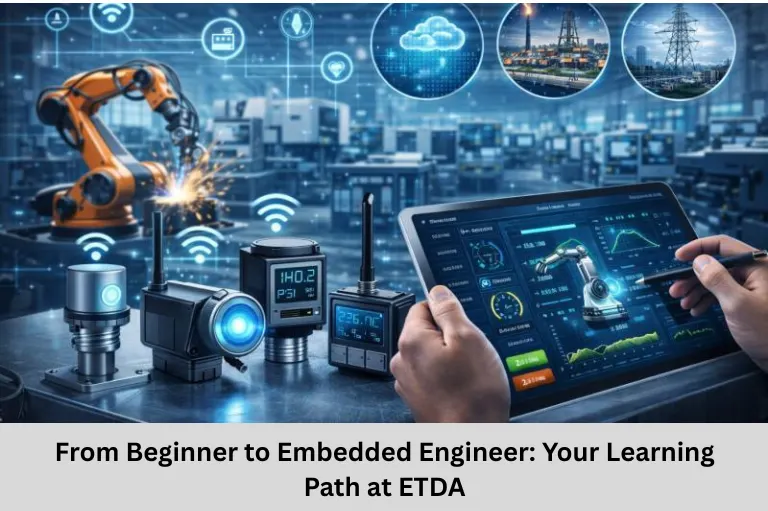
Discover the complete learning path from beginner to Embedded Engineer at ETDA. Learn C Programming, Embedded C, ARM, STM32, LPC1768, IoT, RTOS, real-time projects, and get assured placement support.
- From Beginner to Embedded Engineer: Your Learning Path at ETDA
-
From Beginner to Embedded Engineer: Your Learning Path at ETDA
- Why a Structured Learning Path is Important
- Stage 1 – Building a Strong Programming Foundation
- Stage 2 – Understanding Electronics Fundamentals
- Stage 3 – Entering the World of Embedded C
- Stage 4 – Learning ARM Cortex-M Architecture
- Stage 5 – Hands-On Development with LPC1768
- Stage 6 – Advanced Embedded Development with STM32
- Stage 7 – Mastering Communication Protocols
- Stage 8 – Learning Real-Time Operating Systems (RTOS)
- Stage 9 – Exploring IoT Development
- Stage 10 – Automotive Embedded Systems
- Stage 11 – Building Real-Time Industry Projects
- Stage 12 – Placement Preparation
- Why Students Choose ETDA
- Career Opportunities After Completing ETDA Training
- Frequently Asked Questions (FAQs)
- Conclusion
From Beginner to Embedded Engineer: Your Learning Path at ETDA
The Embedded Systems industry is one of the fastest-growing technology sectors in the world. From smartphones and smart home devices to electric vehicles, industrial automation systems, robotics, medical equipment, and IoT applications, embedded systems power the technology we use every day.
As industries continue to innovate, the demand for skilled Embedded Engineers is increasing rapidly. However, many engineering students and fresh graduates face a common challenge. They know the basics of electronics and programming from college, but they often lack the practical skills required by companies.
Questions such as:
- How do I start learning Embedded Systems?
- Which programming language should I learn first?
- What microcontrollers should I study?
- How can I build projects?
- How do I get placed in a core Embedded Systems company?
are common among aspiring engineers.
This is where Embedded Tech Development Academy (ETDA) provides a clear and structured roadmap.
ETDA has designed a step-by-step learning path that transforms beginners into industry-ready Embedded Engineers through practical training, real-time projects, expert mentorship, and assured placement support. Instead of overwhelming students with advanced concepts from day one, ETDA follows a progressive learning methodology that helps students build a strong foundation before moving toward advanced embedded technologies.
In this guide, we’ll explore the complete journey from beginner to professional Embedded Engineer and how ETDA helps students achieve their career goals.
Why a Structured Learning Path is Important
Many students start learning Embedded Systems by watching random tutorials or jumping directly into advanced topics.
Unfortunately, this often creates confusion.
Embedded Systems development requires knowledge of:
- Programming
- Electronics
- Microcontrollers
- Communication Protocols
- Debugging
- Real-Time Systems
- IoT Technologies
Without a structured approach, learning becomes difficult and frustrating.
ETDA solves this problem by organizing training into logical stages, allowing students to master one concept before moving to the next.
Stage 1 – Building a Strong Programming Foundation
Every successful Embedded Engineer starts with programming.
Why C Programming is the First Step
C Programming is the most widely used language in Embedded Systems development.
Most firmware running inside microcontrollers is written in C because it provides:
- High Performance
- Hardware Control
- Memory Efficiency
- Portability
Without strong C programming skills, advanced embedded concepts become difficult to understand.
What Students Learn at ETDA
Programming Fundamentals
Students begin with:
- Variables and Data Types
- Operators
- Conditional Statements
- Loops
- Functions
Advanced C Concepts
Students then move to:
- Arrays
- Strings
- Structures
- Unions
- Pointers
- Dynamic Memory Allocation
- Bitwise Operators
These concepts are heavily used in embedded firmware development.
Stage 2 – Understanding Electronics Fundamentals
Before controlling hardware through software, students need a strong understanding of basic electronics.
Core Electronics Concepts
At ETDA, students learn:
- Resistors
- Capacitors
- Diodes
- Transistors
- Voltage Regulators
- Power Supplies
Digital Electronics
Students also understand:
- Logic Gates
- Flip-Flops
- Counters
- Multiplexers
- Digital Circuits
These concepts help engineers understand how embedded hardware operates.
Stage 3 – Entering the World of Embedded C
Once programming fundamentals are strong, students begin Embedded C programming.
What is Embedded C?
Embedded C is an extension of C used for programming microcontrollers and embedded hardware.
Unlike regular software development, Embedded C interacts directly with hardware components.
Skills Covered at ETDA
- Register-Level Programming
- GPIO Programming
- Interrupt Handling
- Timers and Counters
- PWM Generation
- ADC and DAC Programming
- Peripheral Configuration
This stage introduces students to real embedded development.
Stage 4 – Learning ARM Cortex-M Architecture
Most modern embedded products use ARM-based microcontrollers.
Understanding ARM architecture is essential for becoming an embedded engineer.
Why ARM?
ARM processors are used in:
- Automotive Electronics
- Medical Devices
- Consumer Electronics
- IoT Products
- Industrial Automation
Learning ARM significantly improves job opportunities.
ARM Concepts Covered
- ARM Cortex-M Architecture
- Memory Organization
- Interrupt Systems
- Processor Registers
- Exception Handling
- Embedded Firmware Design
Students gain a deep understanding of how embedded processors function.
Stage 5 – Hands-On Development with LPC1768
After learning ARM fundamentals, students begin practical programming using LPC1768.
Why LPC1768?
The LPC1768 is a powerful ARM Cortex-M3 microcontroller that provides an excellent platform for learning embedded systems.
Practical Learning Activities
- LED Interfacing
- LCD Interfacing
- Keypad Programming
- UART Communication
- ADC Applications
- PWM Control
- Sensor Integration
Students start writing real firmware and interacting with hardware.
Stage 6 – Advanced Embedded Development with STM32
STM32 microcontrollers are widely used in commercial products.
Learning STM32 prepares students for industry-level embedded development.
Topics Covered
- STM32 Architecture
- Peripheral Programming
- Sensor Interfacing
- Communication Protocols
- Embedded Application Design
This stage bridges the gap between learning and professional development.
Stage 7 – Mastering Communication Protocols
Modern embedded systems rarely operate independently.
They communicate with sensors, modules, controllers, and cloud platforms.
Protocols Covered at ETDA
UART
Serial communication between devices enables reliable data exchange using protocols like UART, SPI, and I2C, supporting microcontrollers, sensors, peripherals, and embedded system applications efficiently
SPI
High-speed communication with peripherals enables fast data transfer between microcontrollers and external devices using SPI and similar protocols for embedded applications.
I2C
CAN
Vehicle communication used in automotive systems enables reliable data exchange between ECUs, sensors, and controllers through CAN protocol networks.
USB
Universal communication interface for embedded products.
Understanding communication protocols is critical for industry projects.
Stage 8 – Learning Real-Time Operating Systems (RTOS)
Many commercial embedded products require multitasking.
This is where RTOS becomes important.
RTOS Skills Covered
- Task Creation
- Scheduling
- Queues
- Semaphores
- Resource Sharing
- Real-Time Concepts
Students learn how complex embedded systems manage multiple tasks efficiently.
Stage 9 – Exploring IoT Development
The future of Embedded Systems is connected technology.
IoT combines embedded devices with internet connectivity and cloud services.
IoT Training at ETDA
- Sensor Integration
- Wireless Communication
- MQTT Protocol
- Cloud Platforms
- IoT Dashboard Development
Students gain skills that are highly valued in today’s job market.
Stage 10 – Automotive Embedded Systems
The automotive industry is one of the largest recruiters of embedded engineers.
Automotive Skills Covered
- CAN Protocol
- ECU Concepts
- Vehicle Communication
- Automotive Software Fundamentals
- Embedded Automotive Applications
These skills prepare students for opportunities in electric vehicles and automotive electronics.
Stage 11 – Building Real-Time Industry Projects
The most important phase of learning is project development.
ETDA emphasizes practical implementation through industry-oriented projects.
Beginner Projects
- LED Blinking
- Digital Clock
- Temperature Monitoring
- LCD Interface
Intermediate Projects
- Home Automation
- Smart Energy Meter
- Motor Speed Controller
- Environmental Monitoring System
Advanced Projects
- IoT Smart Home
- Vehicle Tracking System
- Smart Agriculture
- Industrial Monitoring
- CAN Communication Network
- Smart Healthcare Solutions
These projects strengthen technical skills and improve placement opportunities.
Stage 12 – Placement Preparation
Technical knowledge alone isn’t enough.
Students must also prepare for interviews and recruitment processes.
ETDA Placement Training Includes
- Resume Building
- Technical Interview Preparation
- Aptitude Training
- Mock Interviews
- HR Interview Preparation
- Communication Skills Development
This helps students confidently face recruitment challenges.
Why Students Choose ETDA
Practical Learning Approach
Every concept is taught through practical implementation, ensuring hands-on learning and real-world experience in embedded systems development and programming.
Industry-Relevant Curriculum
Training aligns with current industry demands, equipping learners with relevant skills, practical knowledge, and technologies required by modern embedded systems companies.
Experienced Trainers
Students learn from professionals with real-world experience, gaining practical insights, industry knowledge, and guidance on current embedded systems technologies.
Real-Time Projects
Hands-on project work improves technical confidence, helping students apply concepts practically, solve real-world problems, and strengthen development skills.
Assured Placement Support
Students receive guidance throughout their job search journey, including resume preparation, interview training, career counseling, and placement support.
Career Opportunities After Completing ETDA Training
- Embedded Software Engineer
- Firmware Engineer
- IoT Developer
- Automotive Embedded Engineer
- Embedded Test Engineer
- Robotics Engineer
- Industrial Automation Engineer
- Product Development Engineer
The demand for these roles continues to grow globally.
Frequently Asked Questions (FAQs)
Can beginners learn Embedded Systems?
Yes. ETDA’s structured learning path is specifically designed for beginners and fresh graduates.
What programming language should I learn first?
C Programming is the foundation of Embedded Systems development.
Which microcontrollers are taught at ETDA?
Students learn LPC1768, STM32, and ARM Cortex-M-based microcontrollers.
Does ETDA provide project-based learning?
Yes. Students work on multiple real-time projects throughout the training program.
Is IoT included in the curriculum?
Yes. ETDA provides practical IoT training, including sensor interfacing, cloud connectivity, and communication protocols.
Does ETDA provide placement assistance?
Yes. ETDA offers assured placement support, mock interviews, resume building, and technical interview preparation.
Who can join ETDA Embedded Systems training?
Engineering students, diploma holders, fresh graduates, and job seekers interested in Embedded Systems, IoT, and Automotive Electronics can enroll.
Conclusion
Becoming an Embedded Engineer requires more than learning a few programming concepts. It involves mastering C Programming, Embedded C, ARM Architecture, LPC1768, STM32, Communication Protocols, RTOS, IoT, Automotive Systems, and Real-Time Project Development.
The journey may seem challenging, but with the right guidance and structured learning approach, anyone can transition from a beginner to an industry-ready professional.
Embedded Tech Development Academy (ETDA) provides exactly that pathway. Through a carefully designed curriculum, hands-on hardware training, industry-oriented projects, expert mentorship, and assured placement support, ETDA helps students build the technical expertise and confidence needed to succeed in the Embedded Systems industry.
If your goal is to build a rewarding career in Embedded Systems, Internet of Things(IoT), Automotive Electronics, or Industrial Automation, ETDA offers the complete learning path—from beginner to Embedded Engineer.
Author: ETDA Trainers
Experience: 10+ Years of Industry Experience in Embedded Systems, IoT, and Embedded C Programming