
Applications of C Programming in Embedded Systems | Complete Guide for Beginners | ETDA
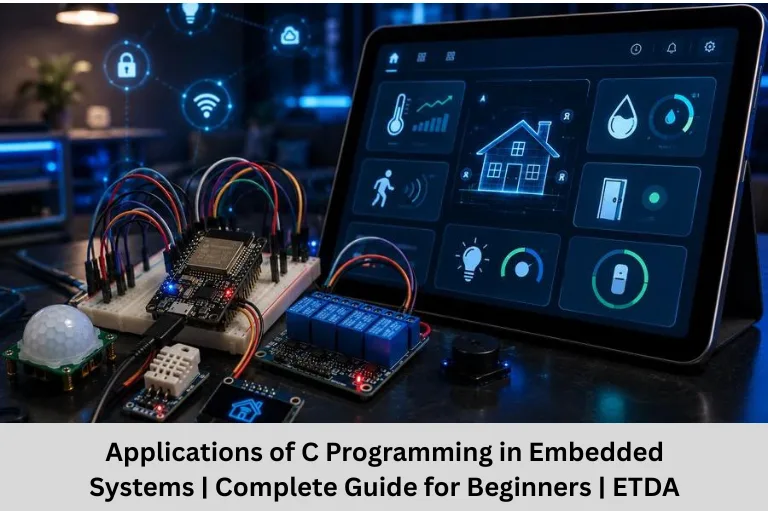
Discover the applications of C Programming in Embedded Systems. Learn why C is the preferred language for firmware development, IoT, automotive, and embedded projects at ETDA, the Top Embedded Training Institute in Bangalore.
- Applications of C Programming in Embedded Systems | Complete Guide for Beginners | ETDA
-
Applications of C Programming in Embedded Systems
- What is C Programming?
- Why is C Programming Used in Embedded Systems?
- Why Every Embedded Engineer Should Learn C Programming
- Applications of C Programming in Embedded Systems
- Embedded C vs Standard C
- How ETDA Teaches C Programming for Embedded Systems
- Real-Time Projects at ETDA
- Why Choose Embedded Tech Development Academy (ETDA)?
-
Frequently Asked Questions (FAQs)
- Why is C Programming important in Embedded Systems?
- Can I learn Embedded Systems without C Programming?
- While it's possible to understand some concepts, C Programming is considered the foundation of embedded development and is required by most employers.
- Which microcontrollers use C Programming?
- Why should I join ETDA for Embedded Systems training?
- Is ETDA suitable for beginners?
- Conclusion
Applications of C Programming in Embedded Systems
Embedded Systems are the invisible technology behind many of the devices we use every day. From smartphones and washing machines to smart TVs, medical equipment, industrial automation systems, and electric vehicles, embedded systems make modern electronics intelligent and efficient. At the heart of these systems lies one of the world’s most reliable programming languages—C Programming.
Despite the emergence of newer programming languages, C Programming continues to be the backbone of Embedded Systems development. Its speed, efficiency, portability, and ability to interact directly with hardware make it the preferred choice for firmware development across industries.
For engineering students and fresh graduates who want to build a successful career in Embedded Systems, learning C Programming is not optional—it is essential. Companies expect embedded engineers to write optimized code, manage memory efficiently, interface with hardware, and develop firmware for microcontrollers.
If you’re looking to master these skills, joining the Top Embedded Training Institute in Bangalore can give you the right mix of theoretical knowledge and practical experience. Embedded Tech Development Academy (ETDA) offers industry-oriented training in C Programming, Embedded C, ARM, STM32, LPC1768, Internet of Things(IoT), RTOS, and Automotive Embedded Systems, along with real-time projects and assured placement support.
In this blog, you’ll learn why C Programming is indispensable in Embedded Systems, explore its real-world applications, and discover how ETDA helps students become job-ready embedded engineers.
What is C Programming?
C Programming is a powerful, general-purpose programming language developed to create efficient and high-performance software. Because it provides direct access to memory and hardware, it is widely used in embedded software development.
Unlike high-level languages, C allows developers to write optimized code with minimal resource usage. This makes it ideal for microcontrollers and embedded devices, where memory and processing power are often limited.
Why is C Programming Used in Embedded Systems?
Embedded devices must perform tasks quickly, reliably, and with minimal power consumption. C Programming fulfills these requirements better than most programming languages.
High Performance
C generates fast and efficient machine code, making it ideal for real-time embedded applications where high performance, low memory usage, and quick response to hardware events are essential.
Direct Hardware Access
C allows programmers to directly access and manipulate hardware registers, memory locations, and peripheral devices, providing precise control over embedded hardware and enabling efficient system-level programming.
Low Memory Usage
Embedded devices often have limited RAM and storage resources. C enables developers to write compact, efficient, and optimized code that maximizes performance while minimizing memory and storage usage.
Portability
Code written in C can be easily adapted and reused across different microcontrollers and hardware platforms with minimal modifications, making embedded system development more flexible, scalable, and cost-effective.
Why Every Embedded Engineer Should Learn C Programming
Before learning advanced technologies such as ARM, STM32, or IoT, students need a solid foundation in C Programming.
Essential Concepts Covered
- Variables and Data Types
- Operators
- Conditional Statements
- Loops
- Functions
- Arrays
- Structures and Unions
- Pointers
- Dynamic Memory Allocation
- Bitwise Operators
- File Handling
These concepts form the basis of Embedded C Programming and firmware development.
Applications of C Programming in Embedded Systems
C Programming is used in almost every area of embedded technology. Let’s explore its major applications.
1. Microcontroller Programming
Microcontrollers are the brain of embedded devices. Engineers use C Programming to develop firmware that controls these processors.
Common Tasks
- Reading sensor inputs
- Controlling LEDs
- Driving motors
- Displaying information on LCDs
- Managing timers and interrupts
Microcontrollers such as STM32, LPC1768, and ARM Cortex-M processors are commonly programmed using C.
2. Consumer Electronics
Many household electronic products rely on firmware written in C.
Examples
- Washing Machines
- Microwave Ovens
- Refrigerators
- Smart TVs
- Air Conditioners
- Digital Cameras
C ensures these devices operate efficiently with limited hardware resources.
3. Internet of Things (IoT)
IoT devices combine sensors, communication modules, and cloud connectivity. C Programming is widely used to control these devices.
IoT Applications
- Smart Home Automation
- Smart Agriculture
- Smart Energy Meters
- Weather Monitoring Systems
- Industrial IoT Solutions
C helps manage sensor data, communication protocols, and device control efficiently.
4. Automotive Embedded Systems
Modern vehicles contain dozens of Electronic Control Units (ECUs), all running embedded software.
Automotive Applications
- Engine Control Units
- Airbag Systems
- ABS Braking Systems
- Battery Management Systems
- Electric Vehicle Controllers
- Infotainment Systems
C Programming is extensively used to develop reliable automotive firmware.
5. Industrial Automation
Factories rely on embedded systems to automate manufacturing processes.
Industrial Applications
- PLC Controllers
- Conveyor Belt Systems
- Industrial Robots
- Process Control Systems
- Motor Controllers
Embedded software written in C ensures reliable and real-time operation.
6. Medical Electronics
Medical devices require highly reliable software because they directly impact patient safety.
Examples
- ECG Machines
- Blood Pressure Monitors
- Patient Monitoring Systems
- Infusion Pumps
- Ventilators
C Programming provides the stability and efficiency required for these applications.
7. Robotics
Robots require precise control of sensors, motors, and actuators.
Applications
- Robot Navigation
- Motion Control
- Sensor Processing
- Autonomous Systems
- Industrial Robots
C enables fast execution and real-time control.
8. Aerospace and Defense
Embedded software is used extensively in aircraft and defense systems.
Applications
- Flight Control Systems
- Navigation Systems
- Radar Equipment
- Satellite Communication
C Programming ensures deterministic and efficient execution.
Embedded C vs Standard C
Key Differences
| Feature | Standard C | Embedded C |
|---|---|---|
| Purpose | General Software | Embedded Systems |
| Hardware Access | Limited | Direct Register Access |
| Memory Optimization | Moderate | High |
| Microcontroller Support | No | Yes |
| Real-Time Applications | Limited | Excellent |
Understanding both Standard C and Embedded C is essential for embedded engineers, as it helps them develop efficient software and effectively interact with hardware in real-world embedded systems.
How ETDA Teaches C Programming for Embedded Systems
As the Top Embedded Training Institute in Bangalore, Embedded Tech Development Academy (ETDA) focuses on practical implementation rather than just theoretical concepts.
Step-by-Step Learning Approach
Stage 1 – C Programming Fundamentals
Students build a strong foundation in embedded systems by learning core programming concepts, problem-solving techniques, and software development practices essential for real-world applications.
Stage 2 – Embedded C
Students apply C Programming to control microcontrollers, hardware components, and peripheral devices, gaining practical experience in developing real-world embedded system applications.
Stage 3 – Microcontroller Programming
Hands-on programming using:
- LPC1768
- STM32
- ARM Cortex-M
Stage 4 – Advanced Embedded Technologies
Students learn:
- RTOS
- IoT
- CAN Protocol
- ECU Concepts
- Automotive Embedded Systems
This structured approach helps students confidently progress from beginner to industry-ready engineer.
Real-Time Projects at ETDA
Learning becomes more effective when students work on practical applications.
Beginner Projects
- LED Blinking
- Digital Clock
- LCD Interfacing
- Temperature Monitoring
Intermediate Projects
- Home Automation System
- Smart Energy Meter
- Motor Speed Controller
- Weather Monitoring
Advanced Projects
- IoT Smart Home
- Smart Agriculture System
- Vehicle Tracking System
- Industrial Automation
- Smart Healthcare Device
- CAN-Based Automotive Network
These projects strengthen technical skills and improve placement readiness.
Why Choose Embedded Tech Development Academy (ETDA)?
Choosing the right training institute is one of the most important decisions for aspiring embedded engineers.
Embedded Tech Development Academy (ETDA) is widely recognized as the Top Embedded Training Institute in Bangalore because of its industry-focused curriculum and practical learning approach.
Why Students Prefer ETDA
- Comprehensive C Programming Training
- Embedded C Programming
- ARM Cortex-M Development
- LPC1768 Programming
- STM32 Development
- RTOS Training
- IoT Development
- CAN Protocol
- ECU Concepts
- Automotive Embedded Systems
- Modern Hardware Labs
- Real-Time Industry Projects
- Experienced Industry Trainers
- Assured Placement Support
ETDA prepares students with the technical knowledge and confidence required for successful careers in Embedded Systems.
Career Opportunities After Learning C Programming
A strong understanding of C Programming opens the door to numerous core engineering roles.
Career Options
- Embedded Software Engineer
- Firmware Engineer
- IoT Developer
- Automotive Embedded Engineer
- Embedded Test Engineer
- Robotics Engineer
- Industrial Automation Engineer
- Product Development Engineer
Professionals with practical C Programming skills are in demand across product companies, semiconductor firms, automotive manufacturers, healthcare technology companies, and IoT startups.
Frequently Asked Questions (FAQs)
Why is C Programming important in Embedded Systems?
C Programming provides high performance, direct hardware access, and efficient memory management, making it ideal for embedded software development.
Can I learn Embedded Systems without C Programming?
While it’s possible to understand some concepts, C Programming is considered the foundation of embedded development and is required by most employers.
While it's possible to understand some concepts, C Programming is considered the foundation of embedded development and is required by most employers.
C is used in microcontroller programming, IoT devices, automotive electronics, industrial automation, consumer electronics, robotics, aerospace, and medical equipment.
Which microcontrollers use C Programming?
Popular microcontrollers such as STM32, LPC1768, AVR, PIC, and ARM Cortex-M are commonly programmed using C.
Why should I join ETDA for Embedded Systems training?
ETDA offers practical training in C Programming, Embedded C, ARM, STM32, LPC1768, IoT, RTOS, Automotive Embedded Systems, and real-time projects with assured placement support.
Is ETDA suitable for beginners?
Yes. ETDA follows a structured learning path that starts with C Programming fundamentals and gradually progresses to advanced embedded technologies.
Conclusion
C Programming remains the foundation of Embedded Systems development because of its speed, efficiency, portability, and ability to interact directly with hardware. From microcontroller programming and IoT devices to automotive electronics, industrial automation, medical equipment, and robotics, C continues to power countless embedded applications across industries.
For students who want to build a successful career in this field, mastering C Programming is the first step toward becoming a skilled Embedded Systems Engineer. Choosing the Top Embedded Training Institute in Bangalore can make this journey much smoother.
Embedded Tech Development Academy (ETDA) provides industry-oriented training that combines C Programming, Embedded C, ARM Cortex-M, STM32, LPC1768, RTOS, Internet of Things(IoT), CAN Protocol, ECU concepts, and Automotive Embedded Systems with extensive hands-on projects and assured placement support. By focusing on practical implementation, real-world projects, and career preparation, ETDA equips students with the skills employers are actively looking for.
If you’re ready to move beyond theory and build a rewarding career in Embedded Systems, Embedded Tech Development Academy (ETDA) offers the expertise, infrastructure, and guidance to help you achieve your goals.
Author: ETDA Trainers
Experience: 10+ Years of Industry Experience in Embedded Systems, IoT, and Embedded C Programming