
C Programming vs Embedded C: Key Differences Explained | ETDA Bangalore
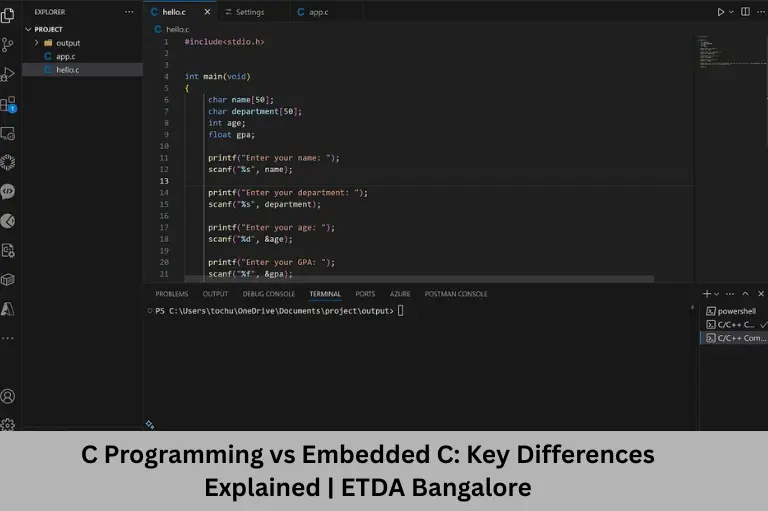
Learn the key differences between C Programming and Embedded C. Discover career opportunities, applications, and why Embedded Tech Development Academy (ETDA) Bangalore is the best choice for embedded systems training with assured placement support.
- C Programming vs Embedded C: Key Differences Explained | ETDA Bangalore
-
C Programming vs Embedded C: Key Differences Explained
- What is C Programming?
- What is Embedded C?
- Why Embedded C is Different from Standard C
- Memory Management
- Input and Output Handling
- Compiler Differences
- C Programming vs Embedded C – Key Differences
- Why Learn Embedded C After C Programming?
- Skills Required to Become an Embedded C Developer
- Why Companies Prefer Engineers with Embedded C Skills
- Why Practical Training is Essential for Embedded C
- Why Choose Embedded Tech Development Academy (ETDA)?
- Who Should Learn Embedded C?
-
Frequently Asked Questions (FAQs)
- What is the main difference between C Programming and Embedded C?
- Can I learn Embedded C without knowing C Programming?
- Which industries hire Embedded C developers?
- Is Embedded C a good career choice in 2026?
- Does ETDA provide hands-on Embedded C training?
- Does ETDA provide assured placement support?
- How long does it take to learn Embedded C?
- What projects will I build during Embedded C training?
- What job roles are available after learning Embedded C?
- Why should I choose ETDA for Embedded Systems training?
- Conclusion
C Programming vs Embedded C: Key Differences Explained
Programming languages form the backbone of every software and hardware application we use today. Among them, C Programming remains one of the most popular and influential languages. It serves as the foundation for many modern programming languages, operating systems, and embedded software. However, when it comes to designing intelligent electronic devices such as smart home systems, automotive controllers, medical equipment, industrial automation systems, and IoT devices, another specialized version comes into play—Embedded C.
Many students and fresh graduates often assume that C Programming and Embedded C are the same. While they share the same syntax and programming principles, they differ significantly in terms of purpose, execution, hardware interaction, memory management, and real-world applications.
If you’re planning a career in embedded systems, understanding these differences is essential. This guide explains C Programming vs Embedded C in detail and helps you decide which skill you should learn for a successful career in embedded technology.
At Embedded Tech Development Academy (ETDA), recognized as one of the top embedded training institutes in Bangalore, students receive industry-oriented training in C Programming, Embedded C, ARM, STM32, Internet of Things (IoT), and Automotive Embedded Systems. The curriculum emphasizes hands-on projects, real-time industry practices, and practical skill development to help students become job-ready. ETDA also provides assured placement support, guiding students through technical training, resume preparation, mock interviews, and placement assistance to help them build successful careers in the embedded systems industry.
What is C Programming?
C Programming is a general-purpose programming language developed to create system software, application software, compilers, databases, operating systems, and utility programs.
It is known for:
- High execution speed
- Efficient memory management
- Portability across platforms
- Structured programming
- Strong performance
C provides programmers with direct memory access through pointers while remaining flexible enough for a wide variety of applications.
Common Applications of C Programming
C Programming is widely used in:
- Operating Systems
- Database Systems
- Desktop Applications
- Compilers
- Network Programming
- Game Development
- System Utilities
Its versatility makes it one of the first programming languages taught in engineering colleges.
What is Embedded C?
Embedded C is an extension of the C language specifically designed for programming embedded systems.
Unlike traditional C programs that execute on computers, Embedded C programs run inside microcontrollers and microprocessors that control dedicated hardware.
Embedded C enables developers to interact directly with electronic components such as:
- Sensors
- LEDs
- Motors
- LCD Displays
- Communication Modules
- Relays
- Timers
- ADCs
- GPIO Pins
Because embedded devices often have limited memory and processing power, Embedded C emphasizes optimized and efficient coding practices.
Where is Embedded C Used?
Embedded C powers countless smart devices, including:
- Automotive ECUs
- Smart Watches
- Washing Machines
- Smart TVs
- Air Conditioners
- Industrial Automation Systems
- Medical Devices
- Robotics
- Drones
- IoT Products
Almost every modern electronic device contains firmware developed using Embedded C.
Why Embedded C is Different from Standard C
Although Embedded C follows the syntax of C Programming, it introduces hardware-specific concepts that are absent in standard software development.
Developers write Embedded C programs to interact directly with microcontroller registers, interrupts, communication protocols, and peripherals.
This requires a deeper understanding of both software and electronics.
Hardware Dependency
C Programming
Standard C programs can generally run on any operating system with minimal changes.
Examples include:
- Windows
- Linux
- macOS
The operating system manages hardware resources on behalf of the application.
Embedded C
Embedded C programs are hardware-dependent.
A program written for one microcontroller (such as STM32) may require modifications before running on another microcontroller.
Each hardware platform has:
- Different registers
- Clock configurations
- Peripheral mappings
- Memory layouts
Memory Management
Memory management is one of the biggest differences between C Programming and Embedded C.
Memory in C Programming
Desktop systems usually have:
- Gigabytes of RAM
- Virtual Memory
- Large Storage Capacity
Programmers rarely worry about every byte of memory.
Memory in Embedded C
Embedded devices often have:
- 32 KB RAM
- 64 KB Flash
- Limited EEPROM
Every byte matters.
Developers must optimize:
- Variables
- Functions
- Buffers
- Stack Usage
- Program Size
Efficient memory usage directly impacts product performance.
Input and Output Handling
C Programming
Applications interact with users through:
- Keyboard
- Mouse
- Monitor
- Files
- Network
Operating systems provide standard libraries for these interactions.
Embedded C
Embedded C communicates directly with hardware peripherals.
Examples include:
- UART
- SPI
- I2C
- CAN
- GPIO
- PWM
- ADC
Instead of displaying text on a monitor, Embedded C may switch ON an LED, rotate a motor, or read data from a temperature sensor.
Compiler Differences
Standard C Compiler
C Programming commonly uses compilers like:
- GCC
- Clang
- Turbo C
- Microsoft Visual C
These generate executables for desktop operating systems.
Embedded C Compiler
Embedded systems require hardware-specific compilers such as:
- Keil
- IAR Embedded Workbench
- MPLAB XC
- STM32CubeIDE
- ARM GCC
These compilers generate firmware for microcontrollers instead of desktop applications.
Execution Environment
C Programs
C applications execute under an operating system.
The OS manages:
- Memory
- Scheduling
- File Systems
- Hardware Drivers
This simplifies application development.
Embedded C Programs
Embedded C often runs without a traditional operating system or with a Real-Time Operating System (RTOS).
Programs directly control hardware resources while meeting strict timing requirements.
This makes Embedded C programming more challenging but also highly rewarding.
C Programming vs Embedded C – Key Differences
Comparison Table
| Feature | C Programming | Embedded C |
|---|---|---|
| Purpose | General software development | Embedded device programming |
| Platform | Computers | Microcontrollers |
| Hardware Access | Limited | Direct hardware control |
| Memory | Large | Highly limited |
| Operating System | Required | Optional |
| Input/Output | Keyboard, files, display | Sensors, motors, GPIO |
| Applications | Software applications | Embedded products |
| Performance Focus | General efficiency | Real-time execution |
| Compiler / IDE | GCC, Clang | Keil, IAR, STM32CubeIDE |
Why Learn Embedded C After C Programming?
Most embedded engineers begin by learning standard C because it provides the programming fundamentals required for Embedded C.
Once students understand variables, loops, pointers, functions, arrays, structures, and memory concepts, transitioning to Embedded C becomes much easier.
Learning Embedded C opens doors to exciting careers in:
- Automotive Electronics
- IoT Development
- Robotics
- Consumer Electronics
- Industrial Automation
- Medical Electronics
- Aerospace
- Semiconductor Industry
Skills Required to Become an Embedded C Developer
Becoming a successful embedded engineer requires much more than knowing the syntax of C. Employers look for professionals who can combine software programming with hardware understanding to build reliable and efficient embedded applications.
Core Technical Skills
A strong Embedded C developer should have knowledge of:
- C Programming fundamentals
- Embedded C Programming
- Microcontrollers (ARM Cortex, STM32, LPC, AVR, PIC)
- Memory management
- Interrupt handling
- Timers and Counters
- GPIO Programming
- UART, SPI, I2C, CAN Protocols
- Analog-to-Digital Converter (ADC)
- Pulse Width Modulation (PWM)
- Embedded Linux basics
- Real-Time Operating Systems (RTOS)
- Hardware debugging
- Firmware development
Practical exposure to these technologies significantly improves employability and prepares students for real-world embedded projects.
Why Companies Prefer Engineers with Embedded C Skills
Today, almost every electronic product contains embedded software. As a result, companies actively seek engineers who can develop, optimize, and debug firmware for embedded devices.
Growing Demand Across Industries
Embedded C professionals are in demand across sectors such as:
- Automotive Electronics
- Industrial Automation
- Medical Devices
- Consumer Electronics
- IoT Product Development
- Robotics
- Aerospace and Defense
- Smart Home Technology
- Telecommunications
- Semiconductor Manufacturing
As connected devices become more intelligent, the need for skilled embedded engineers continues to increase.
Better Career Opportunities
Learning Embedded C can open doors to various job roles, including firmware developer, embedded engineer, IoT developer, automotive engineer, and system designer.
Firmware Engineer
Embedded Software Engineer
Design and optimize software for microcontrollers and embedded processors, improving performance, reliability, memory efficiency, and real-time system functionality across applications.
IoT Developer
Develop smart connected devices that communicate using wireless technologies, enabling real-time monitoring, automation, seamless connectivity, and efficient Internet of Things (IoT)-based applications.
Embedded Linux Engineer
Build and maintain embedded applications running on Linux-based systems, ensuring reliable performance, hardware integration, scalability, and efficient software development.
Device Driver Developer
Develop low-level software that enables operating systems to communicate with hardware peripherals.
These career paths offer long-term growth and opportunities to work on innovative technologies.
Why Practical Training is Essential for Embedded C
Unlike traditional programming, Embedded C cannot be mastered through theory alone.
Students must work directly with development boards, sensors, communication modules, and debugging tools to understand how software interacts with hardware.
Practical Learning Builds Confidence
Hands-on training helps students learn how to:
- Write efficient firmware
- Interface hardware peripherals
- Troubleshoot embedded systems
- Debug real-time applications
- Optimize memory usage
- Build complete embedded projects
Employers value candidates who have real project experience because they can contribute more quickly in a professional environment.
Why Choose Embedded Tech Development Academy (ETDA)?
If you’re planning to build a career in embedded systems, selecting the right training institute is one of the most important decisions you’ll make.
Embedded Tech Development Academy (ETDA) focuses on providing practical, industry-oriented training that prepares students for real-world engineering roles.
Whether you’re a final-year student, recent graduate, diploma holder, or working professional, ETDA offers a structured learning path designed to make you job-ready.
Throughout the course, students benefit from hands-on labs, expert guidance, real-time projects, and assured placement support.
The Top Embedded Training Institute in Bangalore is often associated with institutions that combine practical learning with strong career support, and ETDA follows this approach by aligning its curriculum with current industry requirements.
Industry-Oriented Curriculum
ETDA’s curriculum is designed around the technologies used by embedded companies today.
Programming Modules
Students learn:
- C Programming
- Embedded C
- Data Structures
- Pointers
- Memory Management
- Bit Manipulation
Embedded Development
The course also covers:
- ARM Cortex Programming
- STM32 Microcontrollers
- Embedded Linux
- RTOS
- Communication Protocols
- Bootloaders
- Device Drivers
This comprehensive approach helps students gain both theoretical understanding and practical implementation skills.
Real-Time Projects
One of ETDA’s biggest strengths is its emphasis on project-based learning, providing hands-on experience, practical skills, and real-world embedded development expertise.
Projects Include
IoT-Based Smart Home Automation
Build systems that monitor and control household appliances using embedded controllers, enabling smart automation, efficient energy management, and reliable device operation.
Industrial Automation
Develop automation solutions using sensors, actuators, and microcontrollers to create efficient, reliable, intelligent, and real-time embedded control systems.
Smart Energy Monitoring
Design embedded applications for tracking and managing energy consumption, enabling efficient monitoring, analysis, optimization, and reliable power management across smart systems.
Medical Monitoring Devices
Create embedded solutions for healthcare applications and patient monitoring.
Working on such projects enhances problem-solving skills and prepares students for technical interviews.
Modern Lab Facilities
Students gain practical exposure using industry-standard tools, including:
- STM32 Development Boards
- ARM Evaluation Kits
- Oscilloscopes
- Logic Analyzers
- Debugging Tools
- Embedded IDEs
- Sensors and Communication Modules
Learning in a practical lab environment bridges the gap between academic knowledge and industry expectations.
Assured Placement Support
Learning technical skills is only one part of career preparation.
ETDA also helps students become interview-ready through dedicated placement assistance.
Placement Support Includes
- Resume Building
- Technical Mock Interviews
- HR Interview Preparation
- Aptitude Training
- Communication Skills Development
- Career Counseling
- Placement Drives
- Company Referrals
This structured support increases students’ confidence and improves their chances of securing jobs in the embedded industry.
Who Should Learn Embedded C?
Embedded C is an excellent choice for:
- Electronics and Communication Engineering students
- Electrical Engineering students
- Computer Science graduates interested in firmware
- Instrumentation Engineers
- Mechatronics students
- Diploma holders
- Fresh graduates
- Working professionals planning a career transition into embedded systems
No matter your background, mastering Embedded C can significantly enhance your career prospects in today’s technology-driven world.
Frequently Asked Questions (FAQs)
What is the main difference between C Programming and Embedded C?
C Programming is used for developing general-purpose software applications, whereas Embedded C is used to program microcontrollers and embedded hardware devices.
Can I learn Embedded C without knowing C Programming?
It is recommended to learn the fundamentals of C Programming first because Embedded C is based on the C language and uses the same syntax and programming concepts.
Which industries hire Embedded C developers?
Embedded C professionals are hired by automotive, IoT, robotics, medical electronics, aerospace, industrial automation, telecommunications, and semiconductor companies.
Is Embedded C a good career choice in 2026?
Yes. The demand for Embedded C developers continues to grow due to advancements in IoT, electric vehicles, automation, consumer electronics, and smart devices.
Does ETDA provide hands-on Embedded C training?
Yes. ETDA offers practical training using real hardware, development boards, debugging tools, and industry-oriented projects to help students gain real-world experience.
Does ETDA provide assured placement support?
Yes. ETDA provides assured placement support that includes resume preparation, mock interviews, technical guidance, placement drives, and career mentoring.
How long does it take to learn Embedded C?
Most students can build a strong foundation in 3 to 6 months, depending on the course structure and the amount of practical training they complete.
What projects will I build during Embedded C training?
Students typically work on projects such as smart home automation, IoT monitoring systems, industrial automation, sensor interfacing, motor control, and embedded communication applications.
What job roles are available after learning Embedded C?
You can apply for roles such as Embedded Software Engineer, Firmware Engineer, Embedded Linux Engineer, IoT Developer, Device Driver Developer, Hardware Validation Engineer, and Systems Engineer.
Why should I choose ETDA for Embedded Systems training?
ETDA offers an industry-relevant curriculum, experienced trainers, modern lab facilities, real-time projects, interview preparation, and assured placement support, helping students become job-ready embedded professionals.
Conclusion
Although C Programming and Embedded C share the same language foundation, they serve very different purposes. C Programming is primarily used for developing general-purpose software, while Embedded C is specifically designed for programming microcontrollers and embedded devices that power modern electronics.
If your goal is to build a career in embedded systems, learning Embedded C after mastering C Programming is the logical next step. With industries rapidly adopting Internet of Things (IoT), automation, robotics, and intelligent devices, professionals with strong Embedded C skills are in high demand.
As one of the top embedded training institutes in Bangalore, Embedded Tech Development Academy (ETDA) equips students with the practical expertise needed to succeed through industry-focused training, real-time projects, experienced mentors, and modern laboratory facilities. ETDA also provides assured placement support, helping students prepare for technical interviews, resume building, aptitude tests, and recruitment drives.
By emphasizing hands-on learning and real-world project experience, ETDA enables students to confidently transition into the embedded systems industry and build successful careers in core engineering domains.
If you’re ready to build a rewarding career in embedded technology, ETDA, a top embedded training institute in Bangalore, provides the skills, guidance, hands-on experience, and placement assistance needed to help you achieve your career goals.
Author: ETDA Trainers
Experience: 10+ Years of Industry Experience in Embedded Systems, IoT, and Embedded C Programming