
C Programming Basics Every Engineering Student Should Know | ETDA
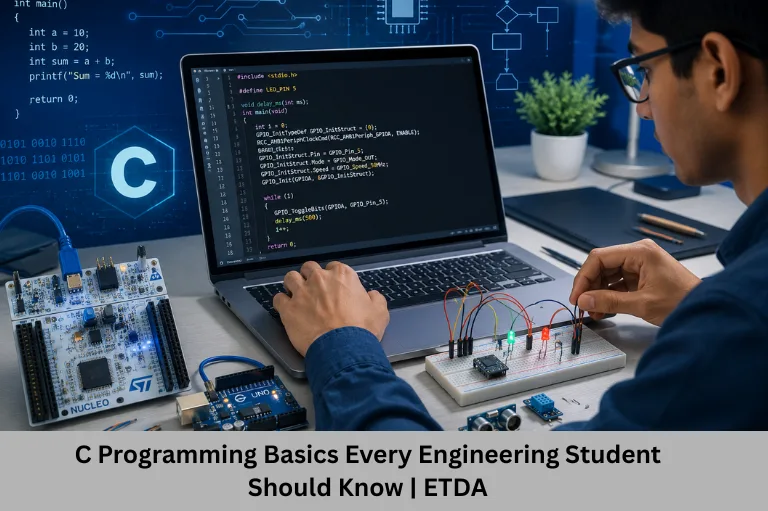
Learn the essential C programming basics every engineering student should know. Build a strong programming foundation with Embedded Tech Development Academy (ETDA) practical training.
- C Programming Basics Every Engineering Student Should Know | ETDA
-
C Programming Basics Every Engineering Student Should Know
- What is C Programming?
- Why Every Engineering Student Should Learn C Programming
- C Programming Basics Every Engineering Student Should Know
- Importance of Practical Learning
- Advanced C Programming Concepts Every Engineering Student Should Know
- Common Mistakes Beginners Should Avoid
- Career Opportunities After Learning C Programming
- Learn C Programming at ETDA
- Assured Placement Support at ETDA
- Why Choose ETDA?
-
Frequently Asked Questions (FAQs)
- Why should engineering students learn C Programming?
- Is C Programming still relevant in 2026?
- What are the basic concepts every beginner should learn in C?
- How long does it take to learn C Programming?
- Can I learn Embedded C without knowing C Programming?
- Does ETDA provide practical C Programming training?
- What career opportunities are available after learning C Programming?
- Does ETDA provide placement support after C Programming training?
- Conclusion
C Programming Basics Every Engineering Student Should Know
C Programming is often called the foundation of modern programming because it introduces the core concepts used in many popular programming languages, including C++, Java, Python, and Embedded C. Whether you are pursuing Electronics, Electrical, Computer Science, Information Science, Mechanical, or Artificial Intelligence engineering, learning C Programming is one of the most valuable skills you can acquire.
A strong understanding of C Programming not only improves logical thinking and problem-solving abilities but also prepares students for advanced technologies such as Embedded Systems, Internet of Things(IoT), Robotics, Artificial Intelligence, Operating Systems, and Automotive Software Development.
Most software and embedded companies expect engineering graduates to have a solid grasp of C Programming fundamentals. That’s why mastering C during your college years can significantly improve your placement opportunities.
At Embedded Tech Development Academy (ETDA), students receive industry-oriented C Programming training with hands-on coding exercises, real-time projects, and expert mentorship. As a Top Embedded Training Institute in Bangalore, ETDA helps students develop practical programming skills while providing assured placement support to prepare them for successful engineering careers.
What is C Programming?
C Programming is a powerful, general-purpose programming language developed to create efficient and high-performance software. It allows programmers to write structured, modular, and reusable code while providing direct access to system resources.
Despite being introduced several decades ago, C continues to be one of the most widely used programming languages because of its speed, portability, and simplicity.
Today, C is extensively used in:
- Operating Systems
- Embedded Systems
- Device Drivers
- Networking Applications
- Database Management Systems
- Compiler Development
- Industrial Automation
- Consumer Electronics
Learning C Programming builds a strong foundation for understanding how software interacts with hardware.
Why Every Engineering Student Should Learn C Programming
C Programming is much more than an academic subject. It develops the analytical and technical skills required for engineering careers.
Strong Programming Foundation
Most advanced programming languages borrow concepts from C. Learning C helps students understand:
- Variables
- Data Types
- Loops
- Functions
- Memory Management
- Pointers
Once these concepts are clear, learning languages like C++, Java, Python, or Embedded C becomes much easier.
Improves Logical Thinking
Programming teaches students how to solve problems systematically.
Writing C programs encourages:
- Logical reasoning
- Algorithm development
- Step-by-step thinking
- Efficient problem-solving
These skills are useful in technical interviews as well as engineering projects.
Essential for Embedded Systems
Embedded Systems rely heavily on C Programming because it offers direct hardware control and efficient memory management.
Students interested in:
- Embedded Systems
- Internet of Things(IoT)
- Robotics
- Automotive Electronics
must first master C Programming before moving to Embedded C and firmware development.
C Programming Basics Every Engineering Student Should Know
Understanding the following concepts is essential for becoming a confident programmer.
Variables and Data Types
Variables store information that a program uses during execution.
Common data types include:
Integer
Stores whole numbers.
Example:
- 10
- 500
- -25
Float
Stores decimal numbers.
Example:
- 10.5
- 99.99
Character
Stores single characters.
Examples:
- A
- B
- Z
Double
Used for storing high-precision decimal values.
Operators
Operators perform mathematical and logical operations.
Arithmetic Operators
Examples include:
- Addition (+)
- Subtraction (-)
- Multiplication (*)
- Division (/)
- Modulus (%)
Relational Operators
Used for comparisons.
Examples:
- Greater than
- Less than
- Equal to
- Not equal to
Logical Operators
Used for combining conditions.
Examples:
- AND
- OR
- NOT
Input and Output
Every C programmer should understand how to interact with users.
Common functions include:
Input
Used to receive information from users.
Output
Used to display results on the screen.
Input and output operations are among the first concepts every beginner learns.
Conditional Statements
Conditional statements allow programs to make decisions.
if Statement
Executes code only when a condition is true.
if-else Statement
Chooses between two different blocks of code.
switch Statement
Useful when selecting from multiple options.
Conditional statements make programs intelligent and dynamic.
Loops
Loops execute repetitive tasks efficiently.
for Loop
Used when the number of iterations is known.
while Loop
Executes as long as a condition remains true.
do-while Loop
Guarantees that the code executes at least once before checking the condition.
Loops reduce repetitive coding and improve program efficiency.
Functions
Functions divide large programs into smaller, reusable modules.
Benefits include:
- Better readability
- Code reusability
- Easier debugging
- Simplified maintenance
Functions are one of the most important concepts in C Programming.
Arrays
Arrays store multiple values of the same data type under a single variable name.
Examples include storing:
- Student marks
- Sensor readings
- Temperature values
- Employee IDs
Arrays make data management more efficient.
Strings
Strings represent collections of characters.
Common applications include:
- User names
- Messages
- Product names
- File names
String handling is widely used in software development.
Pointers
Pointers are considered one of the most powerful features of C Programming.
They store memory addresses instead of actual values.
Why Learn Pointers?
Pointers are essential for:
- Dynamic Memory Allocation
- Embedded Systems
- Device Drivers
- Linked Lists
- Efficient Programming
Although beginners find pointers challenging, mastering them significantly improves programming skills.
Structures
Structures allow programmers to combine different data types into one unit.
For example, a student record may include:
- Name
- Roll Number
- Age
- Department
- Marks
Structures improve data organization and are widely used in real-world applications.
Importance of Practical Learning
Reading programming concepts alone is not enough. Engineering students become proficient by writing programs, debugging errors, and solving coding challenges.
At Embedded Tech Development Academy (ETDA), students practice C Programming through hands-on lab sessions, coding assignments, and mini-projects. As a Top Embedded Training Institute in Bangalore, ETDA emphasizes practical learning to help students build confidence before progressing to advanced topics like Embedded C, Microcontrollers, ARM Programming, RTOS, and IoT.
Advanced C Programming Concepts Every Engineering Student Should Know
Once you have mastered the fundamentals, the next step is to explore advanced concepts that are widely used in software development, embedded systems, and technical interviews.
Dynamic Memory Allocation
Dynamic memory allocation allows programs to allocate memory during runtime instead of at compile time.
Why It Matters
Dynamic memory is useful when:
- The size of data is unknown beforehand.
- Applications need flexible memory management.
- Developing complex software applications.
- Working on embedded systems with optimized memory usage.
Functions such as malloc(), calloc(), realloc(), and free() are commonly used for dynamic memory management.
File Handling
File handling enables programs to store and retrieve data permanently.
Common Applications
- Student management systems
- Employee records
- Inventory software
- Log file generation
- Configuration storage
Learning file handling prepares students for developing real-world software applications.
Bitwise Operations
Bitwise operators manipulate data at the binary level and are especially important in embedded systems programming.
Applications of Bitwise Operations
- Register configuration
- GPIO programming
- Flag manipulation
- Device communication
- Performance optimization
Bitwise programming is a core skill for aspiring embedded engineers.
Common Mistakes Beginners Should Avoid
Many engineering students struggle with C Programming because of a few common mistakes. Avoiding these errors early can improve coding efficiency and confidence.
Ignoring Programming Logic
Memorizing syntax is not enough. Focus on understanding algorithms and problem-solving techniques rather than simply remembering code.
Neglecting Pointers
Pointers may seem difficult initially, but they are fundamental to advanced C Programming and embedded systems. Spend time practicing pointer concepts with simple examples.
Not Practicing Regularly
Programming is a practical skill that improves with consistent practice. Writing programs daily strengthens logical thinking and debugging abilities.
Poor Code Formatting
Well-organized code is easier to read, debug, and maintain. Follow consistent indentation, meaningful variable names, and proper comments to improve code quality.
Career Opportunities After Learning C Programming
C Programming is a valuable skill that opens doors to multiple technology domains. It serves as the foundation for software development and embedded systems.
Popular Career Paths
After mastering C Programming, students can pursue roles such as:
- Software Developer
- Embedded Software Engineer
- Firmware Developer
- IoT Engineer
- Systems Programmer
- Robotics Engineer
- Automotive Embedded Engineer
- Electronics Design Engineer
- Linux Developer
As industries continue to adopt embedded technologies and automation, professionals with strong C Programming skills remain in high demand.
Industries That Use C Programming
C Programming is widely used across various industries, including:
Embedded Systems
Developing firmware for microcontrollers and embedded devices.
Automotive
Building software for Electronic Control Units (ECUs), Advanced Driver Assistance Systems (ADAS), and electric vehicles.
Consumer Electronics
Developing software for smart TVs, home appliances, wearable devices, and smart home products.
Industrial Automation
Programming PLCs, industrial controllers, robotics, and machine automation systems.
Networking and Telecommunications
Developing communication software, networking protocols, and system-level applications.
Learn C Programming at ETDA
A strong understanding of C Programming is the first step toward becoming an embedded systems engineer. Embedded Tech Development Academy (ETDA) offers industry-oriented C Programming training designed to help students gain practical knowledge through hands-on learning.
As a Top Embedded Training Institute in Bangalore, ETDA focuses on developing technical skills that align with current industry requirements.
Comprehensive Training Curriculum
Students receive practical training in:
Core C Programming
- Variables and Data Types
- Operators
- Decision Making
- Loops
- Functions
- Arrays
- Strings
- Structures
- Pointers
- File Handling
Embedded Programming Foundation
Students also gain exposure to:
- Embedded C
- Microcontrollers
- STM32
- ARM Cortex-M
- GPIO Programming
- Communication Protocols (UART, SPI, I2C, CAN)
This progression helps students transition smoothly from C Programming to embedded systems development.
Hands-On Project Experience
Practical learning is a key focus at Embedded Tech Development Academy (ETDA). Students work on mini-projects and real-world applications to strengthen their programming and debugging skills.
Project-based learning improves confidence and enhances problem-solving abilities, making students better prepared for technical interviews.
Assured Placement Support at ETDA
Embedded Tech Development Academy (ETDA) believes that technical education should lead to meaningful career opportunities. Along with practical training, the academy provides assured placement support to help students become industry-ready.
Placement Preparation
Students receive guidance in:
- Resume Building
- Aptitude Training
- Technical Interview Preparation
- Mock Interviews
- Communication Skills
- HR Interview Preparation
These sessions help students perform confidently during campus and off-campus recruitment drives.
Industry-Focused Learning Environment
ETDA offers:
- Experienced Industry Trainers
- Modern Lab Facilities
- Practical Coding Sessions
- Real-Time Projects
- Continuous Mentorship
- Career Guidance
This combination of technical training and career support helps students build a strong foundation for success.
Why Choose ETDA?
Choosing the right training institute is an important step in your engineering career. Embedded Tech Development Academy (ETDA) stands out by offering a practical, industry-oriented learning experience.
Key benefits include:
- Industry-aligned curriculum
- Hands-on C Programming and Embedded C training
- Training on STM32, ARM, RTOS, IoT, and Embedded Linux
- Real-time projects
- Modern laboratory infrastructure
- Expert trainers with industry experience
- Interview preparation and soft skills development
- Assured placement support
As a Top Embedded Training Institute in Bangalore, ETDA equips students with the skills and confidence needed to excel in the embedded systems industry.
Frequently Asked Questions (FAQs)
Why should engineering students learn C Programming?
C Programming builds a strong foundation in programming concepts such as variables, loops, functions, pointers, and memory management. It also prepares students for advanced technologies like Embedded Systems, IoT, and Robotics.
Is C Programming still relevant in 2026?
Yes. C Programming remains one of the most widely used languages in embedded systems, operating systems, automotive software, industrial automation, and system programming.
What are the basic concepts every beginner should learn in C?
Beginners should focus on variables, data types, operators, conditional statements, loops, functions, arrays, strings, pointers, structures, and file handling.
How long does it take to learn C Programming?
With regular practice, most beginners can learn the fundamentals of C Programming in 6–8 weeks. Mastering advanced concepts and building projects may take a few additional months.
Can I learn Embedded C without knowing C Programming?
No. A strong understanding of C Programming is essential before learning Embedded C, as Embedded C is based on the concepts of the C language.
Does ETDA provide practical C Programming training?
Yes. ETDA offers hands-on C Programming training through coding exercises, lab sessions, mini-projects, and real-time applications to help students develop practical skills.
What career opportunities are available after learning C Programming?
Learning C Programming can lead to careers such as Software Developer, Embedded Software Engineer, Firmware Developer, IoT Engineer, Robotics Engineer, and Automotive Embedded Engineer.
Does ETDA provide placement support after C Programming training?
Yes. ETDA provides assured placement support, including resume building, mock interviews, aptitude training, technical interview preparation, and career guidance to help students secure roles in leading technology companies.
Conclusion
C Programming is one of the most important skills every engineering student should learn. It lays the foundation for advanced technologies such as Embedded Systems, Internet of Things(IoT), Robotics, Artificial Intelligence, and Operating Systems. By mastering concepts like variables, loops, functions, arrays, pointers, structures, and memory management, students develop strong programming logic and problem-solving abilities.
However, theoretical knowledge alone is not enough. Practical coding experience, real-time projects, and industry-oriented training are essential for becoming job-ready.
If you’re looking to build a successful career in software or embedded systems, Embedded Tech Development Academy (ETDA) provides the ideal learning environment. With expert faculty, hands-on practical sessions, real-world projects, and assured placement support, ETDA helps engineering students transform their programming knowledge into professional expertise. As a Top Embedded Training Institute in Bangalore, ETDA is committed to preparing students for rewarding careers in today’s fast-growing technology industry.
Author: ETDA Trainers
Experience: 10+ Years of Industry Experience in Embedded Systems, IoT, and Embedded C Programming