
Introduction to Sensors and IoT: Types, Architecture, Applications & Future Trends
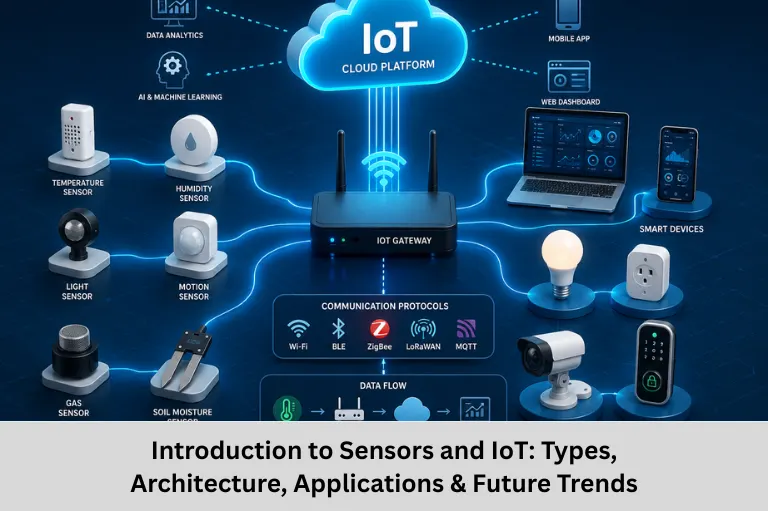
Learn the fundamentals of sensors and Internet of Things (IoT), including sensor types, IoT architecture, communication protocols, applications, design considerations, and future trends in smart technology.
- Introduction to Sensors and IoT: Types, Architecture, Applications & Future Trends
-
Introduction: Understanding Sensors and IoT
- Understanding Sensors
- Common Types of Sensors
- Key Characteristics of Sensors
- Fundamentals of IoT
- IoT Architecture
- Common IoT Communication Protocols
- Sensor-to-Cloud Data Pipeline
- Applications of Sensors and IoT
- Design Considerations for IoT Systems
- Development Platforms for Beginners
- Frequently Asked Questions (FAQs)
- Conclusion
Introduction: Understanding Sensors and IoT
The world is becoming smarter every day, thanks to the rapid advancement of Sensors and the Internet of Things (IoT). From smart homes and wearable fitness trackers to industrial automation, connected vehicles, healthcare monitoring systems, and smart cities, sensors and Internet of Things (IoT) technologies are transforming how people interact with devices and the environment. These technologies enable machines to collect real-time data, communicate over networks, make intelligent decisions, and automate everyday tasks with minimal human intervention.
A sensor acts as the “eyes and ears” of an electronic system by detecting physical parameters such as temperature, humidity, pressure, light, motion, sound, gas concentration, proximity, vibration, and position. When integrated with Internet of Things (IoT) platforms, these sensors continuously gather valuable information and send it to cloud servers or edge devices for processing, analysis, visualization, and decision-making. This seamless integration creates intelligent systems capable of improving efficiency, safety, productivity, and user experience.
The increasing adoption of Industry 4.0, Artificial Intelligence (AI), Machine Learning (ML), cloud computing, edge computing, wireless communication, embedded systems, smart agriculture, industrial IoT (IIoT), smart healthcare, home automation, robotics, and autonomous systems has accelerated the demand for skilled professionals in sensors and Internet of Things (IoT) technologies.
Understanding concepts such as Internet of Things (IoT) architecture, sensor interfacing, wireless communication protocols, embedded systems, microcontrollers, cloud computing, MQTT, Bluetooth, Wi-Fi, Zigbee, LoRaWAN, edge computing, data acquisition, signal conditioning, Internet of Things (IoT) security, real-time monitoring, and smart device communication is essential for students and electronics engineers looking to build next-generation intelligent systems.
For aspiring embedded and IoT engineers, Embedded Tech Development Academy (ETDA) provides industry-oriented training in embedded systems, Internet of Things (IoT) development, Arduino, ESP32, Raspberry Pi, ARM microcontrollers, STM32, wireless communication, PCB design, embedded C programming, and real-time IoT projects. Through hands-on laboratory sessions and practical industry projects, Embedded Tech Development Academy (ETDA) helps students develop the technical expertise required to build smart embedded solutions for modern industries.
In this guide, you’ll explore the fundamentals of sensors, Internet of Things (IoT) architecture, communication protocols, sensor-to-cloud connectivity, applications, design considerations, and emerging technologies that are driving the future of connected systems.
Understanding Sensors
Sensors are electronic devices that detect physical changes in the environment and convert them into measurable electrical signals.
They serve as the primary input devices in embedded systems and Internet of Things (IoT) applications.
What Do Sensors Measure?
Sensors can detect:
- Temperature
- Pressure
- Humidity
- Light intensity
- Motion
- Sound
- Gas concentration
- Position
- Vibration
- Distance
Why Sensors Matter
Without sensors, Internet of Things (IoT) systems would have no real-world data to monitor, analyze, or automate processes.
Common Types of Sensors
Different applications require different types of sensors.
Temperature Sensors
Examples:
- Thermocouples
- RTDs
- Thermistors
Applications:
- HVAC systems
- Industrial automation
- Medical equipment
Motion Sensors
Examples:
- Accelerometers
- Gyroscopes
- PIR Sensors
Applications:
- Smartphones
- Wearable devices
- Security systems
Environmental Sensors
Examples:
- Humidity Sensors
- Air Quality Sensors
- UV Sensors
Applications:
- Smart farming
- Weather monitoring
- Environmental analysis
Optical Sensors
Examples:
- Photodiodes
- Infrared Sensors
- Cameras
Applications:
- Machine vision
- Robotics
- Industrial inspection
Position Sensors
Examples:
- GPS Modules
- Encoders
- Proximity Sensors
Applications:
- Autonomous vehicles
- Navigation
- Robotics
Biometric Sensors
Examples:
- Fingerprint Sensors
- Heart Rate Sensors
- Pulse Oximeters
Applications:
- Healthcare
- Smartwatches
- Access control
Key Characteristics of Sensors
When selecting a sensor, engineers evaluate several important parameters.
Performance Parameters
- Accuracy
- Precision
- Sensitivity
- Resolution
- Measurement Range
- Response Time
- Repeatability
- Stability
- Power Consumption
Fundamentals of IoT
The Internet of Things (IoT) is a network of interconnected physical devices capable of collecting, exchanging, and processing data over the internet.
IoT combines:
- Sensors
- Embedded Systems
- Communication networks
- Cloud computing
- Artificial Intelligence
IoT Architecture
A typical IoT system consists of four major layers.
1. Perception Layer
Responsible for:
- Data sensing
- Data collection
- Actuator control
2. Network Layer
Handles communication using protocols such as:
- Wi-Fi
- Bluetooth
- Zigbee
- LoRaWAN
- Cellular Networks
3. Middleware Layer
Functions include:
- Data storage
- Data processing
- Cloud services
- Device management
4. Application Layer
Provides user services such as:
- Mobile applications
- Web dashboards
- Analytics
- Automation
Architecture Goal
Transform sensor data into meaningful insights and automated actions.
Common IoT Communication Protocols
Wireless Communication Technologies
| Protocol | Frequency | Range | Power Consumption | Typical Applications |
|---|---|---|---|---|
| Wi-Fi | 2.4 / 5 GHz | Medium | High | Smart Homes |
| Bluetooth / BLE | 2.4 GHz | Short | Low | Wearables |
| Zigbee | 2.4 GHz | Medium | Low | Home Automation |
| LoRaWAN | Sub-GHz | Long | Very Low | Smart Agriculture |
| NB-IoT / LTE-M | Cellular | Long | Medium | Asset Tracking |
Sensor-to-Cloud Data Pipeline
Internet of Things (IoT) systems transfer sensor information through multiple stages.
1. Data Acquisition
Includes:
- Analog-to-Digital Conversion
- Signal Conditioning
- Data Sampling
2. Edge Processing
Performs:
- Noise filtering
- Data compression
- Feature extraction
- Local decision-making
3. Cloud Integration
Cloud platforms provide:
- Data storage
- Machine learning
- Analytics
- Visualization dashboards
Applications of Sensors and IoT
Sensors and Internet of Things (IoT) are transforming numerous industries.
Smart Homes
- Smart lighting
- Security systems
- Smart appliances
- Voice assistants
Smart Cities
- Traffic management
- Smart parking
- Waste management
- Environmental monitoring
Industrial IoT (IIoT)
- Predictive maintenance
- Asset tracking
- Process automation
- Equipment monitoring
Healthcare
- Remote patient monitoring
- Smart medical devices
- Wearable health trackers
Smart Agriculture
- Soil moisture monitoring
- Precision irrigation
- Weather stations
- Livestock monitoring
Transportation
- Fleet management
- Connected vehicles
- Intelligent traffic systems
Design Considerations for IoT Systems
Developing efficient IoT systems requires careful planning.
Power Management
- Low-power processors
- Sleep modes
- Energy harvesting
- Battery optimization
Security
Important measures include:
- Device authentication
- Data encryption
- Secure firmware updates
- Access control
Scalability
Consider:
- Device management
- Network expansion
- Cloud scalability
- Data aggregation
Emerging Trends in Sensors and IoT
Technology continues evolving rapidly.
AI at the Edge
Benefits include:
- Faster processing
- Reduced latency
- Improved privacy
Self-Powered Sensors
Examples:
- Solar-powered sensors
- Piezoelectric energy harvesting
- RF energy harvesting
Advanced Sensor Materials
Emerging innovations include:
- Flexible electronics
- Stretchable sensors
- Nanotechnology-based sensors
- Biodegradable electronics
Development Platforms for Beginners
Popular IoT Platforms
- Arduino
- ESP32
- ESP8266
- Raspberry Pi
- STM32 Development Boards
- NodeMCU
Beginner Tip
Start with Arduino or ESP32 to build simple IoT projects before moving to industrial-grade embedded platforms.
Frequently Asked Questions (FAQs)
What is a sensor in an IoT system?
A sensor is an electronic device that detects physical parameters such as temperature, pressure, humidity, motion, or light and converts them into electrical signals that can be processed by an IoT system.
What is the Internet of Things (IoT)?
The Internet of Things (IoT) is a network of interconnected devices equipped with sensors, processors, and communication technologies that collect, exchange, and analyze data over the internet.
Which communication protocols are commonly used in IoT?
Popular IoT communication protocols include Wi-Fi, Bluetooth Low Energy (BLE), Zigbee, LoRaWAN, MQTT, NB-IoT, LTE-M, and Cellular Networks, depending on the application’s range, power, and bandwidth requirements.
What are the major applications of sensors and IoT?
Sensors and IoT are widely used in smart homes, industrial automation, healthcare, agriculture, transportation, wearable devices, smart cities, environmental monitoring, logistics, and consumer electronics.
Why should students learn sensors and IoT?
Learning sensors and IoT helps students develop skills in embedded systems, automation, wireless communication, cloud computing, AI integration, and smart device development, opening career opportunities in electronics, robotics, semiconductor industries, industrial automation, and Internet of Things (IoT) solution development.
Conclusion
Sensors and Internet of Things (IoT) technologies are driving the digital transformation of industries by enabling intelligent, connected, and automated systems. Understanding concepts such as sensor interfacing, embedded systems, Internet of Things (IoT) architecture, wireless communication, cloud computing, edge computing, MQTT, Bluetooth, Wi-Fi, Zigbee, LoRaWAN, real-time monitoring, data acquisition, signal conditioning, Internet of Things (IoT) security, machine learning, AI integration, and smart automation is becoming increasingly valuable for modern electronics and embedded engineers.
From smart homes, healthcare, agriculture, industrial automation, transportation, wearable devices, robotics, consumer electronics, and smart cities to future innovations powered by AI, Industry 4.0, edge intelligence, and next-generation wireless communication, sensors and Internet of Things (IoT) continue to reshape how people and machines interact with the physical world. As businesses adopt intelligent automation and connected devices at an unprecedented pace, demand for skilled Internet of Things (IoT) and embedded engineers will continue to rise.
At Embedded Tech Development Academy (ETDA), students gain practical experience through hands-on training in embedded systems, Internet of Things (IoT) development, Arduino, ESP32, Raspberry Pi, STM32, ARM processors, PCB design, embedded C programming, and real-time IoT projects. Embedded Tech Development Academy (ETDA)‘s industry-focused curriculum equips learners with the practical skills required to build innovative IoT solutions and pursue successful careers in embedded systems, electronics, automation, semiconductor industries, and smart technology development.
Whether you are an engineering student, electronics enthusiast, or aspiring Internet of Things (IoT) developer, mastering sensors and Internet of Things (IoT) technologies is an essential step toward building the intelligent connected systems that will define the future.
Author: ETDA Trainers
Experience: 10+ Years of Industry Experience in Embedded Systems, IoT, and Embedded C Programming