
Digital Electronics: Fundamentals, Logic Gates, Circuits & Applications
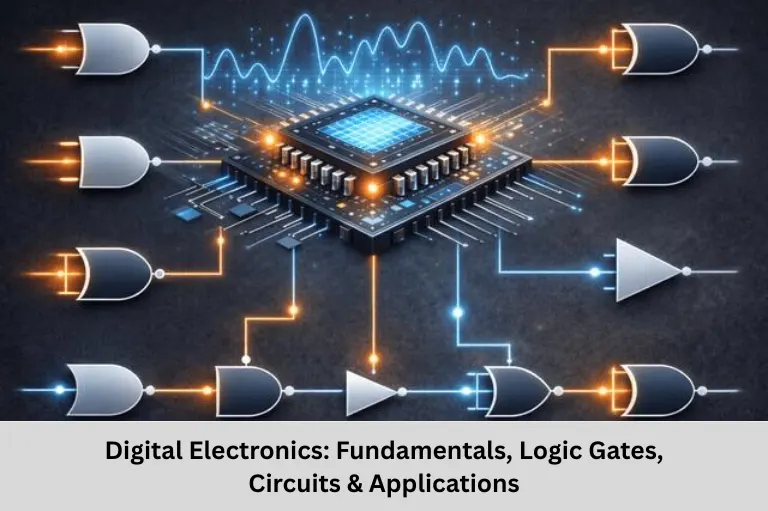
Learn the fundamentals of Digital Electronics, including logic gates, combinational and sequential circuits, number systems, applications, and career opportunities in embedded systems
- Digital Electronics: Fundamentals, Logic Gates, Circuits & Applications
-
Introduction to Digital Electronics
- What is Digital Electronics?
- Why Digital Electronics is Important
- Basic Building Blocks of Digital Electronics
- Combinational Circuits
- Sequential Circuits
- Number Systems in Digital Electronics
- Applications of Digital Electronics
- Emerging Technologies in Digital Electronics
- Career Opportunities in Digital Electronics
- Frequently Asked Questions (FAQs)
- Conclusion
Introduction to Digital Electronics
Digital Electronics is the backbone of today’s technological revolution, powering everything from smartphones, laptops, smart TVs, and wearable devices to automobiles, industrial automation systems, medical equipment, and advanced robotics. Every modern electronic device that processes, stores, or transmits digital information depends on digital electronic circuits for reliable and efficient operation. As technology continues to evolve, digital electronics has become an indispensable field in embedded systems, Internet of Things (IoT), artificial intelligence (AI), robotics, wireless communication, automotive electronics, semiconductor design, industrial automation, and consumer electronics.
Unlike analog electronics, which processes continuously varying signals, digital electronics works with binary values (0 and 1), allowing systems to perform computations with exceptional accuracy, speed, and reliability. Digital circuits are less susceptible to electrical noise, easier to design, highly scalable, and capable of handling complex processing tasks using millions or even billions of transistors integrated into a single microchip.
The concepts of Boolean algebra, logic gates, combinational circuits, sequential circuits, flip-flops, registers, counters, multiplexers, decoders, binary arithmetic, number systems, digital logic design, FPGA, VLSI, microprocessors, microcontrollers, ARM processors, embedded C programming, and digital signal processing (DSP) form the core foundation for engineers working in electronics and embedded technologies.
With the rapid adoption of Industry 4.0, smart manufacturing, autonomous vehicles, AI hardware accelerators, edge computing, cloud-connected devices, and intelligent embedded systems, professionals with strong knowledge of digital electronics are in high demand across industries.
For aspiring engineers, Embedded Tech Development Academy (ETDA) provides industry-oriented training in Digital Electronics, Embedded Systems, Microcontrollers, ARM Cortex, STM32, Embedded C, Internet of Things (IoT), PCB Design, RTOS, Robotics, FPGA, and Industrial Automation. Through practical lab sessions, real-time projects, and placement-focused programs, Embedded Tech Development Academy (ETDA) helps students build the technical expertise required to excel in embedded systems and semiconductor industries.
In this guide, you’ll learn the fundamentals of digital electronics, including logic gates, combinational and sequential circuits, number systems, applications, emerging technologies, and career opportunities.
What is Digital Electronics?
Digital Electronics is a branch of electronics that processes and represents information using digital signals, which have two discrete logic levels:
- Logic 0 → LOW Voltage (0V)
- Logic 1 → HIGH Voltage (typically 3.3V or 5V)
Unlike analog systems, digital systems operate using binary logic, making them highly reliable and suitable for modern computing applications.
Why Binary?
Binary representation simplifies circuit design and enables electronic devices to process large amounts of data accurately.
Why Digital Electronics is Important
Digital electronics is the foundation of nearly every modern electronic system.
Major Advantages
- High accuracy
- Excellent reliability
- Fast processing speed
- Easy data storage
- Noise immunity
- Easy programmability
- High scalability
- Low power consumption
- Compact integrated circuits
- Seamless integration with microcontrollers and computers
Digital electronics enables complex computational tasks that would be difficult to achieve using analog systems alone.
Basic Building Blocks of Digital Electronics
Digital systems are constructed using several fundamental electronic components.
Logic Gates
Logic gates are the basic building blocks of all digital circuits. They perform logical operations on binary inputs.
Common Logic Gates
- AND Gate
- OR Gate
- NOT Gate
- NAND Gate
- NOR Gate
- XOR Gate
- XNOR Gate
Example – AND Gate Truth Table
| A | B | Output |
|---|---|---|
| 0 | 0 | 0 |
| 0 | 1 | 0 |
| 1 | 0 | 0 |
| 1 | 1 | 1 |
An AND gate produces a HIGH output only when all inputs are HIGH.
Combinational Circuits
What are Combinational Circuits?
Combinational circuits generate outputs based only on the current input values. They do not store previous information.
Examples
- Half Adder
- Full Adder
- Subtractor
- Multiplexer (MUX)
- Demultiplexer (DEMUX)
- Encoder
- Decoder
- Comparator
These circuits are widely used in Arithmetic Logic Units (ALUs) inside processors.
Sequential Circuits
What are Sequential Circuits?
Sequential circuits depend on both present inputs and previous outputs because they include memory elements.
Memory Components
- Latches
- Flip-Flops
- Registers
- Shift Registers
- Counters
Sequential circuits are essential in:
- Microprocessors
- Embedded Systems
- Digital Communication
- Control Systems
Number Systems in Digital Electronics
Different number systems are used for representing data.
Common Number Systems
| Number System | Base | Example |
|---|---|---|
| Decimal | 10 | 245 |
| Binary | 2 | 1011 |
| Octal | 8 | 17 |
| Hexadecimal | 16 | A3 |
Binary is the primary language of digital electronics because digital circuits operate using only two logic states.
Applications of Digital Electronics
Digital electronics has transformed numerous industries.
Consumer Electronics
Examples include:
- Smartphones
- Laptops
- Smart TVs
- Gaming Consoles
- Wearable Devices
Automotive Electronics
Applications include:
- Engine Control Units (ECU)
- Anti-lock Braking Systems (ABS)
- Airbag Systems
- Advanced Driver Assistance Systems (ADAS)
Communication Systems
Digital electronics powers:
- Mobile Networks
- Satellite Communication
- Fiber Optic Communication
- Wi-Fi Routers
- 5G Infrastructure
Embedded Systems
Examples include:
- Microcontrollers
- ARM Processors
- Internet of Things (IoT) Devices
- Robotics
- Smart Appliances
Industrial Automation
Digital control systems are widely used in:
- PLCs
- CNC Machines
- Industrial Robots
- Process Automation
Emerging Technologies in Digital Electronics
The field continues to evolve rapidly.
Artificial Intelligence Hardware
AI accelerators enable faster machine learning and neural network processing.
Internet of Things (IoT)
Billions of connected smart devices rely on digital electronics for sensing, communication, and control.
Edge Computing
Processing data closer to the source reduces latency and improves efficiency.
VLSI and Semiconductor Technology
Modern VLSI chips integrate billions of transistors, delivering extraordinary computational performance in compact devices.
Future Outlook
Advancements in semiconductor manufacturing continue to make digital systems faster, smaller, and more energy-efficient.
Career Opportunities in Digital Electronics
Professionals skilled in digital electronics can pursue careers in:
- Embedded Systems Development
- VLSI Design
- FPGA Programming
- PCB Design
- Semiconductor Industry
- Robotics
- Internet of Things (IoT) Development
- Consumer Electronics
- Automotive Electronics
- Industrial Automation
- Aerospace & Defense
Frequently Asked Questions (FAQs)
What is Digital Electronics?
Digital Electronics is a branch of electronics that processes information using binary values (0 and 1) through digital circuits such as logic gates, flip-flops, registers, and microprocessors.
What is the difference between analog and digital electronics?
Analog electronics processes continuously varying signals, while digital electronics processes discrete binary signals (0 and 1), making digital systems more accurate, reliable, and resistant to noise.
What are the basic building blocks of digital electronics?
The primary building blocks include logic gates, combinational circuits, sequential circuits, flip-flops, registers, counters, multiplexers, decoders, and arithmetic circuits, which form the basis of digital systems.
Where is Digital Electronics used?
Digital Electronics is widely used in computers, smartphones, embedded systems, IoT devices, robotics, automotive electronics, industrial automation, communication systems, medical equipment, aerospace, and consumer electronics.
Why should engineering students learn Digital Electronics?
Digital Electronics is a core subject for careers in embedded systems, VLSI, FPGA design, semiconductor engineering, robotics, Internet of Things (IoT), automation, computer engineering, and electronics product development, making it an essential skill for modern engineers.
Conclusion
Digital Electronics serves as the technological foundation of the modern digital world. From logic gates, Boolean algebra, binary arithmetic, combinational circuits, sequential circuits, flip-flops, registers, counters, multiplexers, decoders, FPGA, VLSI, Embedded Systems, microcontrollers, ARM processors, digital signal processing (DSP), Internet of Things (IoT) devices, AI hardware, robotics, wireless communication, automotive electronics, and industrial automation to next-generation computing platforms, digital electronics enables intelligent machines to process information quickly, accurately, and reliably.
As innovations in Artificial Intelligence, Internet of Things (IoT), edge computing, autonomous systems, cloud computing, smart manufacturing, and semiconductor technology continue to accelerate, expertise in digital electronics has become one of the most valuable skills for electronics and embedded engineers.
Embedded Tech Development Academy (ETDA) empowers aspiring engineers with practical, industry-oriented training in Digital Electronics, Embedded Systems, ARM Cortex, STM32, Embedded C, PCB Design, FPGA, RTOS, Robotics, Internet of Things (IoT), and Industrial Automation. Through hands-on laboratory sessions, live industry projects, and placement-focused learning, Embedded Tech Development Academy (ETDA) equips students with the technical skills required to build intelligent embedded systems and pursue rewarding careers in the rapidly growing electronics and semiconductor industries.
Whether you are an engineering student, electronics enthusiast, or working professional, mastering Digital Electronics provides the essential foundation for designing innovative electronic products and shaping the future of modern technology.
Author: ETDA Trainers
Experience: 10+ Years of Industry Experience in Embedded Systems, IoT, and Embedded C Programming