
Variables and Data Types in C: A Complete Guide | ETDA
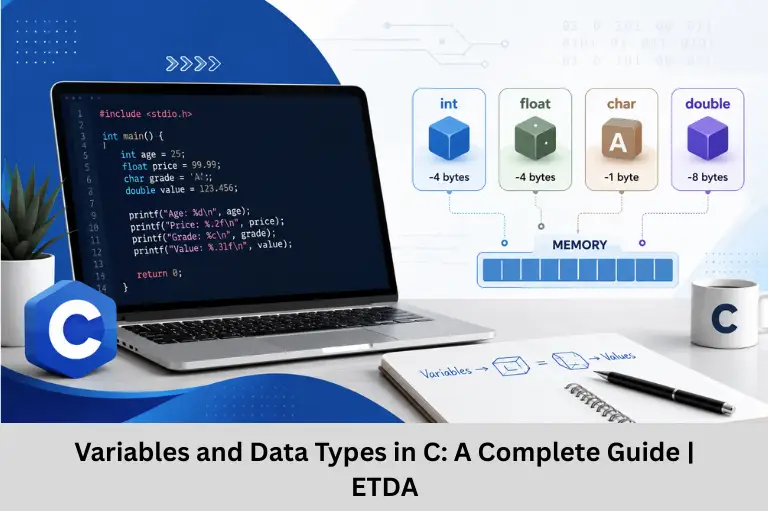
Learn variables and data types in C with this complete beginner’s guide. Understand syntax, examples, applications, and build programming skills with Embedded Tech Development Academy (ETDA).
- Variables and Data Types in C: A Complete Guide | ETDA
-
Variables and Data Types in C: A Complete Guide | ETDA
- What Are Variables in C?
- What Are Data Types in C?
- Types of Data Types in C
- Variable Declaration in C
- Variable Initialization
- Multiple Variable Declaration
- User-Defined and Derived Data Types
- Importance of Variables and Data Types in Embedded Systems
- Learn C Programming at ETDA
- Scope and Lifetime of Variables in C
- Constants in C Programming
- Type Modifiers in C
- Common Mistakes Beginners Should Avoid
- Why Learn C Programming at ETDA?
- Assured Placement Support at ETDA
-
Frequently Asked Questions (FAQs)
- What is a variable in C Programming?
- What are data types in C?
- Why are variables and data types important in Embedded Systems?
- What is the difference between float and double in C?
- What is variable scope in C?
- Does ETDA provide practical C Programming training?
- What projects can I build after learning C Programming?
- Does ETDA provide placement support after C Programming training?
- Conclusion
Variables and Data Types in C: A Complete Guide | ETDA
C Programming is one of the most important programming languages every engineering student should learn. Whether you want to become an Embedded Systems Engineer, Software Developer,Internet of Things (IoT) Engineer, or Robotics Engineer, understanding variables and data types in C is the first step toward writing efficient programs.
Every C program revolves around storing, processing, and manipulating data. Variables allow programmers to store values, while data types define the kind of information those variables can hold. Choosing the correct data type not only improves program performance but also optimizes memory usage—an essential requirement in embedded systems development.
For students planning to build a career in Embedded Systems, mastering these concepts is crucial. At Embedded Tech Development Academy (ETDA), students learn C Programming through practical coding exercises, hardware-based projects, and real-world applications. As a Top Embedded Training Institute in Bangalore, Embedded Tech Development Academy (ETDA) provides industry-oriented training with assured placement support, helping students become job-ready professionals.
What Are Variables in C?
A variable is a named memory location used to store data during the execution of a program. Instead of repeatedly entering the same value, programmers assign it to a variable and use it whenever required.
Variables make programs flexible because their values can change while the program is running.
For example, a student’s marks, an employee’s salary, or a sensor’s temperature reading can all be stored in variables.
Why Are Variables Important?
Variables are essential because they allow programs to:
- Store user input
- Perform calculations
- Save intermediate results
- Control program flow
- Process real-time sensor data
- Manage memory efficiently
Without variables, creating dynamic applications would not be possible.
Rules for Naming Variables
C Programming follows specific rules for variable names.
Valid Naming Rules
- Variable names must begin with a letter or underscore (_).
- They can contain letters, digits, and underscores.
- Spaces are not allowed.
- Special characters are not permitted.
- Keywords such as
intorfloatcannot be used as variable names. - Variable names are case-sensitive.
Choosing meaningful variable names improves code readability and maintenance.
What Are Data Types in C?
A data type defines the type of value a variable can store. It also determines how much memory is allocated and what operations can be performed on the stored data.
For example, storing a student’s age requires a different data type than storing a decimal temperature value.
Using the appropriate data type helps improve performance and memory efficiency, especially in embedded systems where hardware resources are limited.
Why Data Types Matter
Selecting the right data type provides several advantages:
- Efficient memory utilization
- Faster program execution
- Better code readability
- Improved program reliability
- Reduced memory wastage
Proper data type selection is a key skill for embedded software developers.
Types of Data Types in C
C Programming provides several built-in data types for different kinds of information.
Integer (int)
The int data type stores whole numbers without decimal points.
Examples
- Number of students
- Age
- Roll number
- Product quantity
- Sensor count
Integers are among the most frequently used data types in C Programming.
Character (char)
The char data type stores a single character.
Examples
- Grade
- Initials
- Menu selection
- Device status indicator
Characters are internally stored using their ASCII values.
Float (float)
The float data type stores decimal numbers with single precision.
Examples
- Temperature
- Voltage
- Speed
- Distance
- Percentage
Float is commonly used in scientific calculations and sensor-based applications.
Double (double)
The double data type stores decimal values with higher precision than float.
Examples
- Scientific measurements
- Financial calculations
- GPS coordinates
- Engineering computations
When greater accuracy is required, developers typically use the double data type.
Void (void)
The void data type represents the absence of a value.
Common Uses
- Functions that do not return a value
- Generic pointers
- Placeholder return types
Void is widely used in function declarations.
Variable Declaration in C
Before using a variable, it must be declared. Variable declaration informs the compiler about the variable’s name and the type of data it will store.
Components of a Variable Declaration
A declaration typically includes:
- Data type
- Variable name
- Optional initial value
Declaring variables correctly helps the compiler allocate the required memory.
Variable Initialization
Initialization means assigning a value to a variable when it is created.
Proper initialization prevents unpredictable behavior and improves program reliability.
Benefits of Initialization
- Reduces programming errors
- Improves code clarity
- Prevents undefined values
- Makes debugging easier
Good programming practice always encourages initializing variables whenever possible.
Multiple Variable Declaration
C allows multiple variables of the same data type to be declared together.
Advantages
- Cleaner code
- Reduced repetition
- Improved readability
- Easier maintenance
This approach is commonly used when several related variables share the same data type.
User-Defined and Derived Data Types
In addition to built-in types, C supports more advanced data structures.
Arrays
Arrays store multiple values of the same data type under a single variable name.
Applications
- Student marks
- Temperature readings
- Sensor values
- Product prices
Arrays simplify data management and processing.
Structures
Structures allow programmers to group different data types into a single unit.
Example Applications
- Student records
- Employee details
- Vehicle information
- Product databases
Structures are widely used in embedded systems for organizing related data.
Unions
Unions allow different variables to share the same memory location, making them useful for memory optimization.
Common Embedded Applications
- Communication buffers
- Protocol packets
- Memory-efficient device programming
Unions are especially valuable in resource-constrained embedded systems.
Importance of Variables and Data Types in Embedded Systems
Embedded devices often have limited RAM and Flash memory. Selecting the correct variable type directly impacts system performance and memory usage.
For example:
- Using an unnecessarily large data type increases memory consumption.
- Choosing the appropriate type improves execution speed and reduces resource usage.
- Efficient memory management is critical for microcontrollers such as STM32, AVR, PIC, ESP32, and ARM Cortex-M.
Understanding variables and data types is therefore a fundamental skill for every aspiring embedded engineer.
Learn C Programming at ETDA
At Embedded Tech Development Academy (ETDA), students build a strong programming foundation through practical learning rather than theory alone. The curriculum is designed to help beginners understand core C concepts before progressing to advanced embedded technologies.
As a Top Embedded Training Institute in Bangalore, Embedded Tech Development Academy (ETDA) offers training in:
Programming Fundamentals
- Variables and Data Types
- Operators
- Decision Making
- Loops
- Functions
- Arrays
- Pointers
- Structures
- File Handling
Embedded Technologies
- Embedded C
- STM32 Programming
- ARM Cortex-M
- UART
- SPI
- I2C
- CAN
- RTOS
- Internet of Things (IoT)
Students also gain practical experience through coding exercises, hardware interfacing, and mini-projects.
Scope and Lifetime of Variables in C
Understanding where a variable can be accessed and how long it exists in memory is essential for writing efficient C programs.
Local Variables
Local variables are declared inside a function or block and can only be accessed within that block.
Characteristics
- Accessible only inside the function
- Memory is allocated when the function starts
- Memory is released when the function ends
- Helps avoid accidental modification of data
Local variables are widely used for temporary calculations and function-specific operations.
Global Variables
Global variables are declared outside all functions and are accessible throughout the program.
Advantages
- Shared across multiple functions
- Suitable for common configuration values
- Reduces repeated data declarations
However, excessive use of global variables can make programs difficult to debug and maintain.
Static Variables
Static variables retain their values even after a function finishes execution.
Applications
- Event counters
- Device status tracking
- Communication buffers
- Embedded firmware state management
Static variables are frequently used in embedded systems where preserving values between function calls is necessary.
Constants in C Programming
Constants are fixed values that cannot be changed during program execution.
Using constants improves program readability and prevents accidental modification of important values.
Benefits of Constants
- Better code readability
- Improved program safety
- Easier maintenance
- Reduced programming errors
Constants are commonly used for hardware configurations, communication settings, and mathematical values.
Type Modifiers in C
Type modifiers change the size or range of basic data types.
Common modifiers include:
Signed
Allows storing both positive and negative values.
Unsigned
Stores only positive values, increasing the maximum range for positive numbers.
Short
Uses less memory than a standard integer and is useful for memory-constrained applications.
Long
Provides a larger storage range for handling bigger numerical values.
Selecting the correct modifier improves memory utilization and program efficiency.
Common Mistakes Beginners Should Avoid
Learning C Programming becomes easier when common mistakes are avoided.
Choosing the Wrong Data Type
Using an incorrect data type can waste memory or produce inaccurate results. Always select the most appropriate type based on the application’s requirements.
Using Uninitialized Variables
Variables should always be initialized before use. Uninitialized variables contain unpredictable values that may cause incorrect program behavior.
Confusing Characters and Strings
A character stores a single symbol, while a string stores a sequence of characters. Understanding this difference is essential for correct programming.
Ignoring Variable Scope
Accessing variables outside their valid scope leads to compilation errors and unexpected behavior. Understanding local and global scope helps create organized programs.
Poor Variable Naming
Meaningful variable names improve readability and make debugging easier. Avoid generic names whenever possible.
Real-World Applications of Variables and Data Types
Variables and data types are used in almost every software and embedded application.
Embedded Systems
Examples include:
- Reading sensor values
- Controlling LEDs
- Monitoring battery voltage
- Motor speed control
- Device configuration
Internet of Things (IoT)
Internet of Things (IoT) devices use variables to store:
- Temperature values
- Humidity readings
- GPS coordinates
- Network status
- Device IDs
Robotics
Robotics applications use variables for:
- Motor control
- Position tracking
- Distance measurement
- Object detection
- Navigation algorithms
Automotive Electronics
Variables play an important role in:
- Engine Control Units (ECUs)
- Battery Management Systems
- Vehicle diagnostics
- Speed monitoring
- Fuel management
Why Learn C Programming at ETDA?
Learning C Programming from experienced professionals helps students build confidence and gain practical knowledge. Embedded Tech Development Academy (ETDA) offers industry-oriented training that prepares students for careers in Embedded Systems and IoT.
As a Top Embedded Training Institute in Bangalore, Embedded Tech Development Academy (ETDA) combines classroom learning with real-time practical sessions.
Comprehensive Curriculum
Students receive hands-on training in:
- C Programming
- Embedded C
- C++
- STM32 Programming
- ARM Cortex-M
- RTOS
- Embedded Linux
- IoT Development
- Communication Protocols (UART, SPI, I2C, CAN)
Practical Learning Approach
Students work on real-world projects such as:
- Smart Home Automation
- Internet of Things (IoT) Monitoring Systems
- Robotics Applications
- Industrial Automation
- Sensor Interfacing Projects
This practical approach strengthens programming skills and improves problem-solving abilities.
Assured Placement Support at ETDA
Embedded Tech Development Academy (ETDA) not only focuses on technical training but also prepares students for successful careers through assured placement support.
Placement-Oriented Training
Students receive assistance with:
- Resume Building
- Aptitude Training
- Technical Interview Preparation
- Mock Interviews
- Communication Skills
- HR Interview Preparation
This comprehensive support helps students confidently participate in recruitment drives.
Industry-Focused Learning Environment
ETDA provides:
- Experienced Industry Trainers
- Modern Embedded Systems Labs
- Hands-On Hardware Practice
- Real-Time Projects
- Continuous Mentorship
- Career Guidance
Students graduate with practical experience that aligns with industry expectations.
Frequently Asked Questions (FAQs)
What is a variable in C Programming?
A variable is a named memory location used to store data that can change during program execution. Variables enable programs to process user input, perform calculations, and manage information efficiently.
What are data types in C?
Data types define the type of data a variable can store, such as integers, characters, decimal values, or floating-point numbers. They also determine memory allocation and valid operations.
Why are variables and data types important in Embedded Systems?
Embedded systems have limited memory and processing power. Choosing the correct variable type helps optimize memory usage, improve performance, and enhance system reliability.
What is the difference between float and double in C?
Both store decimal values, but double provides higher precision and a larger range than float, making it suitable for applications requiring greater accuracy.
What is variable scope in C?
Variable scope defines where a variable can be accessed. Local variables are accessible only within the function where they are declared, while global variables can be accessed throughout the program.
Does ETDA provide practical C Programming training?
Yes. ETDA offers hands-on C Programming training through coding exercises, hardware-based experiments, mini-projects, and real-world embedded applications.
What projects can I build after learning C Programming?
You can build projects such as sensor monitoring systems, LED control applications, IoT devices, robotics projects, smart home automation systems, and embedded firmware applications.
Does ETDA provide placement support after C Programming training?
Yes. ETDA provides assured placement support, including resume preparation, mock interviews, technical interview guidance, aptitude training, and career mentoring to help students secure opportunities in leading embedded systems and technology companies.
Conclusion
Variables and data types are the building blocks of every C program. They determine how data is stored, processed, and managed, making them essential concepts for every engineering student. A solid understanding of variables, data types, scope, constants, and memory management forms the foundation for advanced topics such as Embedded C, microcontroller programming, Internet of Things (IoT), robotics, and real-time systems.
Whether you aspire to become an Embedded Software Engineer, Firmware Developer, or Internet of Things (IoT) Engineer, mastering these fundamentals will strengthen your programming skills and improve your career prospects.
If you’re looking for practical, industry-oriented training, Embedded Tech Development Academy (ETDA) offers an excellent learning experience. With expert faculty, hands-on projects, modern laboratory facilities, and assured placement support, Embedded Tech Development Academy (ETDA) helps students transform theoretical concepts into real-world skills. As a Top Embedded Training Institute in Bangalore, Embedded Tech Development Academy (ETDA) is committed to preparing aspiring engineers for successful careers in the embedded systems industry.
Author: ETDA Trainers
Experience: 10+ Years of Industry Experience in Embedded Systems, IoT, and Embedded C Programming