
Power Factor: Importance, Correction Methods & Applications | ETDA Bangalore
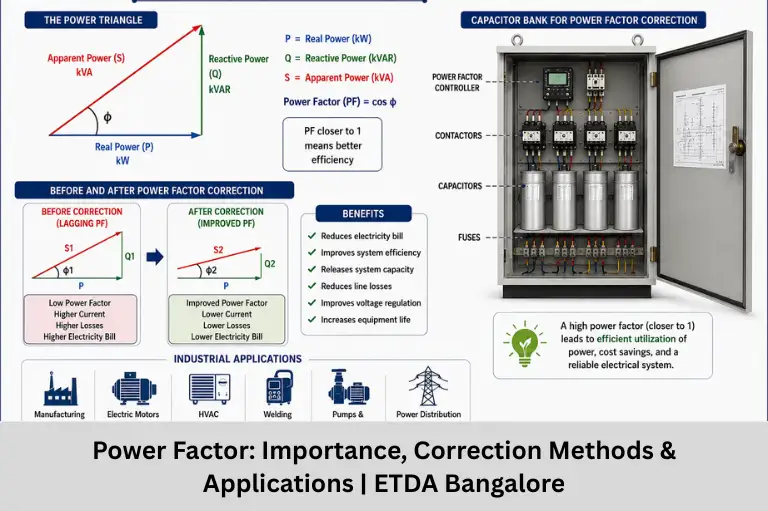
Learn about power factor, power factor correction, power triangle, capacitor banks, reactive power, and industrial applications. Explore embedded training at Embedded Tech Development Academy (ETDA), the Top Embedded Training Institute in Bangalore.
- Power Factor: Importance, Correction Methods & Applications | ETDA Bangalore
-
Power Factor: The Key to Efficient Electrical Systems
- Introduction
- What is Power Factor?
- Why Power Factor Matters
- Fundamental Concepts of Power Factor
- Causes of Low Power Factor
- Power Factor Correction Methods
- Measuring Power Factor
- Economic Benefits of Power Factor Improvement
- Standards and Regulations
- System Design Considerations
- Emerging Technologies
- Common Troubleshooting Issues
- Best Practices for Power Factor Optimization
- Applications of Power Factor Correction
- Why Learn Power Electronics and Electrical Systems at Embedded Tech Development Academy (ETDA)?
- Frequently Asked Questions (FAQs)
- Conclusion
Power Factor: The Key to Efficient Electrical Systems
Introduction
Power factor is one of the most important concepts in electrical and electronics engineering because it directly impacts the efficiency, reliability, and operating cost of electrical systems. Whether in industrial plants, commercial buildings, renewable energy systems, or embedded power electronics applications, maintaining a high power factor ensures that electrical energy is utilized effectively while minimizing unnecessary power losses. A poor power factor leads to increased electricity bills, higher transmission losses, voltage drops, equipment overheating, and reduced system performance.
In alternating current (AC) systems, electrical power consists of real power (kW), reactive power (kVAR), and apparent power (kVA). Power factor is the ratio of real power to apparent power and indicates how efficiently electrical energy is converted into useful work. Modern industries rely heavily on motors, transformers, variable frequency drives (VFDs), switch-mode power supplies (SMPS), and inductive loads, making power factor correction an essential part of electrical system design.
Understanding concepts such as reactive power compensation, capacitor banks, active power factor correction (PFC), harmonic mitigation, power quality analysis, energy efficiency, electrical distribution systems, three-phase power systems, industrial automation, smart grids, and electrical load management is vital for electrical, electronics, and embedded engineers.
At Embedded Tech Development Academy (ETDA), recognized as a Top Embedded Training Institute in Bangalore, students gain practical exposure to electrical and embedded technologies through industry-focused training. Embedded Tech Development Academy (ETDA) offers hands-on learning in embedded systems, microcontrollers, power electronics, PCB design, Internet of Things (IoT), automation, and communication systems, helping learners build strong technical skills for successful engineering careers.
What is Power Factor?
Power factor (PF) is a measure of how efficiently electrical power is being used in an AC circuit. It represents the ratio between the useful power (real power) and the total supplied power (apparent power).
Power Factor Formula
Basic Equation
Power Factor (PF) = cos θ = P / S = kW / kVA
Where:
- P = Real Power (Watts or kW)
- Q = Reactive Power (VAR or kVAR)
- S = Apparent Power (VA or kVA)
A power factor close to 1.0 indicates maximum efficiency, while lower values indicate wasted electrical energy.
Why Power Factor Matters
A good power factor provides several technical and economic benefits.
Advantages of High Power Factor
- Improves energy efficiency
- Reduces electricity bills
- Minimizes transmission losses
- Reduces voltage drop
- Increases transformer capacity
- Improves motor performance
- Extends equipment life
- Enhances overall power quality
Fundamental Concepts of Power Factor
The Power Triangle
The power triangle illustrates the relationship between:
- Real Power (P) – Useful work performed
- Reactive Power (Q) – Power required for magnetic fields
- Apparent Power (S) – Total supplied power
Key Equations
Real Power (P)
P = V × I × cosθ
Reactive Power (Q)
Q = V × I × sinθ
Apparent Power (S)
S = V × I
or
S = √(P² + Q²)
Types of Power Factor
| Type | Characteristics | Common Causes |
|---|---|---|
| Displacement Power Factor | Phase angle difference | Motors, transformers |
| Distortion Power Factor | Harmonic currents | VFDs, SMPS |
| Total Power Factor | Combination of both | Industrial electrical systems |
Causes of Low Power Factor
Inductive Loads
The most common reason for poor power factor is inductive equipment.
Examples include:
- Electric motors
- Transformers
- Induction furnaces
- Solenoids
- Contactors
- Welding machines
Harmonic-Producing Equipment
Modern electronic devices introduce harmonic distortion.
Examples include:
- Variable Frequency Drives (VFD)
- UPS systems
- Computers
- LED lighting
- Switched Mode Power Supplies (SMPS)
- Industrial automation equipment
Power Factor Correction Methods
Passive Power Factor Correction
Capacitor Banks
Capacitor banks provide reactive power locally, reducing the burden on the electrical supply.
Types include:
- Fixed capacitor banks
- Automatic capacitor banks
- Individual motor compensation
- Group compensation
- Centralized compensation
Capacitor Sizing Formula
Qc = P × (tan θ₁ − tan θ₂)
Where:
- Qc = Required capacitor rating (kVAR)
- θ₁ = Existing power factor angle
- θ₂ = Desired power factor angle
Active Power Factor Correction
Advanced systems use electronic converters.
Examples:
- Active PFC circuits
- Static VAR Compensators (SVC)
- STATCOM
- Synchronous condensers
Harmonic Mitigation
To improve overall power quality:
- Passive harmonic filters
- Active harmonic filters
- Detuned capacitor banks
- Multi-pulse rectifiers
Measuring Power Factor
Instruments Used
- tmlDigital Power Factor Meter
- Energy Analyzer
- Power Quality Analyzer
- Harmonic Analyzer
- Smart Energy Meter
Recommended Values
| Parameter | Ideal | Poor |
|---|---|---|
| Power Factor | 0.95 – 1.0 | Below 0.80 |
| THD Voltage | Below 5% | Above 10% |
| THD Current | Below 10% | Above 30% |
Economic Benefits of Power Factor Improvement
Lower Electricity Bills
Utilities often charge penalties for low power factor.
Improving PF:
- Reduces demand charges
- Lowers monthly electricity costs
- Improves return on investment
Increased System Capacity
Better power factor allows:
- More equipment on existing transformers
- Lower cable current
- Reduced power losses
- Better voltage regulation
Standards and Regulations
International Standards
Important standards include:
- IEEE 519
- IEC 61000-3-2
- EN 50160
Utility Requirements
| Region | Recommended PF |
|---|---|
| USA | 0.97 |
| Europe | 0.95 |
| India | 0.90 or above |
System Design Considerations
Capacitor Installation
Engineers should consider:
- Avoid overcompensation
- Prevent harmonic resonance
- Proper switching methods
- Temperature considerations
- Protection coordination
Motor Applications
Best practices include:
- Individual motor correction
- Automatic capacitor switching
- Avoid self-excitation
- Proper relay coordination
Emerging Technologies
Smart Power Factor Correction
Future systems include:
- Internet of Things (IoT)-enabled capacitor banks
- AI-based energy management
- Predictive maintenance
- Smart grid integration
Wide Bandgap Devices
Modern power electronics increasingly use:
- Silicon Carbide (SiC)
- Gallium Nitride (GaN)
Benefits include:
- Higher efficiency
- Faster switching
- Smaller passive components
- Better thermal performance
Common Troubleshooting Issues
Frequently Observed Problems
| Problem | Cause | Solution |
|---|---|---|
| Capacitor Failure | Harmonic resonance | Install detuned reactor |
| Low PF | Heavy inductive load | Install capacitor bank |
| Overheated Cables | High reactive current | Improve PF above 0.95 |
| Voltage Drop | Poor power quality | Proper compensation |
Best Practices for Power Factor Optimization
Recommended Guidelines
- Monitor power quality regularly.
- Use automatic capacitor banks.
- Perform harmonic analysis.
- Maintain PF above 0.95.
- Conduct periodic energy audits.
- Use active filters where necessary.
- Install smart energy monitoring systems.
Applications of Power Factor Correction
Industrial Applications
- Manufacturing plants
- Cement industries
- Steel plants
- Textile mills
- Chemical industries
Commercial Applications
- Shopping malls
- Hospitals
- Office buildings
- Hotels
- Data centers
Renewable Energy Systems
- Solar power plants
- Wind farms
- Hybrid energy systems
- Battery Energy Storage Systems (BESS)
Why Learn Power Electronics and Electrical Systems at Embedded Tech Development Academy (ETDA)?
Industry-Oriented Practical Training
Embedded Tech Development Academy (ETDA), known as the Top Embedded Training Institute in Bangalore, provides practical training that bridges academic concepts with real-world engineering applications. Students gain hands-on experience in embedded systems, power electronics, electrical machines, microcontrollers, Internet of Things (IoT), PCB design, communication protocols, automation, and industrial electronics through project-based learning.
With experienced mentors, modern laboratories, and placement-oriented programs, Embedded Tech Development Academy (ETDA) equips aspiring engineers with the skills needed to excel in industries such as embedded systems, semiconductor design, industrial automation, renewable energy, automotive electronics, and smart power systems.
Frequently Asked Questions (FAQs)
What is power factor in electrical engineering?
Power factor is the ratio of real power (kW) to apparent power (kVA) in an AC circuit. It indicates how efficiently electrical energy is converted into useful work.
Why is maintaining a high power factor important?
A high power factor reduces electricity costs, minimizes power losses, improves voltage regulation, increases system capacity, and enhances the lifespan of electrical equipment.
How can power factor be improved?
Power factor can be improved using capacitor banks, active power factor correction (PFC), harmonic filters, synchronous condensers, and proper load management techniques.
What causes a low power factor?
Low power factor is commonly caused by inductive loads such as motors, transformers, fluorescent lighting, welding machines, variable frequency drives (VFDs), and other non-linear electrical loads.
What industries benefit from power factor correction?
Industries such as manufacturing, automotive, renewable energy, healthcare, commercial buildings, data centers, industrial automation, and utilities benefit significantly from effective power factor correction and energy management.
Conclusion
Power factor is much more than just an electrical parameter—it is a critical indicator of the efficiency, reliability, and overall performance of AC power systems. By improving power factor through capacitor banks, active power factor correction, harmonic filters, reactive power compensation, smart energy management, and power quality monitoring, industries can significantly reduce energy costs, improve voltage stability, increase equipment lifespan, and maximize the utilization of existing electrical infrastructure.
As industries adopt Industry 4.0, smart grids, renewable energy integration, electric vehicles, industrial automation, IoT-enabled energy management, and intelligent power electronics, understanding power factor becomes an essential skill for every electrical and electronics engineer.
For students looking to build a successful career in embedded systems, power electronics, automation, and electrical engineering, Embedded Tech Development Academy (ETDA)—the Top Embedded Training Institute in Bangalore—offers industry-oriented training, hands-on projects, expert mentorship, and placement support. By combining theoretical knowledge with practical implementation, Embedded Tech Development Academy (ETDA) prepares future engineers to solve real-world challenges in modern electrical and embedded systems.
Author: ETDA Trainers
Experience: 10+ Years of Industry Experience in Embedded Systems, IoT, and Embedded C Programming