
Strings in C Programming: Complete Guide with Functions & Examples | ETDA
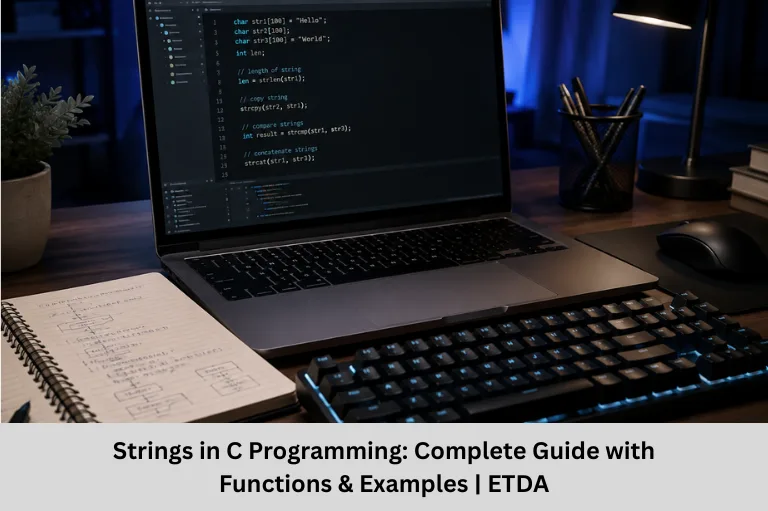
Learn Strings in C Programming with syntax, memory representation, string functions, examples, and best practices. Master C Programming with Embedded Tech Development Academy (ETDA).
- Strings in C Programming: Complete Guide with Functions & Examples | ETDA
-
Strings in C Programming: Complete Guide with Functions & Examples
- What Are Strings in C Programming?
- How Strings Are Stored in Memory
- Declaring Strings in C
- Input and Output of Strings
- Standard String Library (string.h)
- Internship Opportunities for Practical Experience
- Strings and Arrays
- String Handling in Embedded Systems
- Learn C Programming at ETDA
- Advanced String Manipulation Techniques
- Strings and Pointers
- Memory Optimization for String Handling
- Common String Programming Mistakes
- Best Practices for String Programming
- Strings in Real-World Embedded Systems
- Why Learn C Programming at ETDA?
-
FAQs
- What is a string in C Programming?
- Why does C use a null terminator for strings?
- Which header file contains standard string functions?
- What are the most commonly used string functions in C?
- What is the relationship between strings and pointers?
- Why are strings important in Embedded Systems?
- How can buffer overflow be avoided when handling strings?
- Why should I learn C Programming at ETDA?
- What projects can I build after learning string handling in C?
- How does ETDA prepare students for Embedded Systems careers?
- Conclusion
Strings in C Programming: Complete Guide with Functions & Examples
Strings are one of the most widely used data structures in C Programming. Whether you are developing desktop applications, embedded firmware, operating systems, or Internet of Things (IoT) devices, handling text efficiently is an essential programming skill. Strings enable applications to process names, commands, passwords, configuration data, communication packets, sensor information, and much more.
Unlike many modern programming languages, C does not provide a built-in string data type. Instead, strings are represented as arrays of characters terminated by a special null character ('\0'). Understanding how strings are stored, manipulated, and processed is fundamental for writing efficient and reliable C programs.
For students pursuing careers in Embedded Systems, mastering string handling is especially important because many embedded applications use strings for UART communication, LCD displays, command processing, and data logging. At Embedded Tech Development Academy (ETDA), students learn C Programming through hands-on coding sessions, real-time embedded projects, and practical debugging exercises. Recognized by many learners as a Top Embedded Training Institute in Bangalore, ETDA provides industry-oriented training with assured placement support to prepare students for successful careers.
What Are Strings in C Programming?
A string in C is a sequence of characters stored in a character array and terminated with a null character ('\0').
Unlike integers or floating-point numbers, strings can contain multiple characters such as letters, digits, symbols, and spaces.
Examples of strings include:
"Embedded Systems""Hello World""STM32""UART Communication""Temperature Sensor"
The null terminator marks the end of the string and allows C library functions to determine its length.
Why Are Strings Important?
Strings are used extensively in almost every software application.
Common Applications
- User input
- Password validation
- File processing
- Configuration settings
- Communication protocols
- Device names
- Sensor information
- Command parsing
- Error messages
Efficient string handling improves software usability and performance.
How Strings Are Stored in Memory
Understanding memory representation is one of the most important concepts in C Programming.
Each character occupies one byte of memory, and characters are stored sequentially in consecutive memory locations.
At the end of every string, C automatically stores a null character ('\0'), which indicates where the string ends.
Memory Layout
For a string like "ETDA":
| Character | Memory Content |
|---|---|
| E | Character |
| T | Character |
| D | Character |
| A | Character |
| '\0' | Null Terminator |
The null terminator is not visible when printing the string, but it is essential for proper string handling.
Why the Null Character Matters
Without the null terminator:
- String functions cannot determine where the string ends.
- Programs may read invalid memory.
- Unexpected output may occur.
- Buffer overflows become more likely.
Proper null termination is a key aspect of safe C programming.
Declaring Strings in C
Strings are declared using the char data type.
Character Arrays
A string is stored as an array of characters.
Declaration Rules
- Specify sufficient array size.
- Reserve space for the null character.
- Use meaningful variable names.
- Avoid allocating less memory than required.
Proper declaration helps prevent memory-related bugs.
String Initialization
Strings can be initialized during declaration.
Best Practices
- Allocate adequate memory.
- Initialize when possible.
- Ensure null termination.
- Avoid modifying string literals.
Correct initialization improves program reliability.
Input and Output of Strings
String input and output are common operations in C Programming.
Reading Strings
Applications commonly read strings from:
- Keyboard input
- Files
- Serial communication
- Network packets
- Sensors
Choosing the appropriate input method depends on the application requirements.
Displaying Strings
Strings are displayed in:
- Console applications
- LCD displays
- OLED displays
- UART terminals
- Debug consoles
Displaying strings correctly is important for diagnostics and user interaction.
Standard String Library (string.h)
C provides a powerful standard library called string.h that contains functions for string manipulation.
Instead of writing custom algorithms, programmers can use optimized library functions.
strlen()
The strlen() function calculates the number of characters in a string, excluding the null terminator.
Common Uses
- Input validation
- Buffer management
- Communication protocols
- Password length checking
It is one of the most frequently used string function
strcpy()
The strcpy() function copies one string into another.
Applications
- Configuration copying
- Device name storage
- Buffer initialization
- Text duplication
Always ensure the destination buffer has enough space before copying.
Internship Opportunities for Practical Experience
Internships bridge the gap between classroom learning and industry requirements.
strncpy()
strncpy() copies a specified number of characters, making it safer than strcpy() for many applications.
Benefits
- Prevents excessive copying
- Helps reduce buffer overflow risks
- Suitable for fixed-length buffers
It is commonly used in embedded firmware where memory safety is important.
strcat()
The strcat() function appends one string to the end of another.
Applications
- Building messages
- Creating file paths
- Constructing communication packets
- Generating log entries
Always verify available buffer space before concatenation.
strncat()
This function appends only a specified number of characters.
Advantages
- Improved memory safety
- Better buffer control
- Suitable for embedded applications
strcmp()
strcmp() compares two strings character by character.
Typical Applications
- Password verification
- Command recognition
- User authentication
- Device configuration matching
String comparison is widely used in command-based embedded systems.
strncmp()
This function compares only a specified number of characters.
It is useful when comparing:
- Command prefixes
- Communication headers
- Protocol identifiers
strchr()
strchr() searches for the first occurrence of a character within a string.
Applications
- Parsing commands
- Searching delimiters
- Finding separators
- Token processing
strstr()
strstr() searches for one string inside another.
Common Uses
- Keyword searching
- Configuration parsing
- Message filtering
- Log analysis
Strings and Arrays
Strings are implemented using character arrays.
Relationship
Every string is an array of characters, but not every character array is necessarily a valid string.
A character array becomes a string only when it contains a terminating null character.
Advantages of Character Arrays
- Direct memory access
- High execution speed
- Efficient storage
- Hardware compatibility
This makes strings particularly suitable for embedded systems programming.
String Handling in Embedded Systems
String processing plays an important role in embedded firmware.
Common Embedded Applications
- UART Command Processing
- GPS Data Parsing
- LCD Display Messages
- Bluetooth Communication
- Wi-Fi Configuration
- Sensor Data Logging
- AT Command Processing
- Debug Console Output
Efficient string handling ensures reliable communication and system performance.
Learn C Programming at ETDA
At Embedded Tech Development Academy (ETDA), students learn string manipulation through hands-on programming exercises and real embedded hardware projects.
As a Top Embedded Training Institute in Bangalore, ETDA provides practical training in:
Core Programming
- Variables
- Data Types
- Operators
- Functions
- Arrays
- Pointers
- Strings
- Structures
- File Handling
Embedded Technologies
- Embedded C
- STM32 Programming
- ARM Cortex-M
- UART
- SPI
- I2C
- CAN
- RTOS
- Embedded Linux
- Internet of Things (IoT) Development
Students gain practical experience through real-world embedded applications.
Advanced String Manipulation Techniques
As applications become more complex, developers often need advanced string operations beyond copying and comparing. Efficient string manipulation is especially important in embedded systems where memory and processing power are limited.
Tokenizing Strings
Tokenization is the process of breaking a string into smaller parts using delimiters such as commas, spaces, or colons.
Common Applications
- Command-line interpreters
- CSV file processing
- GPS data parsing
- Communication protocol decoding
- Configuration file processing
Tokenization simplifies processing structured text data received from sensors or communication interfaces.
Reversing a String
Reversing a string is a common programming exercise that strengthens understanding of arrays and memory access.
Uses
- Algorithm practice
- Data processing
- Interview questions
- Educational programming exercises
Although not frequently used in embedded firmware, it helps improve logical thinking.
Converting Character Case
Programs often convert characters between uppercase and lowercase.
Applications
- User input normalization
- Command processing
- Case-insensitive comparisons
- Data formatting
These operations improve software usability and compatibility.
Strings and Pointers
Since strings are stored as character arrays, pointers provide an efficient way to access and manipulate them.
Relationship Between Strings and Pointers
A pointer can reference the first character of a string and traverse it one character at a time.
Advantages
- Faster traversal
- Efficient memory access
- Reduced indexing overhead
- Better performance in large datasets
Pointer-based string handling is widely used in operating systems, embedded firmware, and device drivers.
Pointer Arithmetic with Strings
Pointer arithmetic allows developers to move through characters efficiently.
Common Uses
- Parsing communication packets
- Buffer processing
- Protocol implementation
- Data validation
- Text scanning
Understanding pointer arithmetic is essential for professional C programmers.
Memory Optimization for String Handling
Embedded systems often have limited RAM and Flash memory. Efficient string handling helps reduce memory usage and improve performance.
Memory Optimization Techniques
- Allocate only the required buffer size.
- Reuse existing buffers whenever possible.
- Avoid unnecessary string copies.
- Prefer safer bounded string functions.
- Store constant strings in read-only memory where supported.
- Minimize dynamic memory allocation in embedded applications.
These practices improve reliability and reduce memory-related issues.
Common String Programming Mistakes
String-related bugs are among the most common issues in C Programming. Understanding these mistakes helps developers write safer code.
Buffer Overflow
Buffer overflow occurs when more characters are written than the allocated buffer can hold.
Prevention
- Validate input length.
- Allocate sufficient memory.
- Use bounded string functions.
- Perform boundary checks before copying or concatenating.
Missing Null Terminator
Forgetting to terminate a string with '\0' causes undefined behavior because library functions cannot determine where the string ends.
Best Practice
Always ensure every string is properly null-terminated before processing.
Modifying String Literals
String literals are generally stored in read-only memory. Attempting to modify them can cause program crashes or undefined behavior.
Use writable character arrays when the string content needs to change.
Using Unsafe Library Functions
Functions that do not limit the number of copied characters can increase the risk of memory corruption if buffer sizes are not validated.
Choose bounded alternatives where appropriate and always verify destination buffer capacity.
Best Practices for String Programming
Following good coding practices improves maintainability, performance, and reliability.
Recommended Practices
- Initialize character arrays before use.
- Validate user input.
- Check buffer boundaries.
- Use meaningful variable names.
- Avoid unnecessary string copies.
- Document string-processing logic.
- Test edge cases such as empty strings.
- Handle invalid input gracefully.
These practices are valuable for both application software and embedded firmware.
Strings in Real-World Embedded Systems
String processing is used extensively in embedded applications.
UART Communication
Microcontrollers receive text-based commands over UART for configuration and debugging.
GPS Modules
GPS receivers transmit NMEA sentences that must be parsed into useful information.
Bluetooth Modules
AT commands are exchanged as strings for pairing, configuration, and communication.
Wi-Fi Modules
Wi-Fi modules use strings for:
- Network names (SSID)
- Passwords
- IP configuration
- HTTP requests
- MQTT topics
LCD and OLED Displays
Embedded systems display:
- Status messages
- Menu options
- Sensor readings
- Warning messages
- Diagnostic information
Efficient string formatting ensures clear user interfaces.
Why Learn C Programming at ETDA?
Strong C Programming skills form the foundation of Embedded Systems development. At Embedded Tech Development Academy (ETDA) students gain both theoretical knowledge and practical implementation experience through structured training.
Recognized by many aspiring engineers as a Top Embedded Training Institute in Bangalore, Embedded Tech Development Academy (ETDA) emphasizes hands-on learning using industry-standard tools and real embedded hardware.
Industry-Oriented Curriculum
Students receive practical training in:
- C Programming
- Embedded C
- C++
- Data Structures
- ARM Cortex-M
- STM32 Programming
- UART, SPI, I2C, and CAN
- RTOS
- Embedded Linux
- Internet of Things (IoT) Development
The curriculum is regularly updated to reflect current industry requirements.
Hands-On Learning
Students strengthen their skills through:
- Coding exercises
- Hardware interfacing
- Firmware development
- Debugging sessions
- Communication protocol implementation
- Real-time embedded projects
This project-based approach helps bridge the gap between academic learning and industry expectations.
Assured Placement Support
Embedded Tech Development Academy (ETDA) supports students throughout their career journey with assured placement support, including:
- Resume building
- Aptitude preparation
- Technical interview coaching
- Mock interviews
- HR interview guidance
- Career mentoring
This combination of technical training and career preparation helps students become industry-ready.
FAQs
What is a string in C Programming?
A string in C is a sequence of characters stored in a character array and terminated by a null character ('\0'). The null terminator indicates the end of the string.
Why does C use a null terminator for strings?
The null terminator allows string-handling functions to determine where the string ends, enabling safe processing and preventing reads beyond valid memory.
Which header file contains standard string functions?
The standard string functions are declared in the string.h header file. It provides functions for copying, comparing, searching, concatenating, and measuring string length.
What are the most commonly used string functions in C?
Common functions include strlen(), strcpy(), strncpy(), strcat(), strncat(), strcmp(), strncmp(), strchr(), and strstr().
What is the relationship between strings and pointers?
Strings are stored as character arrays, and a pointer can reference the first character of the array. Pointer arithmetic enables efficient traversal and manipulation of string data.
Why are strings important in Embedded Systems?
Strings are used for UART communication, AT command processing, GPS parsing, LCD displays, Bluetooth and Wi-Fi configuration, data logging, and diagnostic messages.
How can buffer overflow be avoided when handling strings?
Prevent buffer overflows by validating input length, allocating sufficient memory, checking buffer boundaries, and using bounded string-handling functions where appropriate.
Why should I learn C Programming at ETDA?
ETDA offers hands-on C Programming and Embedded Systems training through practical coding exercises, real-time projects, experienced instructors, modern labs, and assured placement support, helping students build industry-ready skills.
What projects can I build after learning string handling in C?
You can build UART command interpreters, GPS data parsers, IoT sensor loggers, menu-driven embedded applications, communication protocol analyzers, and configuration management systems.
How does ETDA prepare students for Embedded Systems careers?
Embedded Tech Development Academy (ETDA) combines an industry-aligned curriculum, practical hardware experience, embedded projects, interview preparation, and assured placement support to help students transition confidently into embedded engineering roles.
Conclusion
Strings are one of the most important concepts in C Programming because they enable applications to process, store, and communicate textual information efficiently. A solid understanding of string declaration, memory representation, library functions, pointers, and safe programming practices is essential for building reliable software.
In Embedded Systems, strings play a crucial role in UART communication, Bluetooth and Wi-Fi modules, GPS data parsing, display interfaces, and command processing. Mastering string handling improves both coding efficiency and debugging skills while preparing developers for advanced topics such as Embedded C, firmware development, and Internet of Things (IoT).
If you want to build a strong foundation in C Programming and Embedded Systems, Embedded Tech Development Academy (ETDA) offers practical training through industry-focused courses, modern laboratories, real-time projects, and assured placement support. As a Top Embedded Training Institute in Bangalore, Embedded Tech Development Academy (ETDA) equips students with the technical expertise and practical experience needed to succeed in today’s embedded systems industry.
Author: ETDA Trainers
Experience: 10+ Years of Industry Experience in Embedded Systems, IoT, and Embedded C Programming