
Digital Communication Systems: Complete Guide to Modern Connectivity | ETDA
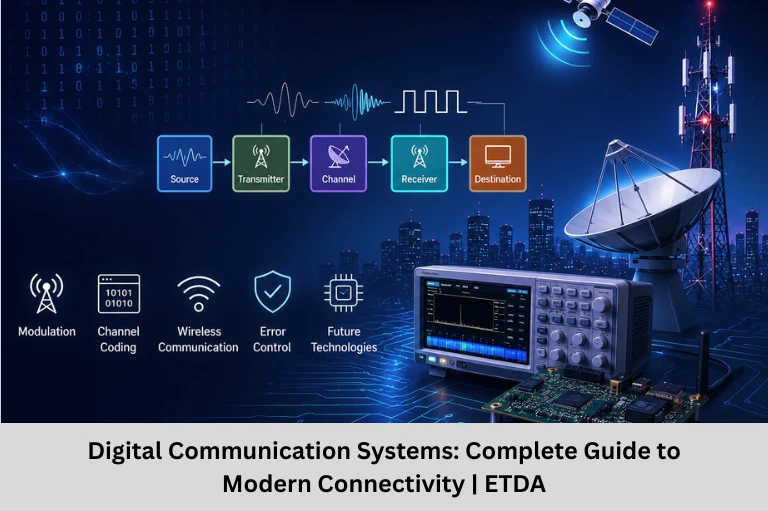
Learn Digital Communication Systems, including modulation, channel coding, wireless communication, error control, and future technologies. Explore practical applications with Embedded Tech Development Academy (ETDA), the Top Embedded Training Institute in Bangalore.
- Digital Communication Systems: Complete Guide to Modern Connectivity | ETDA
- Digital Communication Systems: The Backbone of Modern Connectivity
Digital Communication Systems: The Backbone of Modern Connectivity
Introduction to Digital Communication
Digital Communication Systems form the foundation of today’s connected world. From smartphones and Wi-Fi networks to satellite communication, Internet of Things (IoT) devices, autonomous vehicles, and industrial automation, digital communication enables the fast, reliable, and secure exchange of information. Unlike traditional analog communication, digital systems convert voice, images, videos, and sensor data into binary bits (0s and 1s), making transmission more resistant to noise, easier to process, and significantly more efficient.
Modern technologies such as 5G networks, cloud computing, artificial intelligence (AI), embedded systems, edge computing, fiber optic communication, software-defined radio (SDR), Internet of Things (IoT), machine-to-machine (M2M) communication, wireless sensor networks, satellite communication, optical communication, and industrial automation all rely on robust digital communication principles.
The rapid growth of smart cities, Industry 4.0, autonomous vehicles, wearable electronics, robotics, and intelligent healthcare systems has further increased the demand for engineers skilled in digital communication technologies. Understanding modulation techniques, channel coding, multiplexing, error correction, signal processing, and wireless protocols has become essential for electronics, embedded systems, telecommunication, and networking professionals.
For students and working professionals looking to build expertise in communication technologies, Embedded Tech Development Academy (ETDA) provides industry-oriented training that bridges the gap between theoretical concepts and practical implementation. As the Top Embedded Training Institute in Bangalore, Embedded Tech Development Academy (ETDA) emphasizes hands-on learning through real-time projects, communication protocols, embedded hardware platforms, and placement-focused training that prepares learners for careers in embedded systems, wireless communication, Internet of Things (IoT), automotive electronics, and telecommunications.
Key Advantages over Analog
- Noise immunity through regeneration
- Error detection and correction capabilities
- Higher security through encryption
- Efficient multiplexing using TDM
- Easy integration with digital signal processing
- Better scalability and higher data transmission rates
- Improved compatibility with modern networking technologies
Fundamental Building Blocks
System Architecture

Key Performance Metrics
| Parameter | Definition | Typical Values |
|---|---|---|
| Bit Rate | Bits transmitted per second (bps) | 1 kbps – 100 Gbps |
| Bandwidth | Frequency spectrum occupied by the signal | kHz – GHz |
| BER (Bit Error Rate) | Probability of a bit being received incorrectly | 10−3 to 10−12 |
| SNR | Signal-to-Noise Ratio | 0–30 dB |
| Spectral Efficiency | Number of bits transmitted per second per Hz of bandwidth | 0.5–20 bps/Hz |
Core Technologies
Modulation Techniques
| Type | Scheme | Bandwidth Efficiency | Robustness |
|---|---|---|---|
| ASK | Amplitude Shift Keying | Low | Poor |
| FSK | Frequency Shift Keying | Medium | Good |
| PSK | Phase Shift Keying | High | Excellent |
| QAM | Quadrature Amplitude Modulation | Very High | Moderate |
16-QAM Constellation Diagram
● ● ● ●
● ● ● ●
● ● ● ●
● ● ● ●
Channel Coding
| Code Type | Redundancy | Applications |
|---|---|---|
| Hamming | Low | Memory systems |
| Convolutional | Medium | Wireless communication |
| LDPC | High | 5G, DVB-S2 |
| Turbo | Very High | Space communication |
Modern Communication Systems
Wireless Standards
| Generation | Key Technologies | Data Rates |
|---|---|---|
| 2G | GSM, GPRS | 14.4–64 kbps |
| 3G | WCDMA, HSPA | 384 kbps–2 Mbps |
| 4G | LTE, OFDMA | 100–300 Mbps |
| 5G | mmWave, Massive MIMO | 1–20 Gbps |
Optical Communication
- DWDM: 80+ channels @100 GHz spacing
- Coherent Detection with DSP receivers
- PAM4 signaling for high-speed data centers
Signal Processing Essentials
Nyquist Criteria
Sampling Theorem
fs ≥ 2fm
where fm is the maximum signal frequency.
Pulse Shaping
# Raised Cosine Filter in Python
def rcos_filter(alpha, T, fs):
t = np.arange(-3*T, 3*T, 1/fs)
h = np.sinc(t/T) * np.cos(np.pi*alpha*t/T) / (1 – (2*alpha*t/T)**2)
return h / np.sum(h)
Equalization Techniques
- Linear Equalizers (ZF, MMSE)
- Decision Feedback Equalizer (DFE)
- Adaptive Filters (LMS, RLS)
Multiple Access Methods
Comparative Analysis
| Technique | Principle | Applications |
|---|---|---|
| TDMA | Time Slots | 2G, Satellite |
| FDMA | Frequency Bands | AMPS, OFDMA |
| CDMA | Code Division | 3G, GPS |
| SDMA | Spatial Streams | Massive MIMO |
OFDM Implementation
Key Steps
- Serial-to-parallel conversion
- IFFT processing
- Cyclic Prefix insertion
- Parallel-to-serial conversion
Error Control Mechanisms
ARQ Protocols
| Type | Efficiency | Latency |
|---|---|---|
| Stop-and-Wait | Low | High |
| Go-Back-N | Medium | Medium |
| Selective Repeat | High | Low |
FEC Performance
Coding Gain Comparison
SNR Required for BER = 10⁻⁵
- Uncoded – 12.5 dB
- Hamming (7,4) – 9.8 dB
- Convolutional – 7.2 dB
- Turbo – 4.5 dB
Emerging Technologies
6G Enablers
- Terahertz Communication (100 GHz–10 THz)
- Reconfigurable Intelligent Surfaces
- Holographic Beamforming
Quantum Communication
- Quantum Key Distribution (QKD)
- Entanglement-based Networks
- Quantum Repeaters
Practical Implementation
Software Defined Radio
GNU Radio Flowgraph
[Signal Source]
↓
[Throttle]
↓
[PSK Mod]
↓
[Channel Model]
↓
[PSK Demod]
↓
[BER Probe]
Test and Measurement
- Vector Signal Analyzers
- Bit Error Rate Testers
- Protocol Analyzers
Industry Applications
Telecommunications
- Core Network Infrastructure
- Mobile Backhaul
- Fiber-to-the-Home (FTTH)
Satellite Systems
- GEO & LEO Constellations
- VSAT Networks
- Deep Space Communication
Industrial IoT
- WirelessHART
- LoRaWAN
- 5G URLLC
FAQs
What is a Digital Communication System?
A Digital Communication System converts information into binary data and transmits it over communication channels with improved reliability, security, and resistance to noise compared to analog communication.
What are the major modulation techniques used in digital communication?
The most common modulation techniques include Amplitude Shift Keying (ASK), Frequency Shift Keying (FSK), Phase Shift Keying (PSK), Quadrature Phase Shift Keying (QPSK), and Quadrature Amplitude Modulation (QAM).
Why is channel coding important in digital communication?
Channel coding adds controlled redundancy to transmitted data, enabling the receiver to detect and correct errors caused by noise, interference, or fading, thereby improving communication reliability.
What industries use Digital Communication Systems?
Digital communication is widely used in telecommunications, embedded systems, IoT, automotive electronics, aerospace, satellite communication, industrial automation, defense, healthcare, networking, and consumer electronics.
How can I build a career in Digital Communication and Embedded Systems?
Start by learning digital communication fundamentals, signal processing, wireless communication, embedded C, microcontrollers, Internet of Things (IoT), and networking concepts. Practical training with real-time projects from Embedded Tech Development Academy (ETDA), the Top Embedded Training Institute in Bangalore, can help develop job-ready skills and improve career opportunities in the embedded and communication industries.
Conclusion
Digital Communication Systems have become the driving force behind the digital transformation occurring across industries worldwide. Whether enabling ultra-fast 5G connectivity, supporting cloud computing, powering Internet of Things (IoT) ecosystems, facilitating satellite communication, or enabling smart manufacturing, digital communication technologies continue to redefine how people, devices, and businesses connect.
As communication networks evolve toward 6G, artificial intelligence-driven networking, quantum communication, terahertz wireless communication, massive MIMO, edge computing, software-defined networking (SDN), network virtualization (NFV), optical fiber communication, embedded wireless systems, industrial Internet of Things (IoT), autonomous transportation, and smart infrastructure, engineers must continuously update their technical skills to remain competitive in the industry.
A strong understanding of digital modulation, multiplexing, channel coding, error control, digital signal processing, wireless protocols, optical communication, and embedded communication interfaces provides the foundation for successful careers in electronics, telecommunications, embedded systems, networking, and semiconductor industries.
For aspiring engineers seeking practical knowledge and industry exposure, Embedded Tech Development Academy (ETDA) offers comprehensive training that combines theoretical learning with real-world implementation. Recognized as the Top Embedded Training Institute in Bangalore, Embedded Tech Development Academy (ETDA) equips students with hands-on experience in embedded systems, communication protocols, Internet of Things (IoT) development, ARM microcontrollers, RTOS, and industry projects, along with dedicated placement support to help them build successful careers in the rapidly growing embedded and communication technology sectors.
By mastering digital communication concepts today, learners prepare themselves for tomorrow’s innovations in smart devices, connected infrastructure, autonomous systems, and next-generation wireless networks.
Author: ETDA Trainers
Experience: 10+ Years of Industry Experience in Embedded Systems, IoT, and Embedded C Programming