
Communication Systems Explained: Components, Types, Modulation & Applications | ETDA
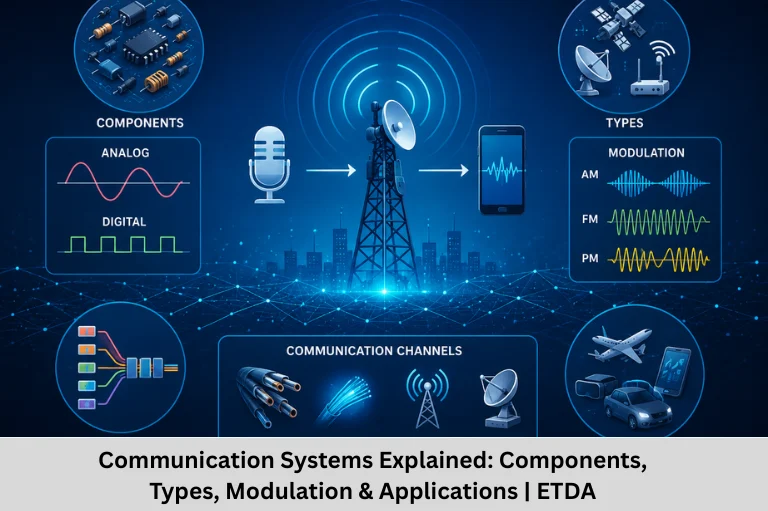
Learn Communication Systems, including analog and digital communication, modulation, multiplexing, communication channels, and real-world applications. Explore communication engineering with Embedded Tech Development Academy (ETDA), the Top Embedded Training Institute in Bangalore.
- Communication Systems Explained: Components, Types, Modulation & Applications | ETDA
-
Communication Systems: Connecting the World, One Signal at a Time
- Introduction to Communication Systems
- What Is a Communication System?
- Everyday Examples of Communication Systems
- Basic Components of a Communication System
- Analog vs Digital Communication
- Key Concepts in Communication Systems
- Real-World Applications of Communication Systems
- Why Are Communication Systems Important?
- Future of Communication Systems
- FAQs
- Conclusion
Communication Systems: Connecting the World, One Signal at a Time
Introduction to Communication Systems
Communication Systems are the backbone of the modern digital world, enabling billions of devices and people to exchange information instantly across cities, countries, and even continents. Whether you are making a mobile phone call, sending an email, streaming a movie, attending an online meeting, using GPS navigation, or controlling industrial machines remotely, communication systems ensure that information reaches its destination quickly, accurately, and securely.
At its core, a communication system transfers information from a source to a destination through a communication channel while minimizing errors and interference. The information can be in the form of voice, text, images, video, or sensor data, and it is transmitted using electrical, optical, or electromagnetic signals. Advances in communication technologies have transformed every sector, including telecommunications, healthcare, banking, defense, transportation, manufacturing, education, and smart cities.
Modern communication engineering is driven by technologies such as 5G and 6G networks, Internet of Things (IoT), embedded systems, wireless communication, fiber optic communication, satellite communication, cloud computing, edge computing, software-defined radio (SDR), digital signal processing (DSP), wireless sensor networks, Bluetooth, Wi-Fi, Near Field Communication (NFC), Zigbee, LoRaWAN, RFID, artificial intelligence (AI), machine learning, cybersecurity, network protocols, and smart industrial automation. These technologies work together to create reliable, high-speed, and secure communication infrastructures capable of supporting billions of connected devices.
Understanding communication systems is essential for students pursuing electronics, electrical engineering, embedded systems, telecommunication, networking, robotics, and Internet of Things (IoT). Knowledge of signal transmission, modulation, multiplexing, channel coding, error detection, communication protocols, and wireless networking provides the foundation for designing advanced communication equipment and intelligent connected systems.
For aspiring engineers looking to gain practical experience, Embedded Tech Development Academy (ETDA) offers industry-oriented training that combines theoretical concepts with real-time implementation. Recognized as the Top Embedded Training Institute in Bangalore, Embedded Tech Development Academy (ETDA) provides hands-on learning in embedded systems, ARM microcontrollers, communication protocols, Internet of Things (IoT), industrial automation, wireless technologies, and real-world engineering projects, preparing students for successful careers in the rapidly growing communication and embedded technology industries.
Why Communication Systems Matter
Communication systems play a vital role because they:
- Enable instant global connectivity
- Support secure and reliable data transmission
- Power mobile networks and the Internet
- Facilitate remote work and online education
- Enable industrial automation and IoT
- Improve healthcare through telemedicine
- Support defense, aerospace, and satellite communication
- Drive digital transformation across industries
What Is a Communication System?
A Communication System is a system that transmits information from a sender (transmitter) to a receiver through a communication channel. Its primary objective is to ensure that information is delivered accurately, efficiently, and with minimal distortion or loss.
Simply put:
A communication system allows devices and people to exchange information using electrical, optical, or wireless signals.
Everyday Examples of Communication Systems
- Mobile phone calls
- Wi-Fi internet connections
- Television broadcasting
- Radio broadcasting
- Satellite communication
- GPS navigation
- Video conferencing
- Email communication
- Smart home devices
- Industrial IoT communication
Basic Components of a Communication System
1. Information Source
The origin of the message.
Examples:
- Human voice
- Video
- Images
- Sensor data
- Computer files
2. Transmitter
Converts the information into a signal suitable for transmission using modulation and signal processing techniques.
3. Communication Channel (Medium)
The transmission path through which the signal travels.
Types of Communication Channels
- Twisted Pair Cable
- Coaxial Cable
- Fiber Optic Cable
- Radio Waves
- Microwave Links
- Satellite Links
- Infrared Communication
4. Noise
Noise refers to unwanted electrical or electromagnetic interference that degrades signal quality during transmission.
5. Receiver
Receives, demodulates, filters, and reconstructs the original message.
6. Destination
The final user or device that receives the transmitted information.
Analog vs Digital Communication
| Type | Description | Examples |
|---|---|---|
| Analog Communication | Continuous signals | AM/FM Radio, Traditional Telephone |
| Digital Communication | Binary signals (0s and 1s) | Mobile Networks, Internet, Email, VoIP |
Why Digital Communication Is Preferred
- Better noise immunity
- Higher transmission speed
- Data encryption
- Error detection and correction
- Easy data compression
- Improved reliability
- High bandwidth efficiency
Key Concepts in Communication Systems
Modulation
Modulation is the process of varying a carrier signal to transmit information over long distances.
Analog Modulation Techniques
- Amplitude Modulation (AM)
- Frequency Modulation (FM)
- Phase Modulation (PM)
Digital Modulation Techniques
- Amplitude Shift Keying (ASK)
- Frequency Shift Keying (FSK)
- Phase Shift Keying (PSK)
- Quadrature Amplitude Modulation (QAM)
Multiplexing
Multiplexing combines multiple signals into a single communication channel to improve bandwidth utilization.
Common Multiplexing Techniques
- Time Division Multiplexing (TDM)
- Frequency Division Multiplexing (FDM)
- Code Division Multiplexing (CDM)
- Wavelength Division Multiplexing (WDM)
Encryption and Error Detection
Communication systems use advanced techniques to ensure secure and accurate data transmission.
Common Techniques
- CRC (Cyclic Redundancy Check)
- Hamming Code
- Reed-Solomon Coding
- AES Encryption
- RSA Encryption
Real-World Applications of Communication Systems
| Technology | Applications |
|---|---|
| Mobile Networks | Voice, SMS, Internet |
| Satellite Communication | GPS, Weather Monitoring |
| Wireless LAN | Wi-Fi Connectivity |
| Fiber Optic Networks | High-Speed Internet |
| Broadcasting | Television and Radio |
| Industrial IoT | Factory Automation |
| Smart Cities | Traffic and Utility Monitoring |
| Healthcare | Telemedicine and Remote Monitoring |
| Defense | Secure Military Communication |
| Space Exploration | Deep Space Communication |
Why Are Communication Systems Important?
Major Benefits
Communication systems enable:
- Global connectivity
- Real-time communication
- Secure information exchange
- Remote monitoring and control
- Cloud computing services
- Smart manufacturing
- Online education
- Digital banking
- Emergency communication
- Autonomous transportation
Future of Communication Systems
Emerging Technologies
The future of communication systems includes:
- 6G Wireless Networks
- Internet of Things (IoT)
- Artificial Intelligence in Networking
- Quantum Communication
- Terahertz Communication
- Software-Defined Networking (SDN)
- Network Function Virtualization (NFV)
- Edge Computing
- Smart Satellites
- Interplanetary Internet
- Autonomous Connected Vehicles
These technologies will provide ultra-fast, low-latency, secure, and intelligent communication across billions of connected devices.
FAQs
What is a Communication System?
A communication system is a combination of devices and processes that transmit information from a sender to a receiver through a communication channel while ensuring reliable and efficient data transfer.
What are the main components of a Communication System?
The primary components include the information source, transmitter, communication channel, noise, receiver, and destination. Together, they enable accurate signal transmission and reception.
What is the difference between Analog and Digital Communication?
Analog communication uses continuous signals and is more susceptible to noise, whereas digital communication uses binary signals (0s and 1s), offering better noise immunity, higher security, data compression, and error correction.
Where are Communication Systems used?
Communication systems are widely used in mobile networks, satellite communication, Wi-Fi, broadcasting, fiber optic networks, industrial automation, IoT, healthcare, defense, banking, smart cities, and space exploration.
How can I build a career in Communication Systems and Embedded Engineering?
Start by learning communication fundamentals, digital signal processing, embedded C, microcontrollers, wireless protocols, Internet of Things (IoT), networking, and communication interfaces. Embedded Tech Development Academy (ETDA), recognized as the Top Embedded Training Institute in Bangalore, provides practical, project-based training with placement support to help students develop industry-ready skills in communication systems and embedded engineering.
Conclusion
Communication Systems are the invisible infrastructure that powers today’s connected society. Every phone call, video conference, online transaction, cloud application, GPS navigation request, smart home command, and industrial automation process relies on efficient communication technologies to transfer information accurately and securely.
As technologies such as 5G, 6G, Internet of Things (IoT), embedded systems, artificial intelligence, cloud computing, fiber optic communication, software-defined radio, wireless sensor networks, edge computing, satellite communication, smart factories, autonomous vehicles, cybersecurity, digital communication, RF engineering, communication protocols, industrial automation, and smart cities continue to evolve, the demand for engineers skilled in communication systems is growing rapidly across industries.
Developing expertise in communication principles, signal processing, modulation, multiplexing, wireless networking, communication protocols, and embedded communication interfaces provides excellent career opportunities in telecommunications, networking, aerospace, automotive electronics, semiconductor industries, defense, healthcare, and Internet of Things (IoT) development.
For students and professionals seeking practical, industry-oriented training, Embedded Tech Development Academy (ETDA) offers comprehensive programs that combine classroom learning with real-time laboratory experience and project-based implementation. Recognized as the Top Embedded Training Institute in Bangalore, Embedded Tech Development Academy (ETDA) provides hands-on training in embedded systems, ARM microcontrollers, Internet of Things (IoT), communication protocols, RTOS, industrial automation, and wireless technologies, along with placement-focused guidance to help learners become industry-ready.
By mastering communication systems today, engineers can contribute to building the next generation of intelligent networks, connected devices, autonomous systems, and advanced digital infrastructures that will shape the future of global communication.
Author: ETDA Trainers
Experience: 10+ Years of Industry Experience in Embedded Systems, IoT, and Embedded C Programming