
Digital Switching Systems: Complete Guide to Architecture, Signaling & 5G | ETDA
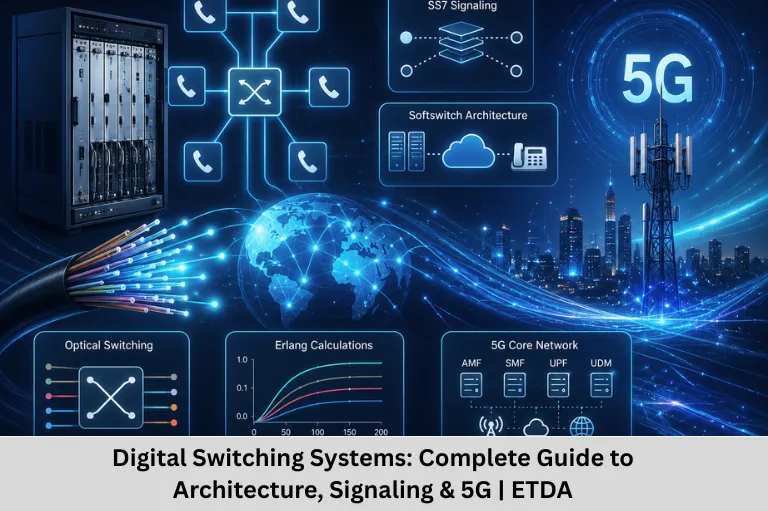
Learn Digital Switching Systems, including switching techniques, TST architecture, SS7, softswitches, optical switching, Erlang calculations, 5G core networks, and emerging technologies with Embedded Tech Development Academy (ETDA).
- Digital Switching Systems: Complete Guide to Architecture, Signaling & 5G | ETDA
-
Digital Switching Systems: The Backbone of Modern Telecommunications
- Introduction to Digital Switching Systems
- Fundamental Switching Concepts
- Digital Switching Components
- Signaling Systems
- Modern Digital Switching Technologies
- Performance Metrics of Digital Switching Systems
- Emerging Trends in Digital Switching
- Design Challenges in Digital Switching
- Digital Switching Case Studies
- Future Directions of Digital Switching
- FAQs
- Conclusion
Digital Switching Systems: The Backbone of Modern Telecommunications
Introduction to Digital Switching Systems
Digital switching systems are a fundamental part of modern telecommunications infrastructure. Every time a user makes a phone call, connects to a mobile network, accesses a voice service, or establishes a real-time communication session, switching technology plays a critical role in determining where and how that information should be delivered.
In simple terms, a digital switching system receives digital information from one or more sources, determines the appropriate destination, and establishes or manages a communication path between them. Unlike traditional mechanical switching systems, modern digital switches use electronic circuits, processors, software, and high-speed communication interfaces to handle enormous volumes of voice, data, and multimedia traffic.
The evolution of telecommunications has transformed switching from traditional electromechanical exchanges and circuit-switched telephone networks into sophisticated packet-based, IP-enabled, software-defined, cloud-native, and 5G core network architectures. Technologies such as Time Division Switching (TDS), Space Division Switching (SDS), Time-Space-Time (TST) switching, Packet Switching, SS7 signaling, SIP, VoIP, softswitches, Media Gateway Controllers, optical switching, Software-Defined Networking (SDN), Network Functions Virtualization (NFV), network slicing, edge computing, and cloud telecommunications have significantly changed how modern networks route and manage communication traffic.
Digital switching is especially important because modern communication networks must provide high availability, low latency, scalability, efficient resource utilization, security, and reliable quality of service (QoS). Telecom operators need switching platforms capable of processing millions of connection attempts while maintaining consistent performance during normal operation and peak traffic periods.
Understanding digital switching systems is valuable for students and professionals interested in telecommunication engineering, embedded systems, networking, wireless communication, 4G/5G technologies, Internet of Things (IoT), optical networks, and software-defined networking. Knowledge of switching architectures, signaling protocols, digital hierarchy, traffic engineering, and network performance provides a strong foundation for working with modern communication infrastructure.
For learners seeking practical exposure to embedded and communication technologies, Embedded Tech Development Academy (ETDA) offers industry-oriented technical training that connects engineering fundamentals with real-world implementation. As the Top Embedded Training Institute in Bangalore, Embedded Tech Development Academy (ETDA) focuses on practical learning in embedded systems, communication protocols, microcontrollers, Internet of Things (IoT), networking, and related technologies, helping students develop job-ready skills for the evolving telecommunications and embedded technology sectors.
Key Advantages of Digital Switching
Digital switching systems provide several advantages over traditional switching technologies:
- Higher reliability with fewer mechanical components
- Faster call and connection processing
- Improved voice and data quality
- Greater network scalability
- Efficient bandwidth utilization
- Advanced call management features
- Better integration with IP and data networks
- Support for VoIP, 4G, and 5G infrastructure
- Software-based control and configuration
- Improved network monitoring and fault management
Fundamental Switching Concepts
Switching Techniques Comparison
| Technique | Principle | Delay Characteristics | Typical Use |
|---|---|---|---|
| Circuit Switching | Dedicated communication path | Connection setup delay | PSTN, traditional telephone networks |
| Packet Switching | Data divided into packets | Variable queuing delay | IP networks, Internet |
| Message Switching | Complete message transferred between nodes | High delay | Legacy communication systems |
Time-Space-Time Switching Architecture
Time-Space-Time (TST) switching combines time and space switching techniques to efficiently establish communication paths.
Basic Architecture
Input → Time Switch → Space Switch → Time Switch → Output
The three major stages perform different functions:
- First Time Switch: Performs timeslot interchange
- Space Switch: Establishes the physical switching path
- Second Time Switch: Performs additional timeslot interchange
Why TST Switching Is Important
TST architectures provide an efficient way to connect multiple digital channels while reducing the complexity and hardware requirements associated with large switching networks.
Digital Switching Components
Core Functional Units
| Unit | Function | Key Technologies |
|---|---|---|
| Line Interface | Analog-to-digital and digital-to-analog conversion | PCM codecs, SLICs |
| Switching Network | Establishes communication paths | TSI, digital switching matrices |
| Control Processor | Handles call processing | Fault-tolerant processors |
| Signaling System | Coordinates network communication | SS7, SIP |
Digital Hierarchy: PDH and SDH
Digital telecommunications networks use standardized digital transmission hierarchies to transport large numbers of voice and data channels.
PDH Rates
- E1: 2.048 Mbps, commonly organized into 32 timeslots
- E3: 34.368 Mbps
- T1: 1.544 Mbps, commonly carrying 24 voice channels
SDH Rates
- STM-1: 155.52 Mbps
- STM-4: 622.08 Mbps
- STM-16: 2.488 Gbps
PDH vs SDH
SDH provides improved synchronization, management, scalability, and fault protection compared with traditional PDH systems, making it more suitable for high-capacity carrier networks.
Signaling Systems
Evolution of Signaling
Telecommunication signaling has evolved through several stages:
- In-band signaling using multifrequency tones
- Common-channel signaling using SS7
- Packet-based signaling using protocols such as SIP and SIGTRAN
SS7 Protocol Stack
| Level | Protocol | Function |
|---|---|---|
| Level 4 | TCAP | Transaction capabilities |
| Level 3 | SCCP | Connectionless and advanced signaling services |
| Level 2 | MTP-2 | Signaling link control |
| Level 1 | MTP-1 | Physical transmission layer |
Role of SS7
Signaling System No. 7 (SS7) has historically been essential for call establishment, routing, mobility management, SMS services, and other functions within traditional telecommunications networks.
Modern Digital Switching Technologies
Softswitch Architecture
A softswitch separates call control from traditional hardware-based switching functions and enables telecommunications services to operate over IP networks.
Key Components
- Media Gateway: Converts between TDM and IP media streams
- Media Gateway Controller: Handles call control and session management
- Signaling Gateway: Enables signaling interoperability between SS7 and IP networks
Benefits of Softswitch Technology
- Reduced hardware dependency
- Flexible service deployment
- Easier network scaling
- IP network integration
- Software-based service management
Optical Switching
Optical switching technologies are used in high-capacity optical communication networks.
| Technology | Switching Time | Typical Capacity | Applications |
|---|---|---|---|
| MEMS | Millisecond range | Very high | Optical core networks |
| Liquid Crystal | Millisecond range | High | Optical network equipment |
| Semiconductor | Very fast | High | Data centers and optical systems |
Performance Metrics of Digital Switching Systems
Key Switching Parameters
| Parameter | Definition | Typical Target |
|---|---|---|
| Blocking Probability | Probability of connection rejection | Low, often <1% |
| Grade of Service | Measure of service quality/availability | High availability |
| Call Setup Time | Time required to establish a connection | Typically hundreds of milliseconds or less |
| Busy Hour Call Attempts | Number of connection attempts during peak hour | Thousands to millions |
Erlang Calculations
Telecommunication engineers use Erlang traffic theory to estimate network capacity and determine the number of circuits required to handle expected traffic.
Erlang B Formula
Pb=∑k=0NAk/k!AN/N!
Where:
- A = Offered traffic in Erlangs
- N = Number of available circuits
- Pb = Blocking probability
Why Erlang Calculations Matter
Erlang calculations help network engineers plan switching capacity, estimate required circuits, minimize blocking, and maintain an acceptable Grade of Service during busy periods.
Emerging Trends in Digital Switching
Cloud-Based Switching
Modern telecom networks are increasingly moving switching and network functions into cloud-based infrastructure.
Major Technologies
- Network Functions Virtualization (NFV)
- Containerized network functions
- Kubernetes-based orchestration
- AI-assisted traffic management
- Cloud-native network architectures
5G Core Network
Modern 5G networks introduce software-oriented architectures designed for flexible service delivery.
Key Technologies
- Control and User Plane Separation (CUPS)
- Network slicing
- Service-Based Architecture (SBA)
- Virtualized network functions
- Edge computing
- Network automation
Role of Switching in 5G
Digital switching concepts continue to evolve within packet-based 5G core networks, where intelligent routing, session management, traffic steering, and service orchestration replace many functions traditionally associated with circuit-switched networks.
Design Challenges in Digital Switching
Scalability Issues
Large telecommunications networks must efficiently handle increasing numbers of users and devices.
Common Solutions
- Non-blocking switch architectures
- Clos network designs
- Load-balancing algorithms
- Distributed control planes
- Horizontal scaling
- Intelligent traffic management
Security Considerations
Modern switching systems must protect signaling, control, and media traffic against increasingly sophisticated attacks.
Major Security Concerns
- SS7 vulnerabilities
- Signaling manipulation
- DDoS attacks against VoIP infrastructure
- Unauthorized access
- Media interception
- Network configuration attacks
Security Measures
- Signaling firewalls
- Encryption
- Authentication
- Access control
- Traffic monitoring
- Intrusion detection systems
Digital Switching Case Studies
Carrier-Grade Switching
Carrier-grade telecommunications systems require extremely high availability and fault tolerance.
Important Characteristics
- High availability
- Geographic redundancy
- Fault-tolerant architecture
- Hot-swappable components
- Automated fault recovery
- Large-scale traffic processing
Enterprise IP-PBX
Enterprise IP-PBX platforms provide organizations with advanced voice and unified communication services.
Common Features
- VoIP calling
- Unified communications
- Call routing
- Voice mail
- Quality of Service (QoS)
- Failover and survivability
- Integration with enterprise networks
Future Directions of Digital Switching
Quantum Networking and Switching
Future communication networks may incorporate quantum technologies for highly secure information exchange.
Potential Technologies
- Quantum key distribution
- Entanglement-based networking
- Quantum repeaters
- Quantum routing
AI-Optimized Networks
Artificial intelligence is expected to make communication networks more adaptive and autonomous.
Potential Applications
- Predictive call routing
- Dynamic resource allocation
- Self-healing networks
- Automated fault detection
- Intelligent congestion management
- Predictive network maintenance
FAQs
What is a Digital Switching System?
A digital switching system is a telecommunications system that establishes and manages communication paths between users or network nodes using digital signals and electronic or software-controlled switching technology.
What is TST switching in telecommunications?
TST stands for Time-Space-Time switching. It combines time switching, space switching, and another stage of time switching to establish communication paths efficiently between digital channels.
What is the difference between Circuit Switching and Packet Switching?
Circuit switching establishes a dedicated communication path for the duration of a connection, while packet switching divides information into packets that can be independently routed through a network. Traditional telephone networks relied heavily on circuit switching, whereas modern Internet and 5G networks primarily use packet-based communication.
What is a Softswitch?
A softswitch is a software-based telecommunications switching platform that separates call-control functions from media transport. It commonly works with components such as Media Gateways, Media Gateway Controllers, and Signaling Gateways to support IP-based communication.
How can I learn Digital Switching and Telecommunication Technologies?
Students should build a foundation in digital communication, computer networks, signaling protocols, embedded systems, IP networking, and wireless technologies before moving into advanced switching concepts. Embedded Tech Development Academy (ETDA), recognized as the Top Embedded Training Institute in Bangalore, provides practical, industry-focused training in embedded systems, communication protocols, Internet of Things (IoT), networking, and related technologies, helping learners develop job-ready skills for modern telecommunications and embedded engineering careers.
Conclusion
Digital Switching Systems have evolved dramatically from mechanical telephone exchanges into highly intelligent, software-driven communication platforms capable of managing enormous volumes of voice, data, and multimedia traffic. They remain a critical part of telecommunications infrastructure even as networks transition from traditional circuit-switched architectures toward packet-based, IP-centric, cloud-native, and 5G technologies.
The future of digital switching is closely connected with 5G and 6G networks, software-defined networking (SDN), network functions virtualization (NFV), cloud-native telecommunications, edge computing, artificial intelligence, machine learning, optical switching, network slicing, VoIP, SIP, Internet of Things (IoT) connectivity, cybersecurity, network automation, and intelligent traffic management. These technologies are transforming switching from a primarily hardware-based function into a flexible software-controlled capability distributed across modern communication networks.
Engineers who understand TST switching, time-slot interchange, digital switching matrices, SS7 signaling, SIP, softswitch architecture, optical networks, Erlang traffic theory, IP networking, and 5G core concepts can build a strong foundation for careers in telecommunications, networking, embedded systems, Internet of Things (IoT), wireless communication, and infrastructure engineering.
For students and professionals looking to develop practical technical expertise, Embedded Tech Development Academy (ETDA) provides industry-oriented training that connects core engineering concepts with real-world implementation. As the Top Embedded Training Institute in Bangalore, Embedded Tech Development Academy (ETDA) offers hands-on training in embedded systems, communication protocols, microcontrollers, networking, Internet of Things (IoT), RTOS, and related technologies, along with placement-focused learning to help students develop industry-ready skills.
As telecommunications continues its transition toward intelligent, autonomous, cloud-based, and software-defined infrastructure, digital switching will remain a fundamental concept for understanding how modern networks connect people, machines, applications, and services.
Author: ETDA Trainers
Experience: 10+ Years of Industry Experience in Embedded Systems, IoT, and Embedded C Programming