
What Is Data Structure? Complete Guide for Beginners | ETDA
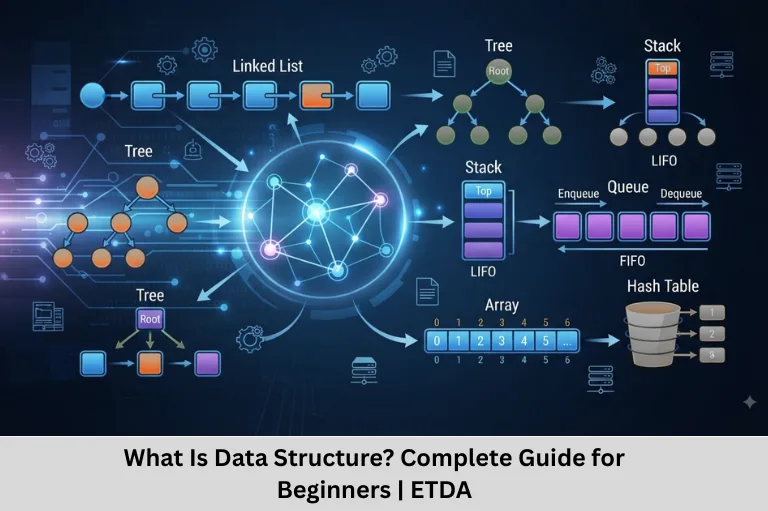
Learn what data structures are, their types, operations, complexity, and applications. Explore arrays, linked lists, stacks, queues, trees, and more. Embedded Tech Development Academy (ETDA).
- What Is Data Structure? Complete Guide for Beginners | ETDA
-
What Is Data Structure? A Complete Guide for Beginners
- What Is a Data Structure?
- Why Are Data Structures Important?
- Classification of Data Structures
- Arrays
- Linked Lists
- Stack
- Queue
- Circular Queue
- Trees
- Binary Tree
- Heap
- Hash Tables
- Time and Space Complexity
- Data Structures in C Programming
- Data Structures in Embedded Systems
- Data Structures and Technical Interviews
- Learn Data Structures at ETDA
-
Assured Placement Support at ETDA
- Placement Preparation Includes
- FAQs
- What is a data structure?
- What are the main types of data structures?
- Why are data structures important in programming?
- What is the difference between an array and a linked list?
- What is a stack?
- What is a queue?
- Which data structures are useful in Embedded Systems?
- Why should embedded engineers learn data structures using C?
- Does ETDA provide placement support?
- Why choose ETDA for Embedded Systems training?
- Conclusion
What Is Data Structure? A Complete Guide for Beginners
A data structure is a fundamental concept in computer science and programming that defines how data is organized, stored, accessed, and manipulated inside a computer system. Choosing the right data structure can significantly affect a program’s performance, memory usage, scalability, and maintainability.
For engineering students learning C, C++, Embedded C, or software development, understanding data structures is essential. Concepts such as arrays, linked lists, stacks, queues, trees, and hash tables are used to solve programming problems efficiently and are frequently tested in technical interviews.
Data structures are particularly important in embedded systems because microcontrollers often operate with limited RAM, processing power, and storage. Efficient data organization can make the difference between reliable firmware and a system that consumes unnecessary resources.
Students looking for a Top Embedded Training Institute in Bangalore can benefit from an institute that combines programming fundamentals with practical embedded development. Embedded Tech Development Academy (ETDA) focuses on C, C++, Embedded C, microcontrollers, real-time projects, and industry-oriented training, along with assured placement support.
What Is a Data Structure?
A data structure is a method of organizing data so that a program can efficiently perform operations such as:
- Insertion
- Deletion
- Searching
- Sorting
- Traversal
- Updating
- Accessing
For example, if a program needs to store the marks of 100 students, an array may be appropriate. If elements need to be frequently inserted and removed, a linked list may be more suitable.
Therefore, data structures are not simply containers for storing data. They determine how efficiently a program can work with that data.
Why Are Data Structures Important?
Efficient software requires efficient data organization.
Major Benefits
Efficient Data Access
A suitable data structure can reduce the time required to find or modify information.
Better Memory Management
Choosing an appropriate structure can prevent unnecessary memory consumption.
Improved Program Performance
Efficient data organization can reduce processing time and improve application responsiveness.
Reusable Code
Data structures can be implemented as reusable components for different applications.
Importance in Embedded Systems
Embedded systems often have strict RAM and processing constraints. Efficient data structures help developers manage buffers, sensor readings, communication packets, task information, and device states without wasting resources.
Classification of Data Structures
Data structures are broadly classified into linear and non-linear data structures.
Linear Data Structures
In a linear data structure, elements are organized sequentially.
Examples include:
- Arrays
- Linked Lists
- Stacks
- Queues
Each element generally has a logical predecessor and successor, except elements at the boundaries.
Non-Linear Data Structures
In non-linear structures, data is organized hierarchically or through relationships rather than a simple sequence.
Examples include:
- Trees
- Graphs
- Heaps
Non-linear structures are useful for representing complex relationships and hierarchical information.
Arrays
An array is a collection of elements of the same data type stored in contiguous memory locations.
Characteristics of Arrays
- Fixed-size structure in traditional C arrays
- Same data type for all elements
- Contiguous memory allocation
- Fast index-based access
For example:
int marks[5] = {80, 75, 90, 85, 88};The elements can be accessed using indexes.
Advantages
Array access by index is generally efficient because the address of an element can be calculated directly.
Limitations
Insertion or deletion in the middle of an array may require shifting multiple elements.
Linked Lists
A linked list consists of nodes where each node contains data and a link to another node.
Types of Linked Lists
- Singly Linked List
- Doubly Linked List
- Circular Linked List
A basic singly linked-list node in C can be represented as:
struct Node
{
    int data;
    struct Node *next;
};
The pointer connects one node to the next.
Advantages
Linked lists can grow dynamically, and inserting or deleting nodes can be efficient when the required position is already known.
Limitations
Linked lists require additional memory for pointers and do not provide the same direct index-based access as arrays.
Stack
A stack is a linear data structure that follows the LIFO (Last In, First Out) principle.
The last element inserted is the first element removed.
Basic Stack Operations
- Push
- Pop
- Peek/Top
- IsEmpty
- IsFull
Applications
Stacks are used in:
- Function call management
- Expression evaluation
- Parentheses matching
- Undo operations
- Backtracking
- Program execution
The call stack is particularly important in C and Embedded C because function calls and local variables commonly use stack memory.
Queue
A queue follows the FIFO (First In, First Out) principle.
The first element inserted is the first element removed.
Basic Queue Operations
- Enqueue
- Dequeue
- Front
- Rear
Applications
Queues are commonly used for:
- Task scheduling
- Printer management
- Data buffering
- Communication systems
- Event handling
In embedded systems, queues are particularly useful for handling data received through UART, SPI, CAN, or other communication interfaces.
Circular Queue
A circular queue connects the end of the queue back to the beginning.
This approach makes better use of available storage compared with a simple linear queue in many implementations.
Applications
Circular buffers are widely used for:
- UART receive buffers
- Audio data
- Sensor data
- Network packets
- Continuous data streams
Why Circular Buffers Matter in Embedded Systems
A circular buffer can continuously accept and process data without repeatedly moving existing elements in memory. This makes it highly useful for real-time firmware.
Trees
A tree is a non-linear data structure consisting of nodes connected in a hierarchical relationship.
Important Tree Terms
- Root
- Parent
- Child
- Leaf
- Edge
- Height
- Depth
- Subtree
A tree can represent hierarchical information such as file systems, organizational structures, or decision processes.
Binary Tree
A binary tree is a tree where each node can have at most two children.
The children are commonly referred to as:
- Left child
- Right child
Binary Search Tree
A Binary Search Tree (BST) organizes values according to an ordering rule.
Typically:
Left subtree < Node < Right subtree
This structure can provide efficient searching when the tree remains appropriately balanced.
Heap
A heap is a specialized tree-based data structure commonly used for priority-based operations.
Types of Heap
- Min Heap
- Max Heap
A min heap keeps the smallest element at the root, while a max heap keeps the largest element at the root.
Applications
Heaps are commonly used in:
- Priority queues
- Scheduling
- Graph algorithms
- Heap sort
Hash Tables
A hash table stores data using a key-value relationship.
A hash function converts a key into an index or hash value used to locate the corresponding data.
Advantages
Hash tables can provide very fast average-case lookup, insertion, and deletion.
Applications
They are commonly used for:
- Dictionaries
- Symbol tables
- Caches
- Database indexing
- Fast lookup systems
Hash tables require careful handling of collisions, where multiple keys produce the same hash location.
Time and Space Complexity
Understanding data structures also requires understanding algorithm complexity.
Time Complexity
Time complexity describes how the execution time of an algorithm grows as input size increases.
Common complexity classes include:
- O(1) — Constant
- O(log n) — Logarithmic
- O(n) — Linear
- O(n log n) — Linearithmic
- O(n²) — Quadratic
Example
Accessing an element of an array by index is generally O(1).
Searching an unsorted array may require checking multiple elements and can take O(n) time.
Space Complexity
Space complexity describes how much additional memory an algorithm requires as input size grows.
This is especially important in embedded systems because available RAM can be limited.
Data Structures in C Programming
C does not provide built-in classes like C++, but developers can implement many data structures using:
- Arrays
- Structures
- Pointers
- Dynamic memory
- Functions
Example: Structure-Based Node
struct Node
{
    int data;
    struct Node *next;
};
This simple structure can form the foundation of a linked list.
Why C Is Important
Learning data structures using C helps students understand what happens at the memory level rather than relying entirely on high-level abstractions.
This knowledge is particularly useful for embedded software development.
Data Structures in Embedded Systems
Embedded applications frequently process continuous streams of data from hardware.
Common Use Cases
- Sensor data buffers
- UART receive queues
- CAN message queues
- SPI communication buffers
- Task management
- Event queues
- Circular buffers
- Device configuration tables
Example: UART Buffer
When characters arrive through UART faster than the main application can process them, a circular buffer can temporarily store incoming data.
This prevents immediate data loss and allows firmware to process received information asynchronously.
Data Structures and Technical Interviews
Data structures are among the most common technical interview topics for software and embedded engineering positions.
Topics Frequently Asked
- Array manipulation
- Pointer-based problems
- Linked lists
- Stack implementation
- Queue implementation
- Searching
- Sorting
- Recursion
- Trees
- Complexity analysis
Students should focus on understanding the underlying logic rather than memorizing implementations.
Learn Data Structures at ETDA
Embedded Tech Development Academy (ETDA) emphasizes strong programming fundamentals as part of embedded systems training.
Technical Learning
Students can develop skills in:
- C Programming
- C++
- Data Structures
- Pointers
- Memory Management
- Embedded C
- Microcontrollers
- ARM Cortex-M
- STM32
- RTOS
- UART
- SPI
- I2C
- CAN
Practical Approach
Rather than treating data structures as an isolated theoretical subject, practical implementation helps students understand how arrays, pointers, queues, buffers, and other structures are used in actual firmware.
Assured Placement Support at ETDA
Strong technical knowledge needs to be combined with interview preparation. Embedded Tech Development Academy (ETDA) provides assured placement support to help students prepare for embedded and software engineering opportunities.
Placement Preparation Includes
- Resume development
- Aptitude preparation
- Technical interview practice
- Coding assessments
- Mock interviews
- HR interview preparation
- Communication skills
- Career guidance
This helps students improve both their technical problem-solving ability and interview readiness.
FAQs
What is a data structure?
A data structure is a method of organizing and storing data so that operations such as insertion, deletion, searching, updating, and accessing can be performed efficiently.
What are the main types of data structures?
Data structures are commonly categorized as linear and non-linear. Arrays, linked lists, stacks, and queues are linear, while trees and graphs are non-linear.
Why are data structures important in programming?
They help programmers organize data efficiently, improve program performance, manage memory, and select appropriate approaches for solving computational problems.
What is the difference between an array and a linked list?
An array generally stores elements in contiguous memory and provides efficient index-based access. A linked list uses dynamically connected nodes and can provide more flexible insertion and deletion.
What is a stack?
A stack is a linear data structure that follows the LIFO principle, meaning the last element inserted is the first element removed.
What is a queue?
A queue is a linear data structure based on the FIFO principle, where the first element inserted is the first element removed.
Which data structures are useful in Embedded Systems?
Arrays, structures, queues, stacks, and circular buffers are particularly useful in embedded systems for sensor processing, communication buffering, task management, and firmware data handling.
Why should embedded engineers learn data structures using C?
C exposes programmers to pointers, memory addresses, structures, arrays, and manual memory management. These concepts provide a strong understanding of how data structures operate at the memory level.
Does ETDA provide placement support?
Yes. Embedded Tech Development Academy (ETDA) provides assured placement support, including resume preparation, coding and technical interview preparation, mock interviews, aptitude training, and career guidance.
Why choose ETDA for Embedded Systems training?
ETDA combines programming fundamentals, data structures, Embedded C, C++, microcontrollers, communication protocols, RTOS concepts, practical projects, and assured placement support. This makes it a suitable choice for engineering students preparing for careers in embedded technology.
Conclusion
Data structures are fundamental to efficient programming because they determine how information is stored, accessed, modified, and processed. Arrays, linked lists, stacks, queues, trees, heaps, and hash tables each solve different types of problems.
For embedded developers, data structures have an even more practical role. Circular buffers, queues, arrays, structures, and linked lists can be used to manage sensor data, communication packets, task information, and hardware events efficiently. Understanding time and space complexity also helps developers make better decisions when working with limited memory and processing resources.
Students who want to build strong programming and embedded development skills can consider Embedded Tech Development Academy (ETDA). As a Top Embedded Training Institute in Bangalore, Embedded Tech Development Academy (ETDA) combines C, C++, data structures, Embedded C, microcontrollers, communication protocols, practical projects, and assured placement support to help learners develop industry-relevant technical skills.
Author: ETDA Trainers
Experience: 10+ Years of Industry Experience in Embedded Systems, IoT, and Embedded C Programming