
What Is Automotive Embedded Systems? Complete Guide | ETDA
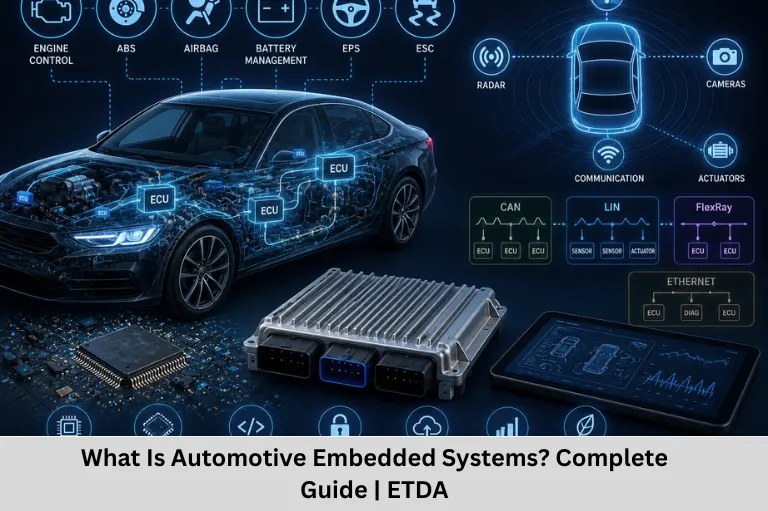
Learn automotive embedded systems, ECU architecture, CAN, AUTOSAR, sensors, ADAS, applications, and career opportunities with this technical beginner’s guide. Embedded Tech Development Academy (ETDA).
- What Is Automotive Embedded Systems? Complete Guide | ETDA
-
What Is Automotive Embedded Systems? A Complete Guide for Beginners
- What Are Automotive Embedded Systems?
- Automotive ECU Architecture
- Microcontrollers in Automotive Embedded Systems
- Role of Embedded C in Automotive Systems
- Automotive Communication Protocols
- Sensors and Actuators in Automotive Systems
- AUTOSAR in Automotive Software
- Automotive Embedded Systems and RTOS
- Functional Safety in Automotive Embedded Systems
- ADAS and Automotive Embedded Systems
- Applications of Automotive Embedded Systems
- Automotive Embedded Software Development Process
- Skills Required for an Automotive Embedded Engineer
- Learn Automotive Embedded Systems at ETDA
-
Assured Placement Support at ETDA
- Placement Preparation
- FAQs
- What are automotive embedded systems?
- What programming language is commonly used in automotive embedded systems?
- What is an ECU?
- Why is CAN important in automotive systems?
- What is AUTOSAR?
- What skills are required for an automotive embedded engineer?
- What is the role of an RTOS in automotive embedded systems?
- Are automotive embedded systems used in electric vehicles?
- Does ETDA provide placement support?
- Why choose ETDA for automotive embedded training?
- Conclusion
What Is Automotive Embedded Systems? A Complete Guide for Beginners
Automotive embedded systems are specialized computer systems designed to perform dedicated functions inside vehicles. Modern cars contain numerous electronic control units (ECUs) that monitor sensors, process information, communicate with other controllers, and control components such as engines, brakes, airbags, lighting, transmission systems, and infotainment.
Unlike general-purpose computers, automotive embedded systems are designed for specific tasks and must satisfy strict requirements for real-time performance, reliability, safety, security, and resource efficiency.
For engineering students planning a career in automotive electronics or firmware development, understanding microcontrollers, Embedded C, communication protocols, sensors, ECUs, RTOS, and automotive software architecture is essential. Students searching for a Top Embedded Training Institute in Bangalore can build these skills through practical, industry-oriented training at Embedded Tech Development Academy (ETDA), which also provides assured placement support.
What Are Automotive Embedded Systems?
An automotive embedded system is a combination of hardware and software integrated into a vehicle to perform a specific function.
A typical automotive embedded system consists of:
- Microcontroller or processor
- Memory
- Sensors
- Actuators
- Communication interfaces
- Embedded software
- Power-management circuitry
For example, an Electronic Control Unit responsible for engine management receives information from sensors such as engine temperature, throttle position, oxygen concentration, and crankshaft position. The ECU processes this information and generates appropriate control signals for actuators.
Why Automotive Embedded Systems Are Important
Modern vehicles depend heavily on electronics for performance, safety, comfort, and connectivity.
Major Functions
Automotive embedded systems are responsible for:
- Engine control
- Transmission control
- Braking
- Airbag deployment
- Vehicle lighting
- Steering assistance
- Climate control
- Instrument clusters
- Infotainment
- Parking assistance
- Driver assistance
- Battery management
Real-Time Operation
Many automotive functions have strict timing requirements. An airbag controller, for example, cannot respond after an arbitrary delay. Safety-critical systems need predictable and timely responses.
This makes real-time embedded programming an important area of automotive software development.
Automotive ECU Architecture
An Electronic Control Unit (ECU) is one of the fundamental building blocks of automotive embedded systems.
An ECU typically contains:
- Microcontroller
- Flash memory
- RAM
- Communication interfaces
- Input/output interfaces
- Power-management circuits
- Software and diagnostics
How an ECU Works
A simplified ECU operation can be represented as:
Sensor → Signal Conditioning → ADC → Microcontroller → Software Processing → Actuator
For example, a temperature sensor may generate an analog voltage. The ECU’s ADC converts this signal into a digital value. Software then processes the value and determines whether an actuator needs to be controlled.
Microcontrollers in Automotive Embedded Systems
Microcontrollers are widely used in automotive ECUs because they integrate processing, memory, timers, communication peripherals, ADCs, and GPIO interfaces.
Important Microcontroller Features
Automotive microcontrollers commonly provide:
- CPU core
- Flash memory
- SRAM
- ADC
- PWM
- Timers
- Watchdog timer
- GPIO
- UART
- SPI
- I2C
- CAN
- LIN interfaces
Automotive Requirements
Automotive microcontrollers must often support features related to:
- Fault detection
- Watchdog operation
- Diagnostic mechanisms
- Functional safety
- Reliable communication
- Deterministic execution
Role of Embedded C in Automotive Systems
Embedded C is one of the most important programming skills for automotive firmware engineers.
C provides efficient control over memory and hardware resources while allowing developers to create portable firmware.
Common Embedded C Applications
Automotive developers use C for:
- GPIO control
- Register configuration
- Interrupt handling
- Timer programming
- ADC processing
- Communication drivers
- Diagnostic software
- ECU application logic
Important C Concepts
An automotive embedded engineer should understand:
- Pointers
- Structures
- Arrays
- Functions
- Bitwise operators
- Memory management
- Interrupts
- Function pointers
- Volatile variables
- Fixed-width integer types
Why volatile Matters
The volatile keyword tells the compiler that a variable may change unexpectedly outside the normal program flow.
It can be relevant when working with:
- Hardware registers
- Interrupt-shared variables
- Memory-mapped peripherals
Correct use of volatile is important when writing low-level firmware.
Automotive Communication Protocols
Different ECUs need to exchange information reliably. Automotive communication protocols provide standardized mechanisms for this communication.
CAN Protocol
Controller Area Network (CAN) is one of the most important communication protocols in automotive systems.
CAN allows multiple ECUs to communicate over a shared bus without requiring a dedicated connection between every controller.
CAN Characteristics
- Multi-node communication
- Message-based communication
- Arbitration mechanism
- Error detection
- Robust communication
- Priority-based message handling
CAN is commonly used for engine control, transmission, braking, body electronics, and diagnostic communication.
LIN Protocol
Local Interconnect Network (LIN) is a lower-cost communication protocol commonly used for simpler automotive applications.
Examples
LIN can be used for:
- Window controls
- Seat controls
- Mirror controls
- Wiper systems
- Interior lighting
It is generally used where CAN’s capabilities are unnecessary.
Automotive Ethernet
Automotive Ethernet is increasingly important as vehicles require higher bandwidth for advanced applications.
Applications
It can support:
- Cameras
- Infotainment
- ADAS
- Diagnostics
- High-speed data communication
- Vehicle networking
Sensors and Actuators in Automotive Systems
Sensors provide information about the vehicle’s physical state, while actuators perform actions based on ECU commands.
Common Automotive Sensors
- Temperature sensors
- Pressure sensors
- Oxygen sensors
- Wheel-speed sensors
- Position sensors
- Accelerometers
- Gyroscopes
- Radar sensors
- Camera systems
Common Automotive Actuators
- Fuel injectors
- Motors
- Solenoids
- Relays
- Valves
- Braking actuators
- Lighting systems
The ECU continuously processes sensor data and controls actuators according to software logic.
AUTOSAR in Automotive Software
AUTOSAR (AUTomotive Open System ARchitecture) is an important software architecture framework used in automotive development.
It aims to establish standardized software architecture and interfaces for automotive electronic systems.
Major AUTOSAR Concepts
- Application Layer
- Runtime Environment (RTE)
- Basic Software (BSW)
- Microcontroller Abstraction Layer (MCAL)
Why AUTOSAR Matters
AUTOSAR helps improve software modularity, portability, scalability, and reuse across automotive projects.
Engineers working toward automotive embedded careers can benefit from understanding AUTOSAR concepts alongside C, microcontrollers, RTOS, and communication protocols.
Automotive Embedded Systems and RTOS
Some automotive applications require multiple tasks to execute with predictable timing.
An RTOS (Real-Time Operating System) can provide scheduling and synchronization mechanisms.
Common RTOS Concepts
- Tasks
- Scheduling
- Semaphores
- Mutexes
- Queues
- Timers
- Interrupts
- Inter-task communication
An RTOS can help organize complex software where multiple activities must execute concurrently.
Functional Safety in Automotive Embedded Systems
Automotive systems can include safety-critical functions. A software or hardware failure in these systems can have serious consequences.
ISO 26262 is an important international standard addressing functional safety for road vehicles.
Safety-Oriented Development
Automotive development can involve:
- Hazard analysis
- Risk assessment
- Safety requirements
- Fault detection
- Diagnostics
- Verification
- Validation
- Safety mechanisms
Watchdog Timer
A watchdog timer can monitor software execution and reset or recover a system if expected software activity does not occur within a defined period.
This is one example of a hardware-assisted reliability mechanism.
ADAS and Automotive Embedded Systems
Advanced Driver Assistance Systems (ADAS) use embedded computing, sensors, software, and communication technologies to assist drivers.
Common ADAS Functions
- Adaptive cruise control
- Lane departure warning
- Automatic emergency braking
- Parking assistance
- Blind-spot monitoring
- Collision detection
Embedded Technology Behind ADAS
ADAS can involve:
- Cameras
- Radar
- Ultrasonic sensors
- High-performance processors
- Automotive Ethernet
- Real-time software
- Sensor-fusion algorithms
These systems demonstrate how automotive embedded development is evolving from simple ECU control toward sophisticated software-defined vehicle architectures.
Applications of Automotive Embedded Systems
Automotive embedded technology is used throughout modern vehicles.
Powertrain Systems
Powertrain ECUs control functions associated with:
- Engine
- Transmission
- Fuel systems
- Electric motors
- Battery systems
Body Electronics
Body control systems manage:
- Central locking
- Windows
- Mirrors
- Lighting
- Wipers
- Seats
Safety Systems
Embedded controllers support:
- Airbags
- ABS
- Electronic stability control
- Traction control
- Collision detection
Electric Vehicles
EVs depend heavily on embedded systems for:
- Battery Management Systems
- Motor control
- Charging systems
- Thermal management
- Energy monitoring
Automotive Embedded Software Development Process
Automotive software development follows structured engineering processes.
Typical Development Flow
- Requirement analysis
- System architecture
- Software design
- Coding
- Unit testing
- Integration testing
- Hardware-in-the-loop testing
- Validation
- Deployment
Debugging and Testing
Automotive developers may use debuggers, oscilloscopes, logic analyzers, CAN tools, simulation environments, and automated testing frameworks to identify software and hardware problems.
Skills Required for an Automotive Embedded Engineer
Essential Technical Skills
- C Programming
- Embedded C
- C++
- Data Structures
- Microcontrollers
- ARM architecture
- CAN
- LIN
- SPI
- I2C
- RTOS
- AUTOSAR fundamentals
- Debugging
- Version control
- Automotive testing
Learn Automotive Embedded Systems at ETDA
Embedded Tech Development Academy (ETDA) provides industry-oriented embedded training designed to help engineering students and graduates develop practical skills.
Technical Training
Students can build knowledge in:
- C Programming
- Embedded C
- C++
- Data Structures
- ARM Cortex-M
- STM32
- RTOS
- Communication protocols
- CAN
- Automotive embedded concepts
- Internet of Things (IoT)
- Embedded Linux
Practical Project Experience
Project-based learning helps students understand how software interacts with actual microcontrollers, sensors, communication interfaces, and other hardware components.
Assured Placement Support at ETDA
Technical knowledge should be combined with career preparation. Embedded Tech Development Academy (ETDA) provides assured placement support to help students prepare for opportunities in embedded and automotive technology.
Placement Preparation
- Resume development
- Aptitude preparation
- Technical interview preparation
- Coding practice
- Mock interviews
- HR interview preparation
- Communication skills
- Career mentoring
This approach helps learners prepare for both technical assessments and professional interviews.
FAQs
What are automotive embedded systems?
Automotive embedded systems are dedicated hardware and software systems integrated into vehicles to perform functions such as engine control, braking, safety, communication, infotainment, and battery management.
What programming language is commonly used in automotive embedded systems?
C and Embedded C are widely used for automotive firmware because they provide efficient execution, predictable resource usage, and low-level hardware access. C++ is also used in many modern automotive software applications.
What is an ECU?
ECU, or Electronic Control Unit, is an embedded computer that performs a specific function within a vehicle. It typically contains a microcontroller, memory, communication interfaces, software, and input/output peripherals.
Why is CAN important in automotive systems?
CAN provides reliable multi-node communication between ECUs and is widely used for exchanging control and diagnostic information throughout vehicles.
What is AUTOSAR?
AUTOSAR is an automotive software architecture framework designed to standardize software components and interfaces, improving modularity, scalability, and software reuse.
What skills are required for an automotive embedded engineer?
Important skills include C, Embedded C, C++, microcontrollers, data structures, CAN, LIN, RTOS, debugging, AUTOSAR fundamentals, sensors, and automotive testing concepts.
What is the role of an RTOS in automotive embedded systems?
An RTOS provides mechanisms for scheduling tasks and managing timing, synchronization, and communication in systems where predictable response times are important.
Are automotive embedded systems used in electric vehicles?
Yes. EVs depend extensively on embedded systems for battery management, motor control, charging, thermal management, safety, and vehicle communication.
Does ETDA provide placement support?
Yes. Embedded Tech Development Academy (ETDA) provides assured placement support, including resume preparation, aptitude training, technical interview preparation, mock interviews, HR interview guidance, and career mentoring.
Why choose ETDA for automotive embedded training?
ETDA combines C, Embedded C, microcontrollers, communication protocols, RTOS, practical projects, and automotive embedded concepts with assured placement support, helping engineering students develop industry-relevant skills for embedded technology careers.
Conclusion
Automotive embedded systems are at the heart of modern vehicles. From engine control and braking to ADAS, infotainment, electric vehicles, and battery management, embedded controllers allow vehicles to sense their environment, process information, communicate with other systems, and control physical components.
To build a career in this field, engineers need more than basic programming knowledge. Strong skills in C, Embedded C, microcontrollers, CAN, LIN, RTOS, AUTOSAR, debugging, sensors, and automotive software architecture provide a solid technical foundation.
For students searching for a Top Embedded Training Institute in Bangalore, Embedded Tech Development Academy (ETDA) provides practical and industry-oriented training focused on embedded technologies and real-time project development. With assured placement support, technical interview preparation, hands-on learning, and career guidance, Embedded Tech Development Academy (ETDA) helps aspiring engineers prepare for opportunities in embedded and automotive software development.
Author: ETDA Trainers
Experience: 10+ Years of Industry Experience in Embedded Systems, IoT, and Embedded C Programming