
What Is a Microcontroller? Complete Guide for Beginners | ETDA
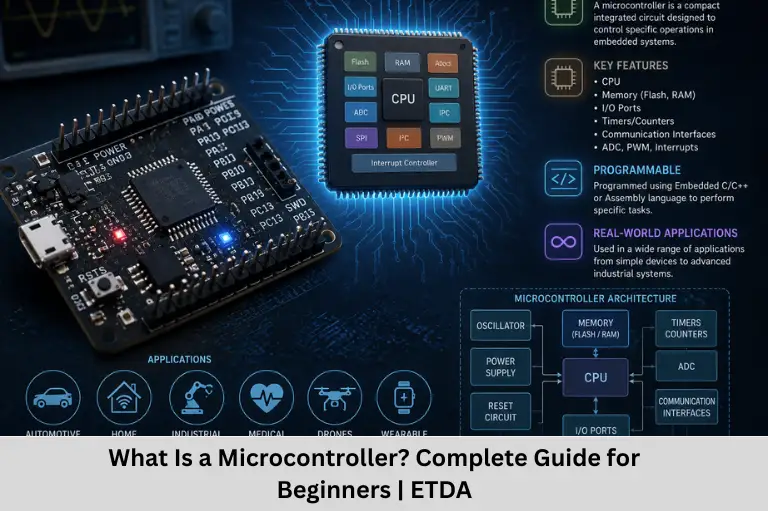
Learn what a microcontroller is, its architecture, memory, GPIO, timers, ADC, PWM, communication protocols, applications, and programming with this guide. Embedded Tech Development Academy (ETDA).
- What Is a Microcontroller? Complete Guide for Beginners | ETDA
-
What Is a Microcontroller? A Complete Guide for Beginners
- What Is a Microcontroller?
- Microcontroller Architecture
- Types of Microcontrollers
- Microcontroller Memory
- GPIO and Digital I/O
- Timers and Counters
- ADC and Analog Interfaces
- PWM in Microcontrollers
- Communication Protocols in Microcontrollers
- Interrupts in Microcontrollers
- Watchdog Timer
- Microcontroller Programming Using Embedded C
- Microcontroller vs Microprocessor
- Applications of Microcontrollers
- How to Learn Microcontroller Programming
- Learn Microcontroller Programming at ETDA
-
Assured Placement Support at ETDA
- Placement Preparation
- FAQs
- What is a microcontroller?
- What are the main components of a microcontroller?
- What is the difference between a microcontroller and a microprocessor?
- Which programming language is commonly used for microcontrollers?
- What is GPIO in a microcontroller?
- Why are interrupts used in microcontrollers?
- What is ADC in a microcontroller?
- What communication protocols should an embedded engineer learn?
- Does ETDA provide placement support?
- Why choose ETDA for microcontroller training?
- Conclusion
What Is a Microcontroller? A Complete Guide for Beginners
A microcontroller is a compact integrated circuit designed to control specific functions in an electronic or embedded system. It typically contains a processor core, memory, input/output peripherals, timers, communication interfaces, and other hardware blocks on a single chip.
Microcontrollers are present in products such as washing machines, automotive control units, medical devices, smart meters, industrial controllers, security systems, robots, Internet of Things (IoT) devices, and consumer electronics.
For engineering students interested in embedded development, learning how a microcontroller works is one of the most important steps toward understanding hardware-software interaction. Students searching for a Top Embedded Training Institute in Bangalore can build practical skills in microcontrollers, Embedded C, ARM architecture, communication protocols, and real-time systems through Embedded Tech Development Academy (ETDA), which also provides assured placement support.
What Is a Microcontroller?
A microcontroller, often abbreviated as MCU, is a programmable semiconductor device designed to perform dedicated control tasks.
Unlike a traditional desktop processor that generally requires external memory and peripheral controllers, a microcontroller integrates many essential components into a single chip.
A simplified microcontroller contains:
CPU Core + Flash + RAM + GPIO + Timers + Communication Peripherals + Analog Peripheral
Main Components of a Microcontroller
1. Processor Core
The processor executes instructions stored in program memory.
It performs operations such as:
- Arithmetic calculations
- Logical operations
- Data movement
- Branching
- Peripheral control
2. Flash Memory
Flash is non-volatile memory used to store firmware.
The program remains stored even when the device is powered off.
3. RAM
RAM stores temporary information during program execution.
It may contain:
- Variables
- Buffers
- Stack
- Runtime data
4. GPIO
GPIO stands for General Purpose Input/Output. GPIO pins allow the microcontroller to communicate with external digital devices.
Microcontroller Architecture
Microcontroller architecture describes how the processor, memory, buses, and peripherals work together.
CPU and Memory
The CPU fetches instructions from program memory, decodes them, and executes them.
A simplified instruction cycle is:
Fetch → Decode → Execute
Memory Organization
A typical microcontroller has several memory regions:
- Program memory
- Data memory
- Peripheral address space
- Non-volatile configuration memory in some architectures
Memory-Mapped Peripherals
Many modern microcontrollers use memory-mapped I/O. Peripheral registers are assigned addresses within the processor’s address space.
Software can configure hardware by reading from or writing to these registers.
This concept is fundamental to register-level embedded programming.
Types of Microcontrollers
Based on Word Size
Common categories include:
- 8-bit microcontrollers
- 16-bit microcontrollers
- 32-bit microcontrollers
8-Bit Microcontrollers
8-bit MCUs are useful for relatively simple control applications where low cost and low resource requirements are important.
16-Bit Microcontrollers
16-bit devices provide greater processing capability than many 8-bit devices and can be useful for control and measurement applications.
32-Bit Microcontrollers
32-bit microcontrollers provide higher processing performance and are widely used in modern embedded products.
Examples include ARM Cortex-M based devices such as:
- STM32
- LPC1768
- NXP Kinetis
- TI Tiva devices
Why 32-Bit MCUs Are Popular
32-bit MCUs can provide:
- Higher processing performance
- Larger address spaces
- Advanced peripherals
- Better support for complex firmware
- Efficient handling of 32-bit data
Microcontroller Memory
Memory plays a major role in embedded system design.
Flash Memory
Flash stores firmware and other persistent information.
It is non-volatile, meaning its contents remain after power is removed.
Typical Uses
Flash may contain:
- Boot code
- Application firmware
- Constant data
- Configuration information
SRAM
SRAM is volatile memory used during program execution.
SRAM Stores
- Variables
- Arrays
- Buffers
- Stack
- Runtime data
Stack and Heap
The stack is typically used for function calls, local variables, and return information.
Depending on the system and runtime environment, dynamic memory allocation may use a heap.
In resource-constrained embedded systems, developers often carefully manage memory usage.
GPIO and Digital I/O
GPIO is one of the most basic and important microcontroller peripherals.
GPIO Output
A GPIO configured as an output can control:
- LEDs
- Relays
- Buzzers
- Digital control lines
For example, firmware can set a GPIO register to produce a HIGH or LOW logic level.
GPIO Input
An input pin can read signals from:
- Push buttons
- Switches
- Digital sensors
- External controllers
Pull-Up and Pull-Down Resistors
GPIO inputs may use pull-up or pull-down configurations to prevent floating input states.
GPIO Interrupts
A GPIO pin can often generate an interrupt when its signal changes.
This allows the processor to respond to an external event without continuously polling the pin.
Timers and Counters
Timers are hardware peripherals used for precise timing operations.
Common Timer Applications
- Delays
- Periodic interrupts
- Event counting
- Pulse measurement
- Frequency measurement
- PWM generation
Timer Interrupts
A timer can generate an interrupt after a configured period. The CPU can then execute an interrupt service routine.
This technique is useful for periodic tasks in real-time embedded systems.
ADC and Analog Interfaces
Real-world signals are often analog, while microcontrollers generally process digital values.
An ADC (Analog-to-Digital Converter) bridges this gap.
How ADC Works
A sensor may produce an analog voltage. The ADC samples the voltage and converts it into a digital representation.
The firmware can then process the resulting value.
ADC Applications
ADC is commonly used for:
- Temperature measurement
- Light sensing
- Battery monitoring
- Pressure measurement
- Potentiometers
- Current sensing
ADC Resolution
ADC resolution determines how finely an analog input range can be represented.
For an ideal N-bit ADC, the number of possible digital levels is:
2ᴺ
For example, a 12-bit ADC provides:
2¹² = 4096 levels
PWM in Microcontrollers
PWM Applications
PWM is commonly used for:
- Motor speed control
- LED brightness control
- Servo control
- Power regulation
- Actuator control
Duty Cycle
The duty cycle represents the percentage of a PWM period during which the signal remains active.
For example, a 25% duty cycle means the signal is active for approximately one-quarter of the period.
Communication Protocols in Microcontrollers
Modern embedded systems rarely operate alone. Microcontrollers communicate with sensors, displays, memory devices, other controllers, and network interfaces.
UART
UART is commonly used for asynchronous serial communication.
Applications include:
- Debugging
- GPS modules
- Bluetooth modules
- GSM modules
- Serial terminals
SPI
SPI is a synchronous serial protocol commonly used for relatively high-speed communication with peripherals.
Applications include:
- Displays
- Flash memory
- Sensors
- ADC/DAC devices
I2C
I2C generally uses two signal lines:
- SDA — Serial Data
- SCL — Serial Clock
It is commonly used for sensors, EEPROMs, RTCs, and other peripheral ICs.
CAN
CAN (Controller Area Network) is widely used in automotive and industrial applications.
It provides robust multi-node communication and includes mechanisms for arbitration and error detection.
Interrupts in Microcontrollers
An interrupt allows hardware or software events to request processor attention.
How Interrupts Work
A typical sequence is:
Event → Interrupt Request → CPU Saves Context → ISR Executes → Return to Program
Common Interrupt Sources
- Timers
- UART
- GPIO
- ADC
- SPI
- I2C
- CAN
- External hardware
Interrupt Service Routine
The function executed in response to an interrupt is commonly called an Interrupt Service Routine (ISR).
ISRs should generally be designed to execute efficiently because long-running interrupt handlers can delay other system activities.
Watchdog Timer
A watchdog timer is a hardware safety mechanism that can reset the microcontroller if software stops operating as expected.
How It Works
The firmware periodically refreshes or services the watchdog.
If the software fails to do so within the configured timeout period, the watchdog can initiate a reset.
Applications
Watchdogs are useful for systems that must recover from certain software failures, such as:
- Infinite loops
- Firmware hangs
- Unexpected execution failures
Microcontroller Programming Using Embedded C
Embedded C is one of the most widely used programming approaches for microcontroller firmware.
Important Embedded C Concepts
A microcontroller programmer should understand:
- Variables
- Data types
- Pointers
- Arrays
- Structures
- Functions
- Bitwise operators
- Preprocessor directives
- Volatile variables
- Interrupt handling
- Register manipulation
Bitwise Operations
Bitwise operations are especially important because individual bits in control registers are often used to enable or configure hardware features.
For example:
This sets bit 3 of register_value.
Volatile Keyword
The volatile keyword tells the compiler that a variable’s value can change unexpectedly.
It is commonly relevant when working with:
- Hardware registers
- Interrupt-shared variables
- Memory-mapped I/O
Microcontroller vs Microprocessor
Microcontrollers and microprocessors are both processing devices, but their typical architectures and applications differ.
| Feature | Microcontroller | Microprocessor |
|---|---|---|
| Integration | CPU, memory, and peripherals are often integrated | Primarily contains the processing core/system |
| Application | Designed for dedicated control applications | Used for general-purpose and high-performance computing |
| Power Consumption | Usually lower | Often higher |
| External Components | Fewer external components are required | More external components are often needed |
| Real-Time Control | Well suited for real-time control | Depends on the overall system |
| Examples | STM32, LPC1768 | Intel Core, AMD Ryzen, ARM Cortex-A-series |
Choosing Between Them
A microcontroller is generally appropriate when an application requires dedicated control, low power, deterministic behavior, and integrated peripherals.
A microprocessor-based system is more appropriate when an application requires a powerful operating environment, high computing performance, or complex graphical and networking capabilities.
Applications of Microcontrollers
Microcontrollers are used in almost every area of modern electronics.
Consumer Electronics
Applications include:
- Washing machines
- Microwave ovens
- Remote controls
- Smart appliances
- Security systems
Automotive Electronics
Microcontrollers are used in:
- Engine control
- Body control
- Instrument clusters
- Airbag systems
- Battery management
- Motor control
Industrial Automation
They control:
- Motors
- Sensors
- Actuators
- Industrial machines
- Monitoring systems
IoT Devices
Microcontrollers are widely used in:
- Smart sensors
- Wearables
- Home automation
- Environmental monitoring
- Connected devices
Medical Electronics
They can be found in:
- Patient monitoring devices
- Portable medical instruments
- Measurement equipment
- Diagnostic systems
How to Learn Microcontroller Programming
A structured approach makes microcontroller learning easier.
Step 1: Learn C Programming
Start with:
- Variables
- Data types
- Operators
- Functions
- Arrays
- Pointers
- Structures
Step 2: Learn Digital Electronics
Understand:
- Logic gates
- Digital signals
- Binary numbers
- Registers
- Pull-up/pull-down concepts
Step 3: Learn Microcontroller Architecture
Study:
- CPU
- Memory
- Bus architecture
- GPIO
- Timers
- Interrupts
Step 4: Learn Communication Protocols
Progress through:
- UART
- SPI
- I2C
- CAN
- Ethernet
Step 5: Build Projects
Practical projects can include:
- LED control
- Button interface
- Digital thermometer
- UART terminal
- LCD interface
- Motor control
- Sensor monitoring
- CAN communication
Step 6: Learn RTOS
After understanding bare-metal programming, learning an RTOS can introduce:
- Tasks
- Scheduling
- Queues
- Semaphores
- Mutexes
- Inter-task communication
Learn Microcontroller Programming at ETDA
Embedded Tech Development Academy (ETDA) provides practical training designed around embedded systems and microcontroller development.
Technical Skills Covered
Students can develop skills in:
- C Programming
- Embedded C
- C++
- Data Structures
- ARM Cortex-M
- LPC1768
- STM32
- GPIO
- Timers
- ADC
- PWM
- UART
- SPI
- I2C
- CAN
- Ethernet
- RTOS
- Embedded Linux
- Internet of Things (IoT)
Hands-On Embedded Projects
Practical hardware projects allow students to understand how software interacts with registers, peripherals, sensors, communication interfaces, and external devices.
Assured Placement Support at ETDA
Learning technical concepts is important, but engineering students also need to prepare for recruitment.
Embedded Tech Development Academy (ETDA) provides assured placement support to help learners prepare for embedded engineering opportunities.
Placement Preparation
Support can include:
- Resume preparation
- Technical interview preparation
- C and Embedded C practice
- Aptitude training
- Coding assessments
- Mock interviews
- HR interview preparation
- Communication skills
- Career guidance
This combination of hands-on technical training and placement preparation helps students become more industry-ready.
FAQs
What is a microcontroller?
A microcontroller is a programmable integrated circuit that combines a processor, memory, and peripherals such as GPIO, timers, communication interfaces, and analog components for dedicated embedded applications.
What are the main components of a microcontroller?
The major components include a CPU core, Flash memory, RAM, GPIO, timers, interrupt controller, communication peripherals, and application-specific peripherals such as ADC, DAC, and PWM.
What is the difference between a microcontroller and a microprocessor?
A microcontroller typically integrates the CPU, memory, and peripherals on one chip for dedicated control applications. A microprocessor generally focuses on processing and often requires additional external components for memory and peripherals.
Which programming language is commonly used for microcontrollers?
C and Embedded C are widely used for microcontroller programming because they provide efficient hardware access and good control over memory and processor resources. C++ is also used for many modern embedded applications.
What is GPIO in a microcontroller?
GPIO stands for General Purpose Input/Output. GPIO pins allow a microcontroller to read digital inputs or generate digital outputs for interacting with external hardware.
Why are interrupts used in microcontrollers?
Interrupts allow the processor to respond to hardware or software events without continuously polling for them. They are commonly used for timers, communication peripherals, GPIO events, and sensor inputs.
What is ADC in a microcontroller?
ADC, or Analog-to-Digital Converter, converts an analog electrical signal into a digital value that the microcontroller can process.
What communication protocols should an embedded engineer learn?
Important protocols include UART, SPI, I2C, CAN, and Ethernet. The appropriate protocol depends on the application’s speed, distance, number of devices, and reliability requirements.
Does ETDA provide placement support?
Yes. Embedded Tech Development Academy (ETDA) provides assured placement support, including technical interview preparation, resume guidance, coding practice, aptitude training, mock interviews, and career mentoring.
Why choose ETDA for microcontroller training?
Embedded Tech Development Academy (ETDA) combines C and Embedded C programming with ARM Cortex-M, STM32, LPC1768, GPIO, timers, ADC, PWM, communication protocols, RTOS, and practical embedded projects. Its assured placement support also helps engineering students prepare for embedded technology careers.
Conclusion
A microcontroller is a compact computing device that combines processing, memory, and peripherals to control dedicated functions in embedded systems. Understanding its architecture and peripherals is essential for anyone planning a career in embedded software or firmware development.
From GPIO and timers to ADC, PWM, interrupts, UART, SPI, I2C, and CAN, microcontrollers provide the hardware interfaces required to interact with the physical world. Programming them using Embedded C also develops an engineer’s understanding of registers, memory, pointers, bit manipulation, and real-time hardware control.
For engineering students searching for a Top Embedded Training Institute in Bangalore, Embedded Tech Development Academy (ETDA) offers practical embedded systems training covering C, Embedded C, ARM microcontrollers, STM32, LPC1768, communication protocols, RTOS, and real-world projects. Embedded Tech Development Academy (ETDA) also provides assured placement support, helping students strengthen their technical and interview skills for careers in the embedded technology industry.
Author: ETDA Trainers
Experience: 10+ Years of Industry Experience in Embedded Systems, IoT, and Embedded C Programming