
Embedded Systems Course for Beginners: Complete Learning Guide | ETDA
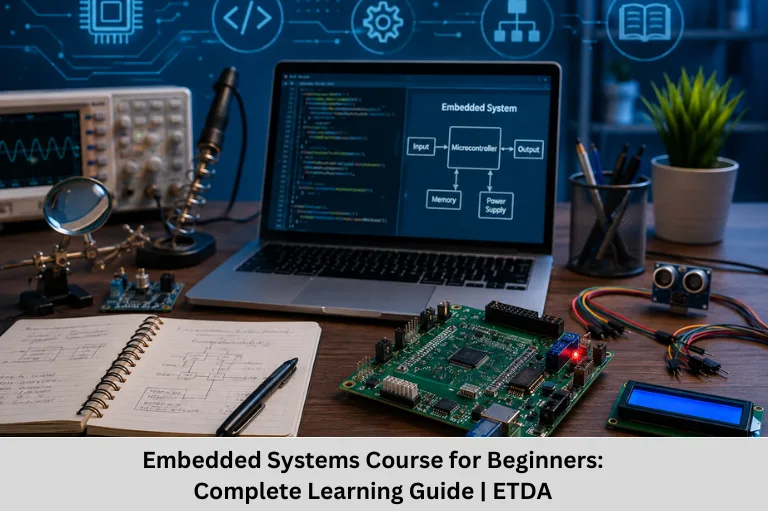
Learn embedded systems from scratch with this beginner-friendly guide covering Embedded C, microcontrollers, communication protocols, RTOS, projects, and career skills. Embedded Tech Development Academy (ETDA).
- Embedded Systems Course for Beginners: Complete Learning Guide | ETDA
-
Embedded Systems Course for Beginners: Complete Guide
- What Are Embedded Systems?
- Why Learn Embedded Systems as a Beginner?
- What Does an Embedded Systems Course for Beginners Cover?
- Microcontrollers and Embedded Hardware
- GPIO, Timers, PWM and ADC
- Embedded Communication Protocols
- Interrupts in Embedded Systems
- RTOS in Embedded Systems
- Embedded Linux for Beginners
- Embedded Systems Projects for Beginners
- How to Choose an Embedded Systems Training Institute
- Why Choose Embedded Tech Development Academy (ETDA)?
-
Career Opportunities After Learning Embedded Systems
- Embedded Software Engineer
- Firmware Engineer
- Device Driver Developer
- FAQs
- What is an embedded systems course for beginners?
- Is C programming necessary for learning embedded systems?
- What should I learn first in embedded systems?
- Which communication protocols should an embedded beginner learn?
- Can a beginner learn embedded systems without electronics knowledge?
- Are projects important in embedded systems training?
- What career options are available after embedded systems training?
- Does ETDA provide placement support?
- Why choose ETDA for embedded systems training?
- Conclusion
Embedded Systems Course for Beginners: Complete Guide
Embedded systems are at the heart of modern electronic products, from smart appliances and automotive controllers to medical devices, industrial machines, Internet of Things (IoT) products, and consumer electronics. For beginners, learning embedded systems can seem challenging because it combines programming, electronics, microcontrollers, communication protocols, operating systems, and hardware debugging.
A well-structured embedded systems course for beginners helps learners understand these concepts progressively instead of trying to learn everything at once. For students looking for a Top Embedded Training Institute in Bangalore, Embedded Tech Development Academy (ETDA) provides practical training focused on embedded programming, microcontrollers, communication protocols, real-time systems, and project development, along with assured placement support.
This guide explains what beginners should learn, which technologies matter, how practical training works, and how to build a strong foundation for an embedded systems career.
What Are Embedded Systems?
An embedded system is a computer-based system designed to perform a specific function within a larger electronic or mechanical product.
Unlike general-purpose computers, embedded systems are usually designed around particular application requirements such as:
- Real-time response
- Low power consumption
- Limited memory
- Hardware control
- Reliability
- Deterministic operation
- Compact size
Examples include:
- Automotive control units
- Washing machine controllers
- Smart meters
- Medical monitoring equipment
- Industrial controllers
- Internet of Things (IoT) devices
- Security systems
- Robotics
- Consumer electronics
Basic Embedded System Architecture
A typical embedded system contains several important components:
Input → Processing → Output
The input may come from sensors, switches, or communication interfaces. A microcontroller or processor processes the information, and the output may control motors, displays, relays, actuators, or communication modules.
Hardware Layer
The hardware layer can include:
- Microcontroller
- Processor
- Memory
- Sensors
- Actuators
- Timers
- Communication peripherals
- Power supply
Software Layer
The software layer generally includes:
- Boot code
- Device drivers
- Embedded C/C++
- Middleware
- RTOS
- Application firmware
Understanding how hardware and software interact is one of the most important objectives of beginner-level embedded training.
Why Learn Embedded Systems as a Beginner?
Embedded systems provide a strong career path for engineering students interested in both software and hardware.
Combination of Hardware and Software
Embedded systems are increasingly used in:
- Electric vehicles
- Advanced automotive systems
- Industrial automation
- Robotics
- Smart appliances
- Internet of Things (IoT)
- Consumer electronics
- Healthcare devices
What Does an Embedded Systems Course for Beginners Cover?
A good beginner course should start with programming fundamentals and gradually introduce microcontrollers and advanced embedded technologies.
C Programming Fundamentals
C programming is one of the most important foundations for embedded development.
Beginners should understand:
- Variables
- Data types
- Operators
- Conditional statements
- Loops
- Functions
- Arrays
- Strings
- Pointers
- Structures
- Unions
- Enumerations
- Storage classes
- Preprocessor directives
- Dynamic and static memory concepts
Why C Is Important
C provides low-level control while maintaining a relatively simple programming model.
For example, bitwise operations are frequently used to configure microcontroller registers.
This type of operation can set a particular bit in a hardware register.
Embedded C Concepts
After learning standard C, beginners should understand embedded-specific concepts such as:
volatile- Memory-mapped registers
- Bit manipulation
- Interrupt service routines
- Fixed-width integer types
- Peripheral registers
- Hardware abstraction
Microcontrollers and Embedded Hardware
After C programming, the next major step is understanding microcontrollers.
What Is a Microcontroller?
A microcontroller is an integrated circuit containing a processor core, memory, and peripherals required for controlling embedded applications.
A typical microcontroller may include:
- CPU core
- Flash memory
- SRAM
- GPIO
- Timers
- PWM
- ADC
- UART
- SPI
- I2C
- CAN
- Interrupt controller
ARM Cortex-M Microcontrollers
ARM Cortex-M processors are widely used in embedded applications.
Beginners may encounter families such as:
- Cortex-M0/M0+
- Cortex-M3
- Cortex-M4
- Cortex-M7
Register-Level Understanding
A beginner should eventually understand how firmware interacts with hardware registers.
For example, configuring a GPIO pin may involve:
- Enabling the peripheral clock.
- Selecting the pin mode.
- Configuring direction.
- Writing or reading the GPIO register.
This knowledge is essential for understanding what happens underneath high-level driver libraries.
GPIO, Timers, PWM and ADC
Microcontroller peripherals form the foundation of embedded programming.
GPIO
GPIO allows firmware to control or read digital signals.
Typical applications include:
- LED control
- Button input
- Relay control
- Digital sensor interfaces
Timers
Timers generate accurate time intervals and support functions such as:
- Delays
- Periodic interrupts
- Event counting
- Input capture
- Output compare
PWM
Pulse Width Modulation is commonly used for:
- Motor control
- LED brightness
- Servo control
- Power regulation
ADC
An Analog-to-Digital Converter converts an analog voltage into a digital representation.
ADC is useful when interfacing with:
- Temperature sensors
- Light sensors
- Potentiometers
- Pressure sensors
- Battery monitoring circuits
Why These Peripherals Matter
Understanding GPIO, timers, PWM, and ADC helps beginners move from simple programming exercises to actual hardware-control applications.
Embedded Communication Protocols
Communication protocols are an essential part of an embedded systems course.
UART
UART provides asynchronous serial communication and is frequently used for:
- Debugging
- GPS modules
- Bluetooth modules
- Serial terminals
SPI
SPI is a synchronous protocol commonly used for:
- Displays
- Flash memory
- Sensors
- ADCs and DACs
I2C
I2C uses SDA and SCL lines and supports multiple addressed devices on a shared bus.
It is commonly used with:
- Sensors
- EEPROMs
- RTCs
- Displays
CAN
CAN is widely used in automotive and industrial applications.
It provides robust multi-node communication and is particularly important for automotive embedded systems.
Ethernet
Embedded Ethernet enables devices to communicate over wired networks and is used in:
- Industrial equipment
- Internet of Things (IoT) gateways
- Networked controllers
- Automotive systems
- Embedded servers
Interrupts in Embedded Systems
Interrupts allow hardware or software events to temporarily interrupt normal program execution.
How Interrupts Work
A simplified sequence is:
Event → Interrupt Request → CPU → ISR → Return to Main Program
For example, when a timer reaches a specific count, it can generate an interrupt.
Interrupt Service Routine
An ISR should generally be:
- Short
- Efficient
- Predictable
Long-running operations inside an ISR can negatively affect system responsiveness.
Interrupt Applications
Interrupts are commonly used for:
- UART reception
- Timer events
- GPIO events
- ADC completion
- Communication peripherals
- Fault handling
RTOS in Embedded Systems
After learning bare-metal programming, beginners can progress to Real-Time Operating Systems (RTOS).
What Is an RTOS?
An RTOS provides mechanisms for managing multiple tasks while meeting timing requirements.
Common concepts include:
- Tasks
- Scheduling
- Priorities
- Semaphores
- Mutexes
- Queues
- Event groups
- Software timers
Why Learn RTOS?
RTOS knowledge becomes valuable when embedded applications become too complex for a simple super-loop architecture.
Example RTOS Architecture
A system might contain:
- Sensor Task
- Communication Task
- Display Task
- Data Processing Task
The scheduler determines when these tasks execute according to the system’s configuration.
Embedded Linux for Beginners
Embedded Linux is another important area for learners who want to work on more powerful embedded platforms.
What Is Embedded Linux?
Embedded Linux uses the Linux kernel and supporting software components in dedicated embedded products.
It can be used in:
- Industrial gateways
- Smart cameras
- Automotive systems
- Networking equipment
- Internet of Things (IoT) gateways
Topics to Learn
Beginners progressing toward Embedded Linux should understand:
- Linux commands
- Shell scripting
- Processes
- Threads
- File systems
- Device drivers
- Cross-compilation
- Boot process
Embedded Linux vs Bare Metal
Bare-metal systems generally run firmware directly on the microcontroller without a conventional operating system.
Embedded Linux is used on more capable processors where multitasking, networking, file systems, and complex software stacks are required.
Embedded Systems Projects for Beginners
Projects are essential for converting theoretical knowledge into practical skills.
Beginner Projects
Good starting projects include:
- LED controller
- Digital thermometer
- Traffic light controller
- UART terminal
- Digital clock
- Temperature monitoring system
Intermediate Projects
After gaining confidence, learners can build:
- SPI-based display controller
- I2C sensor monitoring system
- EEPROM data logger
- CAN communication project
- Motor speed controller
Advanced Projects
Advanced learners can explore:
- RTOS-based monitoring system
- Internet of Things (IoT) gateway
- Embedded Linux application
- Automotive communication system
- Industrial automation controller
What Projects Teach
Projects help students understand:
- Hardware-software integration
- Debugging
- Driver development
- Communication protocols
- Timing
- Memory management
- System architecture
How to Choose an Embedded Systems Training Institute
Choosing the right training program can significantly affect the learning experience.
Look for Practical Training
A useful course should include actual microcontroller programming and hardware-based experiments rather than only theoretical lectures.
Check the Technical Curriculum
The curriculum should ideally cover:
- C
- Embedded C
- Microcontrollers
- ARM
- Communication protocols
- RTOS
- Debugging
- Projects
Consider Placement Support
Students should also evaluate whether the institute provides interview preparation, resume support, technical assessments, and career guidance.
For students looking for a Top Embedded Training Institute in Bangalore, Embedded Tech Development Academy (ETDA) focuses on practical embedded systems education combined with assured placement support.
Why Choose Embedded Tech Development Academy (ETDA)?
Embedded Tech Development Academy (ETDA) focuses on developing practical embedded engineering skills through structured technical training.
Technical Learning
Students can learn areas such as:
- C Programming
- Embedded C
- C++
- Data Structures
- ARM Cortex-M
- STM32
- LPC1768
- GPIO
- Timers
- ADC
- PWM
- UART
- SPI
- I2C
- CAN
- Ethernet
- RTOS
- Embedded Linux
- Internet of Things (IoT)
Hands-On Approach
The learning process can include practical exercises and projects where students work with microcontrollers, peripherals, communication interfaces, and firmware.
Assured Placement Support
Embedded Tech Development Academy (ETDA) also provides assured placement support, helping students prepare for the transition from training to employment through:
- Technical interview preparation
- Embedded C coding practice
- Resume preparation
- Mock interviews
- Aptitude preparation
- HR interview preparation
- Career guidance
Career Opportunities After Learning Embedded Systems
An embedded systems course can prepare beginners for several technical career paths.
Embedded Software Engineer
Embedded software engineers develop firmware that controls microcontrollers and embedded devices.
Firmware Engineer
Firmware engineers work closely with hardware and develop low-level software for electronic products.
Device Driver Developer
Device driver developers create software interfaces between operating systems and hardware peripherals.
Automotive Embedded Engineer
Automotive engineers work on electronic control units, vehicle communication, diagnostics, and automotive software.
IoT Embedded Developer
Internet of Things (IoT) developers combine embedded systems with networking, sensors, cloud connectivity, and data communication.
FAQs
What is an embedded systems course for beginners?
An embedded systems course for beginners introduces programming, electronics, microcontrollers, Embedded C, communication protocols, peripherals, debugging, and project development in a structured manner.
Is C programming necessary for learning embedded systems?
Yes. C is one of the most important programming languages for embedded development because it provides efficient control over memory, registers, and hardware resources.
What should I learn first in embedded systems?
Beginners should start with C programming and basic digital electronics, followed by Embedded C, microcontrollers, GPIO, timers, interrupts, and communication protocols.
Which communication protocols should an embedded beginner learn?
A strong beginner foundation should include UART, SPI, I2C, and CAN. Ethernet can be learned as learners progress toward networked embedded applications.
Can a beginner learn embedded systems without electronics knowledge?
Yes, but basic electronics knowledge makes embedded development much easier. Beginners should understand concepts such as voltage, current, digital signals, logic levels, resistors, and basic circuits.
Are projects important in embedded systems training?
Yes. Projects help learners understand how programming, microcontrollers, peripherals, communication protocols, and hardware interact in real applications.
What career options are available after embedded systems training?
Career options include Embedded Software Engineer, Firmware Engineer, Embedded Developer, Device Driver Developer, Automotive Embedded Engineer, and IoT Embedded Developer.
Does ETDA provide placement support?
Yes. Embedded Tech Development Academy (ETDA) provides assured placement support, including technical interview preparation, resume guidance, coding practice, mock interviews, aptitude preparation, and career guidance.
Why choose ETDA for embedded systems training?
Embedded Tech Development Academy (ETDA) focuses on practical technical learning covering C, Embedded C, ARM microcontrollers, communication protocols, RTOS, Embedded Linux, IoT, and embedded projects, making it a suitable option for learners looking for a Top Embedded Training Institute in Bangalore.
Conclusion
Learning embedded systems requires a combination of C programming, electronics, microcontrollers, communication protocols, interrupts, debugging, RTOS concepts, and practical project development. Beginners should follow a structured learning path rather than attempting advanced technologies immediately.
Start with C programming and digital electronics, move into Embedded C and microcontrollers, then learn GPIO, timers, ADC, PWM, UART, SPI, I2C, and CAN. After developing strong fundamentals, progress toward RTOS, Embedded Linux, Internet of Things (IoT), and advanced embedded projects.
For students searching for a Top Embedded Training Institute in Bangalore, Embedded Tech Development Academy (ETDA) offers practical embedded systems training designed around technical skills and real-world development. Its curriculum covers Embedded C, ARM microcontrollers, communication protocols, RTOS, Embedded Linux, and project development, supported by assured placement support.
Choosing the right embedded systems course for beginners can provide the technical foundation needed to move from engineering fundamentals toward a professional career in firmware, embedded software, automotive electronics, Internet of Things (IoT), and other embedded technology domains.
Author: ETDA Trainers
Experience: 10+ Years of Industry Experience in Embedded Systems, IoT, and Embedded C Programming