
Embedded Firmware Design and Development Guide | ETDA
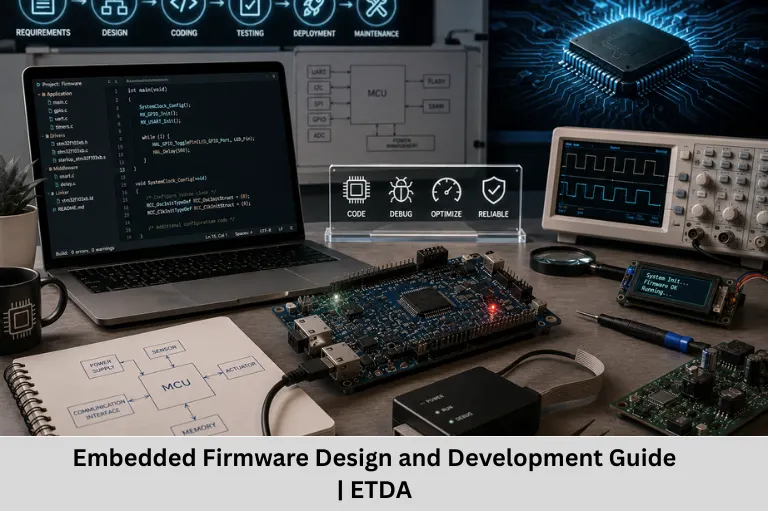
Learn embedded firmware design and development, Embedded C, super loop, RTOS, firmware architecture, development process, and career opportunities.
- Embedded Firmware Design and Development Guide | ETDA
-
Embedded Firmware Design and Development
- Introduction to Embedded Firmware
- Embedded Firmware Design and Development
- Embedded Firmware Design Approaches
- Embedded Operating System Based Firmware
- Embedded Firmware Development Process
- Role of Embedded C in Firmware Development
- Practical Applications of Embedded Firmware
- Embedded Firmware Debugging and Reliability
- Career Opportunities in Embedded Firmware Development
- Conclusion
Embedded Firmware Design and Development
Introduction to Embedded Firmware
Embedded systems are found in automobiles, medical equipment, industrial machines, consumer electronics, Internet of Things (IoT) devices, communication equipment, and many other products. Although the hardware provides the physical computing platform, embedded firmware gives the system its intelligence and controls how that hardware behaves.
Embedded firmware consists of the program instructions and configuration settings stored in the program memory of an embedded device. It connects the application requirements with the microcontroller, processor, memory, peripherals, sensors, and actuators. Whenever a device reads a sensor, controls a motor, communicates through UART, responds to a button, or performs a specific control algorithm, firmware is generally responsible for coordinating that operation.
For students and engineers entering embedded systems, understanding embedded firmware development, Embedded C programming, microcontroller programming, firmware architecture, device drivers, hardware interfacing, real-time systems, and debugging is essential. These concepts form the foundation for developing reliable embedded products.
Embedded Tech Development Academy (ETDA) focuses on practical embedded-system learning that helps students understand both hardware and software development. Learners looking for a Top Embedded Training Institute in Bangalore can benefit from a project-oriented approach that connects programming concepts with real microcontroller-based applications.
What Is Embedded Firmware?
Embedded firmware is the software programmed into an embedded system to control its hardware and perform its assigned functions.
It can include:
- Control algorithms
- Hardware configuration settings
- Peripheral-control routines
- Device drivers
- Communication protocols
- Sensor and actuator control
- Application-level logic
- System initialization code
Unlike general-purpose application software, embedded firmware is developed with specific hardware and functional requirements in mind.
Why Is Embedded Firmware Important?
Firmware is often described as the master brain of an embedded system because it provides the intelligence required for the hardware to perform its intended task.
For example, firmware can instruct a microcontroller to:
- Read temperature from a sensor.
- Process the sensor value.
- Compare it with a predefined threshold.
- Turn a cooling fan ON or OFF.
- Display the temperature.
- Send the information to another device.
Without appropriate firmware, the hardware may not perform its intended function.
Common Languages Used for Firmware Development
Embedded firmware can be developed using different programming approaches depending on the processor, controller, application, and system requirements.
Common choices include:
- Embedded C
- Embedded C++
- Assembly language
- A combination of C/C++ and assembly
Embedded C is particularly important because it provides a practical balance between low-level hardware control and readable, maintainable software.
Embedded Firmware Design and Development
Embedded firmware is responsible for controlling the peripherals of embedded hardware and generating responses according to product requirements.
A firmware developer therefore needs knowledge of both hardware and software.
Important areas include:
- Microcontroller architecture
- Memory organization
- Register configuration
- GPIO programming
- Timers and counters
- Interrupts
- UART, SPI, and I2C
- ADC and DAC
- Sensor interfacing
- Actuator control
- Communication protocols
- Debugging techniques
- Real-time programming
Firmware development begins by understanding what the product is expected to do and converting those requirements into a suitable software architecture.
Hardware Knowledge Required for Firmware Development
A firmware developer should understand the hardware on which the software will execute.
This includes:
- Component interfacing
- Memory map
- I/O ports
- Peripheral registers
- Clock configuration
- Interrupt structure
- Processor/controller instruction set
- Communication interfaces
- Sensor and actuator connections
For example, when developing firmware for an ARM Cortex-M microcontroller, the developer may need to configure GPIO registers, timers, UART peripherals, interrupt controllers, and memory-mapped registers directly or through a hardware abstraction layer.
Firmware Development Using an IDE
Modern firmware development is commonly performed using an Integrated Development Environment (IDE).
A typical embedded IDE may provide:
- Source-code editor
- Compiler
- Linker
- Debugger
- Simulator or debugging utilities
- Project management
- Build tools
- Flash programming support
The exact IDE depends on the target microcontroller or processor and the development environment being used.
Assembly Language and High-Level Programming
Firmware can be developed using assembly language based on the instruction set supported by the target processor.
However, modern embedded projects commonly use C or C++ for most application code because these languages provide better portability and maintainability while still allowing low-level hardware access.
Assembly may still be useful when developers need precise control over processor instructions or highly optimized routines.
Embedded Firmware Design Approaches
The firmware design approach depends on the complexity of the product, number of tasks, timing requirements, memory availability, and required response time.
Two fundamental approaches are:
- Super-loop based firmware
- Embedded operating system or RTOS-based firmware
Super-Loop Based Firmware Approach
A super loop is a straightforward firmware architecture in which tasks are executed sequentially inside an infinite loop.
It is suitable for relatively simple systems where:
- The number of tasks is limited.
- Timing requirements are manageable.
- Missing a deadline is acceptable.
- An operating system is unnecessary.
- Memory resources are limited.
The basic execution sequence is:
Initialization → Task 1 → Task 2 → Task 3 → Task N → Repeat
Typical Super-Loop Execution
A typical super-loop firmware application performs the following steps:
- Configure common system parameters.
- Initialize hardware peripherals.
- Execute the first task.
- Execute the second task.
- Continue through the remaining tasks.
- Return to the first task.
- Repeat continuously.
A simplified structure is:
The actual implementation depends on the application’s hardware and timing requirements.
Advantages of the Super-Loop Approach
The major benefits include:
- Simple architecture
- Easy implementation
- No operating-system overhead
- Small memory footprint
- Suitable for simple embedded applications
- Straightforward debugging
Limitations of the Super-Loop Approach
The approach also has limitations.
As the number and complexity of tasks increase:
- Task execution frequency can decrease.
- Response time can become unpredictable.
- A blocking task can delay other tasks.
- Managing multiple priorities becomes difficult.
- Meeting strict real-time deadlines becomes harder.
A watchdog timer can help detect certain software execution failures, but it does not replace proper real-time task management.
Embedded Operating System Based Firmware
For complex embedded products, an embedded operating system or Real-Time Operating System (RTOS) can provide a more structured method of managing multiple tasks.
An RTOS can provide mechanisms for:
- Task scheduling
- Task priorities
- Inter-task communication
- Synchronization
- Timers
- Resource management
- Interrupt handling
When Is an RTOS Required?
An RTOS becomes useful when an embedded product contains several concurrent or time-sensitive tasks.
For example, an embedded device may need to:
- Read multiple sensors.
- Process data.
- Communicate through UART.
- Handle network traffic.
- Update a display.
- Monitor system faults.
Trying to manage all these operations through a simple sequential loop can become difficult as system complexity increases.
Super Loop vs RTOS
| Feature | Super Loop | RTOS-Based Firmware |
|---|---|---|
| Architecture | Simple | Structured |
| Task Scheduling | Sequential | Scheduler-based |
| Memory Requirement | Lower | Higher |
| Complexity | Low | Moderate to High |
| Multiple Priorities | Difficult | Supported |
| Real-Time Task Management | Limited | Better suited |
| Suitable Applications | Simple Systems | Complex Systems |
Choosing the Right Approach
There is no single firmware architecture that is appropriate for every embedded product.
The selection should consider:
- Number of tasks
- Timing constraints
- CPU performance
- Available RAM and Flash
- Safety requirements
- Communication requirements
- Product complexity
- Maintenance requirements
A small sensor controller may work efficiently with a super loop, while a complex industrial controller or connected embedded product may benefit from an RTOS.
Embedded Firmware Development Process
A reliable firmware project normally begins with requirements and progresses through design, implementation, testing, and maintenance.
Requirement Analysis
Developers first identify:
- Functional requirements
- Hardware requirements
- Timing requirements
- Communication requirements
- Memory limitations
- Power requirements
- Safety and reliability requirements
Firmware Architecture
The requirements are converted into a software architecture.
The architecture may contain:
- Hardware abstraction
- Device drivers
- Middleware
- Communication modules
- Application logic
- Error-handling mechanisms
Coding, Debugging, and Testing
After architecture design, developers implement the firmware and test it on the target hardware.
Typical activities include:
- Writing Embedded C/C++ code
- Compiling and linking
- Flashing the target device
- Debugging with breakpoints
- Monitoring registers
- Testing peripheral interfaces
- Checking timing behavior
- Validating system responses
Firmware development is therefore not simply a coding activity. It involves continuous interaction between hardware, software, testing, and debugging.
Role of Embedded C in Firmware Development
Embedded C is widely associated with microcontroller firmware because it provides access to low-level hardware features while retaining the advantages of a structured programming language.
Developers can use C to work with:
- Pointers
- Structures
- Bit manipulation
- Memory addresses
- Registers
- Interrupt routines
- Peripheral drivers
Register-Level Programming
Microcontrollers expose many hardware peripherals through registers.
Firmware can configure these registers to control:
- GPIO
- Timers
- UART
- SPI
- I2C
- ADC
- Interrupt controllers
Understanding register-level programming helps developers understand what happens underneath high-level libraries and hardware abstraction layers.
Practical Applications of Embedded Firmware
Embedded firmware is used across a wide range of industries.
Automotive
Firmware controls:
- Engine systems
- Body electronics
- Braking systems
- Airbag controllers
- Battery management
- ADAS components
Industrial Automation
Firmware can operate:
- Motor controllers
- PLC-related devices
- Industrial sensors
- Robotics
- Monitoring systems
Consumer and IoT Products
Embedded firmware is also found in:
- Smart appliances
- Wearables
- Smart home devices
- Security systems
- Internet of Things (IoT) sensors
- Connected controllers
These applications demonstrate why practical embedded firmware programming and microcontroller development skills are valuable for engineers.
Embedded Firmware Debugging and Reliability
Firmware must not only work during normal operation; it should also respond appropriately when something goes wrong.
Developers commonly investigate:
- Incorrect sensor readings
- Communication failures
- Unexpected resets
- Timing problems
- Memory issues
- Peripheral configuration errors
- Task execution failures
Watchdog Timer
A watchdog timer can monitor whether software continues to execute correctly. If the firmware fails to refresh the watchdog within the expected time, the system can reset.
Defensive Firmware Design
Reliable firmware can include:
- Input validation
- Error detection
- Timeout mechanisms
- Fault handling
- Recovery procedures
- Watchdog monitoring
Why Testing Matters
Testing helps identify problems before firmware is deployed into the final product. Developers may perform unit testing, integration testing, hardware testing, and system-level validation depending on the project.
Career Opportunities in Embedded Firmware Development
The growing use of intelligent electronic products creates opportunities for engineers with practical embedded skills.
Potential roles include:
- Embedded Firmware Developer
- Embedded C Developer
- Firmware Engineer
- Microcontroller Developer
- Device Driver Developer
- Embedded Software Engineer
- RTOS Developer
- Embedded Test Engineer
For students aiming to enter this field, practical projects can help connect theoretical knowledge with actual hardware development.
Embedded Tech Development Academy (ETDA) can be positioned as a learning destination for students who want hands-on exposure to embedded C, microcontrollers, firmware development, debugging, and real-world projects. For learners searching for a Top Embedded Training Institute in Bangalore, project-based learning can provide a useful bridge between academic concepts and industry-oriented development.
FAQs
What is embedded firmware?
Embedded firmware is software stored in an embedded device that controls its hardware and performs the functions for which the product is designed.
Why is firmware important in embedded systems?
Firmware provides the intelligence that allows a microcontroller or processor to control peripherals, process inputs, communicate with other devices, and generate the required outputs.
Which programming language is commonly used for embedded firmware?
Embedded C is one of the most widely used languages for microcontroller and firmware development. C++, assembly, and other technologies may also be used depending on the application.
What is a super loop in embedded firmware?
A super loop is a simple firmware architecture in which initialization is performed first and application tasks are repeatedly executed inside an infinite loop.
When should an RTOS be used instead of a super loop?
An RTOS is generally useful when an embedded application has multiple concurrent tasks, priority requirements, synchronization needs, or more demanding real-time scheduling requirements.
Conclusion
Embedded firmware design and development is one of the most important foundations of modern embedded systems. Hardware provides the processor, memory, peripherals, sensors, and interfaces, but firmware determines how those resources work together to perform a specific function.
From simple microcontroller applications using a super-loop architecture to complex products using an RTOS, firmware development requires a combination of programming knowledge, hardware understanding, debugging skills, and system-level thinking. Embedded C, device drivers, register programming, interrupts, communication protocols, real-time programming, and firmware testing all contribute to building dependable embedded products.
As embedded technology continues expanding into automotive systems, industrial automation, Internet of Things (IoT), robotics, consumer electronics, and smart devices, the need for skilled firmware developers is also growing. Learning through practical projects can help engineers understand how software interacts with real hardware rather than relying only on theoretical programming exercises.
Embedded Tech Development Academy (ETDA) can help aspiring engineers develop practical skills in embedded firmware, Embedded C, microcontroller programming, RTOS concepts, hardware interfacing, and project development. For students searching for a Top Embedded Training Institute in Bangalore, developing hands-on firmware skills can be an important step toward building an embedded systems career.
Author: ETDA Trainers
Experience: 10+ Years of Industry Experience in Embedded Systems, IoT, and Embedded C Programming