
Why Every Programmer Should Learn C First | C Programming Guide
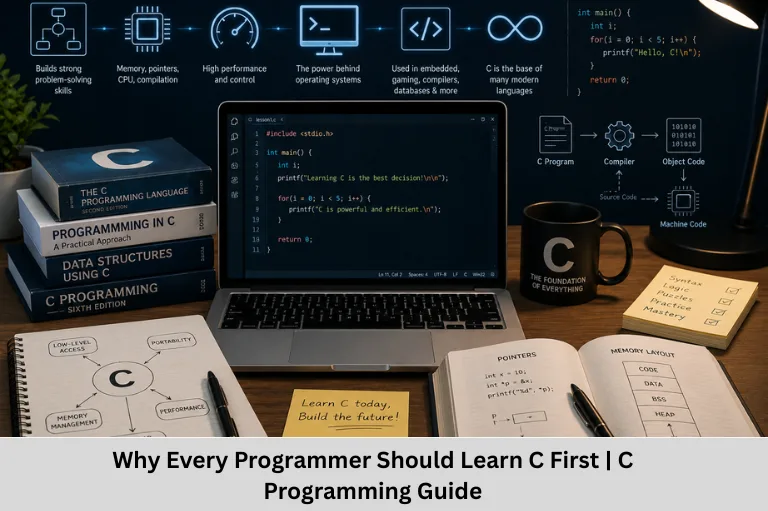
Learn why C programming is an essential first language for programmers. Explore memory, pointers, compilation, systems programming, embedded C, and problem-solving. Embedded Tech Development Academy (ETDA).
- Why Every Programmer Should Learn C First | C Programming Guide
-
Why Every Programmer Should Learn C First: A Technical Foundation for Modern Programming
- Introduction
- 1. C Teaches You How Computers Actually Work
- 2. C Builds a Strong Foundation for Other Programming Languages
- 3. C Develops Efficient Programming Habits
- 4. C Opens the Door to Systems and Embedded Development
- 5. C Develops Strong Problem-Solving Discipline
- 6. C Helps Programmers Understand Modern Languages
- 7. C Is Important for Performance-Critical Software
- 8. C Provides a Strong Foundation for Embedded Career Paths
- 9. A Practical C Learning Roadmap
- Conclusion
Why Every Programmer Should Learn C First: A Technical Foundation for Modern Programming
Introduction
When beginners start learning programming, they are often encouraged to choose languages such as Python, Java, JavaScript, or C++. These languages are excellent for application development, web development, automation, software engineering, and many other domains. However, if the goal is to understand how software interacts with computer hardware, C remains one of the most valuable languages to learn first.
C programming provides direct exposure to fundamental concepts such as memory management, pointers, data types, variables, arrays, functions, stack and heap memory, compilation, linking, data structures, and low-level programming. These concepts form the foundation of operating systems, embedded systems, compilers, device drivers, firmware, networking software, and many performance-critical applications.
For students interested in embedded systems programming, Embedded C, microcontrollers, firmware development, ARM programming, real-time systems, and system-level software, learning C is particularly important. This is one reason Embedded Tech Development Academy (ETDA) emphasizes strong programming fundamentals as part of technical learning. As a Top Embedded Training Institute in Bangalore, Embedded Tech Development Academy (ETDA) focuses on practical programming and hardware-oriented skills, along with assured placement support, helping learners build a foundation applicable to real embedded engineering roles.
Learning C first does not mean avoiding modern programming languages. Instead, it gives programmers a technical foundation that makes learning higher-level languages easier. Understanding what happens beneath an abstraction helps developers write more efficient, predictable, and reliable software.
1. C Teaches You How Computers Actually Work
One of the biggest advantages of learning C is that it exposes programmers to the relationship between software and computer hardware.
High-level languages often hide many implementation details. C allows programmers to understand concepts such as:
- Memory addresses
- Variables and data representation
- Pointers
- Arrays
- Structures
- CPU-oriented operations
- Stack and heap memory
- Function calls
- Compilation and linking
For example:
int value = 10;
int *ptr = &value;
Here, value stores an integer while ptr stores the memory address of value.
The programmer can therefore understand not only what data is stored, but also where that data exists in memory.
Understanding Memory Through C
C introduces programmers to important memory concepts that are fundamental to systems programming.
A typical program uses areas such as:
- Code/text segment
- Read-only data
- Initialized data
- Uninitialized data
- Stack
- Heap
Understanding these areas becomes particularly important when debugging memory leaks, buffer overflows, dangling pointers, stack overflows, and segmentation faults.
Why Pointers Matter
Pointers are one of the most important concepts in C.
They are used extensively in:
- Dynamic memory allocation
- Arrays and strings
- Structures
- Linked lists
- Device drivers
- Memory-mapped peripherals
- Embedded firmware
- Operating-system development
A programmer who understands pointers has a much stronger foundation for understanding memory-oriented programming.
2. C Builds a Strong Foundation for Other Programming Languages
C introduces programming concepts that appear in many other languages.
These include:
- Variables
- Operators
- Conditional statements
- Loops
- Functions
- Arrays
- Structures
- Pointers and references as related concepts
- Data structures
- Compilation
- Linking
- Memory management
Once these fundamentals are understood, moving to C++, Java, C#, Go, Rust, or other languages becomes easier because the programmer already understands many underlying computational concepts.
Compilation and Linking
C is particularly useful for understanding how source code becomes an executable program.
A simplified process is:
C Source Code → Preprocessing → Compilation → Assembly → Object File → Linking → Executable
This teaches programmers the distinction between:
- Source code
- Compiler
- Object files
- Libraries
- Linker
- Executable image
These concepts are highly relevant to system programming, embedded software development, firmware engineering, and build systems.
Understanding Abstraction
Higher-level languages provide abstractions that simplify development. C helps programmers understand what may exist underneath those abstractions.
For example, when a programmer uses a dynamic container, object, function call, or memory allocation mechanism in another language, knowledge of C makes it easier to reason about:
- Memory consumption
- Data representation
- Execution cost
- Allocation behavior
- CPU operations
3. C Develops Efficient Programming Habits
C does not provide the same level of automatic memory management found in garbage-collected languages. This forces programmers to think carefully about resource usage.
For example:
int *buffer = malloc(100 * sizeof(int));

if (buffer != NULL) {
    /* Use buffer */
}

free(buffer);
The programmer is responsible for managing the allocated memory.
This teaches important engineering practices such as:
- Checking allocation failures
- Releasing resources
- Avoiding memory leaks
- Validating array boundaries
- Managing object lifetime
- Understanding memory ownership
Time and Space Efficiency
C encourages programmers to consider time complexity and memory complexity.
For embedded systems, this is particularly important because microcontrollers may have limited:
- RAM
- Flash memory
- CPU performance
- Storage
- Power budget
An inefficient algorithm can therefore affect not only performance but also the feasibility of the entire product.
Resource-Constrained Programming
C is widely suited to environments where hardware resources are limited.
Embedded developers commonly use C to implement:
- GPIO control
- UART communication
- SPI communication
- I2C communication
- ADC interfaces
- PWM generation
- Timers
- Interrupt service routines
- Device drivers
This makes C an important foundation for microcontroller programming and embedded firmware development.
4. C Opens the Door to Systems and Embedded Development
C is particularly valuable for programmers interested in areas where software directly interacts with hardware.
These include:
- Embedded systems
- Firmware development
- Operating systems
- Device drivers
- Networking
- Automotive electronics
- Robotics
- Industrial automation
- Internet of Things (IoT) devices
- Aerospace systems
C in Embedded Systems
Embedded C is essentially C programming applied to embedded hardware with additional consideration for:
- Hardware registers
- Memory maps
- Interrupts
- Timers
- Peripheral configuration
- Real-time constraints
- Limited memory
- Hardware interfaces
For example, a microcontroller GPIO register can be accessed through a memory-mapped address:
#define GPIO_REG (*(volatile unsigned int *)0x40020000)

GPIO_REG |= (1U << 5);
The example demonstrates how software can directly interact with hardware registers.
Why Embedded Engineers Need C
Embedded engineers frequently work with:
- ARM Cortex-M processors
- STM32 microcontrollers
- LPC microcontrollers
- PIC controllers
- AVR devices
- Automotive MCUs
- RTOS-based systems
A strong C foundation makes it easier to understand the relationship between firmware, processor architecture, peripherals, registers, and memory.
This is also why Embedded Tech Development Academy (ETDA) integrates programming fundamentals into embedded-oriented technical training. As a Top Embedded Training Institute in Bangalore, Embedded Tech Development Academy (ETDA) focuses on practical development skills and assured placement support, helping learners connect programming knowledge with embedded engineering applications.
5. C Develops Strong Problem-Solving Discipline
C does not automatically solve many programming problems for you.
The programmer must carefully reason about:
- Data types
- Memory
- Pointers
- Control flow
- Function interfaces
- Error handling
- Resource management
This develops a disciplined approach to debugging.
Debugging Memory Problems
C programmers commonly encounter problems such as:
- Segmentation faults
- Buffer overflows
- Use-after-free
- Double-free errors
- Null-pointer dereferencing
- Uninitialized variables
- Memory leaks
- Stack overflow
Although these errors can be difficult, learning to diagnose them develops strong debugging skills.
Understanding Undefined Behavior
C also teaches an important technical lesson: code that compiles successfully is not necessarily correct.
For example:
int arr[5];

arr[10] = 100;
The program may compile, but accessing memory outside the array boundary produces undefined behavior.
This teaches developers to distinguish between:
Compilation correctness ≠ Runtime correctness
That distinction is fundamental to professional software engineering.
6. C Helps Programmers Understand Modern Languages
Learning C first does not mean that programmers must use C for every application.
Instead, C provides a useful foundation for understanding abstraction.
From Low-Level Concepts to High-Level Abstractions
After learning C, programmers can better understand concepts such as:
- Automatic memory management
- Objects
- References
- Exceptions
- Garbage collection
- Containers
- Runtime environments
- Virtual machines
- Type systems
For example, learning manual memory allocation in C makes automatic memory management in other languages easier to appreciate.
Similarly, understanding arrays and pointers makes it easier to reason about how data structures are represented internally.
7. C Is Important for Performance-Critical Software
Performance-sensitive applications often require careful control over computation and memory.
C remains relevant in areas such as:
- Operating-system components
- Embedded firmware
- Networking software
- Real-time applications
- Database engines
- Compilers
- Device drivers
- Hardware abstraction layers
Deterministic Resource Usage
In real-time systems, predictable execution is often more important than simply achieving high average performance.
A developer may need to consider:
- CPU cycles
- Interrupt latency
- Memory allocation
- Stack usage
- Execution deadlines
- Peripheral response time
These considerations are central to real-time embedded systems.
C and Real-Time Programming
For embedded applications, developers often combine C with an RTOS such as FreeRTOS or another real-time operating system.
C code may implement:
- Tasks
- Interrupt handlers
- Drivers
- Synchronization mechanisms
- Queues
- Timers
- Hardware abstraction layers
Therefore, learning C provides a practical starting point for understanding real-time software architecture.
8. C Provides a Strong Foundation for Embedded Career Paths
Students who learn C thoroughly can progress toward several technical domains.
Possible Career Areas
C knowledge can support careers in:
- Embedded Software Development
- Firmware Development
- Device Driver Development
- Automotive Embedded systems
- Internet of Things (IoT) Development
- Robotics
- Industrial Automation
- Operating-System Development
- Semiconductor Software
- Real-Time Systems
Skills to Learn After C
A structured learning path can be:
C Programming → Data Structures → Embedded C → Microcontrollers → ARM Architecture → Communication Protocols → RTOS → Projects
Students can then move into specialized areas such as:
- STM32 development
- ARM Cortex-M programming
- Automotive embedded systems
- AUTOSAR
- Embedded Linux
- Internet of Things (IoT)
- Robotics
- Embedded networking
Practical Learning Matters
Learning syntax alone is not enough. A technically strong programmer should write programs, debug them, inspect memory, analyze compiler output, and build hardware-oriented projects where applicable.
Training environments such as Embedded Tech Development Academy (ETDA) can help learners connect C programming concepts with embedded hardware and practical development. Embedded Tech Development Academy (ETDA), positioned as a Top Embedded Training Institute in Bangalore, also provides assured placement support for learners preparing for embedded engineering career opportunities.
9. A Practical C Learning Roadmap
A beginner should avoid trying to learn every advanced topic simultaneously.
A practical sequence is:
Stage 1 – C Fundamentals
Learn:
- Variables
- Data types
- Operators
if/else- Loops
- Functions
- Arrays
- Strings
Stage 2 – Intermediate C
Then study:
- Pointers
- Structures
- Unions
- Enumerations
- Function pointers
- Storage classes
- Preprocessor directives
- Header files
Stage 3 – System-Level C
Next learn:
- Stack and heap
- Dynamic memory
- Compilation
- Linking
- Static and dynamic libraries
- Memory layout
- Debugging
- Undefined behavior
Stage 4 – Embedded C
Finally move toward:
- Registers
- GPIO
- Interrupts
- Timers
- UART
- SPI
- I2C
- ADC
- PWM
- Watchdog timers
- RTOS concepts
This progression creates a strong foundation for professional embedded development.
FAQs
Why should I learn C before Python or Java?
C provides a deeper understanding of memory, data representation, pointers, compilation, and system-level execution. These concepts can make higher-level languages easier to understand later.
Is C difficult for beginners?
C can initially be challenging because it exposes concepts such as pointers and manual memory management. However, learning these concepts systematically provides strong programming fundamentals.
Is C still relevant for embedded systems?
Yes. C remains highly important for firmware, microcontroller programming, device drivers, real-time applications, and hardware-oriented software.
What should I learn after C?
A strong next step is data structures and algorithms, followed by Embedded C, microcontrollers, ARM architecture, communication protocols, RTOS concepts, and practical projects if your goal is embedded development.
Can learning C help me learn C++?
Yes. C and C++ share many fundamental concepts and syntax elements. A solid C foundation can make it easier to understand C++ programming concepts, although C++ introduces its own object-oriented and generic programming models.
Conclusion
Learning C first is not about choosing an old programming language over newer technologies. It is about developing a technical understanding of how software executes, how memory is organized, how data moves through a program, and how software communicates with hardware.
C teaches programmers to think about memory allocation, pointers, data structures, algorithms, compilation, linking, CPU resources, execution efficiency, and system-level programming. These concepts are especially valuable for embedded systems, firmware development, operating systems, device drivers, automotive software, robotics, Internet of Things (IoT), and real-time applications.
For learners planning an embedded career, this foundation becomes even more important. Embedded Tech Development Academy (ETDA) emphasizes practical C and Embedded C skills as part of its technical learning approach. As a Top Embedded Training Institute in Bangalore, Embedded Tech Development Academy (ETDA) helps learners connect programming fundamentals with microcontrollers, ARM processors, embedded firmware, communication protocols, and real-world projects, while also offering assured placement support.
The objective should not simply be to memorize C syntax. A strong programmer should understand why a program behaves a certain way, where data is stored, how memory is accessed, how the compiler transforms source code, and how hardware resources affect software behavior.
That is the real advantage of learning C first.
C → Memory → Hardware → Systems → Embedded Programming → Advanced Software Engineering
For anyone serious about understanding computers at a deeper technical level, C remains an excellent starting point. With a strong foundation from Embedded Tech Development Academy (ETDA), learners can progress from basic C programming toward professional embedded development. As a Top Embedded Training Institute in Bangalore, Embedded Tech Development Academy (ETDA) combines technical training with assured placement support, making structured learning and practical skill development an important part of the journey toward an embedded engineering career.
Author: ETDA Trainers
Experience: 10+ Years of Industry Experience in Embedded Systems, IoT, and Embedded C Programming