
Why C Is Still Used in Kernels and Embedded Systems | ETDA
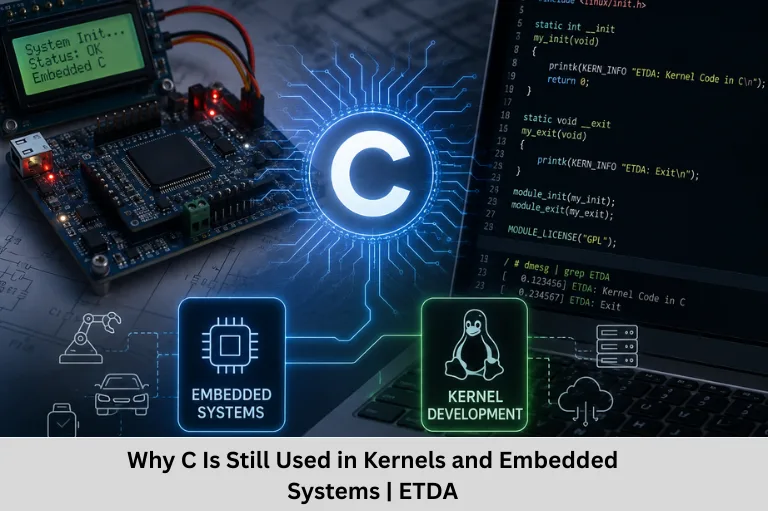
Learn why C remains essential for kernels, firmware, device drivers, and embedded systems through hardware control, performance, portability, and low-level programming. Embedded Tech Development Academy (ETDA).
- Why C Is Still Used in Kernels and Embedded Systems | ETDA
-
Why C Is Still Used in Kernels and Embedded Systems
- Introduction
- 1. C Provides Precise Hardware-Level Control
- 2. C Provides Predictable Resource Management
- 3. C Has a Minimal System-Level Programming Model
- 4. C Can Produce Compact Firmware
- 5. C Matches the Hardware Engineer's Mental Model
- 6. C Is Fundamental to Kernel Development
- 7. C Provides a Balance Between Assembly and High-Level Languages
- 8. Mature C Toolchains Support Embedded Development
- 9. C Works Well With Embedded Debugging Tools
- 10. C Is Embedded in a Huge Existing Software Ecosystem
- 11. C Supports Embedded Operating Systems and RTOS Development
- 12. C Is Important for Interrupt and Peripheral Programming
- 13. C Is Important for Communication Protocols
- 14. C Is Powerful but Requires Engineering Discipline
- 15. C vs Assembly for Embedded Systems
- 16. C vs Modern Systems Programming Languages
- 17. Why C Remains Relevant to Embedded Engineers
- 18. The Actual Reason C Continues to Be Used
- Conclusion
Why C Is Still Used in Kernels and Embedded Systems
Introduction
Every few years, programmers predict that C programming will disappear because newer languages offer stronger memory safety, easier syntax, automatic memory management, and modern development features. Yet when engineers examine the software running inside operating systems, microcontrollers, automotive ECUs, networking equipment, industrial controllers, medical devices, and other hardware-oriented products, C remains deeply relevant.
The reason is not simply tradition or legacy code. C is particularly well suited to system-level programming, where developers need direct access to memory, hardware registers, interrupts, peripheral interfaces, processor instructions, and tightly controlled resources.
In an embedded system, the software may need to initialize a microcontroller immediately after reset, configure clocks, access GPIO registers, handle UART communication, service an interrupt, control a timer, or communicate with a sensor. There may be no large operating environment available underneath the firmware. Memory and processing resources can also be highly constrained.
C provides a practical abstraction between assembly language and higher-level programming languages. It allows developers to write structured, maintainable software while still working with pointers, addresses, bitwise operations, memory-mapped peripherals, and hardware registers.
This is why concepts such as embedded C programming, bare-metal programming, firmware development, memory management, device drivers, microcontroller programming, RTOS programming, kernel development, interrupt handling, and hardware-software interfacing remain strongly connected to C.
For students preparing for embedded careers, understanding these fundamentals is especially important. Embedded Tech Development Academy (ETDA) focuses on technical embedded systems learning that connects programming concepts with microcontrollers, peripherals, debugging, and real-world development practices. Learners looking for a Top Embedded Training Institute in Bangalore can benefit from a curriculum that treats C not merely as a programming language, but as a foundation for understanding how software interacts with hardware, supported by assured placement support.
1. C Provides Precise Hardware-Level Control
At the kernel and embedded level, software frequently needs to communicate directly with hardware.
Hardware Resources Controlled Using C
An embedded developer may need to:
- Configure peripheral registers
- Read sensor values
- Set or clear GPIO bits
- Configure timers
- Enable interrupts
- Access memory-mapped peripherals
- Configure DMA
- Control communication interfaces
- Manage processor-specific resources
C provides pointers, structures, bitwise operators, and volatile variables that make this type of programming practical.
Memory-Mapped I/O in C
Many microcontrollers expose peripheral registers at fixed memory addresses.
Example of Memory-Mapped GPIO Access
#define GPIOA_ODR (*(volatile unsigned int *)0x40020014)

int main(void)
{
    GPIOA_ODR |= (1U << 5);

    while (1)
    {
    }
}
Here, a pointer is used to access a specific hardware register.
The volatile keyword is important when accessing hardware registers because their values can change independently of normal program execution.
Why Hardware Access Matters
A high-level application may simply call:
set_led(1);At the embedded level, the developer may need to understand:
CPU
 ↓
System Bus
 ↓
Peripheral Register
 ↓
GPIO Hardware
 ↓
Output Pin
 ↓
External Circuit
C allows developers to work close to this hardware while retaining structured programming concepts.
2. C Provides Predictable Resource Management
Embedded systems and kernels often operate under strict resource constraints.
Typical Embedded Resources
A microcontroller may have:
- Limited Flash
- Limited SRAM
- Limited CPU performance
- Limited power budget
- Limited communication bandwidth
Therefore, developers need to understand how software consumes these resources.
Static Memory Allocation
For example:
uint8_t buffer[128];The programmer knows that the buffer contains 128 bytes of storage.
Dynamic Memory Allocation
C also supports dynamic allocation:
char *buffer = malloc(128);However, dynamic memory introduces additional concerns:
- Memory fragmentation
- Allocation failure
- Memory leaks
- Lifetime management
- Non-deterministic behavior
Because of these issues, many embedded systems use static allocation or controlled memory pools where appropriate.
Deterministic Execution
C does not automatically guarantee deterministic execution. Actual execution time depends on factors such as:
- Processor architecture
- Compiler optimization
- Interrupts
- Memory wait states
- Caches
- Branch behavior
However, C enables developers to design systems where resource usage and execution behavior can be analyzed and controlled.
Applications Requiring Predictable Execution
This is particularly important for:
- Real-time operating systems
- Interrupt service routines
- Motor-control firmware
- Device drivers
- Safety-related systems
- Industrial controllers
3. C Has a Minimal System-Level Programming Model
C does not require a virtual machine or a managed runtime environment to execute a bare-metal application.
Typical Bare-Metal Execution Flow
Startup Code
↓
Reset Handler
↓
Clock Initialization
↓
Peripheral Initialization
↓
main()
↓
Application Firmware
Bare-Metal Programming
In bare-metal development, the processor may begin executing firmware without a general-purpose operating system.
The firmware may need to:
- Configure the stack.
- Initialize memory sections.
- Configure system clocks.
- Initialize peripherals.
- Configure interrupts.
- Start the application.
- Execute the main control loop.
Why C Is Suitable for Bare-Metal Systems
C provides:
- Direct memory access
- Hardware register access
- Bit manipulation
- Function-based organization
- Structured control flow
- Processor-oriented data types
- Low runtime overhead
These characteristics make it useful for microcontroller firmware development.
4. C Can Produce Compact Firmware
For resource-constrained embedded devices, firmware size can be important.
Factors Affecting Firmware Size
The final binary depends on:
- Compiler
- Optimization level
- Processor architecture
- Libraries
- Linker configuration
- Application complexity
- Runtime requirements
Therefore, C should not be described as automatically producing a small binary. Instead, it provides developers with significant control over software overhead.
Embedded Firmware Optimization
Developers may optimize firmware through:
- Efficient algorithms
- Appropriate data types
- Compiler optimization
- Static allocation
- Efficient data structures
- Linker configuration
- Efficient interrupt routines
Optimization Should Be Measurement-Based
Optimization should be based on actual measurements such as:
- CPU utilization
- Flash consumption
- RAM consumption
- Execution time
- Interrupt latency
- Power consumption
This prevents developers from making unnecessary optimizations that reduce readability without producing meaningful performance improvements.
5. C Matches the Hardware Engineer's Mental Model
Hardware is fundamentally represented using:
- Bits
- Bytes
- Registers
- Addresses
- Buses
- Interrupts
- Memory regions
C contains operators that naturally support these concepts.
Bit Manipulation in C
To set a bit:
status |= (1U << ERROR_FLAG);To clear a bit:
status &= ~(1U << BUSY_FLAG);To test a bit:
if (status & (1U << READY_FLAG))
{
    /* Device is ready */
}
Register-Based Programming
Peripheral registers can also be represented using structures.
Example of a UART Register Structure
typedef struct
{
    volatile unsigned int CTRL;
    volatile unsigned int STATUS;
    volatile unsigned int DATA;
} UART_Regs;

#define UART0 ((UART_Regs *)0x40011000U)
A register can then be accessed using:
UART0->CTRL = 0x01U;Where Register-Level Programming Is Used
This programming approach is common in:
- Microcontroller firmware
- Peripheral drivers
- Board-support packages
- Hardware abstraction layers
- Embedded communication drivers
6. C Is Fundamental to Kernel Development
Operating-system kernels require direct control over processor and memory resources.
Responsibilities of Kernel Software
A kernel may need to manage:
- Virtual memory
- Physical memory
- Scheduling
- Interrupts
- Device drivers
- Hardware interfaces
- CPU architecture features
- Synchronization
C is well suited to these tasks because it provides low-level control while supporting structured software development.
Why Kernel Developers Need Low-Level Control
Consider a simplified device-driver flow:
Hardware Event
      ↓
Interrupt
      ↓
CPU Executes ISR
      ↓
Read Hardware Status
      ↓
Process Data
      ↓
Update Kernel State
      ↓
Notify Application
The software needs to interact closely with the processor and hardware.
C and Linux Kernel Development
The Linux kernel is predominantly written in C, with assembly used for architecture-specific low-level functionality.
This demonstrates the practical balance provided by C:
- Hardware control
- Portability
- Structured programming
- Mature compiler support
- Large developer ecosystem
7. C Provides a Balance Between Assembly and High-Level Languages
Assembly language provides extremely direct processor control, but maintaining large software systems entirely in assembly is difficult.
Limitations of Assembly
Assembly is generally:
- Processor-specific
- Verbose
- Difficult to maintain
- Difficult to scale
- Less portable
Advantages of C Over Assembly
C provides:
- Better readability
- Greater portability
- Structured programming
- Easier maintenance
- Easier testing
- Better scalability
Why Not Write Everything in Assembly?
Consider a large embedded project containing:
- Drivers
- Communication protocols
- Application logic
- Diagnostics
- State machines
- Hardware abstraction layers
Writing the complete project in assembly would significantly increase development and maintenance complexity.
Hybrid C and Assembly Development
Some low-level functions may still require assembly for:
- Startup routines
- Context switching
- Special processor instructions
- Architecture-specific operations
- Highly optimized routines
This creates a practical model:
Assembly → Processor-specific low-level operations
C        → System-level firmware and drivers
8. Mature C Toolchains Support Embedded Development
C has decades of compiler and tooling development behind it.
Common Embedded C Toolchains
Examples include:
- GCC
- Clang/LLVM
- Arm GNU Toolchain
- IAR Embedded Workbench
- Keil development tools
- Vendor-specific IDEs
Typical Embedded Build Process
C Source Code
↓
Compiler
↓
Object Files
↓
Linker
↓
ELF / HEX / Binary
↓
Programmer
↓
Microcontroller
Important Embedded Development Concepts
Embedded engineers may need to understand:
- Startup files
- Linker scripts
- Memory sections
- Stack
- Heap
.text.data.bss- Vector tables
- Interrupt handlers
Why Toolchain Knowledge Matters
Learning only C syntax is not enough for professional firmware development. Developers should understand how source code becomes executable firmware and how that firmware is loaded into the target microcontroller.
9. C Works Well With Embedded Debugging Tools
Embedded software failures often require examining the actual processor state.
Common Embedded Debugging Interfaces
Developers may use:
- JTAG
- SWD
- On-chip debugging
- Breakpoints
- Watchpoints
- Logic analyzers
- Oscilloscopes
- Trace systems
Processor Information During Debugging
Engineers may inspect:
Program Counter
Stack Pointer
General-Purpose Registers
Status Registers
Memory
Peripheral Registers
Debugging a Firmware Fault
A typical debugging process may involve:
- Identify the faulting instruction.
- Inspect the program counter.
- Examine the stack frame.
- Check pointer values.
- Inspect memory.
- Check peripheral registers.
- Analyze interrupt context.
This close relationship between source code and processor state is one reason C remains valuable for embedded debugging.
10. C Is Embedded in a Huge Existing Software Ecosystem
Embedded industries contain enormous amounts of existing C software.
Common C-Based Embedded Components
These include:
- Device drivers
- Bootloaders
- Board-support packages
- Communication stacks
- Middleware
- RTOS components
- Firmware libraries
- Hardware abstraction layers
Why Existing Code Matters
Rewriting stable and tested software can introduce:
- New bugs
- Migration costs
- Testing requirements
- Certification challenges
- Integration problems
Therefore, organizations often maintain existing C code while gradually adopting newer technologies where appropriate.
Importance for Embedded Engineers
An embedded engineer may encounter legacy C code while working on:
- Firmware maintenance
- Driver development
- Product migration
- Hardware upgrades
- Bug fixing
- Feature development
Understanding C makes it easier to work with these systems.
11. C Supports Embedded Operating Systems and RTOS Development
C is not limited to bare-metal programming.
Areas Where C Is Used With RTOS-Based Systems
C can be used for:
- RTOS kernels
- Device drivers
- Middleware
- BSPs
- Networking stacks
- File systems
- Embedded applications
Example of an RTOS-Based Application
A conceptual embedded application may contain:
RTOS
 ├── Sensor Task
 ├── Communication Task
 ├── Motor Control Task
 └── Diagnostic Task
Example Embedded Task
void MotorTask(void *argument)
{
    while (1)
    {
        Read_Sensor();
        Calculate_Control();
        Update_PWM();

        osDelay(10);
    }
}
The exact API depends on the RTOS or framework being used.
Why RTOS Knowledge Matters
RTOS concepts become important when embedded applications contain multiple concurrent activities with different timing, priority, synchronization, and communication requirements.
12. C Is Important for Interrupt and Peripheral Programming
Interrupt-driven programming is a fundamental embedded systems concept.
Basic Interrupt Flow
UART Receives Data
↓
UART Interrupt
↓
CPU Enters ISR
↓
Read Data
↓
Store in Buffer
↓
Return From Interrupt
Example Interrupt Handler
void UART_IRQHandler(void)
{
    uint8_t data;

    data = UART_Read();
    buffer_put(data);
}
Characteristics of a Good ISR
An interrupt service routine should generally be:
- Short
- Predictable
- Efficient
- Carefully synchronized
- Free from unnecessary blocking operations
Problems Caused by Poor Interrupt Design
Poor interrupt handling can lead to:
- Missed events
- Race conditions
- Data corruption
- Excessive latency
- Priority problems
These are important concepts in professional embedded firmware development.
13. C Is Important for Communication Protocols
Embedded devices communicate using many hardware and software protocols.
Common Embedded Communication Interfaces
These include:
- UART
- SPI
- I²C
- CAN
- LIN
- Ethernet
- USB
Example UART Driver Interface
void UART_Init(void);
void UART_SendByte(uint8_t data);
uint8_t UART_ReceiveByte(void);
Typical Embedded Software Architecture
Application
     ↓
Driver API
     ↓
Peripheral Driver
     ↓
Hardware Registers
     ↓
Physical Peripheral
This layered architecture allows application code to use hardware without directly manipulating every register.
14. C Is Powerful but Requires Engineering Discipline
C does not provide automatic memory safety.
C does not provide automatic memory safety.
Common problems include:
- Buffer overflows
- Dangling pointers
- Use-after-free
- Double-free errors
- Uninitialized variables
- Integer overflow
- Data races
- Out-of-bounds access
Example of an Out-of-Bounds Access
char buffer[8];

buffer[10] = 'A';
This writes outside the valid bounds of the array and can cause undefined behavior.
How Professional Teams Reduce C-Related Risks
Engineering teams can use:
- Static analysis
- Code reviews
- Unit testing
- Integration testing
- Compiler warnings
- Coding standards
- Runtime diagnostics
- Appropriate testing tools
MISRA C and Embedded Development
MISRA C is widely associated with disciplined C development, particularly in safety- and security-sensitive embedded environments.
The Key Lesson
C requires disciplined engineering. The language provides control, but developers must use that control responsibly.
15. C vs Assembly for Embedded Systems
Technical Comparison
| Feature | C | Assembly |
|---|---|---|
| Hardware control | High | Very High |
| Portability | High | Low |
| Readability | Higher | Lower |
| Development speed | Faster | Slower |
| Maintainability | Better | More Difficult |
| Processor-specific optimization | Possible | Excellent |
| Large firmware development | Suitable | Difficult |
Why C Is Usually Preferred
C provides a practical compromise between:
- Hardware access
- Portability
- Performance
- Readability
- Maintainability
Assembly remains valuable when processor-specific control is required.
16. C vs Modern Systems Programming Languages
Modern systems languages such as Rust provide stronger memory-safety mechanisms.
Why C Still Remains Relevant
Replacing an existing embedded C ecosystem involves considerations such as:
- Existing source code
- Toolchain support
- Hardware SDKs
- Certification
- Developer expertise
- Third-party libraries
- Migration cost
- Testing requirements
Coexistence of Multiple Languages
Modern embedded projects can use different languages for different components.
The choice depends on:
- Hardware
- Safety requirements
- Performance
- Toolchain
- Team expertise
- Existing software architecture
17. Why C Remains Relevant to Embedded Engineers
The continued use of C becomes clear when we consider the requirements of embedded systems.
Core Technical Requirements
Embedded engineers frequently need:
- Direct hardware access
- Efficient memory usage
- Controlled resource management
- Fast interrupt handling
- Hardware register manipulation
- Portable firmware
- Mature compiler support
- Debugging visibility
- Large ecosystem compatibility
ETDA and Practical Embedded Learning
Embedded Tech Development Academy (ETDA) can provide an embedded-focused learning path connecting Embedded C, ARM architecture, microcontrollers, GPIO, UART, SPI, I²C, CAN, timers, interrupts, RTOS concepts, debugging, and firmware development.
For students searching for a Top Embedded Training Institute in Bangalore, practical exposure to these areas can help bridge the gap between theoretical programming knowledge and actual embedded engineering.
The addition of assured placement support can also help learners prepare for the transition from technical training to embedded industry opportunities.
18. The Actual Reason C Continues to Be Used
The strongest argument for C is not that it is perfect.
Key Engineering Advantages of C
C provides a practical combination of:
- Hardware control
- Performance
- Portability
- Resource efficiency
- Toolchain maturity
- Code maintainability
- System-level visibility
Where These Advantages Matter
C remains particularly useful when:
- Memory is limited
- CPU resources matter
- Hardware registers must be controlled
- Interrupt latency matters
- There is no general-purpose operating system
- Firmware communicates directly with peripherals
The Core Principle
C remains relevant because it gives embedded engineers control over the relationship between software, processor architecture, memory, and hardware.
FAQs
Why is C still used in embedded systems?
C provides direct access to memory, registers, pointers, bit operations, and hardware peripherals while supporting structured and portable software development.
Why is C used in operating-system kernels?
Kernel software requires direct control over memory, processors, interrupts, devices, and system resources. C provides this control without requiring the entire kernel to be written in processor-specific assembly.
Is C better than assembly for embedded systems?
For most large embedded projects, C provides a better balance between hardware control, portability, readability, and maintainability. Assembly remains useful for processor-specific low-level operations.
Is C completely safe for embedded programming?
No. C does not provide automatic memory safety. Developers must prevent issues such as buffer overflows, invalid pointers, memory leaks, and out-of-bounds accesses through disciplined development and testing.
Should I learn C to build a career in embedded systems?
Yes. Strong C knowledge is valuable for understanding embedded firmware, microcontrollers, peripheral drivers, RTOS programming, memory, interrupts, and hardware interfaces.
Conclusion
C continues to play a major role in kernel development, embedded systems, firmware engineering, device drivers, RTOS applications, bootloaders, and hardware-interface software because it provides a practical balance between structured programming and low-level hardware control.
Its importance comes from its ability to work with memory addresses, pointers, registers, bit manipulation, interrupts, peripheral drivers, memory-mapped I/O, startup code, communication protocols, and resource-constrained hardware.
C is not automatically safe or deterministic simply because it is C. Good results depend on software architecture, compiler configuration, hardware, coding standards, testing, debugging, and engineering discipline. However, when used correctly, C remains a powerful foundation for developing efficient and maintainable low-level software.
For anyone planning a career in embedded systems, firmware development, microcontroller programming, device-driver development, automotive embedded systems, Internet of things (IoT), robotics, or RTOS-based applications, learning C deeply remains highly valuable.
Embedded Tech Development Academy (ETDA) emphasizes connecting C programming with actual hardware concepts such as Embedded C, ARM architecture, microcontrollers, GPIO, UART, SPI, I²C, CAN, timers, interrupts, RTOS, debugging, and firmware development.
Students looking for a Top Embedded Training Institute in Bangalore can benefit from hands-on learning that connects programming concepts with real embedded hardware and industry-oriented development practices. Assured placement support can further help candidates prepare for embedded software and firmware career opportunities.
Ultimately, C remains important not because it is the newest programming language, but because it continues to provide the control, efficiency, portability, and hardware access required by low-level software.
Author: ETDA Trainers
Experience: 10+ Years of Industry Experience in Embedded Systems, IoT, and Embedded C Programming