
Embedded Systems Training Near Me: Complete Technical Guide | ETDA
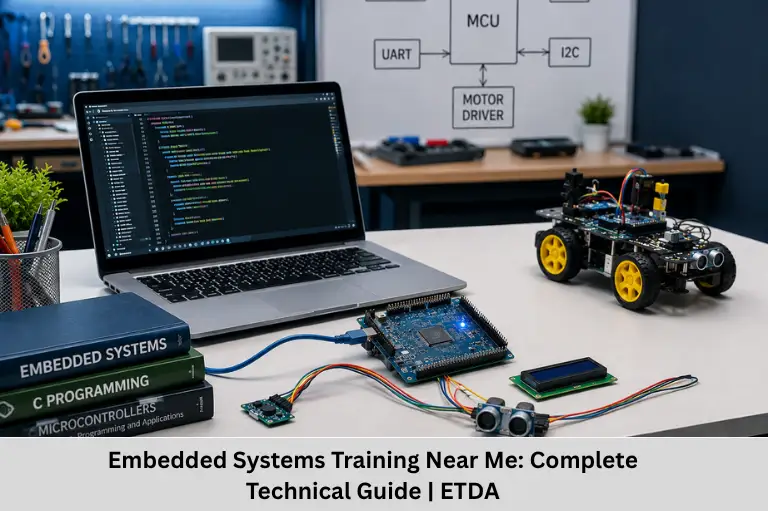
Looking for embedded systems training near you? Learn C, Embedded C, ARM, STM32, RTOS, protocols, debugging, projects, and career skills with Embedded Tech Development Academy (ETDA).
- Embedded Systems Training Near Me: Complete Technical Guide | ETDA
-
Embedded Systems Training Near Me: Complete Technical Guide
- What Are Embedded Systems?
- Why Choose Embedded Systems Training Near You?
- C Programming for Embedded Systems
- Embedded C and Microcontroller Programming
- STM32 and Microcontroller Training
- Embedded Communication Protocols
- Interrupts and RTOS
- Embedded Debugging Skills
- Embedded Systems Projects
- Why Choose ETDA for Embedded Systems Training?
- Career Opportunities After Embedded Training
-
How to Select the Right Embedded Training Institute
- Evaluate the Curriculum
- FAQs
- What does an embedded systems course teach?
- Is C programming necessary for embedded systems?
- What communication protocols should an embedded engineer learn?
- Are practical projects important?
- Can fresh engineering graduates learn embedded systems?
- Does ETDA provide placement support?
- Why choose ETDA for embedded training?
- Conclusion
Embedded Systems Training Near Me: Complete Technical Guide
Searching for “embedded systems training near me” is often the first step for engineering students, fresh graduates, and working professionals who want to build a career in embedded technology. Embedded systems combine hardware and software to perform dedicated functions in products such as automotive ECUs, industrial controllers, Internet of Things (IoT) devices, medical equipment, robotics, consumer electronics, and smart appliances.
Learning embedded systems requires more than theoretical knowledge. A developer needs practical skills in C programming, Embedded C, microcontrollers, ARM architecture, memory management, GPIO, timers, interrupts, ADC, PWM, UART, SPI, I2C, CAN, RTOS, debugging, and hardware interfacing.
For learners searching for a Top Embedded Training Institute in Bangalore, Embedded Tech Development Academy (ETDA) provides practical embedded systems training with industry-relevant technologies, hands-on learning, real-time projects, and assured placement support.
What Are Embedded Systems?
An embedded system is a computer-based system designed to perform a specific function within a larger electronic product.
Unlike general-purpose computers, embedded systems are usually designed around specific performance, power, memory, cost, and timing requirements.
Basic Embedded System Architecture
A typical embedded system consists of:
- Microcontroller or processor
- Program memory
- RAM
- Input devices
- Output devices
- Sensors
- Actuators
- Communication interfaces
- Power supply
The basic operation can be represented as:
Input → Processing → Decision → Output
For example:
Temperature Sensor → Microcontroller → Firmware → Fan Controller
Hardware and Software Interaction
The hardware provides processing and peripheral resources, while firmware controls these resources through registers and software instructions.
Why Practical Training Matters
Understanding how source code changes a physical output is essential for becoming an effective embedded developer. Practical training helps bridge the gap between programming concepts and actual electronic hardware.
Why Choose Embedded Systems Training Near You?
Searching for “embedded systems training near me” often indicates a preference for accessible classroom and laboratory learning.
Benefits of Local Technical Training
A nearby training center can provide:
- Regular laboratory access
- Direct interaction with trainers
- Hands-on hardware practice
- Faster technical assistance
- Group discussions
- Project mentoring
- Interview preparation
Classroom Learning vs Self-Learning
Online resources can explain individual concepts, but structured classroom training can provide a progressive curriculum and guided practical exercises.
What to Look For
When selecting a training institute, check whether the program includes actual development boards, debugging tools, sensors, communication modules, and project work.
C Programming for Embedded Systems
C programming is the foundation of most microcontroller-based embedded development.
Important C Concepts
A technical embedded curriculum should cover:
- Variables
- Data types
- Operators
- Loops
- Conditional statements
- Functions
- Arrays
- Strings
- Pointers
- Structures
- Unions
- Enumerations
- Preprocessor directives
Pointers and Memory
Pointers are particularly important because embedded programs frequently access memory locations, buffers, arrays, and hardware registers.
uint32_t value = 100;
uint32_t *ptr = &value;
Bitwise Operations
Embedded firmware frequently modifies individual bits inside registers.
register_value |= (1U << 5);This sets bit 5 while retaining the other bits.
Embedded C and Microcontroller Programming
Embedded C combines standard C programming with microcontroller-specific programming techniques.
Important Embedded C Concepts
Developers should understand:
volatileconststatic- Register programming
- Bit manipulation
- Memory-mapped I/O
- Interrupt handling
- Peripheral drivers
Microcontroller Fundamentals
A microcontroller generally integrates a CPU, memory, GPIO, timers, communication peripherals, and interrupt functionality.
ARM Cortex-M Training
Modern embedded courses should introduce ARM Cortex-M concepts such as:
- Registers
- Memory map
- Stack
- Exceptions
- NVIC
- Interrupts
- Clock configuration
- Peripheral control
STM32 and Microcontroller Training
STM32 microcontrollers are widely used as a practical platform for learning modern embedded development.
Important STM32 Peripherals
Learners should practice:
- GPIO
- Timers
- ADC
- PWM
- UART
- SPI
- I2C
- CAN
- Interrupts
- DMA
Register-Level Understanding
Even when using vendor development tools, understanding registers helps developers troubleshoot configuration and peripheral problems.
Hardware Practice
Students should ideally work with development boards, sensors, displays, motors, communication modules, and debugging interfaces.
Embedded Communication Protocols
Communication protocols allow embedded devices to exchange information with external components.
UART
UART provides asynchronous serial communication and is frequently used for debugging and device communication.
Important concepts include:
- Baud rate
- Start bit
- Stop bit
- Parity
- TX
- RX
SPI
SPI is a synchronous communication protocol commonly used with displays, sensors, memory devices, and converters.
Typical signals include:
- SCLK
- MOSI
- MISO
- CS
I2C
I2C normally uses SDA and SCL and supports multiple addressed devices on a shared bus.
CAN
CAN is particularly important for automotive and industrial applications. Learners should understand frames, identifiers, arbitration, bit timing, and error handling.
Interrupts and RTOS
Embedded systems often need to respond to events within specific timing constraints.
Interrupts
Interrupt Service Routines
Developers should understand interrupt vectors, priorities, latency, shared variables, and efficient ISR design.
RTOS Concepts
For larger applications, learners should understand:
- Tasks
- Scheduling
- Priorities
- Semaphores
- Mutexes
- Queues
- Event groups
- Software timers
RTOS knowledge is useful in automotive, robotics, Internet of Things (IoT), industrial automation, and other complex embedded applications.
Embedded Debugging Skills
Debugging is an essential part of embedded development.
Common Debugging Tools
Embedded engineers may use:
- JTAG
- SWD
- Debug probes
- Oscilloscopes
- Logic analyzers
- Multimeters
- Serial terminals
Firmware Debugging
Debuggers help developers inspect variables, registers, memory, breakpoints, call stacks, and program execution.
Protocol Debugging
Logic analyzers and oscilloscopes can help identify UART, SPI, I2C, and other timing or communication problems.
Embedded Systems Projects
Projects are essential for converting theoretical concepts into practical engineering skills.
Beginner Projects
Examples include:
- LED controller
- Push-button interface
- Digital counter
- UART application
- Temperature monitor
Intermediate Projects
Examples include:
- I2C sensor interface
- SPI display controller
- ADC data logger
- PWM motor controller
- CAN communication node
Advanced Projects
Advanced projects can combine ARM microcontrollers, RTOS, sensors, communication protocols, and Internet of Things (IoT) connectivity.
Project Skills
Projects demonstrate the ability to write firmware, configure peripherals, interface hardware, debug errors, and organize embedded software.
Why Choose ETDA for Embedded Systems Training?
Embedded Tech Development Academy (ETDA) focuses on practical and industry-oriented embedded systems learning.
Technical Curriculum
Embedded Tech Development Academy (ETDA) training can cover:
- C Programming
- Embedded C
- C++
- Data Structures
- 8051
- ARM Cortex-M
- STM32
- LPC1768
- GPIO
- Timers
- ADC
- PWM
- UART
- SPI
- I2C
- CAN
- RTOS
- Embedded Linux
- Internet of Things (IoT)
- Debugging
Hands-On Learning
Practical exercises help learners understand how firmware interacts with microcontrollers, registers, sensors, displays, and communication interfaces.
Assured Placement Support
Embedded Tech Development Academy (ETDA) also provides assured placement support, including:
- Technical interview preparation
- C and Embedded C coding practice
- Resume guidance
- Mock interviews
- Aptitude preparation
- HR interview preparation
- Career guidance
Career Opportunities After Embedded Training
Embedded training can prepare learners for multiple technical career paths.
Embedded Software Engineer
Develops firmware and software for microcontroller-based products.
Firmware Engineer
Works on low-level software that directly interacts with hardware.
Automotive Embedded Engineer
Works with ECUs, CAN communication, sensors, diagnostics, and vehicle electronics.
IoT Embedded Developer
Develops connected devices using sensors, microcontrollers, communication interfaces, and networking technologies.
Embedded Linux Developer
With additional Linux knowledge, professionals can work on embedded applications, device drivers, networking, and processor-based systems
How to Select the Right Embedded Training Institute
When searching for embedded systems training near me, do not select an institute only because it is geographically convenient.
Evaluate the Curriculum
Check whether the program provides complete coverage of programming, microcontrollers, peripherals, communication protocols, RTOS, debugging, and projects.
Check Practical Exposure
Look for regular hardware laboratory sessions rather than a course based only on presentations and theory.
Consider Career Support
Technical interview preparation, coding practice, project mentoring, resume guidance, and placement support can make the transition from training to employment more structured.
FAQs
What does an embedded systems course teach?
It typically covers C, Embedded C, microcontrollers, ARM, peripherals, communication protocols, RTOS, debugging, Embedded Linux, IoT, and practical projects.
Is C programming necessary for embedded systems?
Yes. C is one of the most important programming languages for microcontroller-based firmware development.
What communication protocols should an embedded engineer learn?
UART, SPI, I2C, and CAN are important protocols. Ethernet and wireless technologies can be learned for advanced networking and IoT applications.
Are practical projects important?
Yes. Projects provide experience in firmware development, hardware interfacing, debugging, peripheral configuration, and protocol implementation.
Can fresh engineering graduates learn embedded systems?
Yes. Graduates from electronics, electrical, computer science, instrumentation, and related engineering backgrounds can build embedded skills through structured training and practical practice.
Does ETDA provide placement support?
Yes. Embedded Tech Development Academy (ETDA) provides assured placement support, including technical interview preparation, coding practice, resume guidance, mock interviews, aptitude preparation, and career guidance.
Why choose ETDA for embedded training?
Embedded Tech Development Academy (ETDA) focuses on C, Embedded C, microcontrollers, ARM, STM32, communication protocols, RTOS, Embedded Linux, Internet of Things (IoT), debugging, and practical projects, making it an option for learners searching for a Top Embedded Training Institute in Bangalore.
Conclusion
Choosing the right embedded systems training near me can help engineering students and professionals develop practical skills required for modern firmware development. A strong learning path should progress from C and Embedded C to microcontrollers, ARM architecture, peripherals, communication protocols, RTOS, debugging, and real-world projects.
For learners looking for a Top Embedded Training Institute in Bangalore, Embedded Tech Development Academy (ETDA) provides practical embedded systems training with industry-relevant technologies and assured placement support. The focus on programming, hardware interfacing, debugging, communication protocols, and project development can help learners build stronger technical capabilities.
When evaluating a Top Embedded Training Institute in Bangalore, consider curriculum quality, hands-on hardware exposure, project experience, trainer guidance, debugging practice, and career support. With systematic learning and consistent practice, an embedded systems course can provide a strong foundation for careers in firmware development, automotive electronics, Internet of Things (IoT), robotics, and industrial automation.
Author: ETDA Trainers
Experience: 10+ Years of Industry Experience in Embedded Systems, IoT, and Embedded C Programming