
TinyML on ESP32 Using MicroPython: Building an Intelligent Gesture Recognition System
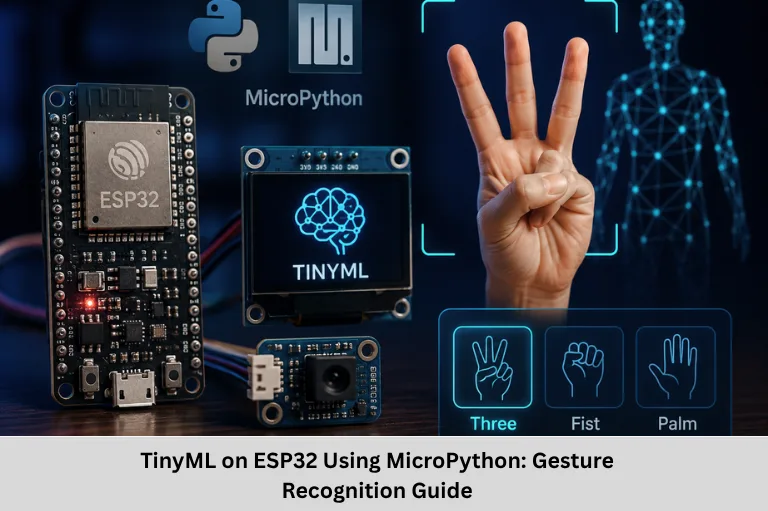
Learn how to build a TinyML gesture recognition system using ESP32, MicroPython and MPU6050, including data collection, model training and edge inference. Embedded Tech Development Academy (ETDA).
- TinyML on ESP32 Using MicroPython: Building an Intelligent Gesture Recognition System
-
TinyML on ESP32 Using MicroPython: Gesture Recognition Guide
- Introduction to TinyML on ESP32
- Understanding TinyML
- Why Use ESP32 for TinyML?
- Project Objective
- Hardware Requirements
- Software Requirements
- Data Collection for Gesture Recognition
- MicroPython MPU6050 Implementation
- Machine Learning Workflow
- Applications of Gesture Recognition
- Advantages and Technical Limitations
- Future Enhancements
- Frequently Asked Questions
- Conclusion
TinyML on ESP32 Using MicroPython: Gesture Recognition Guide
Introduction to TinyML on ESP32
Artificial intelligence is increasingly moving from cloud platforms and high-performance computers to resource-constrained embedded devices. This technology is known as Tiny Machine Learning (TinyML), where optimized machine learning models perform inference directly on microcontrollers. TinyML combines machine learning, embedded systems, edge AI, sensor processing, and low-power computing to create intelligent devices that can make decisions locally.
One practical application is gesture recognition using an accelerometer and gyroscope. Instead of depending on buttons, touchscreens, or continuous internet connectivity, an embedded device can identify physical movements and trigger an appropriate action. In this project, an ESP32 microcontroller, MPU6050 motion sensor, MicroPython, and a TinyML classification model are combined to recognize predefined hand gestures.
The ESP32 collects motion data from the MPU6050 through the I2C communication protocol. The data is then processed into suitable features and supplied to a machine learning model. During deployment, inference occurs locally on the microcontroller, demonstrating the concept of edge machine learning and real-time embedded AI.
TinyML projects such as this require knowledge of ESP32 programming, MicroPython programming, sensor interfacing, accelerometer data, gyroscope data, feature extraction, machine learning classification, model optimization, and embedded inference.
Embedded Tech Development Academy (ETDA) provides practical training in embedded systems, microcontrollers, Embedded C, Internet of things (IoT), and emerging technologies such as TinyML. As a Top Embedded Training Institute in Bangalore, Embedded Tech Development Academy (ETDA) emphasizes hands-on projects and provides assured placement support to learners preparing for embedded engineering careers.
For students and engineers interested in AI-enabled embedded systems and edge AI development, Embedded Tech Development Academy (ETDA), a Top Embedded Training Institute in Bangalore, provides practical exposure to microcontroller-based projects with assured placement support.
Understanding TinyML
What Is Tiny Machine Learning?
TinyML is the deployment of machine learning inference on devices with limited computational resources, such as microcontrollers.
A conventional AI application may follow:
Sensor → Internet → Cloud Server → ML Model → ResponseA TinyML system can instead operate as:
Sensor → Microcontroller → ML Model → ResponseBenefits of TinyML
Important advantages include:
- Low latency
- Reduced network dependency
- Lower power consumption
- Local data processing
- Improved privacy
- Offline operation
- Reduced cloud processing requirements
Edge AI and Embedded Intelligence
The major difference is that the inference engine operates at the edge. This makes TinyML useful for wearables, industrial monitoring, robotics, smart appliances, predictive maintenance, and Internet of things (IoT) devices.
Why Use ESP32 for TinyML?
The ESP32 is widely used for Internet of things (IoT) and embedded development because it combines processing capability with integrated wireless connectivity.
Important ESP32 Features
- 32-bit processor architecture
- Wi-Fi connectivity
- Bluetooth/Bluetooth Low Energy support on supported variants
- GPIO interfaces
- I2C, SPI, UART and other peripherals
- Low-power operating modes
- MicroPython support
- Sufficient resources for many lightweight inference workloads
MicroPython for Rapid Prototyping
MicroPython provides a Python-compatible programming environment for microcontrollers. It simplifies sensor interfacing and application development, making it useful for rapidly prototyping TinyML systems.
For production systems with strict memory, timing, or performance requirements, however, developers may choose optimized C/C++ firmware or a dedicated embedded inference runtime.
Project Objective
Gesture Recognition Workflow
The objective is to recognize predefined hand movements from motion sensor data.
The system performs these operations:
- Read acceleration and gyroscope values.
- Collect time-series motion data.
- Preprocess the sensor readings.
- Extract useful features.
- Run the trained classification model.
- Determine the predicted gesture.
- Trigger a predefined action.
The overall architecture is:
MPU6050
   ↓
ESP32 I2C Interface
   ↓
Sensor Data Acquisition
   ↓
Preprocessing
   ↓
Feature Extraction
   ↓
TinyML Model
   ↓
Gesture Classification
   ↓
Application Action
Hardware Requirements
Required Components
- ESP32 development board
- MPU6050 accelerometer and gyroscope
- Breadboard
- Jumper wires
- USB cable
- Optional LEDs, buzzer, display, or actuator for output
MPU6050 Motion Sensor
The MPU6050 combines a 3-axis accelerometer and 3-axis gyroscope.
The accelerometer measures linear acceleration along the X, Y, and Z axes, while the gyroscope measures angular velocity.
The ESP32 can communicate with the MPU6050 through I2C.
A typical connection is:
MPU6050      ESP32
VCC     →    3.3V
GND     →    GND
SDA     →    GPIO 21
SCL     →    GPIO 22
The exact GPIO assignments can be changed according to the ESP32 board and firmware configuration.
Software Requirements
Development Tools
The software environment may include:
- ESP32 MicroPython firmware
- Thonny IDE
- Python
- NumPy/pandas for offline dataset processing
- TensorFlow or another suitable ML framework
- TensorFlow Lite for Microcontrollers where applicable
- Edge Impulse Studio as an optional TinyML development platform
Model Deployment Consideration
A model trained on a computer cannot always be directly executed on a microcontroller. It generally needs to be converted, quantized, and optimized for the target inference runtime.
Data Collection for Gesture Recognition
Creating the Dataset
Machine learning performance depends heavily on the quality and diversity of training data.
Example gestures include:
- Swipe Left
- Swipe Right
- Hand Up
- Hand Down
- Circular Motion
- No Gesture
For each gesture, acceleration and gyroscope samples are collected over a fixed time window.
Sensor Sampling
A consistent sampling frequency is important. If the training data is collected at one sampling rate but inference uses a substantially different rate, the temporal characteristics of the gesture may change.
Sensor readings can be represented as:
Ax, Ay, Az
Gx, Gy, Gz
where A represents acceleration and G represents angular velocity.
MicroPython MPU6050 Implementation
Reading Sensor Data
A basic MicroPython implementation can look like this:
from machine import Pin, I2C
import time
from mpu6050 import MPU6050

i2c = I2C(0, scl=Pin(22), sda=Pin(21))
sensor = MPU6050(i2c)

while True:
    accel = sensor.read_accel_data()

    print("X:", accel['x'])
    print("Y:", accel['y'])
    print("Z:", accel['z'])

    time.sleep(0.2)
The exact MPU6050 library API may differ depending on the MicroPython driver being used.
Machine Learning Workflow
Step 1 — Collect Motion Data
Perform each gesture multiple times and record the corresponding sensor measurements.
Step 2 — Preprocess Data
Sensor data can contain noise and offsets. Preprocessing may include:
- Normalization
- Filtering
- Offset correction
- Resampling
- Windowing
Step 3 — Feature Extraction
Useful features can be extracted from accelerometer and gyroscope signals.
Examples include:
- Mean
- Standard deviation
- Maximum
- Minimum
- Signal magnitude
- Variance
- Temporal characteristics
Step 4 — Train the Classifier
The prepared dataset can be used to train a classification model. Depending on the application, suitable models may include a small neural network, decision tree, or other lightweight classifier.
Model Quantization
Quantization reduces numerical precision, commonly converting floating-point model parameters to lower-precision representations such as 8-bit integers. This can reduce memory usage and improve inference efficiency on supported embedded runtimes.
Real-Time Inference
During operation, the ESP32 collects a new sensor window and processes it using the same preprocessing pipeline used during training. The model then produces a gesture class and confidence score or equivalent output.
Applications of Gesture Recognition
Smart Home Automation
Gestures can control lights, fans, appliances, or other connected devices.
Robotics
A robotic platform can interpret hand movements as commands for direction, speed, or operation.
Wearable Devices
Gesture recognition can provide touch-free control in wearable electronics.
Healthcare Technology
Motion-based interfaces can support assistive technologies and rehabilitation-oriented applications when designed and validated appropriately.
Human-Machine Interaction
TinyML gesture recognition provides an alternative interface for embedded devices where physical buttons or displays are inconvenient.
Advantages and Technical Limitations
Advantages
- Real-time local inference
- Low communication latency
- Offline operation
- Reduced cloud dependency
- Low-power potential
- Compact hardware implementation
- Privacy-friendly local processing
Limitations
- Limited RAM and flash
- Restricted CPU performance
- Sensor noise
- Dataset dependency
- Model size constraints
- Difficulties recognizing highly similar gestures
- Power consumption must still be considered during continuous sensing
Future Enhancements
Advanced Gesture Classification
The project can be extended to support more complex dynamic gestures and continuous gesture recognition.
Sign Language Recognition
Multiple motion patterns could be combined with additional sensors to develop more sophisticated sign-language interfaces.
Wireless IoT Integration
The ESP32 can transmit recognized gesture events over Wi-Fi or Bluetooth to another system when connectivity is required.
Multi-Sensor Fusion
Combining accelerometer, gyroscope, magnetometer, pressure, or other sensor inputs can improve classification robustness for some applications.
Frequently Asked Questions
What is TinyML?
TinyML is the deployment of machine learning inference on low-power devices such as microcontrollers. It enables devices to process data and make predictions locally without continuously depending on cloud servers.
Can ESP32 run TinyML models?
Yes. ESP32-class microcontrollers can run appropriately sized and optimized machine learning models. The model must fit within the available memory and computational resources, and the selected inference framework must support the target platform.
Why is MPU6050 used for gesture recognition?
The MPU6050 provides three-axis acceleration and three-axis angular velocity measurements. These motion signals contain useful information for identifying different physical gestures.
Is MicroPython suitable for TinyML?
MicroPython is useful for rapid prototyping, sensor acquisition, data processing, and application logic. For highly optimized production inference, developers may use a dedicated embedded ML runtime with C/C++ integration depending on memory and performance requirements.
What skills are required to build an ESP32 TinyML project?
Important skills include Python or MicroPython programming, ESP32 development, I2C communication, sensor interfacing, data preprocessing, machine learning fundamentals, feature extraction, model quantization, and embedded debugging.
Conclusion
TinyML demonstrates how machine learning and embedded systems can be combined to create intelligent devices that operate directly at the edge. An ESP32-based gesture recognition system is a practical example because it combines microcontroller programming, MPU6050 sensor interfacing, I2C communication, MicroPython, signal preprocessing, feature extraction, machine learning classification, model optimization, and real-time inference.
The complete pipeline begins with motion-data acquisition from the accelerometer and gyroscope. The data is then cleaned, organized into time windows, transformed into useful features, and supplied to a lightweight ML model. During deployment, the ESP32 performs inference locally and converts the prediction into an application-specific action.
For embedded engineers, learning TinyML is increasingly valuable because intelligent functionality is moving closer to sensors and edge devices. Knowledge of ESP32 TinyML, MicroPython programming, Edge AI, embedded machine learning, sensor fusion, machine learning inference, and Internet of things (IoT) development can provide a strong foundation for developing next-generation embedded products.
Embedded Tech Development Academy (ETDA) offers practical learning in embedded systems, Embedded C, microcontrollers, Internet of things (IoT), and emerging areas such as TinyML. As a Top Embedded Training Institute in Bangalore, Embedded Tech Development Academy (ETDA) focuses on hands-on technical projects that help learners understand how hardware, firmware, sensors, and intelligent algorithms work together, along with assured placement support.
For learners planning a career in intelligent embedded systems, Embedded Tech Development Academy (ETDA), a Top Embedded Training Institute in Bangalore, provides practical exposure to embedded development and industry-oriented projects with assured placement support. Building projects such as ESP32 gesture recognition can help students move beyond theoretical machine learning concepts and understand their implementation on resource-constrained hardware.
Author: ETDA Trainers
Experience: 10+ Years of Industry Experience in Embedded Systems, IoT, and Embedded C Programming