
Storage Classes in C: Auto, Register, Static and Extern Explained
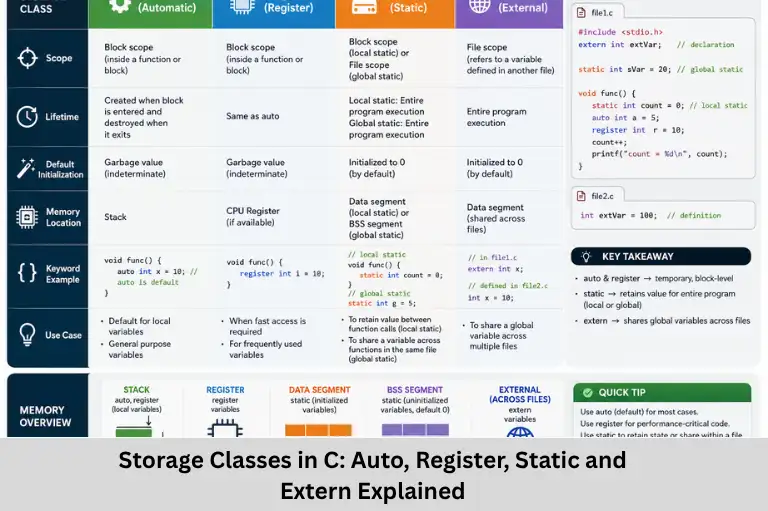
Learn storage classes in C with scope, lifetime, memory, linkage, examples, declaration vs definition, and embedded C applications. Embedded Tech Development Academy (ETDA).
- Storage Classes in C: Auto, Register, Static and Extern Explained
-
Storage Classes in C: Auto, Register, Static and Extern Explained
- Introduction to Storage Classes in C
- What Are Storage Classes in C?
- Auto Storage Class in C
- Register Storage Class in C
- Static Storage Class in C
- Extern Storage Class in C
- Declaration vs Definition in C
- Understanding Linkage in C
- Storage Classes and Embedded Systems
- Storage Classes Summary
- Common Mistakes With Storage Classes
- Frequently Asked Questions
- Conclusion
Storage Classes in C: Auto, Register, Static and Extern Explained
Introduction to Storage Classes in C
Storage classes in C are fundamental concepts that determine how variables and functions behave during program execution. They define important properties such as scope, storage duration, linkage, and visibility of identifiers. Understanding storage classes is especially important when working with C programming, Embedded C, firmware development, microcontrollers, operating systems, device drivers, and performance-critical applications.
In embedded systems, software often runs with limited RAM, Flash memory, CPU resources, and stack space. Therefore, understanding how variables are created, maintained, accessed, and destroyed is essential for developing reliable firmware. Storage classes help developers control variable lifetime and visibility while designing modular embedded software.
For students learning embedded C programming at Embedded Tech Development Academy (ETDA), storage classes are an important part of building a strong foundation in C and embedded systems. As a Top Embedded Training Institute in Bangalore, Embedded Tech Development Academy (ETDA) focuses on practical programming concepts that can be applied to microcontrollers, firmware, drivers, and real-time embedded applications.
The four traditional storage-class specifiers in C are:
autoregisterstaticextern
These keywords are closely related to variable scope, storage duration, memory organization, linkage, stack memory, static memory, global variables, and multi-file programming.
Learning these concepts through practical programming and debugging is also useful for developing industry-ready embedded software skills, supported by assured placement support at Embedded Tech Development Academy (ETDA).
What Are Storage Classes in C?
A storage class specifies characteristics associated with an identifier. The most important properties include scope, storage duration, linkage, and the implementation-defined storage location.
Scope
Scope specifies the region of the source program where an identifier can be accessed.
For example, a local variable normally has block scope:
void function()
{
    int value = 10;
}
The variable value cannot normally be accessed outside the function block.
Storage Duration
Storage duration specifies how long an object exists during program execution.
The major categories relevant here are:
- Automatic storage duration
- Static storage duration
Automatic objects normally exist only while execution is within their block. Static objects exist for the entire execution of the program.
Linkage
Linkage determines whether declarations in different scopes or translation units can refer to the same entity.
C commonly deals with:
- No linkage
- Internal linkage
- External linkage
Auto Storage Class in C
What Is Auto Storage Class?
The auto storage class represents automatic storage duration. Local variables declared inside a function or block have automatic storage duration by default.
int main()
{
    int num1;
    auto int num2;

    num1 = 10;
    num2 = 20;

    return 0;
}
Here, both num1 and num2 are local automatic variables.
Characteristics of Auto Variables
- Scope: Block scope
- Storage duration: Automatic
- Linkage: None
- Initialization: Indeterminate if no initializer is provided
- Typical implementation: Stack or another implementation-defined mechanism
Important Point About Auto Variables
It is not technically correct to state that every auto variable must physically reside on the stack. The C language defines its storage duration and scope, while the compiler determines the actual machine-level storage location.
Auto Variable and Pointer Safety
Returning the address of an automatic local variable is unsafe:
int *get_value()
{
    int value = 100;
    return &value;
}
The lifetime of value ends when the function returns. Using the returned pointer to access that object results in undefined behavior.
Register Storage Class in C
What Is Register Storage Class?
The register keyword requests that the compiler consider storing a variable in a CPU register for efficient access.
int main()
{
    register int i;

    for(i = 0; i < 1000; i++)
    {
        /* processing */
    }

    return 0;
}
Modern optimizing compilers generally make their own register-allocation decisions, so declaring a variable as register does not guarantee that it will actually be placed in a CPU register.
Characteristics of Register Variables
- Scope: Block scope
- Storage duration: Automatic
- Linkage: None
- Address: The address of a
registervariable cannot be explicitly obtained using&
For example:
register int counter;The following is not permitted:
&counter;Register Storage in Embedded C
Embedded developers should distinguish between a C register variable and a hardware register.
A hardware register is a memory-mapped or processor-specific location used to control peripherals such as:
- GPIO
- Timers
- UART
- SPI
- ADC
- Interrupt controllers
The C register keyword is simply a compiler-level storage hint.
Static Storage Class in C
What Is Static?
The static keyword has different effects depending on where it is declared.
For a local variable, it provides static storage duration while maintaining block scope. At file scope, it gives the identifier internal linkage.
Static Local Variables
A static local variable retains its value between function calls.
int book_ticket()
{
    static int ticket_sold = 0;

    ticket_sold++;
    return ticket_sold;
}
If the function is called repeatedly, ticket_sold does not start from zero on every call.
Characteristics of Static Local Variables
- Scope: Block scope
- Storage duration: Entire program execution
- Linkage: None
- Initialization: Performed once
- Typical storage: Static data area
Practical Example
int counter()
{
    static int count = 0;

    count++;
    return count;
}
Calling counter() three times produces:
1
2
3
This behavior is useful for:
- Event counters
- State tracking
- Persistent function state
- Embedded state machines
- Driver status information
Static Global Variables
A file-scope variable declared with static has internal linkage.
static int visitors = 0;

void visit()
{
    visitors++;
}
The variable can be accessed only from the same translation unit.
Static Functions
The static keyword can also be applied to functions.
static void process_sensor_data()
{
    /* Function implementation */
}
This function is visible only within the source file where it is defined.
Why Static Is Important in Embedded Systems
Static file-scope variables and functions are useful for module encapsulation. A driver can keep its internal state private instead of exposing every variable and function to the rest of the firmware.
This helps reduce unintended access and improves software modularity.
Extern Storage Class in C
What Is Extern?
The extern keyword declares an object or function whose definition is provided elsewhere. It is commonly used when multiple source files need to access the same global variable.
Multi-File Example
file1.c
int system_status = 10;file2.c
extern int system_status;

void display_status()
{
    printf("%d\n", system_status);
}
Here, system_status is defined in file1.c and declared in file2.c.
Characteristics of Extern
- Purpose: Declares an entity defined elsewhere
- Common use: Multi-file programming
- Linkage: Usually external for file-scope objects
- Storage duration: Normally static for objects with external linkage
A common embedded software architecture places declarations in header files and definitions in C source files.
Declaration vs Definition in C
Understanding declaration and definition is critical when working with extern.
What Is a Declaration?
A declaration informs the compiler about an identifier and its type.
extern int count;This normally does not define the object.
What Is a Definition?
A definition provides the object itself and, where applicable, storage.
int count = 10;Examples
int x = 10;       /* Definition */
extern int x;     /* Declaration */
Another example is:
extern int x = 20;This declaration also constitutes a definition because it provides an initializer.
Understanding Linkage in C
External Linkage
An identifier with external linkage can be referred to from other translation units.
int global_count = 0;Another source file can declare:
extern int global_count;Internal Linkage
A file-scope static identifier has internal linkage.
static int device_state;Other source files cannot directly access this identifier by declaring it with extern.
No Linkage
Local variables generally have no linkage.
void test()
{
    int value = 10;
}
The local variable belongs to its own block.
Storage Classes and Embedded Systems
Why Storage Classes Matter in Firmware
Embedded applications are commonly divided into modules such as:
- GPIO drivers
- UART drivers
- SPI drivers
- Timer drivers
- Sensor drivers
- Interrupt handlers
- Communication stacks
Storage classes help control the lifetime and visibility of data used by these modules.
Static Data in Embedded Firmware For example:
For example:
static uint8_t sensor_state;This keeps the variable private to the source file while allowing it to retain its value throughout program execution.
Memory Organization
Embedded developers should understand the relationship between storage duration and memory usage.
Automatic variables may require stack space, while static variables generally occupy memory throughout program execution.
This becomes important when working with:
- Limited RAM
- Stack allocation
- Global buffers
- Interrupt routines
- RTOS tasks
- Firmware memory optimization
Storage Classes Summary
| Storage Class | Scope | Storage Duration | Linkage | Typical Use |
|---|---|---|---|---|
auto |
Block | Automatic | None | Local variables |
register |
Block | Automatic | None | Register-allocation hint |
static local |
Block | Entire program | None | Persistent local state |
static global |
File | Entire program | Internal | Private module data |
extern |
Declaration-dependent | Usually static | External | Accessing external objects |
Common Mistakes With Storage Classes
Mistake 1 — Assuming Register Guarantees a CPU Register
The register keyword does not guarantee physical CPU-register allocation.
Mistake 2 — Returning a Pointer to a Local Variable
An automatic variable ceases to exist after its block finishes execution.
Mistake 3 — Confusing Static Scope and Lifetime
A static local variable has block scope but static storage duration.
Mistake 4 — Defining Extern Variables Incorrectly
An extern declaration should not be confused with a definition. Incorrect definitions across multiple source files can result in linker errors.
Frequently Asked Questions
What are the four storage classes in C?
The four traditionally taught C storage-class specifiers are auto, register, static, and extern.
Which storage class retains a value between function calls?
A local variable declared with static retains its value between function calls.
Does register guarantee CPU-register storage?
No. It is a request to the compiler, and modern compilers make register allocation decisions independently.
What is the difference between static and extern?
A file-scope static variable has internal linkage and is accessible only within its translation unit. extern is commonly used to declare an object defined elsewhere.
Why are storage classes important in embedded C?
Storage classes help developers control variable lifetime, visibility, linkage, module boundaries, and memory usage. These are important when developing firmware and resource-constrained embedded applications.
Conclusion
Storage classes in C provide an essential foundation for understanding variable scope, storage duration, linkage, memory organization, static variables, automatic variables, global variables, and multi-file programming. The auto specifier is associated with automatic storage duration, register provides a compiler hint, static can provide persistent local storage or internal linkage, and extern is commonly used to reference definitions provided elsewhere.
For embedded developers, these concepts have direct practical importance. Firmware often contains multiple drivers, interrupt routines, communication modules, state machines, and hardware abstraction layers. Correct use of static and extern can improve module boundaries, while understanding automatic and static storage helps developers reason about RAM and stack requirements.
Embedded Tech Development Academy (ETDA) provides practical learning in C programming, Embedded C, microcontrollers, firmware development, memory management, debugging, and system-level programming. For learners searching for a Top Embedded Training Institute in Bangalore, mastering fundamental C concepts such as storage classes is an important step toward developing strong embedded software skills.
Embedded Tech Development Academy (ETDA)‘s practical approach helps learners connect C language concepts with microcontroller-based applications and firmware development. With assured placement support, learners can work toward building industry-oriented skills for embedded software and firmware roles.
For engineers targeting embedded systems, automotive electronics, Internet of Things (IoT), robotics, industrial automation, and real-time systems, a strong understanding of C storage classes provides an important programming foundation. Embedded Tech Development Academy (ETDA), as a Top Embedded Training Institute in Bangalore, combines technical learning with practical exposure and assured placement support to help learners prepare for embedded engineering careers.
Author: ETDA Trainers
Experience: 10+ Years of Industry Experience in Embedded Systems, IoT, and Embedded C Programming