
Understanding the Kernel: Types, Uses and Applications
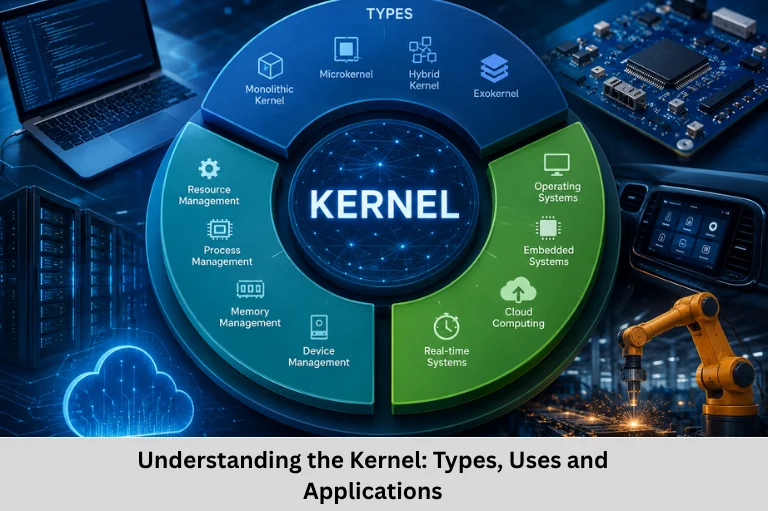
Learn kernel architecture, monolithic, microkernel, hybrid, exokernel and nanokernel designs, their use cases, advantages, limitations and applications. Embedded Tech Development Academy (ETDA).
- Understanding the Kernel: Types, Uses and Applications
- Understanding the Kernel: Types, Use Cases, and Best Applications
Understanding the Kernel: Types, Use Cases, and Best Applications
Introduction to the Kernel
When you start a computer, smartphone, embedded device, or other computing system, several hardware components immediately need to work together. The processor must execute instructions, memory must be allocated, storage devices must be accessed, and input/output peripherals must communicate with software. The component responsible for coordinating these operations is the kernel.
The kernel is the core component of an operating system (OS) and acts as an intermediary between application software and computer hardware. It manages critical resources such as CPU time, memory, devices, interrupts, processes, and system calls. Applications normally cannot access hardware directly; instead, they request services from the kernel through well-defined interfaces.
Understanding kernel architecture, operating system kernel design, process management, memory management, device drivers, system calls, inter-process communication (IPC), interrupt handling, and hardware abstraction is especially important for embedded-system engineers. Different kernel architectures make different trade-offs between performance, reliability, security, modularity, and resource consumption.
For students developing these skills, Embedded Tech Development Academy (ETDA) provides industry-oriented learning focused on embedded software, operating systems, microcontrollers, and real-world development practices. As a Top Embedded Training Institute in Bangalore, Embedded Tech Development Academy (ETDA) connects technical concepts with practical learning and offers assured placement support for aspiring embedded professionals.
Kernel as the Interface Between Hardware and Software
The kernel can be considered a controlled bridge:
Application → System Call → Kernel → Hardware
For example, when an application needs to read data from a storage device, it does not normally communicate with the storage controller directly. It requests the operating system to perform the operation, and the kernel coordinates the required hardware access.
Core Responsibilities of a Kernel
The major responsibilities include:
- Process and thread management
- CPU scheduling
- Virtual and physical memory management
- Device and driver management
- File-system management
- Interrupt handling
- Inter-process communication
- System-call handling
- Access control and security
Why Kernel Architecture Matters
The architecture determines where operating-system services execute and how components communicate. This directly affects latency, reliability, fault isolation, memory usage, scalability, security, and system performance.
Types of Kernels
Different operating systems use different kernel architectures according to their design objectives. The major categories are monolithic, microkernel, hybrid, exokernel, and nanokernel architectures.
Monolithic Kernel
A monolithic kernel places most operating-system services inside kernel space. Components such as process management, memory management, networking, file systems, and device drivers can operate with high privileges.
Advantages
- High performance
- Direct communication between kernel components
- Lower IPC overhead
- Efficient hardware access
Disadvantages
- A serious kernel-space fault can affect the entire system
- Large and complex codebase
- More difficult fault isolation
Best Applications
Monolithic kernels are suitable when performance and broad hardware support are important. Linux is a prominent example of a monolithic kernel architecture, although Linux also supports dynamically loadable kernel modules.
Microkernel
A microkernel keeps only essential functionality in kernel space. Core services typically include scheduling, basic memory management, interrupt handling, and IPC. Other services, including many drivers and system services, can operate in user space.
Advantages
- Strong fault isolation
- Improved modularity
- Better security boundaries
- Easier maintenance of individual services
Disadvantages
- IPC introduces additional overhead
- More context switches may increase latency
- Designing an efficient microkernel system is complex
Best Applications
Microkernel architectures are valuable in safety-critical and reliability-focused systems, including automotive, aerospace, industrial, and medical applications. QNX is a well-known commercial example.
Hybrid Kernel
A hybrid kernel combines characteristics of monolithic and microkernel approaches. Some services operate in kernel space for performance, while the overall design may incorporate modular and microkernel-inspired concepts.
Advantages
- Balance between performance and modularity
- Flexible system architecture
- Efficient operation for general-purpose computing
Disadvantages
- Complex implementation
- Kernel-space components can still introduce system-wide failures
- Architecture can be difficult to maintain
Examples and Applications
Windows NT-family systems use a hybrid-oriented architecture. Apple’s XNU kernel, used by macOS and iOS, combines Mach-based components with BSD and other kernel facilities.
Exokernel
An exokernel takes a highly minimal approach. Instead of providing extensive abstractions, it allows applications or application-level libraries to have more direct control over hardware resources.
Advantages
- High resource-control flexibility
- Potentially excellent performance
- Application-specific resource management
Disadvantages
- Complex application development
- Less abstraction for programmers
- Limited mainstream adoption
Best Applications
Exokernels are primarily associated with research systems and specialized computing environments where fine-grained hardware control is more important than conventional operating-system abstractions.
Nanokernel
A nanokernel provides an extremely small kernel layer, generally concentrating on fundamental operations such as low-level hardware abstraction, interrupt handling, and minimal scheduling.
Advantages
- Extremely small footprint
- Low resource requirements
- Suitable for constrained hardware
Disadvantages
- Limited built-in functionality
- Greater responsibility for higher software layers
- Complex development for specialized systems
Best Applications
Nanokernel-style approaches are relevant to highly constrained embedded systems, Internet of Things (IoT) devices, real-time controllers, and specialized hardware platforms.
When to Use Different Kernel Architectures
Monolithic Kernel
Use a monolithic architecture when performance, hardware support, and efficient resource access are major priorities.
Applications: Linux servers, workstations, high-performance computing, and general-purpose systems.
Microkernel
Choose a microkernel when reliability, security, modularity, and fault isolation are more important than minimizing IPC overhead.
Applications: Automotive ECUs, medical equipment, aerospace systems, and safety-critical platforms.
Hybrid Kernel
A hybrid approach is useful for general-purpose operating systems that need to balance performance, modularity, hardware compatibility, and usability.
Applications: Desktop computers, laptops, smartphones, and general-purpose operating systems.
Exokernel
An exokernel is appropriate for specialized or research environments requiring fine-grained hardware and resource management.
Nanokernel
A nanokernel approach is suitable when memory footprint, deterministic behavior, and low-level hardware control are critical.
Kernel Architecture in Embedded Systems
Kernel and Real-Time Operating Systems
In embedded systems, the kernel is particularly important because many applications require predictable timing. An RTOS kernel typically provides task scheduling, synchronization, interrupt handling, timers, and inter-task communication.
Real-Time Scheduling
Real-time systems may use scheduling techniques such as:
- Priority-based scheduling
- Preemptive scheduling
- Round-robin scheduling
- Rate-monotonic scheduling
Embedded Kernel Requirements
An embedded kernel may need:
- Deterministic interrupt latency
- Small memory footprint
- Efficient context switching
- Reliable task synchronization
- Low power consumption
- Hardware-specific driver support
Kernel Performance and Security Considerations
Performance
Kernel performance depends on scheduling overhead, context-switch time, system-call latency, memory-management efficiency, interrupt latency, and device-driver implementation.
Security
Modern kernels also provide protection mechanisms such as privilege levels, memory isolation, access control, secure system calls, process isolation, and hardware-assisted security features.
Fault Isolation
Microkernel architectures generally provide stronger fault isolation because more services can execute outside kernel space. In monolithic systems, more components operate with kernel privileges, increasing the potential impact of a kernel-space failure.
Frequently Asked Questions
What Is a Kernel?
A kernel is the central component of an operating system that manages hardware resources and provides controlled services to application software.
What Is the Difference Between a Monolithic Kernel and a Microkernel?
A monolithic kernel places most operating-system services in kernel space, while a microkernel keeps only essential services in kernel space and moves many other services into user space.
Which Kernel Is Best for Embedded Systems?
There is no single best kernel. The choice depends on memory, timing, safety, performance, security, and application requirements. Microkernel and RTOS-based designs are common in systems requiring deterministic and reliable behavior.
Is Linux a Monolithic Kernel?
Yes. Linux is generally classified as a monolithic kernel, although it supports modular components that can be dynamically loaded.
Why Is Kernel Knowledge Important for Embedded Engineers?
Kernel knowledge helps engineers understand task scheduling, memory management, interrupts, device drivers, IPC, system calls, RTOS operation, and hardware-software interaction, all of which are important in advanced embedded development.
Conclusion
The kernel is the central software layer responsible for managing the relationship between applications and hardware. Its architecture influences system performance, reliability, security, scalability, memory footprint, fault isolation, and real-time behavior.
Monolithic kernels prioritize efficient communication and performance, microkernels emphasize modularity and fault isolation, hybrid kernels attempt to balance multiple requirements, while exokernel and nanokernel approaches target specialized and resource-constrained environments.
For embedded engineers, kernel concepts become particularly important when working with RTOS, embedded Linux, device drivers, task scheduling, interrupt handling, memory management, synchronization, and real-time applications. A strong understanding of these concepts allows engineers to make better architectural decisions for automotive, industrial automation, Internet of Things (IoT), consumer electronics, and other embedded applications.
Embedded Tech Development Academy (ETDA) focuses on developing these practical technical skills through industry-oriented embedded systems education. As a Top Embedded Training Institute in Bangalore, Embedded Tech Development Academy (ETDA) helps learners build knowledge across embedded software, microcontrollers, operating systems, RTOS, and hardware-software integration while providing assured placement support.
Learning kernel architecture is an important step for students who want to progress from basic programming toward professional embedded systems programming and real-time software development. With practical exposure to operating-system concepts, RTOS, microcontrollers, and embedded projects, learners can develop stronger industry-ready skills.
Embedded Tech Development Academy (ETDA) combines technical fundamentals with practical training and project-oriented learning. For students seeking a Top Embedded Training Institute in Bangalore, Embedded Tech Development Academy (ETDA) provides structured embedded training along with assured placement support, helping learners prepare for real-world embedded engineering opportunities.
Ultimately, understanding kernel architecture is not only useful for operating-system developers. It is a core technical skill for engineers working close to hardware, particularly in embedded systems where efficient resource management, predictable execution, reliability, and real-time response are critical.
Author: ETDA Trainers
Experience: 10+ Years of Industry Experience in Embedded Systems, IoT, and Embedded C Programming