
Real-Time Operating Systems (RTOS): Basics & Applications
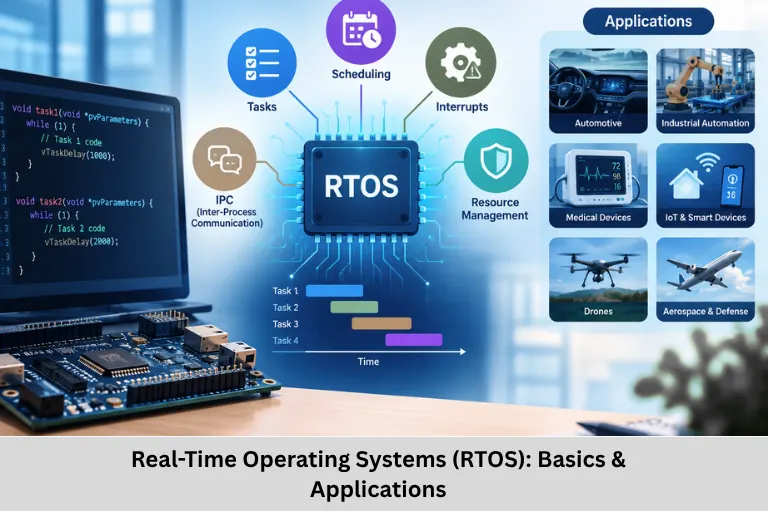
Learn RTOS basics, scheduling, tasks, interrupts, IPC, applications, advantages, challenges, and future trends in embedded systems. Embedded Tech Development Academy (ETDA).
- Real-Time Operating Systems (RTOS): Basics & Applications
- Real-Time Operating Systems (RTOS): Basics and Applications
Real-Time Operating Systems (RTOS): Basics and Applications
Introduction to Real-Time Operating Systems
In modern embedded systems, timing, determinism, and predictable response are critical design requirements. Systems such as automotive electronic control units, anti-lock braking systems, industrial robots, medical devices, aerospace controllers, Internet of Things (IoT) gateways, and communication equipment must respond to events within defined deadlines. A delayed response can reduce system performance and, in safety-critical applications, can lead to system failure. This is where a Real-Time Operating System (RTOS) becomes important.
An RTOS is an operating system designed to manage multiple tasks while providing predictable timing behavior. It focuses on real-time scheduling, low interrupt latency, deterministic task execution, priority management, inter-task communication, synchronization, and efficient memory utilization. Unlike a general-purpose operating system, an RTOS is designed around timing requirements rather than only maximizing overall throughput.
For engineers learning embedded systems programming, embedded C, microcontroller programming, task scheduling, interrupt handling, and real-time system design, understanding RTOS architecture is essential. Embedded Tech Development Academy (ETDA) provides practical training in these industry-relevant areas, making it a strong choice for learners looking for a Top Embedded Training Institute in Bangalore with hands-on exposure and assured placement supportF.
What Is an RTOS?
A Real-Time Operating System is an operating system designed to execute tasks and respond to events within predictable timing constraints. Its primary objective is not simply to execute instructions quickly but to ensure that important operations are completed within their required deadlines.
Key Characteristics of an RTOS
Deterministic Behavior
An RTOS aims to provide predictable execution and scheduling behavior, allowing developers to estimate task response times.
Low Latency
Interrupts and high-priority tasks can be serviced quickly, which is essential for time-critical embedded applications.
Task Prioritization
Tasks can be assigned different priorities so that critical operations receive CPU time before less important operations.
Minimal Jitter
Jitter represents variation in the timing of repeated operations. Low jitter is important for applications requiring consistent periodic execution.
Types of Real-Time Systems
Real-time systems are generally classified according to the consequences of missing a deadline.
Hard Real-Time Systems
In a hard real-time system, missing a deadline can result in system failure or unacceptable consequences. Examples include automotive airbag controllers, certain flight-control systems, and critical medical equipment.
Soft Real-Time Systems
In a soft real-time system, occasional deadline violations may reduce quality or performance without causing catastrophic failure. Video streaming and some multimedia applications are examples.
Firm Real-Time Systems
In a firm real-time system, results received after their deadlines may have little or no value, although an occasional missed deadline may not cause complete system failure. Certain industrial monitoring and automation applications can use this model.
Core Components of an RTOS
RTOS Scheduler
The scheduler determines which task should execute based on scheduling policies and task priorities.
Preemptive Scheduling
In preemptive scheduling, a higher-priority task can interrupt a lower-priority task that is currently executing. This improves responsiveness for critical operations.
Cooperative Scheduling
In cooperative scheduling, a running task continues until it voluntarily yields the processor or reaches a scheduling point.
Tasks and Threads
A task is an independent unit of execution. An RTOS task normally has its own stack, priority, execution state, and Task Control Block (TCB). Tasks may be ready, running, blocked, suspended, or delayed.
Interrupt Service Routines
An Interrupt Service Routine (ISR) responds to hardware or software events such as timers, UART reception, GPIO changes, ADC events, or sensor inputs. ISRs should normally remain short and defer lengthy processing to RTOS tasks.
Inter-Task Communication
RTOS applications require controlled communication between concurrent tasks.
Common IPC Mechanisms
- Queues: Transfer data between tasks or between ISRs and tasks.
- Semaphores: Provide signaling and synchronization.
- Mutexes: Protect shared resources from simultaneous access.
- Event Flags: Allow tasks to wait for one or more events.
Memory Management
RTOS-based systems can use static or dynamic memory allocation. Static allocation provides greater predictability, while dynamic allocation offers flexibility but requires careful management of fragmentation and allocation latency.
Scheduling Algorithms in RTOS
Priority-Based Scheduling
Each task receives a priority, and the scheduler normally selects the highest-priority ready task. This is one of the most common scheduling approaches in RTOS environments.
Round Robin Scheduling
Round Robin scheduling provides CPU time to tasks of the same priority using time slices. It can improve responsiveness among equal-priority tasks.
Rate Monotonic Scheduling
Rate Monotonic Scheduling (RMS) uses fixed priorities. Under classical RMS assumptions, tasks with shorter execution periods receive higher priorities.
Earliest Deadline First
Earliest Deadline First (EDF) dynamically assigns priority according to absolute deadlines, with the task having the nearest deadline receiving the highest priority.
RTOS vs General-Purpose Operating System
| Feature | RTOS | General-Purpose OS |
|---|---|---|
| Primary Goal | Predictability | Throughput and usability |
| Timing | Deterministic-oriented | Not generally deadline-guaranteed |
| Scheduling | Priority/deadline focused | Fairness and workload focused |
| Latency | Designed for low and predictable latency | Can vary with system workload |
| Examples | FreeRTOS, VxWorks, QNX | Windows, Linux |
Popular RTOS Examples
FreeRTOS
FreeRTOS is widely used in microcontroller-based embedded applications and provides task scheduling, queues, semaphores, software timers, and synchronization mechanisms.
VxWorks
VxWorks is a commercial real-time operating system used in demanding embedded applications, including aerospace, defense, industrial, and transportation systems.
QNX
QNX uses a microkernel-oriented architecture and is widely associated with automotive and industrial embedded applications.
Real-Time Linux
Linux can be configured for real-time workloads using technologies such as PREEMPT_RT, although the suitability of a Linux-based system depends on the application’s timing and determinism requirements.
Applications of RTOS
Automotive Embedded Systems
RTOS technology is used in ECUs, braking systems, powertrain controllers, body electronics, and advanced driver-assistance systems where deterministic task execution is important.
Industrial Automation
Robotics, CNC machines, motor controllers, PLC-related systems, and process-control equipment require coordinated real-time operations.
Medical Electronics
Heart monitors, infusion systems, patient monitoring equipment, and other medical devices can depend on predictable processing and response.
Consumer Electronics and IoT
Smart appliances, wearables, cameras, smart-home controllers, and environmental monitoring devices use RTOS technology to coordinate sensors, communication interfaces, timers, and application tasks.
Telecommunications
Routers, communication gateways, wireless equipment, and base stations can use real-time software for packet processing and hardware control.
Advantages and Challenges of RTOS
Advantages
- Predictable task scheduling
- Low response latency
- Efficient CPU utilization
- Reliable interrupt processing
- Priority-based task management
- Effective resource synchronization
Challenges
RTOS development requires careful system architecture, task-priority planning, stack-size estimation, synchronization design, and debugging. Developers must also manage priority inversion, race conditions, deadlocks, resource contention, and limited memory.
Priority Inversion
Priority inversion occurs when a high-priority task is indirectly delayed because a lower-priority task holds a required resource. Mechanisms such as priority inheritance can help reduce this problem.
Importance of Deterministic Design
Developers must analyze worst-case execution time, interrupt latency, task periods, deadlines, memory usage, and scheduling behavior when designing safety- or timing-critical systems.
Future Trends in RTOS
RTOS technology is evolving alongside edge computing, embedded AI, autonomous systems, Internet of Things (IoT) security, multicore processors, deterministic networking, and connected automotive platforms. Modern RTOS platforms increasingly need to support multicore scheduling, stronger isolation, secure boot, real-time communication, and resource-constrained machine-learning workloads.
For engineers planning careers in embedded software, RTOS knowledge combined with Embedded C, microcontrollers, ARM architecture, device drivers, communication protocols, and debugging tools can provide valuable industry skills. Embedded Tech Development Academy (ETDA) focuses on practical embedded development and provides assured placement support, helping learners connect theoretical RTOS concepts with real-world engineering applications.
What is the main purpose of an RTOS?
The primary purpose of an RTOS is to provide predictable task scheduling and response behavior so that time-critical operations can meet their required deadlines under a properly designed and schedulable workload.
Is FreeRTOS a real-time operating system?
Yes. FreeRTOS is a widely used RTOS kernel designed for embedded and microcontroller applications, offering task scheduling, synchronization, queues, timers, and related real-time capabilities.
What is the difference between RTOS and a normal operating system?
An RTOS emphasizes deterministic and predictable timing, while a general-purpose operating system typically focuses on throughput, fairness, usability, and support for diverse workloads.
Which programming language is commonly used with RTOS?
C and Embedded C are widely used because they provide efficient memory and hardware control. C++ is also used in many modern embedded RTOS applications.
Why is RTOS important for embedded systems?
RTOS technology helps embedded systems manage multiple concurrent tasks, interrupts, communication, synchronization, and timing requirements in a controlled and predictable manner.
Conclusion
Real-Time Operating Systems are fundamental to modern real-time embedded systems because they provide structured task scheduling, predictable execution, low-latency interrupt handling, synchronization, inter-task communication, and efficient resource management for applications where timing matters. As IoT, automotive electronics, robotics, industrial automation, edge computing, medical electronics, and autonomous systems continue to expand, the demand for engineers with practical RTOS and embedded software skills is also increasing.
For students and professionals who want to develop these industry-oriented capabilities, Embedded Tech Development Academy (ETDA), a Top Embedded Training Institute in Bangalore, provides practical embedded systems learning covering RTOS, Embedded C, microcontrollers, communication protocols, debugging, and real-world projects along with assured placement support.
Building strong expertise through practical training at Embedded Tech Development Academy (ETDA) can help aspiring engineers prepare for real-time embedded software careers and gain the technical foundation expected from a Top Embedded Training Institute in Bangalore with assured placement support.
Author: ETDA Trainers
Experience: 10+ Years of Industry Experience in Embedded Systems, IoT, and Embedded C Programming