
Bootloader Design in Embedded Systems: Professional Guide
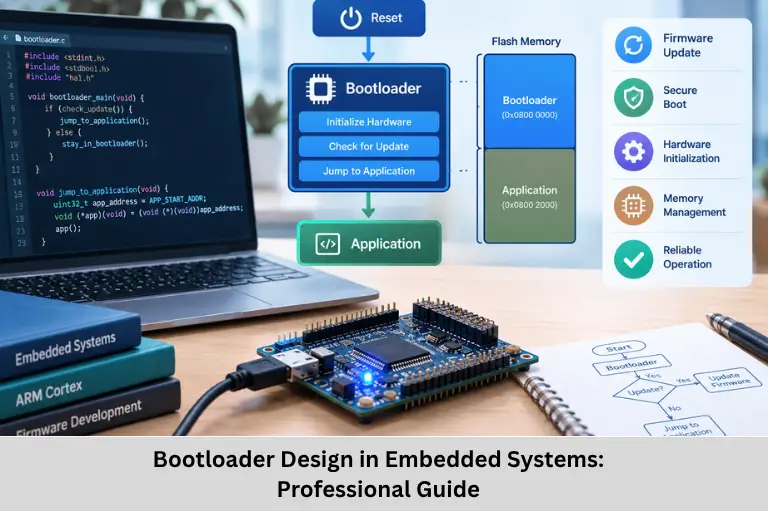
Learn bootloader design in embedded systems, memory layout, firmware updates, secure boot, OTA, validation, rollback, and industry applications. Embedded Tech Development Academy (ETDA).
- Bootloader Design in Embedded Systems: Professional Guide
-
Professional Guide to Bootloader Design in Embedded Systems
- Introduction to Bootloader Design in Embedded Systems
- What Is a Bootloader in Embedded Systems?
- Bootloader Execution Flow
- Memory Architecture and Bootloader Placement
- Firmware Update Mechanisms
- Security Considerations in Bootloader Design
- Bootloader vs Application Responsibilities
- Common Bootloader Design Challenges
- Industry Applications of Bootloaders
- Frequently Asked Questions
- Conclusion
Professional Guide to Bootloader Design in Embedded Systems
Introduction to Bootloader Design in Embedded Systems
In modern embedded products, the bootloader is a critical software component responsible for controlling the system startup sequence, validating firmware, managing software updates, and safely transferring execution to the main application. From resource-constrained 8-bit microcontrollers to powerful 32-bit ARM-based microcontrollers and SoCs, bootloader architecture directly influences firmware reliability, security, maintainability, and field-serviceability.
Unlike a desktop operating system boot process, an embedded bootloader operates under strict flash memory, RAM, processing-time, hardware initialization, and reliability constraints. It must be small enough to fit into a dedicated memory region while providing essential functions such as reset handling, application validation, firmware authentication, flash programming, image management, communication protocol handling, and application handoff.
Modern embedded development increasingly requires knowledge of firmware architecture, embedded C programming, microcontroller boot sequence, flash memory management, secure boot, firmware update mechanisms, OTA updates, ARM Cortex-M architecture, device drivers, communication protocols, and embedded systems security. Embedded Tech Development Academy (ETDA) helps engineers develop these practical embedded software skills through industry-oriented learning. For learners searching for a Top Embedded Training Institute in Bangalore, Embedded Tech Development Academy (ETDA) combines technical training with practical project exposure and assured placement support.
What Is a Bootloader in Embedded Systems?
A bootloader is a small software program that executes after reset or power-on and before the main application firmware. Its primary responsibility is to initialize the minimum hardware required for startup, determine whether valid application firmware exists, optionally perform firmware update operations, and transfer control to the application.
Why Is a Bootloader Required?
A bootloader allows firmware to be programmed or updated without requiring a dedicated external programmer every time. It is especially valuable for products deployed in factories, vehicles, industrial environments, medical equipment, and remote Internet of Things (IoT) installations.
Typical Bootloader Responsibilities
- Minimal hardware initialization
- Firmware integrity verification
- Firmware authentication
- Flash erase and programming
- Firmware version management
- Update-state management
- Application image selection
- Safe application execution
Bootloader Design Objective
The bootloader should remain small, deterministic, stable, and independently maintainable. Application-specific functionality should generally remain outside the bootloader to reduce complexity and attack surface.
Bootloader Execution Flow
The boot process normally follows a controlled sequence.
Reset Vector Execution
After reset, the processor obtains the initial stack pointer and reset-handler address from the vector table according to the device architecture. On ARM Cortex-M systems, the vector table is particularly important because it defines exception and interrupt entry addresses.
Bootloader Startup
The bootloader initializes only essential resources such as the stack, clock configuration, memory interface, watchdog handling, and communication peripherals required for update operations.
Firmware Validation
The bootloader checks whether the application image is valid. Validation may involve a CRC, checksum, cryptographic hash, digital signature, image header, version number, or hardware-specific authentication mechanism.
Update Decision
The bootloader determines whether to enter firmware-update mode or launch the existing application. The decision can depend on a GPIO boot request, communication command, update flag, invalid application image, watchdog recovery condition, or service-mode request.
Application Handoff
Before transferring execution, the bootloader configures the application environment, loads the application’s initial stack pointer, updates the vector-table location when required, disables or resets bootloader-specific interrupts and peripherals, and branches to the application’s reset handler.
Memory Architecture and Bootloader Placement
Memory planning is one of the most important parts of bootloader development. Flash is typically divided into logical regions.
Bootloader Region
The bootloader occupies a dedicated flash area and may be protected against accidental writes or unauthorized modification.
Application Region
The main application firmware is stored in a separate flash region. Its starting address must match the linker configuration and vector-table arrangement.
Metadata Region
A dedicated area may store firmware version, image size, CRC/hash, update status, hardware compatibility information, and boot flags.
Dual-Image Architecture
Advanced products can maintain two firmware images, such as primary and secondary slots. A newly downloaded image can be validated before becoming the active firmware, allowing rollback when an update fails.
Memory Planning Considerations
Engineers must account for flash-sector boundaries, erase/write granularity, application growth, metadata size, RAM requirements, bootloader expansion, and future firmware versions during product architecture.
Firmware Update Mechanisms
UART and USB Bootloading
UART and USB are commonly used for development, factory programming, servicing, and local firmware updates.
CAN-Based Firmware Updates
Automotive ECUs frequently use CAN-based diagnostic and programming mechanisms for firmware updates and service operations.
Ethernet and RS-485 Updates
Industrial controllers can use Ethernet or RS-485 communication for firmware deployment depending on network architecture and protocol requirements.
Over-the-Air Updates
Internet of Things (IoT) and connected embedded devices can support OTA firmware updates through Wi-Fi, Bluetooth, cellular networks, or other wireless communication technologies.
Fail-Safe Firmware Updates
A robust update mechanism should prevent an interrupted transfer or power failure from leaving the device without executable firmware. Techniques include image validation, transactional update states, dual-bank flash, redundant images, and rollback mechanisms.
Security Considerations in Bootloader Design
Security is a fundamental requirement for connected and safety-critical embedded products.
Secure Boot
Secure boot verifies the authenticity and integrity of firmware before allowing execution. Digital signatures and cryptographic verification can establish a chain of trust from immutable or protected boot code to application firmware.
Firmware Authentication
The bootloader should reject firmware that does not originate from an authorized source or does not pass cryptographic verification.
Flash Protection
Microcontrollers often provide hardware mechanisms for protecting critical flash regions against unauthorized modification or read access.
Anti-Rollback Protection
Version counters or monotonic security metadata can prevent attackers from installing older firmware containing known vulnerabilities.
Root of Trust
A secure boot architecture typically establishes a root of trust using protected code, keys, hardware security features, or secure storage. This creates a trusted foundation for subsequent firmware verification.
Bootloader vs Application Responsibilities
| Bootloader | Application |
|---|---|
| Startup validation | Main product functionality |
| Firmware update | Full peripheral management |
| Image authentication | Communication stacks |
| Flash programming | RTOS/task management |
| Application handoff | Business/application logic |
This separation makes the bootloader easier to test, secure, and maintain throughout the product lifecycle.
Common Bootloader Design Challenges
Limited Memory
Bootloaders must operate within strict flash and RAM limits.
Interrupted Updates
Power loss or communication failure during flash programming can corrupt firmware unless redundant-image or recovery mechanisms are implemented.
Hardware Revisions
A bootloader may need to identify compatible hardware revisions before accepting a firmware image.
Long-Term Maintainability
Version compatibility, update protocols, flash layout, security keys, and recovery procedures must be considered throughout the product lifecycle.
Industry Applications of Bootloaders
Automotive Embedded Systems
Bootloaders support ECU programming, diagnostic firmware updates, secure firmware deployment, and field servicing.
Industrial Automation
Industrial controllers, robotics, motor controllers, and process-control systems can receive controlled firmware updates without replacing hardware.
Consumer Electronics
Smart appliances, cameras, networking devices, and other connected products use bootloaders for reliable firmware upgrades.
Medical Devices
Medical embedded systems require controlled firmware deployment, image validation, and strong protection against unauthorized software.
Frequently Asked Questions
What is a bootloader in embedded systems?
A bootloader is software that executes after reset and prepares the system to launch, validate, or update the main application firmware.
Why is a bootloader important?
It enables controlled startup, firmware validation, device programming, firmware upgrades, recovery mechanisms, and, when implemented with appropriate security features, protection against unauthorized firmware execution.
Where is a bootloader stored?
The bootloader is normally stored in a dedicated flash-memory region, often protected against accidental or unauthorized modification.
Can a bootloader support remote firmware updates?
Yes. Bootloaders can support remote or network-based firmware updates through mechanisms such as CAN, Ethernet, Wi-Fi, Bluetooth, or cellular communication, depending on the system architecture.
What is secure boot?
Secure boot is a mechanism that verifies firmware authenticity and integrity before allowing the firmware to execute, helping prevent unauthorized or modified software from running.
Conclusion
Bootloader design is a fundamental part of professional embedded system design and firmware engineering, providing the foundation for reliable startup, application validation, firmware programming, secure boot, flash management, OTA updates, recovery, and long-term product maintainability. A well-engineered bootloader must carefully balance memory usage, execution flow, flash-sector management, communication protocols, firmware authentication, rollback protection, hardware compatibility, and recovery mechanisms while keeping the trusted code base as small and reliable as possible.
As automotive electronics, industrial automation, Internet of Things (IoT), medical devices, robotics, and connected products increasingly depend on secure and remotely maintainable firmware, expertise in bootloader development, Embedded C, ARM microcontrollers, flash memory, firmware update architecture, secure boot, OTA mechanisms, and embedded security has become highly valuable.
Embedded Tech Development Academy (ETDA) provides practical, industry-oriented embedded systems training that helps learners understand these concepts through hands-on development and real-world projects. For engineers looking for a Top Embedded Training Institute in Bangalore, Embedded Tech Development Academy (ETDA) offers structured technical learning along with assured placement support, helping aspiring embedded professionals build practical skills for firmware and embedded software careers.
Choosing Embedded Tech Development Academy (ETDA) can therefore help learners strengthen their bootloader and embedded firmware expertise while receiving assured placement support from a Top Embedded Training Institute in Bangalore.
Author: ETDA Trainers
Experience: 10+ Years of Industry Experience in Embedded Systems, IoT, and Embedded C Programming