
Number Systems in Digital Electronics: Binary, Octal & Hex
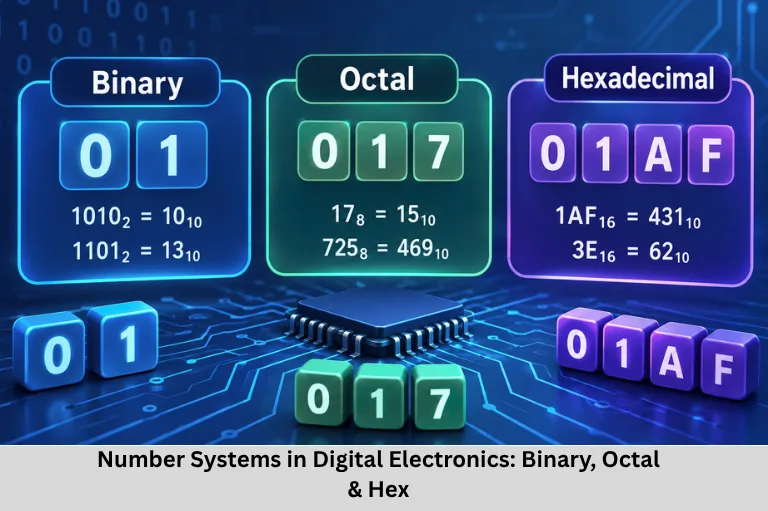
Learn binary, octal, decimal and hexadecimal number systems, conversions, arithmetic, complements and applications in digital electronics and embedded systems. Embedded Tech Development Academy (ETDA).
- Number Systems in Digital Electronics: Binary, Octal & Hex
-
Number Systems in Digital Electronics: Binary, Octal and Hexadecimal
- Introduction to Number Systems in Digital Electronics
- What Is a Number System?
- Decimal Number System
- Binary Number System
- Binary and Decimal Conversion
- Binary Arithmetic and Complements
- Octal Number System
- Hexadecimal Number System
- Hexadecimal Conversion and Embedded Applications
- Comparison of Number Systems
- Applications in Digital Electronics and Embedded Systems
- Frequently Asked Questions
- Conclusion
Number Systems in Digital Electronics: Binary, Octal and Hexadecimal
Introduction to Number Systems in Digital Electronics
Digital electronics forms the foundation of modern computers, microcontrollers, embedded systems, communication devices, processors, memory systems, and digital control applications. Unlike analog electronics, where signals vary continuously, digital systems process information using discrete logic states, typically represented by 0 and 1. These two states correspond to electrical conditions such as LOW and HIGH, making binary representation fundamental to digital hardware.
To store, process, transmit, and manipulate digital information efficiently, engineers use different number systems. The most important systems are decimal, binary, octal, and hexadecimal. Decimal is commonly used by humans, while binary is directly related to digital hardware. Octal and hexadecimal provide compact representations of long binary values.
Understanding number-system conversion, binary arithmetic, hexadecimal notation, positional notation, bits, bytes, logic levels, memory addresses, registers, and digital data representation is essential for students working with digital electronics and embedded programming.
For embedded engineers, number systems are not merely mathematical concepts. Hexadecimal values frequently appear while programming microcontrollers, registers, memory addresses, communication frames, timers, GPIO configurations, and peripheral control registers. Embedded Tech Development Academy (ETDA) helps learners develop these technical foundations through industry-oriented embedded systems education. Students looking for a Top Embedded Training Institute in Bangalore can build practical electronics and programming skills with assured placement support.
What Is a Number System?
Definition of Number System
A number system is a method of representing numerical values using a defined set of symbols and positional rules. Every number system has a base or radix, which determines the number of unique digits available.
Common Number Systems
- Decimal – Base 10
- Binary – Base 2
- Octal – Base 8
- Hexadecimal – Base 16
Positional Notation
The value of a digit depends on its position. For example:
452₁₀ = 4 × 10² + 5 × 10¹ + 2 × 10⁰
Therefore, positional notation is the mathematical foundation for representing numbers in digital systems.
Decimal Number System
Base and Digits
The decimal number system uses base 10 and contains ten digits:
0, 1, 2, 3, 4, 5, 6, 7, 8, 9
Decimal Representation
For example:
452₁₀ = 4 × 100 + 5 × 10 + 2 × 1
Decimal is primarily used for human-readable numerical representation and is commonly converted into binary or hexadecimal when working with digital hardware.
Binary Number System
Binary Representation
The binary number system uses base 2 and contains only two digits:
0 and 1
Each binary digit is called a bit.
Why Binary Is Used in Electronics
Digital circuits naturally operate using two distinguishable logic states.
| Binary | Digital State |
|---|---|
| 0 | LOW / OFF |
| 1 | HIGH / ON |
Binary Positional Values
Each binary position represents a power of 2.
For example:
1011₂ = 1×2³ + 0×2² + 1×2¹ + 1×2⁰
= 8 + 0 + 2 + 1 = 11₁₀
Binary and Decimal Conversion
Binary to Decimal
Consider:
1101₂
Expansion:
1×2³ + 1×2² + 0×2¹ + 1×2⁰
= 8 + 4 + 0 + 1 = 13₁₀
Therefore:
1101₂ = 13₁₀
Decimal to Binary
Decimal-to-binary conversion uses repeated division by 2.
Example: Convert 13 to Binary
| Division | Quotient | Remainder |
|---|---|---|
| 13 ÷ 2 | 6 | 1 |
| 6 ÷ 2 | 3 | 0 |
| 3 ÷ 2 | 1 | 1 |
| 1 ÷ 2 | 0 | 1 |
Reading the Result
Reading the remainders from bottom to top gives:
13₁₀ = 1101₂
Binary Arithmetic and Complements
Binary Addition
The basic binary addition rules are:
| A | B | Sum |
|---|---|---|
| 0 | 0 | 0 |
| 0 | 1 | 1 |
| 1 | 0 | 1 |
| 1 | 1 | 10 |
Example
  1010
+ 0011
------
  1101
Binary Complements
The 1’s complement is obtained by inverting every bit.
1010 → 0101
The 2’s complement is obtained by adding 1 to the 1’s complement:
1010 → 0101 + 1 → 0110
Two’s complement representation is extensively used for signed integers, subtraction, negative numbers, and arithmetic operations inside processors and microcontrollers.
Octal Number System
Base-8 Representation
The octal number system uses base 8 and the digits:
0, 1, 2, 3, 4, 5, 6, 7
Binary Relationship
Because:
2³ = 8
every three binary bits correspond to one octal digit.
Binary to Octal Example
Convert:
101111₂
Group the bits:
101 111
Therefore:
101₂ = 5₈
111₂ = 7₈
So:
101111₂ = 57₈
Octal was particularly useful in older computing systems and remains valuable for understanding compact binary representation.
Hexadecimal Number System
Base-16 Representation
The hexadecimal number system uses base 16. Its digits are:
0–9 and A–F
The letters represent values 10 through 15.
| Hexadecimal | Decimal |
|---|---|
| A | 10 |
| B | 11 |
| C | 12 |
| D | 13 |
| E | 14 |
| F | 15 |
Why Hexadecimal Is Important
Since:
2⁴ = 16
four binary bits correspond to one hexadecimal digit. This makes hexadecimal highly convenient for representing machine data.
Binary to Hexadecimal
Convert:
10101111₂
Group into four bits:
1010 1111
1010 = A
1111 = F
Therefore:
10101111₂ = AF₁₆
Hexadecimal Conversion and Embedded Applications
Hexadecimal to Binary
Consider:
3C₁₆
Convert each hexadecimal digit:
3 = 0011
C = 1100
Therefore:
3C₁₆ = 00111100₂
Decimal to Hexadecimal
Convert 255 to hexadecimal:
255 ÷ 16 = 15 remainder 15
15 ÷ 16 = 0 remainder 15
Since 15 represents F:
255₁₀ = FF₁₆
Microcontroller Applications
Hexadecimal is extensively used in microcontroller programming, register configuration, memory addressing, debugging, machine-level programming, embedded C, and communication protocols.
Register Example
TMOD = 0x01;Here, 0x indicates hexadecimal notation, while 01 is the hexadecimal value being assigned to the register.
Similarly:
PORT = 0xFF;represents an 8-bit value where all bits are set to 1.
Comparison of Number Systems
Technical Comparison
| Number System | Base | Digits |
|---|---|---|
| Decimal | 10 | 0–9 |
| Binary | 2 | 0–1 |
| Octal | 8 | 0–7 |
| Hexadecimal | 16 | 0–9, A–F |
Advantages
- Binary: Directly represents digital logic states.
- Octal: Provides compact three-bit binary representation.
- Hexadecimal: Provides compact four-bit binary representation and is convenient for debugging.
Engineering Relevance
A strong understanding of these representations allows engineers to interpret register values, bit masks, memory locations, instruction codes, communication data, and hardware configurations more efficiently.
Applications in Digital Electronics and Embedded Systems
Binary Applications
Binary is fundamental to:
- Logic gates
- Flip-flops
- Registers
- Processors
- Memory
- Microcontrollers
- Digital communication
Hexadecimal Applications
Hexadecimal is commonly used for:
- Memory addresses
- Embedded C programming
- Microcontroller registers
- Debugging
- Machine code
- Bit manipulation
Embedded Systems
In platforms such as 8051, LPC1768, ARM Cortex-M, and other microcontrollers, engineers frequently work with hexadecimal register values and binary bit fields.
Practical Importance
Understanding the relationship between binary and hexadecimal makes operations such as setting, clearing, toggling, masking, and testing individual bits easier during embedded software development.
Frequently Asked Questions
What is a number system in digital electronics?
A number system is a method of representing numerical information using a defined base and set of digits. Binary, decimal, octal, and hexadecimal are commonly used in digital systems.
Why is binary used in digital electronics?
Binary uses two states, 0 and 1, which correspond naturally to two distinguishable electrical logic states in digital circuits.
Why is hexadecimal used in embedded systems?
Hexadecimal represents four binary bits with a single digit, making long binary values easier to read, debug, and manipulate in microcontroller programming.
What is the difference between 1's and 2's complement?
1’s complement is produced by inverting every binary bit. Two’s complement is obtained by adding 1 to the 1’s complement and is widely used for signed arithmetic.
How are binary and hexadecimal related?
Every hexadecimal digit represents exactly four binary bits because 16 equals 2⁴. For example, hexadecimal A corresponds to binary 1010.
Conclusion
Number systems are a fundamental part of digital electronics, computer architecture, embedded systems, microcontroller programming, digital communication, and hardware-level software development. Binary provides the basic representation used by digital circuits, while decimal provides a convenient human-readable format. Octal and hexadecimal provide more compact representations of binary information.
Understanding binary arithmetic, positional notation, decimal-to-binary conversion, binary-to-decimal conversion, octal conversion, hexadecimal conversion, 1’s complement, 2’s complement, bit representation, logic levels, and hexadecimal register notation enables engineers to understand how digital hardware represents and processes information.
For embedded engineers, these concepts become especially important when working with microcontroller registers, GPIO configuration, timers, memory addresses, bitwise operators, communication protocols, embedded C, processor architecture, and debugging tools. Embedded Tech Development Academy (ETDA) focuses on practical technical learning that helps students connect digital electronics concepts with real embedded-system development. Learners searching for a Top Embedded Training Institute in Bangalore can strengthen their embedded programming and electronics foundations while receiving assured placement support.
Building strong fundamentals in number systems is therefore an important step toward advanced topics such as microcontrollers, embedded C programming, computer architecture, RTOS, digital communication, and hardware-software interfacing. Embedded Tech Development Academy (ETDA) provides industry-oriented learning to help aspiring engineers develop these technical skills. For students seeking a Top Embedded Training Institute in Bangalore, combining theoretical understanding with practical projects and assured placement support can provide a stronger foundation for an embedded engineering career.
Author: ETDA Trainers
Experience: 10+ Years of Industry Experience in Embedded Systems, IoT, and Embedded C Programming