
Memory Partitioning Techniques in Linux for Embedded Systems
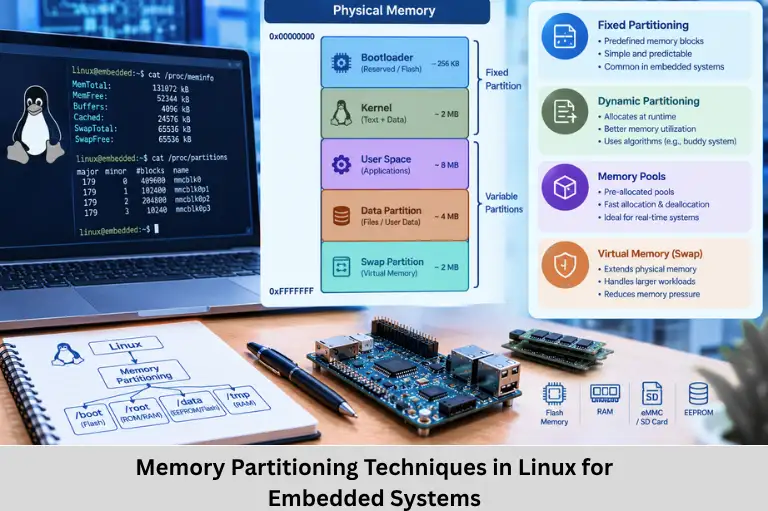
Learn memory partitioning in Linux for embedded systems, including single, fixed, variable, virtual memory, fragmentation, memory zones and real-time allocation. Embedded Tech Development Academy (ETDA).
- Memory Partitioning Techniques in Linux for Embedded Systems
-
Memory Partitioning Techniques in Linux for Embedded Systems
- Introduction to Memory Partitioning in Linux
- Why Memory Partitioning Matters in Embedded Linux
- Single Partition Allocation
- Fixed Partition Allocation
- Variable Partition Allocation
- Virtual Memory and Memory Partitioning
- Fragmentation in Linux Memory Management
- Memory Partitioning for Real-Time Embedded Systems
- Reserved Memory in Embedded Linux
- Practical Memory Partitioning Considerations
- Frequently Asked Questions
- Conclusion
Memory Partitioning Techniques in Linux for Embedded Systems
Introduction to Memory Partitioning in Linux
Modern embedded systems increasingly use Linux to run complex applications involving device drivers, networking stacks, sensor processing, graphical interfaces, databases, multimedia frameworks, and the Internet of Things (IoT). As the number of software components increases, efficient memory management in Linux becomes essential for maintaining system stability, performance, and reliability.
Memory partitioning is a fundamental concept in operating-system memory management. It involves logically dividing available memory into regions that can be assigned to the kernel, applications, buffers, drivers, and other system components. Traditional techniques such as single partition allocation, fixed partition allocation, and variable partition allocation provide the conceptual foundation for understanding how memory resources can be organized.
Modern Linux does not simply divide RAM into traditional partitions for every process. Instead, it combines virtual memory, paging, page tables, memory zones, allocators, protection mechanisms, and physical memory management. Understanding traditional partitioning concepts helps embedded engineers understand why these mechanisms exist and how memory is allocated.
Memory partitioning is particularly important for resource-constrained embedded systems, where RAM, CPU resources, and storage capacity may be limited. Applications involving automotive controllers, industrial automation, robotics, smart devices, and Internet of Things (IoT) gateways require predictable and efficient memory usage.
For learners building professional skills in Linux, C/C++, microcontrollers, and embedded systems, Embedded Tech Development Academy (ETDA) provides practical technical learning. As a Top Embedded Training Institute in Bangalore, Embedded Tech Development Academy (ETDA) focuses on embedded technologies with practical exposure and assured placement support. Understanding memory management is an important part of developing reliable Linux-based embedded applications.
Why Memory Partitioning Matters in Embedded Linux
Limited RAM and Multiple Software Components
An embedded Linux device may simultaneously execute a Linux kernel, device drivers, application processes, networking services, logging systems, and hardware-monitoring applications.
Memory Isolation and Protection
Linux provides each user-space process with its own virtual address space. A process normally cannot directly access another process’s memory because the Memory Management Unit (MMU) and page tables enforce access permissions.
Memory Efficiency
Efficient memory allocation reduces unnecessary memory consumption and helps applications operate reliably. This is especially important for embedded systems and Internet of Things (IoT) devices with limited RAM.
Single Partition Allocation
Basic Concept
Single partition allocation is one of the simplest memory-management approaches. Physical memory is divided conceptually into an operating-system region and a region available to a single user program.
Operating-System Region
The operating system occupies a protected memory area, while the remaining memory can be assigned to an application.
Limitation in Modern Linux
This approach is unsuitable for general-purpose Linux because modern systems require multitasking. Linux must support multiple processes, shared libraries, kernel services, buffers, and device drivers simultaneously.
The concept remains useful for understanding reserved memory, kernel memory, and user-space memory separation.
Fixed Partition Allocation
Dividing Memory into Fixed Regions
Fixed partition allocation divides available memory into predetermined regions. Each partition can accommodate a process or a specific category of workload.
Internal Fragmentation
A major disadvantage is internal fragmentation. If a process requires less memory than the assigned partition, the unused portion may remain unavailable to other workloads.
Linux Memory Zones
Modern Linux uses memory zones for physical memory management. Depending on the architecture and configuration, zones can include ZONE_DMA, ZONE_DMA32, ZONE_NORMAL, and ZONE_HIGHMEM.
These zones are not identical to traditional fixed partitions, but they demonstrate the concept of separating physical memory according to usage constraints.
For example, DMA-capable hardware may require memory that satisfies particular physical-address requirements. Linux therefore maintains suitable memory areas and allocation policies.
Variable Partition Allocation
Dynamic Memory Allocation
Variable partitioning allocates memory according to the requested size rather than assigning every process a fixed-size region.
User-Space Allocation
In Linux applications, functions such as:
malloc();
calloc();
realloc();
free();
are commonly used for dynamic memory management.
Kernel-Space Allocation
The Linux kernel provides allocation mechanisms such as:
kmalloc();
kzalloc();
vmalloc();
kfree();
These mechanisms serve different purposes. kmalloc() provides physically contiguous memory suitable for many kernel operations, while vmalloc() can provide virtually contiguous memory backed by physically non-contiguous pages.
Variable allocation improves flexibility but can introduce allocation overhead and fragmentation.
Virtual Memory and Memory Partitioning
Virtual Address Spaces
Modern Linux relies heavily on virtual memory. Each process receives a virtual address space that is translated into physical memory through page tables.
Paging Mechanism
Physical memory is divided into fixed-size pages, while virtual address spaces are divided into corresponding virtual pages.
Memory Management Unit
The CPU’s MMU performs address translation using page tables. This provides process isolation, access protection, and flexible physical-memory mapping.
A process may perceive its memory as a continuous address range even when its physical pages are located in different regions of RAM.
Fragmentation in Linux Memory Management
Internal Fragmentation
Internal fragmentation occurs when allocated memory contains unused space within an allocated unit.
For example, if an allocation unit is larger than the actual requirement, part of that unit may remain unused.
External Fragmentation
External fragmentation occurs when free memory exists but is divided into smaller separated regions.
Reducing Fragmentation
Linux uses sophisticated allocators and page-based management to reduce fragmentation. Kernel mechanisms such as the buddy allocator manage physical pages, while the SLAB, SLUB, and SLOB-related allocation mechanisms manage smaller kernel objects depending on kernel configuration.
Understanding fragmentation is essential when designing memory-constrained embedded systems.
Memory Partitioning for Real-Time Embedded Systems
Predictable Memory Behavior
Real-time applications require predictable execution. Uncontrolled dynamic allocation can introduce latency because allocation may require searching for suitable memory or triggering additional memory-management operations.
Pre-Allocated Memory Pools
Real-time applications can use pre-allocated buffers and memory pools to reduce runtime allocation overhead.
Dedicated Memory Regions
A critical task may receive a dedicated memory region while non-critical applications use general-purpose memory. This approach can improve predictability for industrial controllers, robotics, automotive systems, and other embedded systems.
For Internet of Things (IoT) devices, controlled memory usage can also improve reliability when applications continuously process sensor data, communication packets, and device events.
Reserved Memory in Embedded Linux
Device-Specific Memory Requirements
Embedded Linux platforms may reserve portions of RAM for hardware peripherals, firmware interfaces, DMA buffers, frame buffers, multimedia pipelines, or real-time workloads.
Device Tree Reserved Memory
Linux device-tree configurations can describe reserved-memory regions that should not be used by normal memory allocation.
DMA Buffers
DMA buffers allow peripherals to transfer data directly between devices and memory with reduced CPU involvement. Correct memory placement and cache handling are important for reliable DMA operation.
This is especially relevant to embedded systems involving cameras, networking hardware, audio devices, storage controllers, and Internet of Things (IoT) gateways.
Practical Memory Partitioning Considerations
Monitor Memory Consumption
Engineers should monitor RAM usage using Linux utilities such as:
free
cat /proc/meminfo
top
ps
Identify Memory Pressure
High memory consumption can lead to allocation failures, reclaim activity, swapping where configured, or system instability.
Optimize Application Design
Embedded applications should avoid unnecessary dynamic allocation, uncontrolled buffer growth, memory leaks, excessive copying, and inefficient data structures.
Embedded Tech Development Academy (ETDA) emphasizes practical knowledge of Linux, C/C++, memory management, device drivers, and embedded systems concepts. Learners searching for a Top Embedded Training Institute in Bangalore can use such technical foundations when preparing for professional embedded development roles with assured placement support.
Frequently Asked Questions
What is memory partitioning in Linux?
Memory partitioning is the organization of available memory into logical or physical regions for different purposes. Modern Linux combines this concept with virtual memory, paging, memory zones, allocators, and protection mechanisms.
What is fixed partition allocation?
Fixed partition allocation divides memory into predetermined regions. It is simple and predictable but can cause internal fragmentation when allocated partitions are larger than the actual memory requirements.
What is variable partition allocation?
Variable partition allocation assigns memory dynamically according to workload requirements. It provides flexibility but can introduce allocation overhead and external fragmentation.
Why is memory management important in embedded Linux?
Memory management is critical because embedded systems often have limited RAM while running multiple processes, drivers, networking services, and hardware interfaces. Efficient memory usage improves reliability and performance.
How does memory partitioning help IoT devices?
The Internet of Things (IoT) often involves continuous sensor processing, communication, buffering, and data handling. Controlled memory allocation helps prevent excessive memory consumption and improves system stability.
Conclusion
Memory partitioning provides an important conceptual foundation for understanding Linux memory management in embedded systems. Traditional techniques such as single partition, fixed partition, and variable partition allocation explain how operating systems can organize memory according to workload requirements. Modern Linux extends these concepts through virtual memory, paging, page tables, memory zones, buddy allocation, kernel object allocators, reserved memory, and DMA-aware memory management.
For real-time and resource-constrained embedded systems, memory allocation must be considered alongside latency, fragmentation, isolation, cache behavior, DMA requirements, and application workload. Pre-allocated memory pools and dedicated memory regions can provide greater predictability for time-sensitive applications. These principles are equally relevant to Internet of Things (IoT) gateways, industrial controllers, robotics platforms, automotive systems, and connected devices.
Engineers learning Linux memory management should also understand C/C++ pointers, stack and heap organization, dynamic memory allocation, virtual addresses, physical addresses, page tables, kernel memory, device drivers, and memory debugging. Embedded Tech Development Academy (ETDA) provides practical learning around these embedded systems concepts. For learners looking for a Top Embedded Training Institute in Bangalore, Embedded Tech Development Academy (ETDA) combines technical learning with practical exposure and assured placement support.
Building strong Linux and memory-management knowledge can help developers understand how software interacts with RAM, processors, peripherals, and operating-system services. Embedded Tech Development Academy (ETDA) supports learning across embedded programming, Linux, firmware, and Internet of Things (IoT) technologies, making memory management an important technical foundation for embedded development. Learners seeking a Top Embedded Training Institute in Bangalore can develop these skills alongside practical embedded projects and assured placement support.
In modern embedded systems, efficient memory partitioning is not simply about dividing RAM into blocks. It is about controlling allocation, protecting address spaces, minimizing fragmentation, meeting hardware constraints, and maintaining predictable system behavior. These principles make memory management a core topic for engineers working with Linux-based Internet of Things (IoT) devices and advanced embedded platforms.
Author: ETDA Trainers
Experience: 10+ Years of Industry Experience in Embedded Systems, IoT, and Embedded C Programming