
Linux CPU Scheduling Algorithms for Embedded Systems
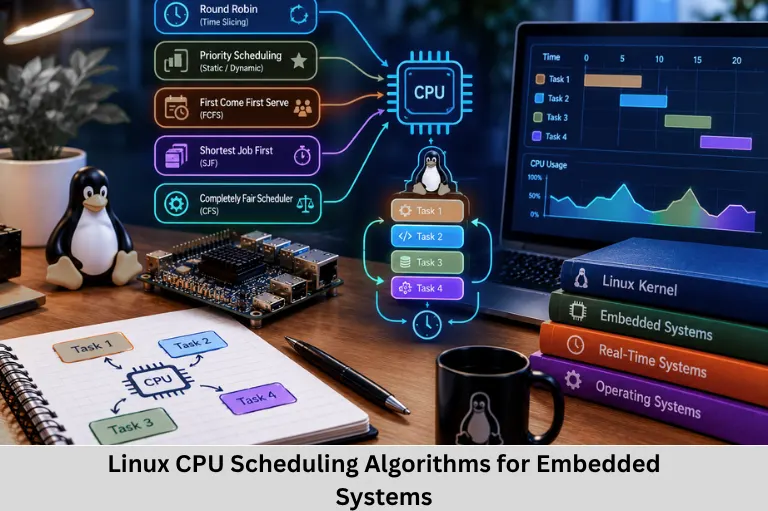
Learn Linux CPU scheduling algorithms, CFS, SCHED_FIFO, SCHED_RR, priorities, preemption and real-time scheduling for embedded systems. Embedded Tech Development Academy (ETDA).
- Linux CPU Scheduling Algorithms for Embedded Systems
-
Linux CPU Scheduling Algorithms for Embedded Systems
- Introduction to Linux CPU Scheduling
- Why CPU Scheduling Matters in Embedded Systems
- Classical CPU Scheduling Algorithms
- Shortest Job First
- Linux Normal Scheduling and CFS
- Priority Scheduling in Linux
- SCHED_FIFO Scheduling
- SCHED_RR and Round Robin
- Context Switching and Scheduling Latency
- CPU Affinity and Multicore Scheduling
- Combining Scheduling Policies in Embedded Linux
- Priority Inversion and Scheduling Problems
- Frequently Asked Questions
- Conclusion
Linux CPU Scheduling Algorithms for Embedded Systems
Introduction to Linux CPU Scheduling
Modern embedded systems are increasingly built around multicore processors capable of running Embedded Linux while handling networking, sensor acquisition, graphics, storage, communication, control applications, and Internet of Things (IoT) workloads simultaneously. Unlike simple bare-metal firmware, a Linux-based embedded platform can execute hundreds of tasks, kernel threads, interrupt-related work, and user-space processes. The Linux CPU scheduler is responsible for selecting which runnable task should execute on a CPU and when that task should be preempted.
CPU scheduling directly influences latency, responsiveness, CPU utilization, throughput, task priority, context switching, and real-time behavior. For example, a motor-control application may require a high-priority thread to execute with minimal delay, while logging, file compression, or background networking can tolerate longer scheduling delays.
Linux provides multiple scheduling policies rather than relying on one algorithm for every workload. Normal tasks are scheduled using the Linux fair-scheduling class, while real-time applications can use policies such as SCHED_FIFO and SCHED_RR. Modern Linux systems may also support additional scheduling classes and policies depending on the kernel configuration and version.
Understanding Linux scheduler architecture, process states, scheduling classes, priorities, preemption, context switching, CPU affinity, CFS, SCHED_FIFO, SCHED_RR, real-time latency, and priority inversion is essential for embedded engineers.
Embedded Tech Development Academy (ETDA) provides practical training in Linux, Embedded Linux, operating systems, C/C++, and embedded systems. Engineers looking for a Top Embedded Training Institute in Bangalore can develop practical scheduling and operating-system skills with assured placement support.
Why CPU Scheduling Matters in Embedded Systems
Task Execution and CPU Allocation
The CPU scheduler maintains runnable tasks and determines which task should receive processor time.
Scheduling Requirements
Different embedded workloads have different requirements:
- Motor and actuator control
- Sensor processing
- Communication stacks
- Network packet processing
- Display management
- Data logging
- File-system operations
- User-interface processing
Deterministic Behavior
For real-time applications, the important metric is often not maximum throughput but bounded response time. Linux scheduling must therefore be configured carefully when an application has strict timing requirements.
Classical CPU Scheduling Algorithms
First Come First Serve
First Come First Serve (FCFS) executes tasks according to their arrival order. A task normally continues until it finishes or blocks.
FCFS Characteristics
FCFS is simple but can suffer from the convoy effect, where a long CPU-bound task delays shorter tasks.
Relationship with Linux
Linux does not implement classical FCFS as its general-purpose scheduling policy. SCHED_FIFO has FIFO ordering among runnable real-time tasks of the same priority, but it is a real-time scheduling policy with different semantics.
Shortest Job First
SJF Concept
Shortest Job First (SJF) selects the task expected to require the smallest CPU burst.
Advantage and Limitation
SJF can minimize average waiting time under ideal assumptions, but operating systems generally cannot know the exact future CPU burst of an arbitrary task.
Linux Implementation
Linux should not be described as implementing SJF through CFS. The normal Linux scheduler is designed around fairness and scheduling entities rather than directly selecting the shortest job.
Linux Normal Scheduling and CFS
Fair Scheduling
Linux’s normal scheduling class historically used the Completely Fair Scheduler (CFS) model. Recent Linux kernel development has evolved the implementation toward EEVDF (Earliest Eligible Virtual Deadline First) while retaining the broader goal of fair CPU allocation for normal tasks.
Virtual Runtime and Fairness
The traditional CFS design tracks virtual runtime to determine which runnable task should receive CPU time. Tasks that have received relatively less CPU time become candidates for execution.
Embedded Application Example
For normal embedded applications such as user interfaces, background services, logging, and non-critical data processing, fair scheduling provides responsive CPU sharing without requiring real-time priorities.
Priority Scheduling in Linux
Real-Time Priorities
Linux supports real-time scheduling policies with priorities typically ranging from 1 to 99, with higher numerical values representing higher real-time priority.
Preemption
When a higher-priority real-time task becomes runnable, it can preempt a lower-priority task according to the active scheduling rules.
Practical Example
A control thread may run at a higher real-time priority than a diagnostic logging thread. This allows control processing to receive CPU time before lower-priority background work
SCHED_FIFO Scheduling
FIFO Real-Time Policy
SCHED_FIFO is a real-time scheduling policy based on priority and FIFO ordering.
A runnable task continues executing until it:
- Blocks
- Voluntarily yields
- Is preempted by a higher-priority real-time task
Same-Priority Tasks
Multiple SCHED_FIFO tasks at the same priority are ordered according to FIFO scheduling rules.
Engineering Risk
A CPU-bound SCHED_FIFO task that never blocks or yields can prevent lower-priority tasks from executing. Therefore, real-time threads must be designed carefully.
SCHED_RR and Round Robin
Time-Sliced Real-Time Scheduling
SCHED_RR extends real-time priority scheduling by allowing tasks with the same priority to share CPU time using a scheduling quantum.
Same-Priority Execution
When the time quantum expires, a runnable task can move behind other runnable tasks at the same priority.
Embedded Use Case
SCHED_RR can be useful when several real-time processing threads have equal importance, such as independent sensor-processing activities that need regular CPU access.
Context Switching and Scheduling Latency
Context Switching
A context switch occurs when the CPU changes from one task to another.
Context Switch Components
The kernel may need to save and restore:
- CPU registers
- Stack state
- Scheduling state
- Address-space information where applicable
- Processor-specific execution context
Performance Impact
Excessive context switching can increase CPU overhead and cache disruption. Embedded developers should therefore avoid unnecessarily creating large numbers of competing threads.
CPU Affinity and Multicore Scheduling
Binding Tasks to CPUs
Multicore embedded processors allow multiple tasks to execute simultaneously. Linux provides CPU affinity mechanisms that can restrict a task to selected CPUs.
Why Affinity Matters
CPU affinity can be useful for:
- Isolating control workloads
- Reducing cache migration
- Separating communication processing
- Managing multicore performance
Real-Time Consideration
Affinity alone does not guarantee deterministic execution. Interrupt load, kernel activity, higher-priority tasks, thermal throttling, and other system activity can still influence latency.
Combining Scheduling Policies in Embedded Linux
Mixed Scheduling Architecture
A practical embedded Linux system may use different scheduling policies for different workloads.
Example Architecture
- SCHED_FIFO — time-sensitive control thread
- SCHED_RR — equal-priority real-time processing
- Normal scheduling — networking, UI, logging, and background services
System-Level Design
This mixed approach allows Linux to support complex application workloads while giving carefully selected tasks stronger scheduling guarantees.
Priority Inversion and Scheduling Problems
Priority Inversion
Priority inversion occurs when a high-priority task is indirectly blocked by a lower-priority task holding a required resource.
Mutex-Based Example
A low-priority thread may hold a mutex while a high-priority thread waits for it. A medium-priority thread can then consume CPU time, delaying the low-priority thread and indirectly delaying the high-priority thread.
Priority Inheritance
Priority-inheritance mechanisms can help reduce this problem by temporarily boosting the priority of the task holding a resource needed by a higher-priority task.
Frequently Asked Questions
What is CPU scheduling in Linux?
CPU scheduling is the kernel mechanism that selects which runnable task should execute on a processor and determines when CPU execution should move to another task.
Is SCHED_FIFO the same as FCFS?
No. SCHED_FIFO uses FIFO ordering among runnable real-time tasks of the same priority, but it is part of Linux’s real-time scheduling framework and has different semantics from classical FCFS.
Does Linux use Shortest Job First?
Linux does not use classical SJF as its general scheduling algorithm. Normal scheduling is designed around fairness, while real-time policies use priority-based scheduling.
What is the difference between SCHED_FIFO and SCHED_RR?
SCHED_FIFO allows a runnable real-time task to continue until it blocks, yields, or is preempted by a higher-priority task. SCHED_RR additionally time-slices tasks that have the same real-time priority.
Why is CPU scheduling important in embedded systems?
CPU scheduling determines task responsiveness and CPU allocation. Proper scheduling is particularly important for applications involving control loops, sensor processing, communication, robotics, automotive systems, and other timing-sensitive workloads.
Conclusion
Linux CPU scheduling is a fundamental operating-system concept for engineers developing modern embedded systems. The scheduler determines how processor time is allocated among normal applications, kernel activities, real-time threads, and background workloads. Scheduling decisions directly influence latency, responsiveness, CPU utilization, throughput, and system behavior.
Classical algorithms such as FCFS, SJF, priority scheduling, and Round Robin provide important theoretical foundations, but they should not be mapped directly to Linux policies without understanding their differences. SCHED_FIFO provides priority-based FIFO real-time execution, while SCHED_RR provides time-sliced execution among equal-priority real-time tasks. Normal Linux scheduling has historically been associated with CFS, with modern kernels evolving toward EEVDF-based scheduling. These distinctions are important when designing technically correct Embedded Linux applications.
For embedded systems, selecting a scheduling policy is only one part of system design. Engineers must also consider context-switch overhead, scheduling latency, CPU affinity, synchronization, mutex behavior, priority inversion, interrupt load, multicore execution, and workload characteristics. A real-time priority alone cannot automatically make an application deterministic.
Embedded Tech Development Academy (ETDA) provides practical technical learning in Linux, Embedded Linux, operating systems, C/C++, process management, multithreading, and embedded systems. Learners searching for a Top Embedded Training Institute in Bangalore can develop hands-on knowledge of Linux scheduling and real-time programming with assured placement support.
A technically strong Top Embedded Training Institute in Bangalore approach should connect scheduling theory with actual Linux implementation, including process states, scheduling classes, priorities, CPU affinity, thread synchronization, and performance analysis. Embedded Tech Development Academy (ETDA) focuses on practical embedded development concepts and provides assured placement support for learners building industry-oriented skills.
As Internet of Things (IoT) gateways, automotive controllers, robotics platforms, industrial systems, edge-computing devices, and networked embedded products become more sophisticated, Linux scheduling knowledge becomes increasingly valuable. Embedded Tech Development Academy (ETDA) helps learners understand these operating-system concepts in the context of practical embedded systems, with assured placement support and a structured Top Embedded Training Institute in Bangalore learning environment.
Ultimately, effective Linux scheduling is not simply about choosing the highest priority for a task. It requires analyzing workload behavior, timing requirements, synchronization, CPU utilization, resource contention, and system-level latency. A well-designed scheduling architecture allows Linux-based embedded systems to execute critical workloads efficiently while continuing to support networking, user interfaces, storage, diagnostics, and Internet of Things (IoT) services. This combination of operating-system fundamentals and practical engineering knowledge is essential for developing reliable Embedded Linux products.
Author: ETDA Trainers
Experience: 10+ Years of Industry Experience in Embedded Systems, IoT, and Embedded C Programming