
TinyML & Edge AI for Intelligent Embedded Systems
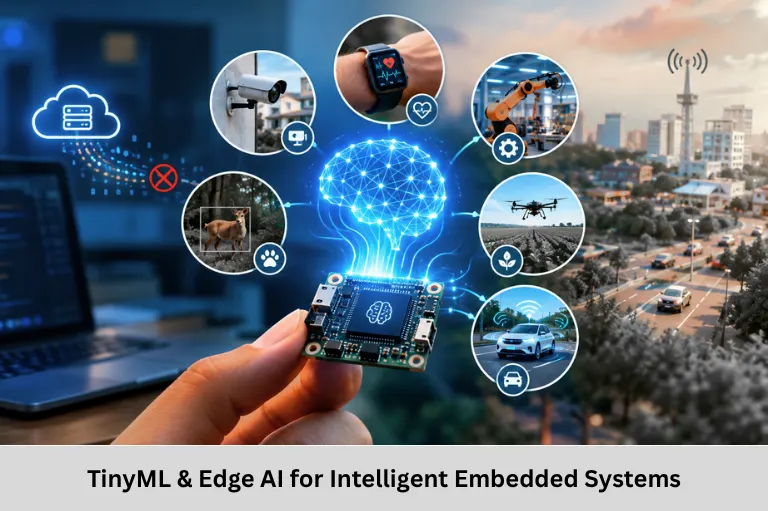
Learn TinyML and Edge AI for embedded systems, including model optimization, quantization, microcontrollers, real-time inference, applications and challenges. Embedded Tech Development Academy (ETDA).
- TinyML & Edge AI for Intelligent Embedded Systems
-
Introduction to TinyML & Edge AI: The Future of Intelligent Embedded Systems
- Introduction to TinyML and Edge AI
- What is Edge AI?
- Understanding TinyML
- Why TinyML and Edge AI Matter
- Technologies Behind TinyML
- TinyML Model Optimization
- Real-World Applications of TinyML and Edge AI
- Challenges in TinyML and Edge AI
- Future of Intelligent Embedded Systems
- Frequently Asked Questions
- Conclusion
Introduction to TinyML & Edge AI: The Future of Intelligent Embedded Systems
Introduction to TinyML and Edge AI
Artificial Intelligence (AI) is rapidly moving from centralized cloud platforms toward intelligent devices capable of processing information locally. Traditional machine-learning systems often transmit large amounts of sensor or user data to cloud servers for analysis. Although cloud computing provides substantial processing power, continuous cloud connectivity can introduce network latency, bandwidth consumption, privacy concerns, and dependency on internet availability. Edge AI and TinyML address these limitations by bringing machine-learning inference closer to the point where data is generated.
Edge AI refers to running AI algorithms on edge devices such as embedded computers, smartphones, industrial controllers, gateways, cameras, and automotive electronic systems. TinyML, a specialized area of Edge AI, focuses on deploying machine-learning models on highly resource-constrained microcontrollers with limited RAM, flash memory, processing capability, and power budgets.
For embedded engineers, TinyML combines embedded C/C++ programming, microcontroller architecture, digital signal processing, sensor interfacing, machine-learning inference, model quantization, memory optimization, and real-time processing. Applications include keyword spotting, vibration analysis, gesture recognition, predictive maintenance, anomaly detection, image classification, and intelligent sensor nodes.
Embedded Tech Development Academy (ETDA) provides practical training in embedded systems, microcontrollers, Internet of Things (IoT), Embedded C/C++, and emerging Edge AI technologies. Students looking for a Top Embedded Training Institute in Bangalore can develop hands-on embedded and AI skills with assured placement support.
What is Edge AI?
Local Intelligence at the Network Edge
Edge AI processes data directly on or near the device generating it instead of sending every raw sample to a remote cloud server.
Edge AI Processing Flow
A typical system follows this sequence:
Sensor → Signal Processing → AI Inference → Decision → Actuator/Communication
Advantages of Local Inference
Local inference reduces communication latency and can allow a device to continue operating when internet connectivity is unavailable. It can also reduce bandwidth requirements because only selected results or events need to be transmitted to the cloud.
Understanding TinyML
Tiny Machine Learning on Microcontrollers
TinyML enables machine-learning inference on microcontrollers with resources measured in kilobytes or a few megabytes rather than the large memory available in conventional computers.
Resource Constraints
TinyML developers must consider:
- RAM usage
- Flash/storage requirements
- CPU cycles
- Inference latency
- Energy consumption
- Model size
- Sensor sampling rate
Embedded Inference
The model is generally trained using more powerful development hardware and then converted, optimized, and deployed to the target microcontroller for local inference.
Why TinyML and Edge AI Matter
Real-Time Decision Making
Many embedded applications require decisions within strict timing constraints.
Low-Latency Processing
An industrial vibration-monitoring node can detect an abnormal frequency pattern locally and immediately generate an alert without waiting for cloud processing.
Deterministic Embedded Behavior
Combining optimized AI inference with real-time firmware techniques can provide predictable response characteristics suitable for embedded applications.
Privacy and Reduced Connectivity
Local processing can prevent sensitive raw data from continuously leaving the device.
Reduced Data Transmission
Instead of transmitting continuous microphone or sensor streams, the device can transmit only an event such as “anomaly detected.”
Offline Operation
Edge inference can continue during temporary network outages, making it useful for remote and industrial environments.
Technologies Behind TinyML
Microcontroller Platforms
Low-power microcontrollers such as ARM Cortex-M devices are widely used for TinyML because they combine efficient processing with low energy consumption.
Hardware Features
Important hardware capabilities include:
- DSP instructions
- Floating-point support where available
- SIMD operations
- Timers
- ADC interfaces
- I2C/SPI peripherals
- Low-power modes
AI Accelerators
Some modern embedded platforms include dedicated neural-processing or AI acceleration hardware to improve inference performance and energy efficiency.
Deployment Pipeline
A typical pipeline is:
Dataset Collection → Preprocessing → Model Training → Quantization → Conversion → Firmware Integration → On-Device Inference
Model Footprint
The deployed model must fit within the available flash and RAM while maintaining acceptable inference accuracy and latency.
TinyML Model Optimization
Quantization
Quantization converts high-precision model parameters, such as floating-point values, into lower-precision representations.
Integer Inference
8-bit integer quantization can significantly reduce memory requirements and improve inference efficiency on suitable microcontrollers.
Accuracy Trade-Off
Quantization must be evaluated carefully because excessive precision reduction can degrade model accuracy.
Pruning
Pruning removes less important weights or connections from a neural network.
Reducing Computation
A smaller model can reduce memory usage and computational requirements.
Hardware Compatibility
The benefits of pruning depend on whether the target inference engine and hardware can efficiently exploit the resulting sparse structure.
Feature Engineering
Instead of processing raw high-volume sensor data, embedded systems can calculate compact features.
Signal Processing
For audio or vibration applications, techniques such as FFT, filtering, windowing, and spectral feature extraction can reduce the data supplied to the model.
Efficient Inference
Good feature extraction can reduce computational complexity while retaining information required for classification.
Real-World Applications of TinyML and Edge AI
Automotive Embedded Systems
Edge AI can support object detection, driver monitoring, sensor fusion, anomaly detection, and predictive maintenance.
Real-Time Vehicle Processing
Local inference is valuable when decisions must be generated quickly and network connectivity cannot be relied upon.
Automotive Reliability
AI models must be validated for latency, accuracy, memory usage, environmental conditions, and safety requirements.
Industrial Automation
TinyML can analyze vibration, temperature, current, acoustic signals, and other machine parameters.
Predictive Maintenance
An embedded node can detect patterns associated with bearing wear or abnormal machine vibration before a major failure occurs.
Edge-Based Monitoring
Local anomaly detection reduces the amount of raw sensor data transmitted to industrial servers.
Healthcare and Wearables
TinyML can process physiological or motion-related signals locally.
Continuous Monitoring
Wearable devices can analyze sensor signals and identify patterns that require further attention.
Power Efficiency
Low-power inference is essential for battery-operated wearable devices that must operate for extended periods.
Smart Homes and IoT
TinyML can be integrated into smart sensors, cameras, voice interfaces, and home-automation devices.
Local Event Detection
Devices can recognize keywords, gestures, occupancy patterns, or abnormal activity locally.
Intelligent IoT Nodes
Combining TinyML with Internet of Things (IoT) communication allows a device to perform local inference while sending only useful results to cloud platforms.
Challenges in TinyML and Edge AI
Limited Hardware Resources
Microcontrollers have significantly fewer resources than desktop processors or cloud servers.
Memory Management
Developers must carefully manage model buffers, stack memory, application variables, sensor buffers, and communication buffers.
Firmware Optimization
Efficient data types, static allocation, optimized algorithms, and appropriate inference libraries are important for reliable deployment.
Model Accuracy and Testing
Reducing model size can affect accuracy.
Validation
Models should be tested using representative real-world datasets rather than relying only on laboratory samples.
Embedded Testing
Testing should cover inference latency, false positives, false negatives, power consumption, memory usage, and environmental variations.
Security
AI-enabled edge devices remain exposed to physical and network attacks.
Firmware Protection
Secure boot, signed firmware, protected credentials, and secure OTA mechanisms can improve device security.
Model Protection
Where required, developers should consider protection against unauthorized extraction or modification of deployed models.
Future of Intelligent Embedded Systems
AI at the Edge
The combination of TinyML, Edge AI, Internet of Things (IoT), embedded Linux, microcontrollers, and specialized accelerators is creating increasingly intelligent edge devices.
Autonomous Embedded Decision Making
Future devices will increasingly perform sensing, analysis, prediction, and control locally.
Industry Opportunities
These technologies are creating opportunities in automotive electronics, robotics, industrial automation, smart manufacturing, healthcare devices, consumer electronics, and Internet of Things (IoT).
Frequently Asked Questions
What is TinyML?
TinyML is the deployment of machine-learning inference on highly resource-constrained devices such as microcontrollers, where memory, processing power, and energy are limited.
What is the difference between TinyML and Edge AI?
Edge AI is the broader concept of running AI near the data source. TinyML focuses specifically on deploying machine-learning models on very small, low-power embedded devices and microcontrollers.
Why is quantization important in TinyML?
Quantization can reduce model memory requirements and computational complexity by representing model parameters and operations with lower numerical precision, such as 8-bit integers.
Which microcontrollers are suitable for TinyML?
ARM Cortex-M microcontrollers are widely used for TinyML. The appropriate device depends on RAM, flash, clock speed, DSP capabilities, power requirements, peripherals, and available AI acceleration.
Where is TinyML used?
TinyML is used in predictive maintenance, keyword spotting, gesture recognition, anomaly detection, smart sensors, wearable devices, automotive systems, industrial automation, robotics, and intelligent IoT products.
Conclusion
TinyML and Edge AI are transforming intelligent embedded systems by moving machine-learning inference closer to sensors and physical devices. Instead of continuously transmitting raw data to cloud platforms, an embedded device can acquire sensor information, preprocess it, execute an optimized machine-learning model, and generate a local decision. This architecture improves response time, reduces bandwidth consumption, supports offline operation, and can improve data privacy.
Technically, successful TinyML development requires more than simply placing an AI model on a microcontroller. Engineers must understand sensor interfacing, signal processing, feature extraction, model architecture, quantization, pruning, memory management, inference latency, power optimization, firmware integration, and embedded debugging. These are essential LSI concepts for developing production-oriented Edge AI systems.
Embedded Tech Development Academy (ETDA) provides practical exposure to embedded programming, microcontrollers, Internet of Things (IoT), AI-enabled embedded applications, and real-time firmware development. Students searching for a Top Embedded Training Institute in Bangalore can build these skills through practical projects while receiving assured placement support.
The future of Internet of Things (IoT) devices will increasingly depend on local intelligence. Smart sensors will not simply collect data; they will analyze signals, detect anomalies, classify events, predict failures, and communicate only meaningful information. This shift will make TinyML, Edge AI, embedded machine learning, sensor analytics, and intelligent edge computing important technologies for next-generation products.
For students and engineers, learning these technologies provides a pathway into rapidly growing technical domains including automotive embedded systems, robotics, industrial automation, predictive maintenance, smart healthcare, consumer electronics, and Internet of Things (IoT). Embedded Tech Development Academy (ETDA) can help learners build practical knowledge of these technologies, while a Top Embedded Training Institute in Bangalore approach combined with assured placement support can connect technical learning with industry-oriented embedded projects.
As semiconductor capabilities improve, microcontrollers and edge processors will provide greater computational performance at lower power levels. Improved AI runtimes, hardware accelerators, optimized neural-network architectures, and efficient model-compression techniques will further expand what can be achieved on embedded hardware.
Ultimately, TinyML and Edge AI represent an important evolution from traditional embedded programming toward intelligent embedded systems. The combination of Embedded Tech Development Academy (ETDA) training, practical microcontroller development, machine-learning optimization, Internet of Things (IoT) connectivity, and assured placement support can prepare engineers for this transition. For learners targeting a Top Embedded Training Institute in Bangalore, developing hands-on expertise in TinyML, Edge AI, embedded C/C++, sensors, and real-time inference can provide a strong technical foundation for building the next generation of intelligent connected devices.
Author: ETDA Trainers
Experience: 10+ Years of Industry Experience in Embedded Systems, IoT, and Embedded C Programming