
STM32 ARM Cortex-M Microcontrollers Guide
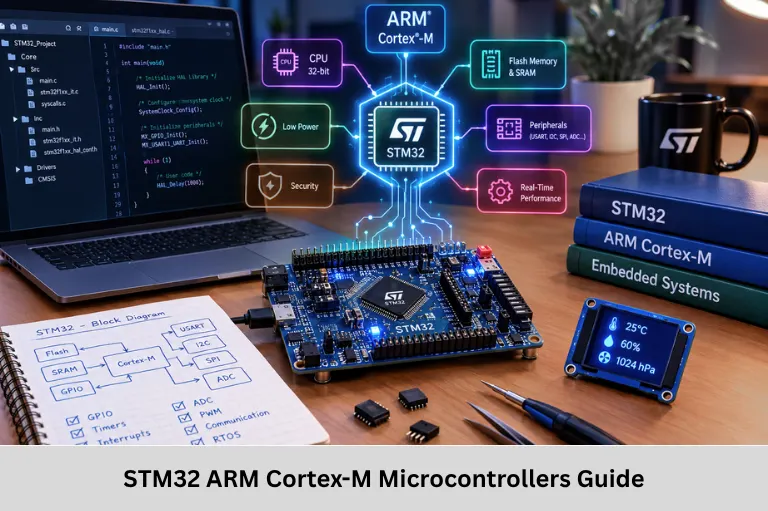
Learn STM32 ARM Cortex-M microcontrollers, architecture, peripherals, IDEs, JTAG, SWD, UART bootloader, programming, debugging and applications. Embedded Tech Development Academy (ETDA).
-
STM32 ARM Cortex-M Microcontrollers Guide
- Introduction to STM32 ARM Cortex-M Microcontrollers
- ARM Cortex-M Architecture
- STM32 Microcontroller Peripherals
- STM32 Software Development Tools
- STM32CubeMX and STM32CubeIDE
- Programming and Debugging STM32
- STM32 Hardware Design and Serial Bootloader
- STM32 Firmware Development Workflow
- Applications of STM32 Microcontrollers
- Frequently Asked Questions
- Conclusion
Introduction to STM32 ARM Cortex-M Microcontrollers
The STM32 microcontroller family is widely used in modern embedded systems because it combines 32-bit ARM Cortex-M processing, efficient power consumption, extensive peripheral integration, and flexible development options. STM32 devices are available across different performance and power ranges, making them suitable for applications such as industrial automation, automotive electronics, Internet of Things (IoT) devices, robotics, motor control, sensor systems, and consumer electronics.
An STM32 microcontroller can integrate GPIO, ADC, DAC, timers, PWM, UART/USART, SPI, I2C, CAN, USB, DMA, and interrupt controllers on a single device. This reduces external hardware requirements while providing firmware developers with extensive control over connected sensors, displays, communication modules, motors, and other electronic components.
The STM32 portfolio includes performance-oriented families such as STM32F-series, mainstream STM32G-series, high-performance STM32H-series, and low-power STM32L-series. The exact clock frequency, memory capacity, package size, peripheral set, and processing capability vary by device.
For engineers, learning STM32 also requires understanding Embedded C, ARM Cortex-M architecture, CMSIS, STM32 HAL/LL drivers, STM32CubeMX, STM32CubeIDE, firmware flashing, debugging, linker scripts, startup code, interrupts, and peripheral configuration.
Embedded Tech Development Academy (ETDA) provides practical embedded systems training covering microcontrollers, Embedded C, communication protocols, debugging, and real-time firmware development. Learners looking for a Top Embedded Training Institute in Bangalore can build practical STM32 development skills with assured placement support.
ARM Cortex-M Architecture
32-Bit Embedded Processing
ARM Cortex-M processors are designed specifically for embedded applications. Compared with traditional 8-bit microcontrollers such as 8051, PIC, and AVR devices, Cortex-M processors provide a larger address space, higher computational capability, and more advanced interrupt and debugging features.
Cortex-M Processor Variants
Common Cortex-M families include:
- Cortex-M0 and M0+
- Cortex-M1
- Cortex-M3
- Cortex-M4
- Cortex-M7
Floating-Point Processing
Some Cortex-M4 and other higher-performance devices include a Floating Point Unit (FPU). FPU support can accelerate mathematical operations used in digital signal processing, motor control, sensor processing, and embedded machine-learning workloads.
STM32 Microcontroller Peripherals
GPIO and Timers
GPIO pins provide digital input and output functionality. Timers provide accurate time measurement, periodic interrupts, input capture, output compare, and PWM generation.
PWM-Based Control
PWM can be used to control motor speed, LED brightness, servo signals, and power electronics.
Timer Configuration
Firmware developers configure timer prescalers, auto-reload values, capture/compare registers, and clock sources according to the required timing characteristics.
Analog and Digital Interfaces
STM32 devices commonly include ADCs for converting analog sensor signals into digital values.
Communication Peripherals
Typical communication interfaces include:
- UART/USART
- SPI
- I2C
- CAN
- USB
Sensor and Actuator Integration
These interfaces allow STM32 controllers to communicate with sensors, EEPROMs, displays, motor drivers, external memory, CAN nodes, and wireless modules.
STM32 Software Development Tools
Integrated Development Environments
STM32 firmware development normally requires an IDE or toolchain containing a compiler, linker, debugger, programming interface, and supporting libraries.
Common Development Environments
Commonly encountered STM32 development tools include:
- Keil MDK with µVision
- IAR Embedded Workbench
- STM32CubeIDE
- STM32CubeMX
- GCC-based ARM toolchains
- Arduino IDE with STM32duino
- MATLAB/Simulink Embedded Coder
Compiler and Debugger
The compiler converts Embedded C/C++ source code into machine instructions, while the debugger allows developers to inspect registers, variables, memory, breakpoints, and program execution.
STM32CubeMX and STM32CubeIDE
Peripheral Configuration
STM32CubeMX helps developers configure clocks, GPIO, timers, ADCs, communication peripherals, interrupts, and middleware through a graphical configuration environment.
Code Generation
After configuration, STM32CubeMX can generate initialization code that can be used with STM32 firmware projects.
HAL and LL Drivers
STM32 projects commonly use HAL (Hardware Abstraction Layer) drivers for easier peripheral development, while Low-Layer (LL) drivers provide more direct and lightweight peripheral control.
Programming and Debugging STM32
JTAG and SWD
ARM Cortex-M microcontrollers support standard debugging technologies including JTAG and Serial Wire Debug (SWD).
Serial Wire Debug
SWD uses fewer physical connections than traditional JTAG and is widely used with ST-LINK debug probes.
Firmware Debugging
Developers can use SWD to program flash memory, set breakpoints, inspect registers, monitor variables, and troubleshoot firmware execution.
STM32 Hardware Design and Serial Bootloader
USB-to-UART Interface
An STM32F103 development board may include a USB-to-UART converter such as the FT232RL. The converter creates a virtual COM port through which a computer can communicate with the microcontroller’s UART.
USART1 Connections
For STM32F103 devices, USART1 commonly uses:
- PA9 → USART1_TX
- PA10 → USART1_RX
Serial Bootloader Programming
The STM32 ROM bootloader can support programming through supported interfaces such as USART, depending on the specific STM32 device and bootloader implementation.
For STM32F103 devices, BOOT0 is used to select the boot mode. When BOOT0 is configured for system-memory boot and the MCU is reset, the internal bootloader can execute instead of the user application.
STM32 Firmware Development Workflow
From Source Code to Flash Memory
A typical STM32 development process follows:
Requirement → CubeMX Configuration → Embedded C Coding → Compilation → Linking → Programming → Debugging → Testing
Build Process
The compiler generates object files from source code. The linker combines these objects with libraries and places program sections according to the STM32 linker script.
Flash Programming
The resulting firmware image is programmed into the microcontroller’s flash memory using an ST-LINK/SWD interface or an appropriate bootloader programming method.
Applications of STM32 Microcontrollers
Industrial and Automotive Systems
STM32 controllers are suitable for industrial control, motor drives, instrumentation, automotive subsystems, and automation equipment.
IoT and Sensor Systems
Their integrated communication and analog peripherals make STM32 devices useful for connected sensor nodes and Internet of Things (IoT) gateways.
Real-Time Embedded Control
Timers, interrupts, DMA, PWM, and communication peripherals allow STM32 firmware to perform deterministic real-time control tasks.
Embedded Tech Development Academy (ETDA) emphasizes these practical microcontroller concepts so learners can understand how STM32 hardware and firmware interact in real embedded products.
Frequently Asked Questions
What is an STM32 microcontroller?
STM32 is a family of 32-bit microcontrollers from STMicroelectronics based primarily on ARM Cortex-M processor cores. Different STM32 families provide different combinations of CPU performance, memory, peripherals, power consumption, and package options.
What programming languages are used for STM32?
Embedded C is the most widely used language for STM32 firmware. C++ can also be used for applications requiring object-oriented programming or larger software architectures.
What is the difference between JTAG and SWD?
JTAG provides a standardized test and debugging interface using multiple signals, while SWD provides a reduced-pin debugging interface specifically suited to ARM Cortex processors. SWD is commonly used with ST-LINK programmers and debuggers.
What is BOOT0 used for in STM32?
BOOT0 helps select the boot source on STM32 devices that implement this boot configuration. On supported STM32F1 devices, setting BOOT0 appropriately and resetting the MCU can start the system-memory bootloader instead of the user application.
Which STM32 tools are useful for beginners?
STM32CubeMX, STM32CubeIDE, ST-LINK, Embedded C, and STM32 HAL provide a practical starting point. Learning GPIO, timers, UART, ADC, SPI, I2C, interrupts, and debugging provides a strong foundation for STM32 development.
Conclusion
The STM32 ARM Cortex-M microcontroller family provides a powerful platform for developing modern embedded systems. Its combination of 32-bit processing, integrated peripherals, timers, ADCs, communication interfaces, DMA, interrupt controllers, and flexible power-management features allows developers to build everything from simple sensor nodes to complex industrial and automotive controllers.
A complete STM32 development workflow involves much more than writing C code. Engineers need to understand ARM Cortex-M architecture, clock configuration, GPIO, ADC, PWM, UART/USART, SPI, I2C, CAN, interrupts, NVIC, DMA, bootloaders, flash programming, linker scripts, startup code, JTAG, SWD, ST-LINK, HAL, LL drivers, and debugging techniques. These LSI concepts form the technical foundation for professional STM32 firmware development.
Embedded Tech Development Academy (ETDA) focuses on practical embedded systems education where learners can work with microcontrollers, Embedded C, communication protocols, debugging tools, and real hardware. Students searching for a Top Embedded Training Institute in Bangalore can strengthen their practical skills through industry-oriented embedded projects and receive assured placement support.
The growing adoption of STM32 microcontrollers in Internet of Things (IoT), robotics, industrial automation, automotive electronics, medical devices, motor control, consumer electronics, and smart embedded products makes Cortex-M knowledge increasingly valuable. A Top Embedded Training Institute in Bangalore should therefore provide hands-on exposure to both firmware development and hardware debugging rather than focusing only on theoretical concepts.
For aspiring embedded engineers, Embedded Tech Development Academy (ETDA) provides a pathway to develop practical knowledge of STM32 development, ARM Cortex-M programming, Embedded C, peripheral interfacing, and real-time firmware. Combining these skills with assured placement support can help learners prepare for embedded software and firmware development roles.
Ultimately, STM32 development is built around the interaction between microcontroller architecture, hardware peripherals, firmware, communication protocols, programming tools, and debugging interfaces. Building strong practical expertise in these areas through Embedded Tech Development Academy (ETDA) can provide a solid foundation for professional embedded development. For learners targeting a Top Embedded Training Institute in Bangalore, hands-on STM32 projects, ARM Cortex-M programming, hardware debugging, and assured placement support can create a strong industry-oriented learning path.
Author: ETDA Trainers
Experience: 10+ Years of Industry Experience in Embedded Systems, IoT, and Embedded C Programming