
IoT Post-Quantum Cryptography: Security & PQC Guide
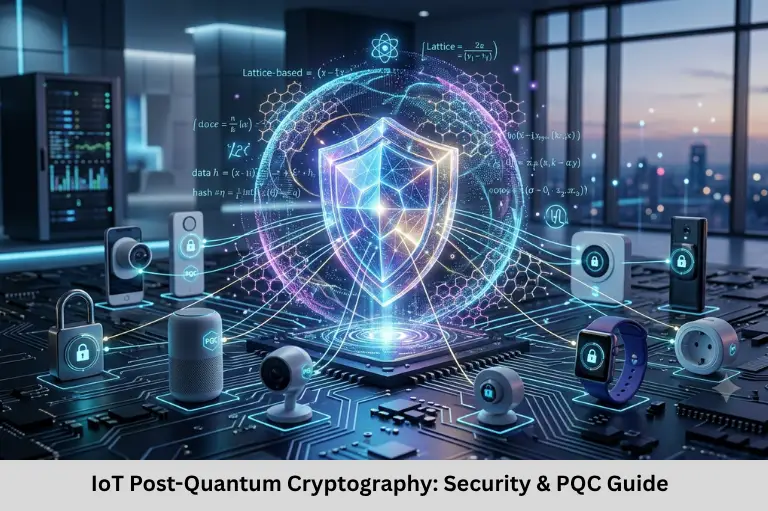
Explore post-quantum cryptography for Internet of Things (IoT), NIST standards, quantum threats, hybrid TLS, secure firmware updates, and PQC migration strategies. Embedded Tech Development Academy (ETDA).
- IoT Post-Quantum Cryptography: Security & PQC Guide
-
IoT Post-Quantum Cryptography: Getting Ready for the Future
- Introduction to Post-Quantum Cryptography in IoT
- What Is Post-Quantum Cryptography?
- Why PQC Is Essential for IoT Security
- Major Algorithm Types for Post-Quantum Cryptography
- Six Steps to Prepare IoT for PQC
- PQC Trade-Offs in IoT Systems
- Building Future-Ready Embedded Security Skills
- Frequently Asked Questions
- Conclusion
IoT Post-Quantum Cryptography: Getting Ready for the Future
Introduction to Post-Quantum Cryptography in IoT
The Internet of Things (IoT) connects billions of devices, including smart meters, industrial sensors, connected vehicles, medical equipment, and home automation controllers. These devices exchange sensitive data and depend on cryptographic mechanisms to authenticate identities, protect communication, verify firmware, and prevent unauthorized access. However, advances in quantum computing may eventually threaten widely used public-key cryptographic algorithms, making post-quantum cryptography (PQC) for Internet of Things (IoT) an important part of future cybersecurity planning.
Traditional algorithms such as RSA, elliptic-curve cryptography (ECC), and Diffie–Hellman key exchange rely on mathematical problems that a sufficiently powerful, fault-tolerant quantum computer could solve using Shor’s algorithm. Although such a machine capable of breaking commonly deployed cryptographic keys is not currently available, attackers may collect encrypted information today and attempt to decrypt it later—a threat known as harvest now, decrypt later.
Preparing Internet of Things (IoT) systems requires more than replacing one algorithm. Engineers must consider microcontroller processing capacity, RAM and flash limitations, firmware-update mechanisms, secure boot, Transport Layer Security (TLS), device identity, and long operational lifetimes. At Embedded Tech Development Academy (ETDA), embedded technology learning can help engineers understand the relationship between microcontrollers, firmware security, and connected-device design. Learners researching the Top Embedded Training Institute in Bangalore can build relevant technical foundations, while assured placement support can help them prepare for technology-related career opportunities.
What Is Post-Quantum Cryptography?
Post-quantum cryptography refers to cryptographic algorithms designed to resist attacks from both classical and quantum computers. Unlike quantum cryptography, PQC generally runs on conventional processors, including embedded microcontrollers and server hardware.
Why Traditional Cryptography Needs Attention
RSA security depends on the difficulty of integer factorization, while ECC and conventional Diffie–Hellman depend on discrete logarithm problems. Shor’s algorithm could solve these problems efficiently on a sufficiently capable quantum computer.
Symmetric encryption, such as AES, is affected differently. Grover’s algorithm can reduce the theoretical search complexity, so appropriate key sizes and security margins remain important. This means quantum migration must evaluate the complete cryptographic system rather than public-key algorithms alone.
Why IoT Devices Are Particularly Vulnerable
Many Internet of Things (IoT) products operate for 10–20 years and may be installed in locations that are difficult or expensive to access. Devices with limited memory, restricted update capability, or unsupported firmware can be challenging to migrate. Consequently, manufacturers should plan for cryptographic upgrades during product design instead of waiting for quantum attacks to become practical.
Why PQC Is Essential for IoT Security
Secure Boot and Firmware Authentication
Secure boot verifies that firmware is authentic and authorized before execution. Digital signatures help the bootloader validate the firmware image. Quantum-resistant signature algorithms can support future-proof firmware authentication, but their larger signatures and verification requirements must be tested against the target hardware.
Secure Communication and Device Authentication
Internet of Things (IoT) gateways and cloud services use TLS to protect data in transit. Public-key cryptography supports authentication and key establishment. PQC-capable key establishment can help protect session keys against future quantum attacks, while quantum-resistant signatures can protect device identities and software updates.
Zero Trust and Post-Quantum Security
Zero Trust assumes that no device or connection should automatically be trusted. Devices must authenticate, receive appropriate permissions, and undergo continuous security evaluation.
PQC supports this model by preparing authentication and key establishment for future cryptographic threats. However, PQC alone does not implement Zero Trust. Device segmentation, access control, identity management, monitoring, and secure configuration remain essential.
Major Algorithm Types for Post-Quantum Cryptography
NIST has published important post-quantum cryptographic standards for real-world adoption.
1. ML-KEM for Key Establishment
ML-KEM (Module-Lattice-Based Key-Encapsulation Mechanism), standardized in FIPS 203, is designed to establish shared secrets over a public channel. It is based on the CRYSTALS-Kyber algorithm family. A shared secret can then be used with symmetric cryptography to protect data.
2. ML-DSA for Digital Signatures
ML-DSA (Module-Lattice-Based Digital Signature Algorithm), standardized in FIPS 204, is derived from CRYSTALS-Dilithium. It supports digital signatures for firmware authenticity, software distribution, and identity verification.
3. SLH-DSA for Digital Signatures
SLH-DSA (Stateless Hash-Based Digital Signature Algorithm), standardized in FIPS 205, is derived from SPHINCS+. It offers a hash-based alternative for digital signatures, with different performance and signature-size trade-offs compared with ML-DSA.
Selecting the Right Algorithm
Selection depends on the purpose, security requirements, implementation maturity, and hardware limitations. Key-establishment algorithms and signature algorithms are not interchangeable: ML-KEM establishes shared secrets, while ML-DSA and SLH-DSA provide digital signatures.
Embedded Implementation Considerations
Measure code size, peak RAM usage, execution time, energy consumption, public-key size, ciphertext size, and signature size on the actual target platform. The best choice is one that satisfies security requirements while remaining practical for the device.
Six Steps to Prepare IoT for PQC
1. Inventory and Classify Devices
Document deployed devices, their cryptographic algorithms, processor architecture, RAM, flash storage, firmware-update capability, communication protocols, and expected service life. This inventory helps identify devices suitable for software upgrades and those requiring gateways or hardware replacement.
2. Implement Crypto-Agility
Crypto-agility means designing software and infrastructure so cryptographic algorithms can be changed without rebuilding the entire product. Use modular cryptographic interfaces, versioned protocols, secure configuration, and authenticated firmware updates. Evaluate compatible libraries such as OpenSSL, wolfSSL, and Mbed TLS for their supported algorithms, versions, and target platforms.
3. Evaluate Hybrid Cryptography
Hybrid key establishment combines a classical algorithm with a post-quantum algorithm. For example, an appropriately configured TLS implementation may combine ECDHE with ML-KEM. The shared secret is derived using the protocol’s specified combination method.
Hybrid deployment can provide transitional compatibility and protection against some classes of algorithm failure, but it increases message sizes and implementation complexity. Test interoperability and use maintained implementations following current standards and deployment guidance.
4. Assess Hardware Acceleration and Memory
Evaluate whether the microcontroller or system-on-chip can support PQC computations, larger cryptographic messages, and increased memory requirements. Consider secure elements, available hardware acceleration, flash expansion, stack usage, and power consumption. Do not assume that every device requires specialized lattice hardware; software implementations may be viable on some platforms.
5. Upgrade Firmware Security
Over-the-air (OTA) update systems should authenticate firmware, protect update metadata, and prevent unauthorized rollback where required. Quantum-resistant digital signatures such as ML-DSA may support future firmware verification.
Legacy devices that cannot validate larger signatures may need a secure update proxy or gateway, but the trust model must ensure that the gateway cannot silently authorize malicious firmware. The end-to-end update design must be reviewed carefully.
6. Participate in Testing and Standards Migration
Use test environments and reputable implementation projects to evaluate PQC interoperability and performance. Monitor NIST publications, relevant IETF standards, and the Open Quantum Safe project for implementation and testing resources. Verify current standards and library support before deployment.
PQC Trade-Offs in IoT Systems
PQC can improve long-term cryptographic resilience, but it introduces engineering trade-offs. Larger keys, ciphertexts, and signatures can increase network bandwidth and storage requirements. Computation may increase latency and energy consumption, especially on small battery-powered devices.
Testing should measure handshake duration, packet fragmentation, memory peaks, boot time, OTA transfer size, and verification time. Security must also account for implementation defects, side-channel attacks, random-number generation, and key management.
Real-World Example: Smart Meter Infrastructure
Consider smart meters designed for a 10-year service life that currently use ECC for secure communication and firmware verification. Millions of deployed meters may be difficult to replace quickly.
A practical migration plan could introduce PQC-capable gateways, test hybrid key establishment between gateways and cloud services, and upgrade meter firmware where hardware permits. New meters can be selected with sufficient memory and cryptographic support for future requirements. Devices that cannot be upgraded securely may need a planned replacement strategy.
Building Future-Ready Embedded Security Skills
PQC migration requires knowledge of embedded C, microcontroller architecture, secure boot, TLS, digital signatures, memory management, and firmware debugging. Embedded Tech Development Academy (ETDA) can help learners develop embedded technology fundamentals through practical technical learning. Those comparing the Top Embedded Training Institute in Bangalore should consider hands-on projects involving microcontrollers, communication protocols, and secure firmware. With assured placement support, learners can work toward roles involving embedded development and connected-device technologies.
Frequently Asked Questions
What is post-quantum cryptography in IoT?
PQC refers to cryptographic algorithms designed to resist attacks from classical and sufficiently capable quantum computers. In IoT, it can help protect device authentication, secure communication, and firmware verification.
Can quantum computers break RSA and ECC?
A sufficiently powerful, fault-tolerant quantum computer running Shor’s algorithm could break commonly deployed RSA and ECC cryptography. Such capability is not currently available at the scale needed to break typical deployed keys.
What are the main NIST post-quantum standards?
Key standards include ML-KEM for key encapsulation, ML-DSA for digital signatures, and SLH-DSA for hash-based digital signatures.
What is hybrid cryptography in IoT?
Hybrid key establishment combines classical and post-quantum methods according to a defined protocol. It can provide a transition path, but requires careful testing for compatibility, security, and performance.
How can an IoT company begin PQC migration?
Start with a cryptographic inventory, classify devices by risk and lifetime, assess firmware-update capabilities, introduce crypto-agility, test PQC algorithms on representative hardware, and plan upgrades or replacements using current standards and guidance.
Conclusion
Post-quantum cryptography is becoming an important consideration for Internet of Things (IoT) cybersecurity because connected devices often remain operational for years, while cryptographic threats and standards continue to evolve. Preparing for quantum-resistant security involves identifying vulnerable algorithms, planning secure firmware updates, adopting crypto-agility, testing hybrid key establishment, and evaluating hardware resources. Device authentication, secure boot, TLS, digital signatures, and Zero Trust controls must be considered together rather than treated as separate security features.
A successful migration should follow established standards, include realistic performance testing, and provide a clear replacement path for devices that cannot be upgraded. Embedded Tech Development Academy (ETDA) supports technical learning in embedded systems, while learners exploring the Top Embedded Training Institute in Bangalore can prioritize practical skills in firmware development and connected-device security. With assured placement support, Embedded Tech Development Academy (ETDA) aims to help learners prepare for technology careers as embedded security requirements continue to evolve.
Author: ETDA Trainers
Experience: 10+ Years of Industry Experience in Embedded Systems, IoT, and Embedded C Programming