
High-Speed Automotive Ethernet: Design and Protocols
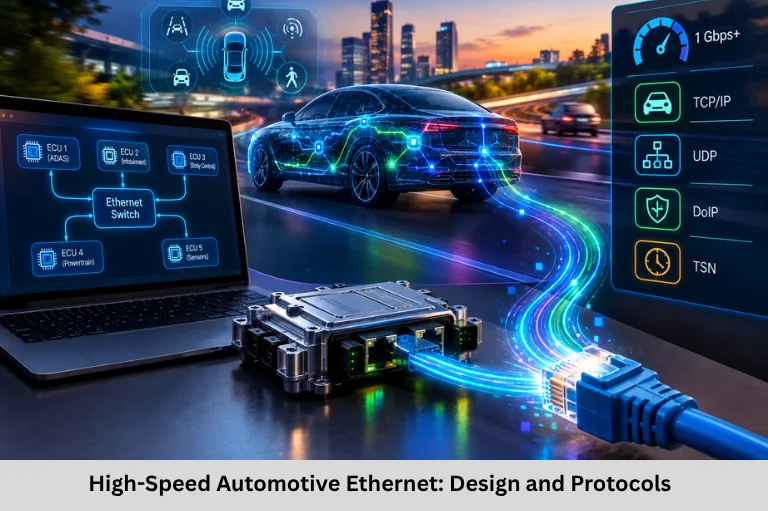
Explore high-speed automotive Ethernet design, PHYs, TCP/IP, SOME/IP, DoIP, TSN, 100BASE-T1, 1000BASE-T1, and vehicle networking applications. Embedded Tech Development Academy (ETDA).
- High-Speed Automotive Ethernet: Design and Protocols
-
High-Speed Automotive Ethernet: Design, Protocols, and Applications
- Introduction to High-Speed Automotive Ethernet
- Automotive Ethernet Architecture
- Automotive Ethernet Physical-Layer Technologies
- Important Automotive Ethernet Protocols
- Time-Sensitive Networking and Synchronization
- Automotive Ethernet Design Challenges
- Real-World Applications of Automotive Ethernet
- Frequently Asked Questions
- Conclusion
High-Speed Automotive Ethernet: Design, Protocols, and Applications
Introduction to High-Speed Automotive Ethernet
Modern vehicles contain numerous electronic control units (ECUs), cameras, radar sensors, infotainment systems, and advanced driver-assistance systems (ADAS). These components continuously exchange data, creating a need for communication networks that provide high bandwidth, predictable latency, low weight, and reliable operation. Automotive Ethernet addresses these requirements by extending Ethernet technology into vehicle environments.
Initially, Ethernet was widely used for ECU diagnostics, software flashing, and data transfer during vehicle development. Today, automotive Ethernet supports high-resolution camera streams, sensor fusion, centralized computing, over-the-air (OTA) software updates, and software-defined vehicle architectures. Single-pair Ethernet technologies also help reduce cable weight and simplify vehicle wiring compared with traditional multi-pair networking approaches.
Understanding automotive Ethernet requires knowledge of the OSI model, physical-layer transceivers, Ethernet frames, TCP/IP, SOME/IP, Diagnostics over IP (DoIP), VLANs, and Time-Sensitive Networking (TSN). Engineers must also consider electromagnetic compatibility (EMC), latency, synchronization, cybersecurity, and fault handling.
Embedded Tech Development Academy (ETDA) supports practical learning in embedded systems, automotive electronics, and communication protocols. Learners researching a Top Embedded Training Institute in Bangalore should prioritize hands-on networking, ECU integration, and protocol debugging. Embedded Tech Development Academy (ETDA)‘s assured placement support can help aspiring engineers prepare for relevant technical career opportunities.
Automotive Ethernet Architecture
Layered Communication Model
Automotive Ethernet uses a layered architecture to separate physical transmission, frame delivery, network routing, transport, and application-level communication.
Physical layer: Transfers electrical signals through automotive Ethernet cables.
Data link layer: Handles Ethernet frames, MAC addressing, and frame error detection.
Network layer: Uses IP addressing and routing to transfer packets between networks.
Transport layer: Uses TCP or UDP according to application requirements.
Application layer: Supports services such as diagnostics, ECU communication, and multimedia data exchange.
Ethernet Switches and ECU Connectivity
An automotive Ethernet switch forwards frames between connected network ports using MAC-address information and configured forwarding rules. Switches can separate traffic using VLANs and apply traffic-management policies when supported.
Domain-Based and Zonal Architectures
In domain-based architectures, ECUs are grouped by function, such as powertrain, body control, or infotainment. Zonal architectures organize connections around physical areas of the vehicle. Both approaches can use Ethernet to connect local controllers with central computing units and gateways.
Automotive Ethernet Physical-Layer Technologies
Single-Pair Ethernet Standards
Automotive Ethernet uses physical-layer technologies designed for vehicle wiring, bandwidth requirements, and electromagnetic conditions.
| Standard | Typical data rate | Common use |
|---|---|---|
| 10BASE-T1S | 10 Mbps | Short-reach networks and edge devices |
| 100BASE-T1 | 100 Mbps | Cameras, ECUs, and control applications |
| 1000BASE-T1 | 1 Gbps | High-bandwidth sensor and backbone links |
| 2.5GBASE-T1 | 2.5 Gbps | Higher-bandwidth vehicle connectivity |
| 5GBASE-T1 | 5 Gbps | Advanced data-intensive applications |
| 10GBASE-T1 | 10 Gbps | High-speed backbone and computing links |
Actual suitability depends on the selected standard, cable length, topology, and application requirements.
PHY Transceivers and Cabling
A physical-layer transceiver (PHY) converts digital data into electrical signals and recovers received data. The MAC and PHY communicate through an appropriate host interface, such as MII, RMII, or RGMII where supported by the selected device.
Automotive single-pair Ethernet commonly uses unshielded or shielded twisted-pair cabling according to the design. Engineers must verify impedance, connectors, insertion loss, return loss, and electromagnetic compatibility against the selected standard.
Important Automotive Ethernet Protocols
TCP/IP and UDP Communication
Internet Protocol (IP) enables communication between devices across interconnected vehicle networks. TCP provides connection-oriented, reliable byte-stream delivery, while UDP offers datagram communication with lower protocol overhead.
For example, a diagnostic application may use TCP where reliable delivery is required. A real-time sensor-data application may use UDP when timely delivery is more important than retransmitting delayed packets. The correct choice depends on the application and its recovery strategy.
SOME/IP and Diagnostics over IP
SOME/IP (Scalable service-Oriented MiddlewarE over IP) supports service-oriented communication between automotive software components. It enables service discovery, method calls, events, and notifications over supported IP transports.
DoIP (Diagnostics over IP) carries vehicle diagnostic communication over IP networks. It can support diagnostic access between a tester and vehicle ECUs through appropriate network interfaces and gateways.
VLANs and Traffic Separation
Virtual LANs (VLANs), defined by IEEE 802.1Q, logically separate Ethernet traffic. Vehicle networks can use VLANs to distinguish diagnostics, infotainment, control-related data, and other traffic classes. VLANs help organize traffic but do not independently guarantee security or timing.
Protocol Selection
Choose protocols based on payload size, latency, reliability, interoperability, and software architecture. Confirm that the selected ECU, switch, operating system, and middleware support the required protocol features.
Time-Sensitive Networking and Synchronization
Deterministic Communication
Ordinary Ethernet provides high throughput but does not automatically guarantee bounded delivery times. Time-Sensitive Networking (TSN) comprises IEEE standards that add mechanisms for time synchronization, traffic scheduling, and resource management.
Depending on the design, TSN features can support scheduled transmission, traffic shaping, and improved latency control. These mechanisms are useful when camera, control, and other time-sensitive data share network infrastructure.
Precision Time Synchronization
IEEE 802.1AS supports time synchronization for time-sensitive bridged networks. Accurate synchronization helps coordinate timestamps, sensor measurements, and scheduled traffic. Engineers must consider synchronization accuracy, network topology, clock quality, and error recovery.
Automotive Ethernet Design Challenges
Signal Integrity and EMC
Vehicle networks operate near switching power electronics, motors, ignition systems, and other potential sources of electromagnetic interference. Poor cable routing, grounding, connectors, or impedance matching can degrade communication.
Design validation may include PHY diagnostics, cable testing, oscilloscope measurements, packet-error analysis, and EMC testing. Engineers should follow the relevant automotive Ethernet specifications and component datasheets.
Reliability, Safety, and Cybersecurity
Automotive Ethernet must be designed for the operating environment and the vehicle’s safety requirements. Ethernet frame checks can detect certain transmission errors, but they do not guarantee end-to-end application integrity or functional safety.
Secure vehicle networks may require authentication, access controls, secure diagnostics, network segmentation, monitoring, and cryptographic protection. Functional safety analysis must separately establish the required fault detection and mitigation measures.
Real-World Applications of Automotive Ethernet
ADAS and High-Resolution Cameras
High-bandwidth Ethernet links can transfer camera and sensor data to domain controllers or centralized computing platforms. These systems process inputs for lane detection, object recognition, parking assistance, and other driver-support functions.
Infotainment and Software Updates
Automotive Ethernet supports high-speed infotainment connectivity, communication between vehicle computers, and diagnostic or software-update workflows. Gateways help control communication between network segments.
Embedded Tech Development Academy (ETDA) helps learners build knowledge relevant to embedded development and automotive communication. Those comparing a Top Embedded Training Institute in Bangalore can look for practical experience with Ethernet fundamentals, ECU communication, and network debugging. Embedded Tech Development Academy (ETDA)‘s assured placement support can help learners prepare for embedded and automotive software roles.
Frequently Asked Questions
What is automotive Ethernet?
Automotive Ethernet is a vehicle networking technology used to transfer data between ECUs, cameras, sensors, gateways, and central computing systems using automotive-qualified Ethernet physical layers and networking protocols.
What is the difference between 100BASE-T1 and 1000BASE-T1?
100BASE-T1 supports a nominal data rate of 100 Mbps, whereas 1000BASE-T1 supports 1 Gbps. The appropriate standard depends on bandwidth, cable, hardware, and application requirements.
What is the purpose of SOME/IP in automotive Ethernet?
SOME/IP enables service-oriented communication between automotive software components, including service discovery, method calls, events, and notifications.
Why is TSN important in automotive Ethernet?
TSN provides mechanisms for time synchronization and traffic scheduling that can help control latency and improve the predictability of communication for time-sensitive applications.
How can engineers troubleshoot automotive Ethernet communication?
Engineers can inspect PHY link status, verify cabling and connector integrity, capture packets, check IP configuration and VLAN settings, analyze error counters, and validate timing and EMC performance using suitable test equipment.
Conclusion
High-speed automotive Ethernet is a key technology for connected, data-intensive vehicles. Its design combines physical-layer standards such as 100BASE-T1 and 1000BASE-T1 with Ethernet switching, TCP/IP, UDP, SOME/IP, DoIP, VLANs, and TSN where required. Engineers must evaluate bandwidth, latency, synchronization, cable performance, EMC, reliability, and cybersecurity to build a network that meets the vehicle’s requirements.
Practical expertise involves more than understanding protocol definitions. Engineers should learn to configure network interfaces, inspect Ethernet frames, analyze packet captures, test PHY connectivity, and diagnose communication failures. Embedded Tech Development Academy (ETDA) supports learning in embedded systems and automotive technologies. For students seeking a Top Embedded Training Institute in Bangalore, practical ECU communication and protocol-debugging experience are valuable priorities. With assured placement support, Embedded Tech Development Academy (ETDA) aims to help aspiring engineers prepare for career opportunities in automotive embedded software, vehicle networking, and ECU integration.
Author: ETDA Trainers
Experience: 10+ Years of Industry Experience in Embedded Systems, IoT, and Embedded C Programming