
Foundations of AI and Its 5 Key Subfields Explained
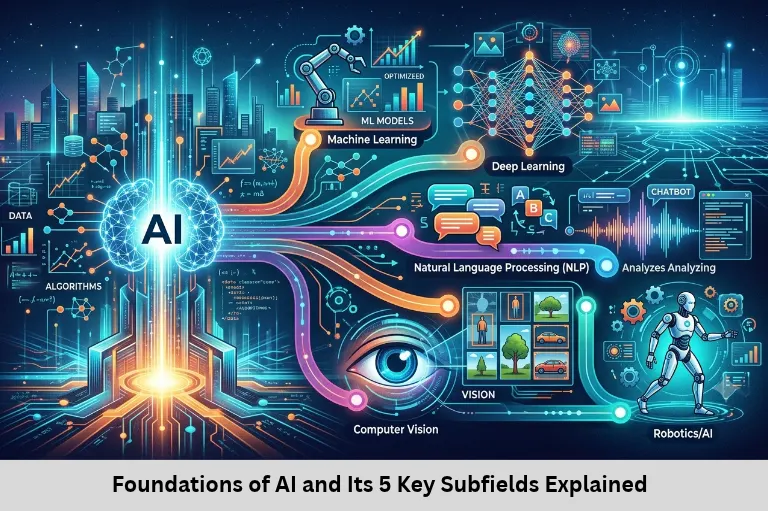
Explore AI fundamentals, machine learning, expert systems, computer vision, NLP, robotics, real-world applications, and AI career skills. Embedded Tech Development Academy (ETDA).
- Foundations of AI and Its 5 Key Subfields Explained
- Foundations of Artificial Intelligence and Its Subfields
Foundations of Artificial Intelligence and Its Subfields
Introduction to Artificial Intelligence
Artificial Intelligence (AI) is a branch of computer science focused on developing systems that perform tasks associated with human intelligence, including learning, reasoning, perception, language understanding, decision-making, and problem-solving. AI technologies are used in smartphones, autonomous vehicles, healthcare, manufacturing, financial services, smart devices, and industrial automation. As computing power and data availability have increased, AI has evolved into a collection of specialized fields that address different types of intelligent behavior.
The foundations of AI include algorithms, data structures, probability, statistics, optimization, neural networks, knowledge representation, and computational logic. Its major subfields include Machine Learning (ML), Expert Systems, Computer Vision (CV), Natural Language Processing (NLP), and Robotics. These fields often work together: a robot may use computer vision to identify objects, machine learning to improve recognition, and planning algorithms to determine its next action. Related concepts such as deep learning, generative AI, intelligent automation, and edge AI extend these capabilities.
Embedded Tech Development Academy (ETDA) supports technical learning that connects programming fundamentals with practical engineering applications. Learners searching for a Top Embedded Training Institute in Bangalore can explore how AI connects with embedded systems, Internet of Things (IoT) devices, computer vision, and intelligent automation. Embedded Tech Development Academy (ETDA) also offers assured placement support to help learners prepare for technical career opportunities.
Understanding the Foundations of AI
What Is Artificial Intelligence?
AI enables computers to analyze inputs, identify patterns, make predictions, generate content, or select actions based on programmed rules and learned models. AI systems do not necessarily think or understand like humans; their behavior depends on their algorithms, training data, objectives, and operating environment.
Core Technologies Behind AI
Algorithms: Define the computational steps used to solve problems.
Data and statistics: Help systems identify patterns and estimate uncertainty.
Knowledge representation: Stores facts, relationships, and rules in a usable form.
Optimization: Improves model parameters or searches for suitable solutions.
Neural networks: Learn complex relationships from data.
Sensors and computing hardware: Provide inputs and processing capabilities for physical AI systems.
Narrow AI and General AI
Most deployed AI applications are narrow AI systems designed for particular tasks, such as speech recognition, fraud detection, or image classification. Artificial general intelligence refers to a broader level of capability across many tasks and remains a research concept rather than an established general-purpose technology.
How AI Subfields Work Together
A smart surveillance system might combine computer vision for detecting movement, machine learning for classifying objects, and rule-based logic for triggering alerts. This integration demonstrates why practical AI development often requires multiple techniques instead of a single algorithm.
Machine Learning
What Is Machine Learning?
Machine Learning is an AI subfield in which algorithms learn patterns from data and use them to make predictions or decisions. Instead of manually writing every decision rule, developers train models using examples, features, objectives, and suitable evaluation methods.
Four Main Types of Machine Learning
Supervised learning: Uses labeled examples to predict outputs. For instance, a model can estimate house prices from location, floor area, and age.
Unsupervised learning: Identifies patterns in unlabeled data, such as grouping customers according to purchasing behavior.
Semi-supervised learning: Combines a small labeled dataset with a larger unlabeled dataset.
Reinforcement learning: Learns action strategies through rewards and penalties received from an environment. AlphaGo is a well-known example of reinforcement learning used in game-playing systems.
Applications of Machine Learning
ML supports credit-risk assessment, fraud detection, product recommendations, predictive maintenance, demand forecasting, and anomaly detection. Its performance depends on data quality, appropriate model selection, and testing against realistic conditions.
Deep Learning and Neural Networks
Deep learning uses neural networks with multiple computational layers to learn complex representations. It is particularly useful for image recognition, speech processing, language models, and other tasks involving large or complicated datasets.
Expert Systems
Definition and Architecture
An expert system uses a structured knowledge base and an inference engine to solve problems within a defined domain. The knowledge base stores facts and rules, while the inference engine applies those rules to available information to derive conclusions or recommendations.
For example, a troubleshooting system might use rules such as: if a device does not power on and its supply voltage is zero, inspect the power source and connection.
Advantages and Limitations
Expert systems can produce consistent, explainable decisions when their rules are well defined. However, they depend on the completeness and accuracy of their knowledge base. They generally do not learn automatically from new examples unless learning mechanisms are added.
Real-World Applications
Medical decision-support systems.
Equipment fault diagnosis.
Technical support and troubleshooting.
Rule-based customer service.
Compliance and eligibility checks.
Expert Systems Versus Machine Learning
Expert systems primarily apply explicitly represented knowledge and rules. Machine learning models infer patterns from training data. Some modern applications combine both approaches to balance learned predictions with business rules or safety constraints.
Computer Vision
What Is Computer Vision?
Computer Vision enables computers to extract meaningful information from images and videos. Digital images are represented as pixel values, which algorithms process to identify objects, estimate positions, classify scenes, or detect changes.
Key Computer Vision Techniques
Image classification: Assigns a label to an image.
Object detection: Identifies objects and estimates their bounding boxes.
Image segmentation: Classifies individual pixels or image regions.
Optical character recognition (OCR): Extracts text from images.
Face analysis: Detects or compares facial features for specific applications.
Deep Learning and Convolutional Neural Networks
Convolutional Neural Networks (CNNs) learn spatial features from images using convolutional filters and layered representations. Modern computer vision also uses vision transformers and other architectures. GPUs, specialized accelerators, and large image datasets have helped improve model training and deployment.
Applications of Computer Vision
Computer vision is used in driver-assistance systems, medical-image analysis, manufacturing quality inspection, agricultural crop monitoring, retail analytics, and robotics. Applications involving faces or surveillance require careful attention to privacy, consent, bias, and applicable laws.
Natural Language Processing
Understanding NLP
Natural Language Processing is the AI field concerned with analyzing, interpreting, and generating human language. It deals with grammar, context, ambiguity, meaning, and relationships between words. NLP systems process written text, spoken language, or both.
Major NLP Tasks
Named Entity Recognition: Identifies names of people, organizations, and locations.
Part-of-Speech Tagging: Labels words as nouns, verbs, adjectives, and other grammatical categories.
Machine Translation: Converts text between languages.
Sentiment Analysis: Classifies opinions or emotional tone.
Text Summarization: Produces shorter versions of longer documents.
Speech Recognition: Converts spoken language into text.
Transformers and Pretrained Models
Transformer architectures use attention mechanisms to model relationships between tokens. Models such as BERT and GPT-family systems demonstrate how transformer-based methods support language understanding and generation. Pretrained models can be adapted or prompted for tasks such as question answering, summarization, and conversational assistance.
Practical NLP Applications
NLP powers virtual assistants, document search, translation tools, customer-support automation, email classification, and information extraction. AI-generated answers should still be checked when factual accuracy, privacy, or safety is important.
Robotics and Intelligent Automation
How Robotics Uses AI
Robotics combines mechanical systems, electronics, sensors, control algorithms, and software to perform physical tasks. AI can help robots perceive their surroundings, recognize objects, plan routes, and adapt to changing conditions.
Main Components of an AI-Enabled Robot
A typical system includes sensors such as cameras or LiDAR, a processing unit, perception software, motion-planning algorithms, motor controllers, and actuators. The controller converts planned actions into commands that operate motors or other mechanisms.
Applications of AI Robotics
AI robotics is used in warehouse automation, industrial inspection, autonomous mobile robots, agricultural machines, and assistive devices. Reliable deployment requires testing for sensor errors, unexpected obstacles, timing constraints, and hardware failures.
Edge AI in Embedded Systems
Edge AI runs inference locally on devices such as microcontrollers, embedded processors, and smart cameras. Local processing can reduce network dependence and response time, although memory, energy consumption, and computational limits must be considered.
Embedded Tech Development Academy (ETDA) helps learners connect programming knowledge with embedded development and intelligent device applications. Students considering a Top Embedded Training Institute in Bangalore can explore practical projects involving sensors, microcontrollers, Internet of Things (IoT), and edge AI. Embedded Tech Development Academy (ETDA)‘s assured placement support can help learners prepare for relevant technical roles.
Frequently Asked Questions
What are the five major subfields of AI?
Five commonly taught areas are Machine Learning, Expert Systems, Computer Vision, Natural Language Processing, and Robotics. AI is broader than these five areas and also includes planning, reasoning, optimization, and other disciplines.
How is Machine Learning different from an Expert System?
Machine Learning models learn patterns from data, whereas traditional expert systems apply predefined facts and rules. Some applications combine both approaches.
Where is Computer Vision used?
Computer Vision is used in medical imaging, driver-assistance systems, manufacturing inspection, agriculture, retail analytics, and robotics to extract information from images and videos.
What is an example of Natural Language Processing?
Machine translation, sentiment analysis, speech recognition, text summarization, and chatbots are common NLP applications.
How does Robotics use Artificial Intelligence?
Robots can use AI to recognize objects, interpret sensor data, plan movements, navigate environments, and adapt to changing conditions. Control systems and hardware execute the resulting actions.
Conclusion
The foundations of Artificial Intelligence span several connected disciplines. Machine Learning identifies patterns from data, Expert Systems apply structured rules, Computer Vision interprets images and videos, Natural Language Processing handles human language, and Robotics combines perception with physical action. Together with deep learning, neural networks, optimization, and edge computing, these technologies support increasingly capable applications across industry and everyday life.
To develop practical AI skills, learners should strengthen Python programming, mathematics, statistics, data processing, model evaluation, and problem-solving. Building small projects—such as an image classifier, text sentiment analyzer, rule-based diagnostic tool, or sensor-based intelligent device—helps turn theoretical knowledge into engineering experience. Embedded Tech Development Academy (ETDA) supports technical learning for aspiring developers. Learners searching for a Top Embedded Training Institute in Bangalore can explore embedded AI, Internet of Things (IoT), and automation projects alongside core programming. With assured placement support, Embedded Tech Development Academy (ETDA) aims to help learners prepare for opportunities in AI-related software, embedded systems, and intelligent automation.
Author: ETDA Trainers
Experience: 10+ Years of Industry Experience in Embedded Systems, IoT, and Embedded C Programming