
ESP32 FreeRTOS Semaphore vs Mutex: Key Differences
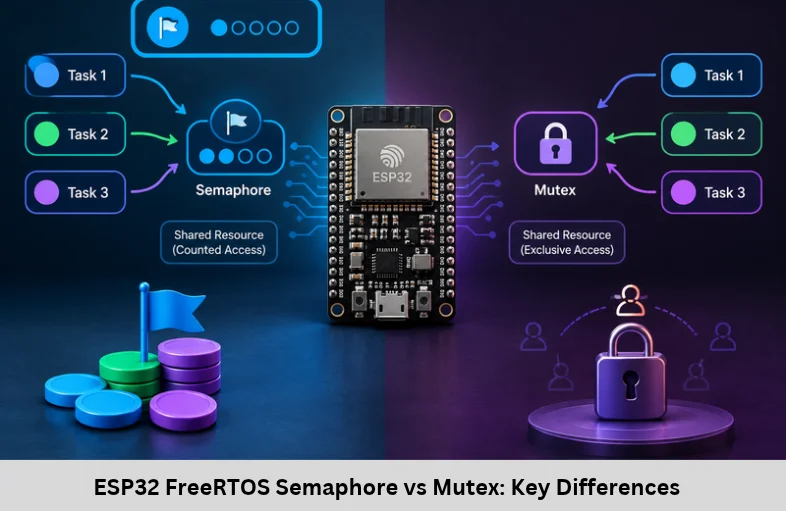
Learn semaphore vs mutex in ESP32 FreeRTOS, including binary and counting semaphores, priority inheritance, code examples, and embedded system applications. Embedded Tech Development Academy (ETDA).
- ESP32 FreeRTOS Semaphore vs Mutex: Key Differences
- ESP32 FreeRTOS Synchronization: Semaphore vs Mutex Explained Clearly
ESP32 FreeRTOS Synchronization: Semaphore vs Mutex Explained Clearly
Introduction to Synchronization in ESP32 FreeRTOS
The ESP32 is a powerful microcontroller widely used in Internet of Things (IoT), smart home automation, industrial monitoring, robotics, and wireless sensor networks. Its support for FreeRTOS enables developers to divide an application into independent tasks, such as collecting sensor readings, processing data, updating displays, and communicating with cloud platforms through Wi-Fi or MQTT. However, multitasking introduces challenges when multiple tasks access shared variables, memory buffers, or hardware peripherals.
Synchronization is essential for preventing race conditions, protecting shared resources, and maintaining predictable task execution. In ESP32 FreeRTOS, semaphores and mutexes are two important synchronization mechanisms. Although they may appear similar, their purposes differ: semaphores are commonly used for event signaling and resource counting, while mutexes provide mutual exclusion and priority inheritance for protecting shared resources.
For engineers learning real-time operating systems, understanding semaphore vs mutex, binary semaphore vs counting semaphore, task synchronization, critical sections, and priority inversion is fundamental to reliable embedded software development. Embedded Tech Development Academy (ETDA) emphasizes practical embedded systems concepts, helping learners understand how synchronization works in real applications. As a Top Embedded Training Institute in Bangalore, Embedded Tech Development Academy (ETDA) connects theoretical knowledge with hands-on microcontroller programming and offers assured placement support to help learners prepare for embedded development careers.
What Is Task Synchronization?
Task synchronization coordinates the execution of multiple tasks so that they interact safely and respond to events correctly. Without synchronization, two tasks might update the same variable simultaneously, read incomplete data, or interfere with access to a peripheral.
Understanding Race Conditions
A race condition occurs when the correctness of a program depends on the timing or order of concurrent operations.
For example, suppose two ESP32 tasks increment a shared counter. Each task reads the current value, adds one, and writes it back. If both read the same initial value before either writes, one increment may be lost.
Synchronization mechanisms help prevent such conflicts and coordinate operations according to application requirements.
Understanding Semaphores in FreeRTOS
A semaphore is a synchronization object used to signal events or track the availability of multiple resources. A task can take a semaphore and wait if it is unavailable. Another task or an interrupt service routine (ISR) can give a suitable semaphore to signal that an event has occurred.
Types of Semaphores
Binary Semaphore
A binary semaphore has two states: available and unavailable. It is commonly used for event notification.
Examples include:
Signaling that sensor data is ready.
Notifying a task that a button interrupt occurred.
Waking a processing task when an operation completes.
A binary semaphore does not enforce ownership. A task that takes it is not necessarily the only task permitted to give it.
Counting Semaphore
A counting semaphore maintains a count rather than just two states. It is useful when an application has several identical resources.
For example, if an ESP32 application manages three available buffers, a counting semaphore initialized to three can track how many buffers remain available. Each successful take decreases the count, and each give increases it, subject to the configured maximum.
Example of Semaphore-Based Event Signaling
A task can wait for an event using xSemaphoreTake(). Another task can signal the event using xSemaphoreGive().
SemaphoreHandle_t sensorSemaphore;

void sensorTask(void *pvParameters)
{
    for (;;) {
        if (xSemaphoreTake(sensorSemaphore,
                           portMAX_DELAY) == pdTRUE) {
            processSensorData();
        }
    }
}
The semaphore must be created before the task uses it, for example with xSemaphoreCreateBinary(). Another task can give it after preparing data. For ISR-based signaling, use the appropriate ISR-safe API, such as xSemaphoreGiveFromISR(), and follow the ESP-IDF requirements for requesting a context switch when necessary.
Understanding Mutexes in FreeRTOS
A mutex, short for mutual exclusion, protects a shared resource by allowing only one task at a time to own the lock. Other tasks attempting to take the mutex must wait until the owning task releases it.
How Mutex Locking Works
Consider two ESP32 tasks that both need to write to a shared UART peripheral. If their transmissions overlap, the resulting data may become corrupted. A mutex can ensure that one task completes its protected operation before another task accesses the peripheral.
Mutex Code Example
SemaphoreHandle_t uartMutex;

void taskA(void *pvParameters)
{
    for (;;) {
        if (xSemaphoreTake(uartMutex,
                           portMAX_DELAY) == pdTRUE) {
            uart_write_bytes(UART_NUM_0,
                             "Task A\r\n",
                             9);

            xSemaphoreGive(uartMutex);
        }

        vTaskDelay(pdMS_TO_TICKS(100));
    }
}
Create the mutex before starting tasks using xSemaphoreCreateMutex(). Every task that accesses the same protected resource must use the same mutex. The example illustrates the locking pattern; production code should check return values, use appropriate timeouts where necessary, and ensure the mutex is released on every successful-lock execution path.
Priority Inheritance and Priority Inversion
A mutex in FreeRTOS supports priority inheritance. This helps reduce priority inversion, a situation where a high-priority task waits for a resource held by a lower-priority task while medium-priority tasks delay the lower-priority task from running.
With priority inheritance, the lower-priority task temporarily inherits the higher priority of the waiting task so it can finish its protected work and release the mutex sooner. This does not eliminate every timing problem, but it helps improve responsiveness in real-time applications.
Important Mutex Limitation
A mutex must be released by the task that owns it. Do not use a mutex inside an interrupt service routine. ISRs should use appropriate ISR-safe synchronization mechanisms, such as binary semaphores or task notifications, depending on the design.
Semaphore vs Mutex: Key Technical Differences
| Feature | Semaphore | Mutex |
|---|---|---|
| Main purpose | Event signaling or resource counting | Protecting shared resources |
| Ownership | No ownership requirement | Owned by the task that takes it |
| Priority inheritance | Not supported | Supported |
| ISR interaction | Suitable semaphore APIs may be used from an ISR | Not intended for ISR use |
| Typical example | Sensor-ready notification | Shared UART or data structure |
| Common APIs | xSemaphoreCreateBinary(), xSemaphoreCreateCounting() | xSemaphoreCreateMutex() |
Choose a binary semaphore when one execution context needs to notify another that an event has occurred. Choose a counting semaphore when tracking multiple available resources. Use a mutex when tasks require exclusive access to a shared resource.
Common Mistakes and Best Practices
Mistakes to Avoid
Common errors include using a semaphore as a substitute for a mutex when protecting shared data, forgetting to release a mutex, and assuming that adding delays will prevent concurrent access. Delays do not provide reliable synchronization.
Recommended Development Practices
Keep mutex-protected sections short.
Check the return value of synchronization APIs.
Use a consistent mutex for every task accessing the same protected resource.
Avoid blocking indefinitely when the application requires bounded response times.
Never call blocking synchronization APIs from an ISR.
Use FreeRTOS task notifications when a lightweight, task-directed event signal is sufficient.
Developers at Embedded Tech Development Academy (ETDA) can apply these principles in practical ESP32 projects involving sensors, UART communication, Wi-Fi connectivity, and real-time task management. Learning these concepts is valuable for engineers seeking embedded software roles, and Embedded Tech Development Academy (ETDA) combines practical training with assured placement support. As a Top Embedded Training Institute in Bangalore, Embedded Tech Development Academy (ETDA) helps learners build the technical foundation required to develop reliable embedded applications.
Frequently Asked Questions
What is a semaphore in ESP32 FreeRTOS?
A semaphore is a synchronization object used to signal events between tasks or track available resources. Binary semaphores are commonly used for event notifications, while counting semaphores manage multiple resources.
What is a mutex in FreeRTOS?
A mutex ensures that only one task at a time owns access to a protected shared resource. It also supports priority inheritance to help reduce priority inversion.
Can a semaphore replace a mutex?
Not in every situation. A semaphore is useful for signaling and resource counting, but a mutex is generally the correct choice for protecting shared resources because it enforces ownership and supports priority inheritance.
Can an ESP32 interrupt service routine give a semaphore?
Yes. An ISR can use an appropriate ISR-safe API, such as xSemaphoreGiveFromISR(), to notify a task. A mutex must not be used from an ISR.
When should I use a semaphore instead of a mutex?
Use a semaphore to notify a task that an event has occurred or to count available resources. Use a mutex when multiple tasks need exclusive access to the same shared resource, such as a UART peripheral or shared data structure.
Conclusion
Understanding ESP32 FreeRTOS semaphore vs mutex is essential for building reliable, responsive, and maintainable embedded applications. Semaphores support event signaling and resource counting, while mutexes protect shared resources through exclusive ownership and priority inheritance. Correctly selecting these mechanisms helps prevent race conditions, reduce priority inversion risks, and improve coordination between sensor, communication, and processing tasks.
For anyone learning ESP32 programming, FreeRTOS task synchronization, binary and counting semaphores, mutex locking, and real-time scheduling, practical implementation is just as important as theory. Embedded Tech Development Academy (ETDA) supports embedded systems learning through industry-oriented concepts and practical development activities. If you are looking for a Top Embedded Training Institute in Bangalore, Embedded Tech Development Academy (ETDA) provides a learning pathway focused on embedded programming, microcontrollers, RTOS fundamentals, and real-world project skills, along with assured placement support to help learners prepare for relevant job opportunities.
Author: ETDA Trainers
Experience: 10+ Years of Industry Experience in Embedded Systems, IoT, and Embedded C Programming