
Embedded AI Applications: Real-World Industry Use Cases
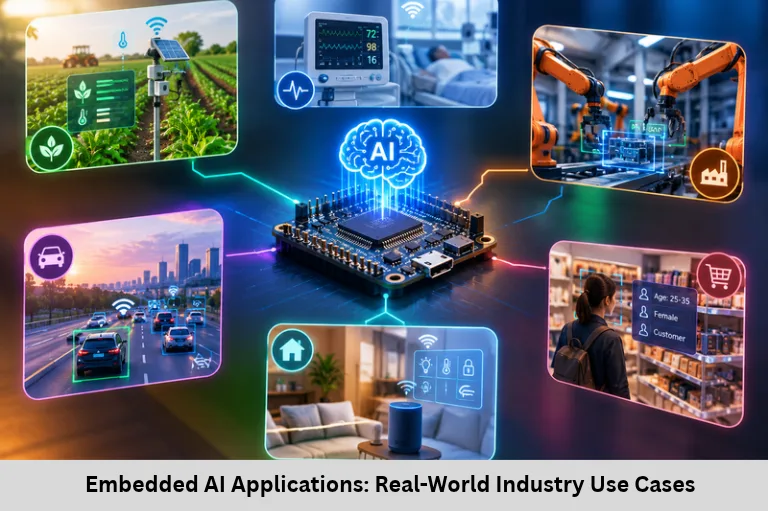
Explore real-world Embedded AI applications in healthcare, automotive, robotics, smart homes, agriculture, and industrial Internet of Things (IoT) using edge computing and TinyML. Embedded Tech Development Academy (ETDA).
- Embedded AI Applications: Real-World Industry Use Cases
-
Embedded AI in Action: Real-World Use Cases Transforming Industries
- Introduction to Embedded Artificial Intelligence
- 1. Wearables: Intelligent Personal Monitoring
- 2. Smart Home Devices: Intelligent Automation
- 3. Industrial IoT: Predictive Maintenance
- 4. Agriculture: Smart Farming Solutions
- 5. Healthcare: Smart Medical Devices
- 6. Automotive Systems: Intelligent Driving
- 7. Robotics and Smart Cities
- 8. Building Embedded AI Systems: Tools and Optimization
- Frequently Asked Questions
- Conclusion
Embedded AI in Action: Real-World Use Cases Transforming Industries
Introduction to Embedded Artificial Intelligence
Embedded Artificial Intelligence (Embedded AI) combines machine learning algorithms with embedded hardware to enable devices to analyze data and make decisions locally. Unlike traditional cloud-based AI systems, which transmit data to remote servers for processing, Embedded AI performs inference directly on microcontrollers, microprocessors, edge gateways, and specialized AI accelerators. This approach can reduce latency, improve privacy, decrease network bandwidth usage, and support real-time decision-making even when internet connectivity is unavailable.
Embedded AI is becoming increasingly important in the Internet of Things (IoT), industrial automation, healthcare monitoring, automotive electronics, robotics, smart agriculture, and intelligent consumer devices. Technologies such as edge computing, TinyML, neural network inference, sensor fusion, computer vision, digital signal processing, and low-power AI accelerators make it possible to deploy machine learning models on resource-constrained devices.
Successful implementation requires more than training an AI model. Developers must consider processor capability, RAM and flash memory, power consumption, sensor accuracy, model quantization, firmware integration, and real-time constraints. Embedded Tech Development Academy (ETDA) helps learners explore embedded systems concepts relevant to modern intelligent devices. For students seeking a Top Embedded Training Institute in Bangalore, practical knowledge of microcontrollers, Embedded C, Internet of Things (IoT), and AI-enabled hardware can support career preparation, complemented by assured placement support.
1. Wearables: Intelligent Personal Monitoring
Wearable devices such as smartwatches, fitness bands, and activity trackers use embedded machine learning to interpret sensor data. Accelerometers and gyroscopes capture movement, while optical sensors can measure pulse-related signals.
Activity Recognition and Health Monitoring
An activity-recognition model processes motion windows to classify walking, running, or other movement patterns. Wearables may also analyze physiological signals to identify patterns that warrant attention.
Technical Implementation
Sensor readings are filtered, normalized, and divided into time windows before being passed to a trained model. A low-power microcontroller can run inference locally, while Bluetooth Low Energy (BLE) transfers selected results to a mobile application.
Key Engineering Challenge
Wearable devices must balance model accuracy, battery life, memory usage, and privacy. Medical alerts require appropriate validation and should not be treated as a replacement for professional diagnosis.
2. Smart Home Devices: Intelligent Automation
Smart speakers, connected appliances, thermostats, and security devices use Embedded AI to recognize events and automate responses.
Wake Word Detection and Adaptive Control
A wake-word model analyzes incoming audio to detect a predefined phrase. Local processing can reduce unnecessary audio transmission, although subsequent voice recognition may still use cloud services.
Smart thermostats can also combine temperature readings, occupancy detection, and historical patterns to adjust heating or cooling. Motion sensors and edge cameras can trigger lighting or security events without requiring every decision to be processed remotely.
3. Industrial IoT: Predictive Maintenance
Industrial equipment generates vibration, temperature, current, and acoustic data that can reveal changes in operating conditions. Embedded AI can identify abnormal patterns before a fault causes major disruption.
Anomaly Detection in Industrial Machines
For example, a motor-monitoring device can analyze vibration signals to identify patterns associated with bearing wear, imbalance, or misalignment. The model may use statistical features, frequency-domain analysis, or a trained neural network.
Edge-Based Processing Pipeline
A typical system follows this sequence:
Acquire data from vibration and temperature sensors.
Filter noise and extract relevant features.
Run the anomaly-detection model on an edge device.
Compare the result against configured thresholds.
Send alerts to a monitoring platform when required.
Local inference reduces response delays and can continue during network outages. However, models must be validated against real machine conditions to minimize false alarms and missed faults.
4. Agriculture: Smart Farming Solutions
Precision agriculture uses Embedded AI to improve irrigation, crop monitoring, and resource management. Soil-moisture sensors, temperature sensors, and imaging devices provide data for automated decision-making.
Intelligent Irrigation and Crop Disease Detection
An embedded controller can combine soil-moisture measurements with environmental data to determine when irrigation may be required. Camera-equipped edge devices can analyze crop images for visual indicators of disease or pest damage.
The controller can then activate irrigation equipment or notify farmers through a connected application. These systems can reduce water wastage, but their effectiveness depends on sensor calibration, crop-specific models, and environmental conditions.
5. Healthcare: Smart Medical Devices
Healthcare devices use embedded processing to analyze physiological signals and support continuous monitoring. Examples include portable ECG monitors, wearable pulse sensors, and connected patient-monitoring equipment.
Signal Processing and Abnormality Detection
An embedded systems may filter ECG signals, remove noise, extract waveform features, and run a model to identify patterns that require further review. Local processing can provide timely alerts and limit the amount of sensitive data transmitted.
Medical applications demand rigorous testing, cybersecurity, and appropriate regulatory compliance. AI outputs should be validated for their intended use, particularly when they influence clinical decisions.
6. Automotive Systems: Intelligent Driving
Modern vehicles use Embedded AI in Advanced Driver Assistance Systems (ADAS), driver monitoring, and selected automated driving functions. Cameras, radar, and other sensors provide information about the vehicle’s surroundings.
ADAS and Sensor Fusion
AI models can identify pedestrians, recognize traffic signs, detect lane markings, and monitor driver attention. Sensor fusion combines information from multiple sensors to improve environmental understanding.
Automotive systems must meet demanding requirements for response time, reliability, fault detection, and functional safety. A model’s prediction must be integrated with validated control logic rather than treated as a complete safety mechanism on its own.
7. Robotics and Smart Cities
Autonomous Robotics
Robots use computer vision, proximity sensors, and motion data to detect obstacles, recognize objects, and support navigation. An embedded processor may run object-detection inference while a real-time controller handles motor commands and time-sensitive operations.
Intelligent Urban Infrastructure
Smart-city applications include adaptive traffic signals, energy-aware street lighting, and local analysis of environmental sensors. Edge-based traffic systems can estimate vehicle density and adjust signal timing according to configured policies.
These applications require careful handling of privacy, security, model reliability, and changing environmental conditions.
8. Building Embedded AI Systems: Tools and Optimization
Hardware and Software Selection
Developers may use microcontrollers for small TinyML models or more capable single-board computers and AI accelerators for computer vision and larger neural networks. Tools such as TensorFlow Lite for Microcontrollers, suitable vendor inference libraries, and model-conversion utilities help deploy trained models to target hardware.
Model Quantization and Performance
Quantization reduces numerical precision, often converting model weights and operations from floating-point to lower-precision formats. This can reduce memory requirements and improve inference speed on supported hardware, though accuracy must be measured after conversion.
Embedded Tech Development Academy (ETDA) supports learning around embedded programming, microcontrollers, and hardware-software integration. Learners exploring AI-enabled devices can benefit from understanding sensor interfacing, firmware optimization, edge computing, and real-time processing. As a Top Embedded Training Institute in Bangalore, Embedded Tech Development Academy (ETDA) promotes practical technical learning and offers assured placement support for learners preparing for embedded engineering opportunities.
Frequently Asked Questions
What is Embedded AI?
Embedded AI is the deployment of machine learning models on devices such as microcontrollers, processors, and edge computers so they can analyze data and make decisions locally.
What is the difference between Embedded AI and cloud AI?
Embedded AI processes data on the device or nearby edge hardware, while cloud AI relies on remote computing infrastructure. Edge processing can reduce latency and bandwidth use, whereas cloud systems may provide more computing power.
What is TinyML?
TinyML refers to machine learning techniques and models designed to operate on resource-constrained devices, including low-power microcontrollers with limited memory and processing capability.
Which industries use Embedded AI?
Embedded AI is used in healthcare, automotive electronics, industrial automation, agriculture, robotics, consumer electronics, and smart-city infrastructure.
What skills are needed to develop Embedded AI applications?
Useful skills include Embedded C or C++, microcontroller architecture, sensor interfacing, Python for model development, machine learning fundamentals, model quantization, and hardware-specific deployment tools.
Conclusion
Embedded AI is transforming how devices collect information, recognize patterns, and respond to changing conditions. From TinyML-powered wearables and predictive maintenance systems to intelligent agriculture, medical monitoring, automotive ADAS, robotics, and smart-city infrastructure, edge intelligence enables faster local decisions and can reduce dependence on cloud connectivity. Successful deployment requires careful selection of hardware, reliable sensor data, model optimization, memory management, power control, and thorough testing under real-world conditions.
As embedded products become more intelligent, skills in Embedded C, microcontrollers, machine learning inference, Internet of Things (IoT) communication, computer vision, sensor fusion, and edge AI optimization are increasingly valuable. Embedded Tech Development Academy (ETDA) offers an industry-oriented learning pathway for students and aspiring engineers interested in embedded technology. If you are searching for a Top Embedded Training Institute in Bangalore, developing strong embedded fundamentals can help you prepare for emerging technical roles, with assured placement support available through Embedded Tech Development Academy (ETDA)‘s training approach.
Author: ETDA Trainers
Experience: 10+ Years of Industry Experience in Embedded Systems, IoT, and Embedded C Programming