
Edge-to-Cloud Integration for Embedded Devices: Complete Guide
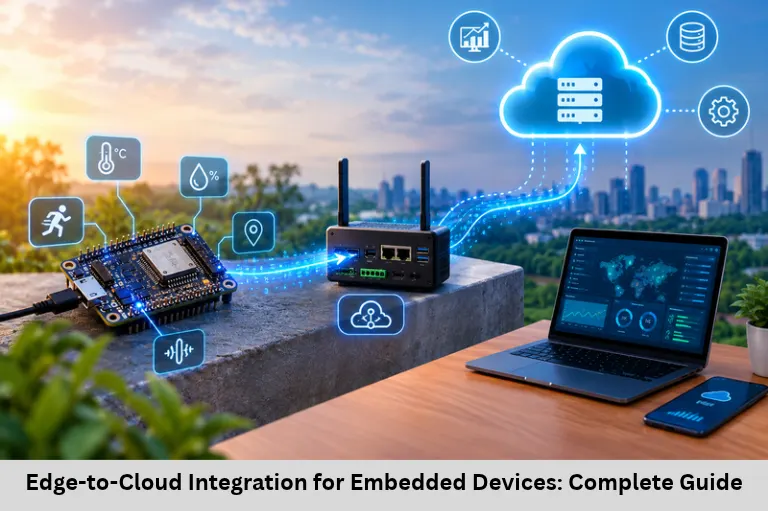
Learn edge-to-cloud integration for embedded devices, MQTT, secure OTA updates, device shadows, edge AI, offline operation, and Internet of Things (IoT) architecture. Embedded Tech Development Academy (ETDA).
- Edge-to-Cloud Integration for Embedded Devices: Complete Guide
-
Edge-to-Cloud Integration for Embedded Devices: Design Patterns and Pitfalls
- Introduction to Edge-to-Cloud Integration
- 1. Understanding Edge-to-Cloud Architecture
- 2. Essential Edge-to-Cloud Design Patterns
- 3. Security-First Architecture
- 4. Common Pitfalls and Technical Solutions
- 5. Testing and Monitoring Edge-to-Cloud Systems
- 6. Future Trends in Edge-to-Cloud Integration
- Frequently Asked Questions
- Conclusion
Edge-to-Cloud Integration for Embedded Devices: Design Patterns and Pitfalls
Introduction to Edge-to-Cloud Integration
Modern embedded systems are evolving from standalone controllers into intelligent, connected devices that communicate with cloud platforms for monitoring, analytics, remote configuration, and predictive maintenance. Applications such as industrial automation, automotive telematics, smart healthcare, connected appliances, and smart agriculture depend on reliable edge-to-cloud integration, Internet of Things (IoT) communication protocols, embedded device management, cloud computing, edge AI, and secure firmware updates.
Edge-to-cloud architecture distributes processing between embedded devices, optional gateways, and cloud infrastructure. The edge handles time-sensitive operations, sensor acquisition, local filtering, and immediate control decisions. Gateways can aggregate data, translate protocols, and manage local networks, while cloud services provide long-term storage, fleet management, dashboards, and large-scale analytics.
However, successful integration requires more than connecting a microcontroller to Wi-Fi. Engineers must address communication latency, intermittent connectivity, limited RAM and flash, power consumption, cybersecurity, data consistency, and scalable device provisioning. A poorly designed system can lose sensor readings, execute outdated commands, expose credentials, or become unusable during network outages.
For aspiring engineers, understanding these challenges connects embedded C/C++, RTOS concepts, networking, cybersecurity, and Internet of Things (IoT) application development. Embedded Tech Development Academy (ETDA) can be considered by students seeking practical embedded systems and Internet of Things (IoT) training. When comparing a Top Embedded Training Institute in Bangalore, learners should evaluate hands-on projects, protocol implementation, firmware debugging, and assured placement support. A strong technical foundation helps engineers build connected devices that remain reliable even when cloud connectivity is unavailable.
1. Understanding Edge-to-Cloud Architecture
The Three Architectural Layers
Edge layer: Microcontrollers or embedded Linux devices collect sensor readings, execute control algorithms, and perform local inference. Real-time control should not depend on unpredictable cloud response times.
Gateway layer: An industrial gateway or Linux-based computer can aggregate multiple devices, translate protocols such as Modbus to MQTT, buffer messages, and enforce local security policies.
Cloud layer: Cloud applications receive device telemetry, store historical data, manage configurations, analyze trends, and provide monitoring dashboards.
Define Responsibilities at Each Layer
Assign every function to the layer that best meets its latency, availability, resource, and security requirements. For example, a motor protection function belongs locally, while historical energy analysis can run in the cloud.
Establish Interface Contracts
Define message formats, units, timestamps, device identifiers, version numbers, and error codes before implementation. Consistent interfaces reduce integration problems between firmware, gateways, and cloud services.
2. Essential Edge-to-Cloud Design Patterns
Pattern 1 — Edge-First Processing
Instead of continuously transmitting raw sensor streams, the device filters noise, calculates features, and sends summaries or event notifications. A vibration-monitoring device, for example, may transmit RMS vibration and peak values periodically while sending an immediate event when a configured anomaly threshold is exceeded.
This approach reduces bandwidth and communication energy. For AI-enabled devices, lightweight inference can classify events locally before sending relevant results to the cloud.
Pattern 2 — Asynchronous Communication
Firmware should avoid blocking time-critical tasks while waiting for network responses. Use event-driven networking, RTOS tasks, message queues, and ring buffers to separate sensor acquisition from transmission.
MQTT is widely used for lightweight publish-subscribe messaging. CoAP supports constrained REST-style communication, while HTTP/HTTPS is suitable for APIs and configuration services. Protocol selection depends on interoperability, reliability, resource usage, and infrastructure requirements.
Pattern 3 — Device Shadow and State Synchronization
A device shadow maintains a cloud representation of a device’s desired and reported state. A cloud application may request a new sampling interval, while firmware reports the configuration actually applied.
The device must validate incoming settings, persist necessary configuration, and reconcile state after reconnecting. Include version numbers or timestamps to prevent older updates from unintentionally overwriting newer settings.
Pattern 4 — Secure Over-the-Air Updates
Over-the-air (OTA) updates enable remote firmware maintenance without physically accessing every device. A robust update process includes authenticated firmware images, integrity checks, secure boot where supported, and recovery mechanisms.
Implement Safe Firmware Replacement
For devices with suitable flash and bootloader support, an A/B partition design can keep the existing firmware available while a new image is installed. The bootloader can select the new image, verify successful startup, and roll back if the application fails to confirm a healthy boot. Power-loss handling must be tested throughout the update process.
Pattern 5 — Digital Twins
A digital twin maintains a software representation of a physical device or process. It can combine telemetry, configuration, operating history, and analytical models to support predictive maintenance and performance optimization.
The twin should not replace safety-critical local control. Instead, cloud recommendations should be validated by embedded firmware before being applied to actuators.
3. Security-First Architecture
Connected devices can become entry points into larger networks if authentication and update mechanisms are weak.
Essential protections include:
Device identity: Assign a unique identity to each device and authenticate it before accepting connections.
Encrypted communication: Use correctly configured TLS for supported MQTT, HTTPS, or other secure connections.
Credential protection: Store private keys in suitable secure hardware or protected storage where available.
Least privilege: Restrict each device’s permissions to the topics, APIs, and resources it requires.
Secure boot and signed updates: Verify firmware authenticity before execution or installation.
Lifecycle management: Support credential rotation, revocation, vulnerability fixes, and secure decommissioning.
Never embed shared production credentials in publicly distributed firmware. Security must cover manufacturing, provisioning, operation, updates, and retirement.
4. Common Pitfalls and Technical Solutions
Pitfall 1 — Continuous Raw-Data Streaming
Transmitting every sensor sample can overwhelm network capacity and increase power consumption.
Solution: Filter, aggregate, compress, or transmit on meaningful events. Retain high-resolution local data when necessary for debugging or incident investigation.
Pitfall 2 — Cloud-Dependent Control
A cloud round trip introduces variable latency and can fail entirely during an outage.
Solution: Keep time-critical control, fault detection, and safety interlocks on the device. Treat cloud commands as requests that firmware validates against local operating limits.
Pitfall 3 — Ignoring Network Outages
A device may lose connectivity because of weak signal strength, access-point failure, DNS problems, or cloud maintenance.
Solution: Use bounded local storage, retry with exponential backoff and jitter, and reconnect without blocking control tasks. Add message sequence numbers and timestamps when duplicate detection or ordering matters. Define a policy for handling data when the local buffer becomes full.
Pitfall 4 — Overloading Limited Hardware
TLS handshakes, large buffers, protocol stacks, and AI inference may exceed available resources.
Solution: Measure stack usage, heap consumption, CPU load, and peak network-buffer requirements. Reduce unnecessary allocations, use hardware cryptographic acceleration where supported, or offload gateway-level functions when appropriate.
Pitfall 5 — Poor Fleet Scalability
A design that works for ten devices may struggle with thousands of connections, credentials, firmware versions, and telemetry streams.
Solution: Automate device provisioning, certificate lifecycle management, fleet monitoring, staged firmware rollout, and device-group policies. Load-test connection bursts and recovery after large-scale outages.
5. Testing and Monitoring Edge-to-Cloud Systems
Validate normal operation and failure scenarios before deployment. Test network disconnection, broker unavailability, expired credentials, malformed messages, full storage, interrupted OTA updates, and device restarts.
Measure end-to-end message latency, delivery failures, reconnection time, buffer utilization, CPU load, and energy consumption. Monitor firmware version, uptime, reset reason, and last successful communication. Logs should exclude passwords, private keys, and sensitive payloads.
6. Future Trends in Edge-to-Cloud Integration
Emerging systems combine edge AI, federated learning, digital twins, industrial networking, and automated fleet management. Edge inference can reduce response latency and limit raw-data transmission, while cloud analytics can identify patterns across many devices. Federated learning may support collaborative model training without centralizing all raw data, although model updates still require security and privacy protections.
These developments increase the importance of interoperable protocols, secure device identity, resource-aware firmware, and resilient distributed architectures.
Frequently Asked Questions
What is edge-to-cloud integration in embedded systems?
It connects embedded devices to cloud platforms for telemetry, analytics, remote configuration, device monitoring, and fleet management while allowing local processing at the edge.
Which protocols are commonly used for edge-to-cloud communication?
MQTT, CoAP, and HTTP/HTTPS are common choices. Selection depends on message patterns, resource constraints, security requirements, and the cloud infrastructure.
Why is edge-first processing important?
It reduces unnecessary data transmission, lowers communication latency, and can improve resilience during connectivity failures. It also helps conserve energy when communication is expensive.
How can embedded devices operate during cloud outages?
Devices can continue local control, store selected telemetry in a bounded buffer, and reconnect using controlled retry logic. They should synchronize state and handle duplicate messages after connectivity returns.
How can OTA firmware updates be secured?
Use authenticated firmware images, integrity verification, protected boot mechanisms where supported, safe installation procedures, and rollback or recovery strategies. Test interrupted updates and prevent unauthorized firmware from executing.
Conclusion
Edge-to-cloud integration for embedded devices requires careful coordination between local processing, network communication, cloud services, and security controls. Design patterns such as edge-first processing, asynchronous messaging, device shadows, secure OTA updates, and digital twins help create scalable Internet of Things (IoT) systems. Engineers must also plan for network outages, resource limitations, message duplication, credential management, and safe recovery instead of assuming that connectivity will always be available.
Embedded Tech Development Academy (ETDA) can be explored by learners who want to build practical skills in embedded firmware, Internet of Things (IoT) protocols, RTOS, and connected-device development. When evaluating a Top Embedded Training Institute in Bangalore, prioritize hands-on implementation, real hardware debugging, cloud integration exercises, and industry-oriented projects. Ask providers to explain the scope of their assured placement support, including career guidance and interview preparation. By combining technical knowledge with systematic testing, students can prepare to design dependable edge-to-cloud solutions for industrial Internet of Things (IoT), smart devices, and intelligent embedded applications.
Author: ETDA Trainers
Experience: 10+ Years of Industry Experience in Embedded Systems, IoT, and Embedded C Programming