
Digital Twins in Manufacturing: Working, Benefits and Applications
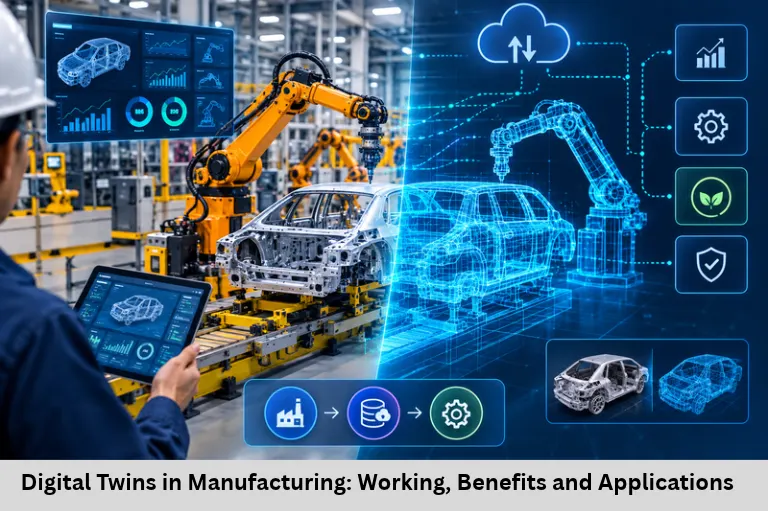
Learn how digital twins improve manufacturing through real-time monitoring, predictive maintenance, simulation, AI optimization, and smart factory integration.
- Digital Twins in Manufacturing: Working, Benefits and Applications
-
Digital Twins in Production: From Tracking to Enhancement
- Introduction to Digital Twins in Manufacturing
- How Does a Manufacturing Digital Twin Work?
- The Four Stages of Digital Twin Maturity
- Digital Twin Example: Injection Molding Machine
- Types of Digital Twins in Manufacturing
- Integration with Smart Factory Systems
- Key Benefits and Emerging Trends
- Frequently Asked Questions
- Conclusion
Digital Twins in Production: From Tracking to Enhancement
Introduction to Digital Twins in Manufacturing
Manufacturing industries are increasingly adopting Industry 4.0 technologies to improve productivity, reduce operational costs, enhance product quality, and minimize equipment downtime. One important technology driving this transformation is the digital twin. A digital twin is a virtual representation of a physical asset, production process, or complete manufacturing facility that uses real-time and historical data to reflect its actual operating condition.
Unlike a static 3D model, a manufacturing digital twin can continuously update using information from sensors, programmable logic controllers (PLCs), supervisory control and data acquisition (SCADA) systems, and industrial Internet of Things (IoT) devices. Engineers can use this information to monitor equipment health, diagnose faults, simulate operating conditions, predict failures, and optimize production parameters without immediately changing the physical process.
Digital twins combine industrial automation, embedded systems, sensor technology, edge computing, cloud platforms, artificial intelligence (AI), machine learning (ML), and predictive maintenance. These capabilities make them valuable for smart factories, automotive manufacturing, electronics assembly, and process industries.
For students exploring embedded systems, industrial Internet of Things (IoT), real-time data acquisition, and intelligent automation, understanding digital twin architecture is increasingly useful. Embedded Tech Development Academy (ETDA) can be explored by learners seeking practical embedded and Internet of Things (IoT) training. Students comparing a Top Embedded Training Institute in Bangalore should evaluate hands-on projects, industrial communication concepts, simulation experience, and assured placement support. Digital twin technology provides a practical connection between embedded hardware, software analytics, and real-world industrial operations.
How Does a Manufacturing Digital Twin Work?
A digital twin connects physical equipment to a virtual model through a continuous data pipeline. The physical system generates operational data, which is collected, processed, and used to update the digital representation.
Core Components of a Digital Twin
Physical asset: A machine, robot, motor, conveyor, production line, or factory.
Sensors and controllers: Measure temperature, vibration, pressure, speed, current, and machine status.
Connectivity layer: Transfers data through industrial Ethernet, OPC UA, MQTT, or other suitable protocols.
Data platform: Stores and processes real-time and historical measurements.
Virtual model: Represents the asset’s structure, operating behavior, and relevant constraints.
Analytics engine: Uses rules, statistical methods, physics-based models, or ML algorithms to generate insights.
Data Flow and Synchronization
For example, vibration sensors on an industrial motor may send measurements to an edge gateway. The gateway filters the data and forwards selected values to a digital twin platform. The model compares current vibration with expected operating behavior and identifies potential anomalies.
Why Data Quality Matters
Sensor calibration, timestamp synchronization, communication reliability, missing-data handling, and model validation directly affect the usefulness of digital twin predictions. A sophisticated model cannot compensate for consistently inaccurate input data.
The Four Stages of Digital Twin Maturity
Stage 1 — Monitoring and Observation
Monitoring provides real-time visibility into machine conditions and production performance. Dashboards display values such as motor temperature, energy consumption, cycle time, pressure, and vibration.
Technologies: Internet of Things (IoT) sensors, PLCs, SCADA, edge gateways, Grafana, and industrial visualization platforms.
Applications and benefits: Operators can identify abnormal temperatures, track energy consumption, inspect remote equipment status, and detect deviations before they cause significant disruption.
Stage 2 — Analysis and Diagnosis
The analysis stage combines current measurements with historical operating data to understand why a problem occurred. Rule-based diagnostics, statistical analysis, and ML models can identify recurring failures, production bottlenecks, and patterns associated with defective products.
Example: If a conveyor’s motor current increases while its speed decreases, analysis may indicate excessive load, mechanical friction, or a developing bearing problem. Additional measurements are needed to determine the actual cause.
Stage 3 — Simulation and Prediction
Simulation evaluates possible future conditions before they are applied to the physical production system. Physics-based models, discrete-event simulation, and data-driven prediction can estimate equipment behavior under different workloads or process settings.
Applications include forecasting maintenance requirements, comparing production schedules, evaluating machine upgrades, and testing changes in temperature, speed, or load.
Stage 4 — Optimization and Prescription
The optimization stage recommends or applies suitable operating parameters to improve throughput, energy efficiency, quality, and equipment utilization. Techniques may include constrained optimization, model-predictive control, and reinforcement learning.
Important: Autonomous changes require validated models, safety limits, authorization rules, and fallback mechanisms. Many factories begin with operator-approved recommendations rather than unrestricted closed-loop control.
Digital Twin Example: Injection Molding Machine
Consider an injection molding machine producing plastic components. Sensors measure barrel temperature, injection pressure, screw position, cooling time, and cycle duration. These measurements update the digital twin, which compares actual operation with approved process parameters.
Detecting and Correcting Process Deviations
If product defects increase, the twin can correlate defect records with temperature profiles, injection pressure, material batches, and cooling time. Simulation can then evaluate possible parameter changes before operators test them on the physical machine.
The resulting workflow supports reduced material waste, more consistent product quality, improved maintenance planning, and better cycle-time control. Actual improvements depend on sensor quality, model accuracy, process stability, and implementation.
Types of Digital Twins in Manufacturing
Different twins represent different levels of a production environment.
Component twin: Represents an individual part, such as a bearing or motor.
Asset twin: Models a complete machine and its operating behavior.
Process twin: Represents a manufacturing process, including its parameters and sequence.
System twin: Connects multiple machines, conveyors, or production cells.
Factory twin: Integrates information across production areas to support facility-level planning.
These levels can be connected to create a broader view of manufacturing operations, provided their data models and interfaces are compatible.
Integration with Smart Factory Systems
Digital twins are more useful when connected to existing industrial software and automation infrastructure.
MES, ERP and PLM Integration
A Manufacturing Execution System (MES) manages shop-floor production activities, while Enterprise Resource Planning (ERP) supports business planning, materials, and resource allocation. Product Lifecycle Management (PLM) connects product design and engineering information with manufacturing.
Integrating these systems can connect machine performance with production orders, component availability, design revisions, and quality records.
Edge Computing and Industrial Connectivity
Edge computing processes time-sensitive data near machines, reducing unnecessary cloud traffic and supporting rapid local responses. Cloud platforms provide scalable storage, cross-site analytics, and centralized model management. Industrial Ethernet, OPC UA, MQTT, and suitable 5G deployments can support communication, depending on the application.
Cybersecurity and Operational Safety
Secure device identity, access controls, network segmentation, encrypted communication, software updates, and audit logs help protect digital twin infrastructure. Any connection that can influence physical equipment must also follow industrial safety and control-system requirements.
Key Benefits and Emerging Trends
Digital twins can improve asset visibility, reduce unplanned downtime, support predictive maintenance, improve quality control, and evaluate process changes with less physical experimentation. They can also help manufacturers compare energy consumption and production performance across facilities.
Emerging developments include AI-assisted digital twins, continuously updated physics-informed models, digital threads that connect product information throughout its lifecycle, and augmented reality interfaces for remote maintenance. Self-learning capabilities are developing, but they still require monitoring, retraining strategies, and validation to prevent model drift or unsafe recommendations.
Embedded Tech Development Academy (ETDA) learners interested in industrial Internet of Things (IoT) can study the sensors, embedded firmware, communication protocols, and edge processing that support these applications. When evaluating a Top Embedded Training Institute in Bangalore, look for practical exposure to real-time data acquisition, microcontrollers, Internet of Things (IoT) connectivity, and industrial use cases, alongside clearly explained assured placement support.
Frequently Asked Questions
What is a digital twin in manufacturing?
A digital twin is a virtual representation of a physical machine, process, or factory that uses operational data and models to reflect behavior, analyze performance, and support decisions.
What is the difference between a digital twin and a 3D model?
A 3D model primarily describes geometry. A digital twin can also incorporate live sensor data, operating logic, historical information, simulations, and predictive analytics.
How do digital twins support predictive maintenance?
They analyze equipment measurements and historical failure patterns to identify anomalies or estimate failure risk, helping maintenance teams plan inspections and repairs before breakdowns occur.
Which technologies are used to build digital twins?
Common technologies include IIoT sensors, PLCs, SCADA, edge computing, cloud platforms, MQTT, OPC UA, physics-based simulation, and AI or ML analytics.
Can a digital twin automatically control factory equipment?
Yes, in appropriately engineered systems, a digital twin can inform or participate in closed-loop control. However, validated models, safety constraints, secure interfaces, and fallback procedures are essential before enabling autonomous changes.
Conclusion
Digital twins are helping manufacturing evolve from basic machine tracking toward data-driven diagnosis, predictive simulation, and controlled optimization. By combining real-time sensor data, industrial automation, embedded systems, Internet of Things (IoT) communication, edge computing, AI analytics, and virtual modeling, manufacturers can understand equipment behavior and make better-informed operational decisions.
Successful deployment requires more than a 3D model or dashboard. It depends on reliable sensors, secure connectivity, accurate models, useful integration with MES and ERP systems, and measurable performance targets. Factories should begin with a specific problem, validate the digital twin against real equipment, and expand its capabilities as confidence grows.
For learners interested in these technologies, Embedded Tech Development Academy (ETDA) can be considered as a training option for building relevant embedded and Internet of Things (IoT) foundations. Students searching for a Top Embedded Training Institute in Bangalore should compare practical projects, industrial communication training, simulation exercises, and the scope of assured placement support. Understanding how physical assets connect with software models and analytics can prepare aspiring engineers to contribute to smart manufacturing and Industry 4.0 projects.
Author: ETDA Trainers
Experience: 10+ Years of Industry Experience in Embedded Systems, IoT, and Embedded C Programming