
Digital Switching Systems: Architecture, Working and Applications
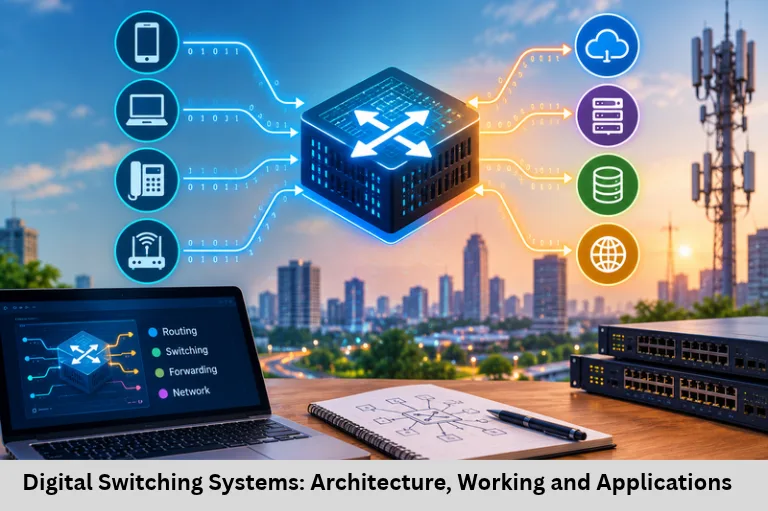
Explore digital switching systems, TST architecture, SS7 signaling, softswitches, optical switching, Erlang traffic engineering, 5G and telecom network design. Embedded Tech Development Academy (ETDA).
- Digital Switching Systems: Architecture, Working and Applications
-
Digital Switching Systems: The Backbone of Modern Telecommunications
- Introduction to Digital Switching Systems
- Fundamental Switching Concepts
- Digital Switching System Components
- Signaling Systems and Protocols
- Modern Switching Technologies
- Performance Metrics and Traffic Engineering
- Key Switching Parameters
- Cloud Switching, 5G and Network Security
- Frequently Asked Questions
- Conclusion
Digital Switching Systems: The Backbone of Modern Telecommunications
Introduction to Digital Switching Systems
Digital switching systems are essential components of modern telecommunications infrastructure. They establish and manage communication paths for voice calls, data sessions, and multimedia services across public switched telephone networks (PSTN), enterprise networks, mobile infrastructure, and Internet Protocol (IP) platforms. Unlike traditional electromechanical exchanges, digital switches use electronic circuits, digital signal processing, and software-controlled switching networks to route traffic efficiently.
Modern digital switching combines time-division multiplexing (TDM), packet switching, signaling protocols, traffic engineering, and fault-tolerant control systems. These technologies support reliable call setup, resource allocation, congestion management, and integration with Voice over IP (VoIP), LTE, and 5G networks. Understanding digital switching architecture also provides a foundation for studying communication protocols, embedded controllers, real-time systems, and network hardware.
For learners interested in telecommunications and embedded electronics, Embedded Tech Development Academy (ETDA) offers a relevant training context for exploring embedded systems fundamentals. Students comparing a Top Embedded Training Institute in Bangalore should evaluate practical projects, communication-protocol training, hardware exposure, and assured placement support. These skills are valuable when developing controllers, gateways, and monitoring systems used in connected communication infrastructure.
Fundamental Switching Concepts
Switching Techniques
Telecommunications networks use different switching techniques depending on traffic characteristics and service requirements.
| Technique | Operating principle | Delay characteristics | Typical applications |
|---|---|---|---|
| Circuit switching | Reserves a dedicated communication path | Setup delay, then predictable circuit resources | Traditional PSTN and ISDN |
| Packet switching | Transfers data in packets over shared links | Variable queuing and transmission delay | IP networks and VoIP |
| Message switching | Stores and forwards complete messages | Potentially high delay | Store-and-forward messaging systems |
Circuit switching provides dedicated resources for a connection, while packet switching improves network-resource sharing. Modern telecom infrastructure commonly uses packet-based transport even when interworking with legacy TDM networks.
Time-Space-Time Architecture
A Time-Space-Time (TST) switch combines time-slot interchange with spatial switching.
Input → Time switch → Space switch → Time switch → Output
The first time switch moves incoming samples between time slots. The space switch connects the selected input to an appropriate output, and the final time switch places the samples into the required outgoing time slot.
Why TST Is Important
TST architectures can reduce the number of physical crosspoints required compared with some direct space-switching designs. However, blocking behavior and capacity depend on the switching stages, internal time slots, and network configuration.
Practical Design Consideration
Engineers must consider switching capacity, time-slot availability, internal bandwidth, and control complexity when designing a TST network.
Digital Switching System Components
Core Functional Units
A digital exchange contains several cooperating subsystems.
| Component | Primary function | Typical technologies |
|---|---|---|
| Line interface | Connects subscriber lines and provides analog or digital interfacing | SLIC, codecs, line cards |
| Switching network | Connects incoming channels to outgoing channels | TSI, space-switch matrices |
| Control processor | Executes call processing and system supervision | Redundant processors and real-time software |
| Signaling subsystem | Exchanges call-control information | SS7, SIP |
| Operations system | Monitors alarms, configuration, and performance | Network-management software |
Pulse Code Modulation (PCM) converts analog voice into digital samples. In traditional telephony, voice channels are commonly sampled at 8 kHz and encoded using 8 bits per sample, producing 64 kbps per channel.
Digital Transmission Hierarchies
The Plesiochronous Digital Hierarchy (PDH) and Synchronous Digital Hierarchy (SDH) support digital transport across telecommunications networks.
E1: 2.048 Mbps, typically organized into 32 time slots, with 30 commonly used for voice and two for framing and signaling.
T1: 1.544 Mbps, providing 24 DS0 channels of 64 kbps each plus framing overhead.
E3: 34.368 Mbps.
STM-1: 155.52 Mbps.
STM-4: 622.08 Mbps.
STM-16: 2.48832 Gbps.
SDH provides standardized synchronous transport and network-management capabilities. Many carrier networks have since migrated to Ethernet and IP/MPLS transport, while SDH remains relevant in some legacy environments.
Signaling Systems and Protocols
Evolution of Telecom Signaling
Signaling communicates call setup, routing, status, and release information. Early systems used in-band tones carried on the same channel as voice. Common Channel Signaling (CCS), particularly Signaling System No. 7 (SS7), separates signaling traffic from voice channels. Modern IP-based systems use Session Initiation Protocol (SIP) for session establishment and related control.
SS7 Protocol Architecture
SS7 uses a layered protocol suite, including:
MTP Level 1: Physical signaling-link interface.
MTP Level 2: Reliable signaling-link transmission, error detection, and retransmission.
MTP Level 3: Message routing and signaling-network management.
SCCP: Additional addressing and connection-oriented or connectionless services.
TCAP: Supports transaction-based applications, including certain database queries and mobility-related services.
The SS7 architecture is more extensive than a simple four-layer stack; application protocols such as ISUP also support call setup and teardown in traditional telephone networks.
Modern Switching Technologies
Softswitch Architecture
A softswitch separates call-control logic from media transport, supporting the migration from TDM to IP networks.
Its major components include:
Media Gateway (MGW): Converts media between formats such as TDM and packetized voice.
Media Gateway Controller (MGC): Controls sessions, call routing, and gateway resources.
Signaling Gateway: Provides interworking between signaling systems, such as SS7 and IP signaling transport.
This architecture allows operators to integrate legacy telephone exchanges with IP-based services.
Optical Switching
Optical switches route optical signals between fibers or ports. Technologies include micro-electromechanical systems (MEMS), liquid-crystal devices, and semiconductor optical switches.
MEMS-based devices are used in optical cross-connects, while reconfigurable optical add-drop multiplexers (ROADMs) help route wavelengths through fiber networks. Switching speed and capacity vary substantially by technology and device design; optical capacity should not be confused with the switching speed of an individual device.
Performance Metrics and Traffic Engineering
Key Switching Parameters
Important performance measures include:
Blocking probability: Probability that a connection request cannot be served because resources are unavailable.
Availability: Fraction of time the system is operational.
Call setup time: Time required to establish a connection.
Busy Hour Call Attempts (BHCA): Number of call attempts handled during the busiest hour.
Targets depend on network type and service-level requirements. Carrier-grade systems may aim for approximately 99.999% availability, but this requires careful redundancy, maintenance, and fault-recovery planning.
Erlang B Traffic Calculation
The Erlang B formula estimates blocking probability in a loss system where blocked calls are cleared rather than queued:
[
P_b=\frac{A^N/N!}{\sum_{k=0}^{N} A^k/k!}
]
Here, (A) is offered traffic in Erlangs, (N) is the number of circuits, and (P_b) is the blocking probability.
One Erlang represents continuous use of one circuit over the measurement interval. Traffic engineers use the formula to estimate the circuit capacity needed for a target blocking probability.
Cloud Switching, 5G and Network Security
Cloud-Native Switching
Network Functions Virtualization (NFV) allows selected network functions to run as software on standard computing infrastructure. Containers and orchestration platforms can support scalable control services, automated deployment, and recovery. AI-based traffic analysis can help forecast demand and detect abnormal patterns, although operational results depend on data quality and system design.
5G Core Architecture
The 5G core uses a Service-Based Architecture (SBA), with network functions communicating through defined service interfaces. Control Plane and User Plane Separation (CUPS) principles allow control and forwarding functions to scale independently. Network slicing provides logical networks with different service characteristics, subject to resource and policy management.
Security and Scalability
Telecom systems must address signaling abuse, denial-of-service attacks, fraud, and unauthorized access. Common protections include signaling firewalls, authentication, access controls, encrypted media using appropriate protocols, monitoring, and geographically redundant deployments. Clos-network designs and load balancing can also improve scalability and reduce bottlenecks.
Embedded Tech Development Academy (ETDA) learners studying embedded communication systems can connect these network concepts with device-level programming, protocol implementation, and real-time control. A Top Embedded Training Institute in Bangalore should provide practical learning opportunities that link theoretical networking with implementation, debugging, and assured placement support.
Frequently Asked Questions
What is a digital switching system?
A digital switching system is an electronic, software-controlled system that establishes communication paths for voice, data, or other digital traffic across a telecommunications network.
What is the difference between circuit switching and packet switching?
Circuit switching reserves resources for a connection, while packet switching divides information into packets that share network links. Packet switching is widely used in modern IP networks.
What is TST switching architecture?
TST stands for Time-Space-Time. It combines time-slot interchange, spatial switching, and another time-slot interchange stage to connect channels through a digital switching network.
What is the role of SS7 in telecommunications?
SS7 is a signaling protocol suite used in traditional telephone networks for functions such as call setup, routing, release, and selected network-service interactions.
How are digital switching systems used in modern networks?
They support call control, media routing, IP telephony, carrier transport, and interworking between legacy telephone systems and modern packet-based infrastructure. Softswitches and cloud-native network functions extend these capabilities.
Conclusion
Digital switching systems have evolved from dedicated circuit-based exchanges into flexible platforms that support TDM, IP communications, cloud-native services, optical transport, and 5G networks. Their performance depends on switching architecture, signaling reliability, traffic engineering, fault tolerance, security, and efficient use of network resources. Concepts such as TST switching, SS7, SIP, SDH, Erlang B calculations, NFV, and network slicing remain important for understanding telecommunications infrastructure.
As voice and data services converge, engineers need knowledge of communication protocols, digital electronics, embedded controllers, real-time software, and network troubleshooting. Embedded Tech Development Academy (ETDA) is relevant to learners exploring practical embedded systems and communication technology. When evaluating a Top Embedded Training Institute in Bangalore, review the curriculum, lab exercises, protocol-based projects, and assured placement support. Building these technical foundations can help students prepare for work involving embedded communication devices, Internet of Things (IoT) gateways, telecom equipment, and connected industrial systems.
Author: ETDA Trainers
Experience: 10+ Years of Industry Experience in Embedded Systems, IoT, and Embedded C Programming