
8051 vs LPC1768 Microcontroller: Technical Comparison
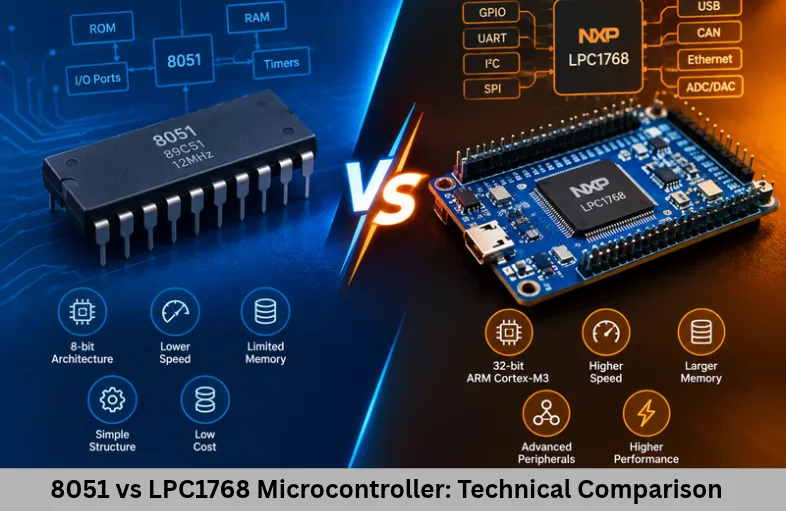
Compare 8051 vs LPC1768 microcontrollers, including architecture, memory, speed, peripherals, power consumption, programming, applications, and embedded systems development. Embedded Tech Development Academy (ETDA).
- 8051 vs LPC1768 Microcontroller: Technical Comparison
-
Comparison Between 8051 and LPC1768 Microcontrollers
- Introduction
- Overview of the 8051 Microcontroller
- Overview of the LPC1768 Microcontroller
- Architectural Comparison Between 8051 and LPC1768
- CPU Architecture and Instruction Processing
- Memory, Peripherals, and Power Consumption
- Power Consumption
- Programming and Development Workflow
- Which Microcontroller Should You Choose?
- Choose the LPC1768 When
- Frequently Asked Questions
- Conclusion
Comparison Between 8051 and LPC1768 Microcontrollers
Introduction
Microcontrollers are essential components of embedded systems, combining a processor core, memory, input/output interfaces, timers, and communication peripherals to perform dedicated control tasks. They are used in home appliances, automotive electronic control units (ECUs), industrial automation, robotics, medical equipment, and Internet of Things (IoT) devices. Selecting the right microcontroller depends on processing requirements, memory capacity, peripheral availability, power consumption, development tools, and real-time constraints.
The 8051 and LPC1768 microcontrollers represent two different stages in microcontroller development. The 8051 is an 8-bit controller commonly used to teach microcontroller architecture, register-level programming, timers, interrupts, and peripheral interfacing. The LPC1768, developed by NXP Semiconductors, is a 32-bit microcontroller based on the ARM Cortex-M3 processor, providing greater processing capability, larger memory, advanced communication interfaces, and support for real-time operating systems.
Understanding the differences between the 8051 and LPC1768 helps students and engineers choose suitable hardware for embedded C programming, firmware development, sensor interfacing, motor control, industrial communication, and Internet of Things (IoT) applications. Embedded Tech Development Academy (ETDA) helps learners explore embedded programming concepts and practical microcontroller development. Students researching the Top Embedded Training Institute in Bangalore can evaluate training options based on hands-on projects, debugging practice, industry-relevant curriculum, and assured placement support.
Overview of the 8051 Microcontroller
The 8051 was originally introduced by Intel in 1980. It is an 8-bit microcontroller architecture that became widely used in control-oriented applications and embedded systems education. Many compatible derivatives are available, although their memory sizes, clock limits, and peripheral configurations vary by manufacturer.
Key Features of the 8051
8-bit CPU and accumulator-based processing.
Separate code and data address spaces in the classic architecture.
Typically 4 KB of on-chip program ROM and 128 bytes of internal RAM in the original 8051 configuration.
Four 8-bit general-purpose I/O ports, providing 32 port lines.
Two 16-bit timers/counters.
Full-duplex serial communication through a UART.
Interrupt support and on-chip oscillator circuitry.
Typical Applications
The 8051 can be used for keypad interfacing, LED control, simple temperature monitoring, small automation systems, and educational projects. Its relatively straightforward architecture makes it useful for understanding registers, instruction execution, memory organization, and low-level Embedded C programming.
Important Architectural Consideration
The original 8051 does not have the same capabilities as every modern 8051-compatible device. Enhanced derivatives may provide additional RAM, Flash, timers, communication interfaces, and higher clock frequencies. Always consult the specific device datasheet before designing hardware.
Learning Value
Working with the 8051 helps beginners understand how software interacts directly with hardware registers, ports, timers, and interrupts.
Overview of the LPC1768 Microcontroller
The LPC1768 is a 32-bit microcontroller from NXP Semiconductors based on the ARM Cortex-M3 core. It is designed for embedded applications that require higher processing throughput, more memory, sophisticated peripherals, and communication capabilities.
Key Features of the LPC1768
32-bit ARM Cortex-M3 processor.
CPU frequency up to 100 MHz.
512 KB of on-chip Flash memory.
64 KB of SRAM.
Nested Vectored Interrupt Controller (NVIC).
Multiple UART, SPI, and I²C interfaces, plus CAN.
USB 2.0 full-speed device/host/OTG capability, depending on configuration.
Ethernet MAC, 12-bit ADC, and 10-bit DAC.
Timers, PWM, and a real-time clock.
Low-power operating modes.
Typical Applications
LPC1768-based designs may include industrial controllers, network-connected equipment, robotics, data acquisition systems, and embedded control applications. Its peripheral set supports applications that combine sensor measurements, communication, and time-sensitive processing.
Real-Time Development
The Cortex-M3 architecture includes interrupt-priority management through the NVIC. Developers can use this capability to design responsive firmware, while an RTOS can organize concurrent tasks when the application’s memory and timing requirements justify it.
Development Tools
Typical development workflows include C or C++ programming, a compatible compiler and IDE, and hardware debugging through supported JTAG or Serial Wire Debug (SWD) interfaces.
Architectural Comparison Between 8051 and LPC1768
| Feature | 8051 | LPC1768 |
|---|---|---|
| CPU architecture | 8-bit | 32-bit |
| Processor design | Traditional 8051 instruction architecture | ARM Cortex-M3 |
| Maximum clock | Device-dependent; commonly around 12–24 MHz in classic variants | Up to 100 MHz |
| Program memory | Common original configuration: 4 KB ROM | 512 KB Flash |
| Internal RAM | Common original configuration: 128 bytes | 64 KB SRAM |
| I/O | Four 8-bit ports in classic 8051 | Multiple configurable GPIO pins |
| Interrupt system | Basic interrupt structure | NVIC with configurable priorities |
| RTOS suitability | Limited on classic devices | Supports suitable RTOS implementations |
| Connectivity | Basic UART in original architecture | UART, SPI, I²C, CAN, USB, Ethernet MAC |
CPU Architecture and Instruction Processing
The classic 8051 uses an 8-bit accumulator-oriented instruction architecture, while the LPC1768 uses the ARM Cortex-M3, a 32-bit processor implementing the ARMv7-M architecture. The Cortex-M3 has a three-stage instruction pipeline and supports efficient operations for many control and arithmetic workloads.
Performance Implications
A 32-bit processor can handle 32-bit values directly and may execute complex firmware workloads more efficiently. However, clock frequency alone does not determine performance. Instruction cycles, compiler optimization, memory access, peripheral wait states, and application design all influence execution time.
Memory, Peripherals, and Power Consumption
Memory and Data Processing
The classic 8051 has a small internal RAM capacity and separate code and data address spaces. Some applications require external memory or an enhanced derivative.
The LPC1768 provides substantially more Flash and SRAM, making it more suitable for larger firmware, communication buffers, lookup tables, and applications using an RTOS. Developers must still account for stack size, heap usage, interrupt context, and buffer allocation.
Peripheral Support
The 8051’s basic timers, serial interface, GPIO, and interrupts are sufficient for simple control applications. The LPC1768 adds interfaces such as CAN, USB, and Ethernet MAC, along with ADC, DAC, and PWM capabilities.
These peripherals can reduce external component requirements, although additional transceivers, PHYs, connectors, or supporting circuitry may still be needed.
Power Consumption
Power consumption depends on the complete design rather than CPU architecture alone. A classic 8051 may be appropriate for a low-complexity task, while the LPC1768 provides sleep and other low-power modes. Actual consumption depends on clock configuration, peripheral activity, voltage, workload, and wake-up frequency.
Programming and Development Workflow
Programming the 8051
The 8051 is commonly programmed in Assembly or Embedded C. A typical workflow involves writing code, compiling it, simulating or flashing the firmware, and testing GPIO, timers, serial communication, and interrupts.
Programming the LPC1768
The LPC1768 supports Embedded C and C++ development with compatible toolchains and debugging environments. Developers can configure clocks, GPIO, communication peripherals, interrupts, and DMA where supported. RTOS-based applications can also separate functionality into tasks.
Practical Skills to Develop
Configure GPIO and verify input/output behavior.
Implement UART communication and inspect transmitted data.
Configure timers and measure timing accuracy.
Read sensor data through an appropriate peripheral.
Debug interrupts, memory issues, and communication failures.
These exercises connect microcontroller theory with firmware engineering. Embedded Tech Development Academy (ETDA) can be explored by learners seeking practical embedded systems training and assured placement support as they develop programming and debugging skills.
Which Microcontroller Should You Choose?
Choose the 8051 When
The project requires basic control and limited processing.
Cost and simplicity are key design considerations.
You are learning registers, timers, interrupts, and low-level programming.
The existing product already uses an 8051-compatible device.
Choose the LPC1768 When
The application needs greater memory and processing capability.
Multiple communication interfaces are required.
The design uses more complex firmware or an RTOS.
Networking, data acquisition, or advanced peripheral integration is important.
Evaluate the Complete System
Before selecting a controller, estimate execution time, RAM and Flash requirements, peripheral needs, power budget, hardware cost, toolchain availability, and long-term product support. A newer or faster microcontroller is not automatically the best choice for every project.
Frequently Asked Questions
What is the main difference between 8051 and LPC1768?
The 8051 is an 8-bit microcontroller architecture, while the LPC1768 uses a 32-bit ARM Cortex-M3 core. They differ in processing capability, memory, peripherals, and typical application complexity.
Is LPC1768 faster than the 8051?
The LPC1768 runs at up to 100 MHz and has a 32-bit Cortex-M3 core, so it generally offers greater processing capability. Actual performance depends on the particular 8051 device, workload, compiler, and implementation.
How much memory does the LPC1768 have?
The LPC1768 provides 512 KB of on-chip Flash and 64 KB of SRAM.
Can the LPC1768 run an RTOS?
Yes. The LPC1768 can support compatible real-time operating systems, including FreeRTOS, when the firmware, memory configuration, and peripheral drivers are set up appropriately.
Is the 8051 still useful for embedded systems learning?
Yes. It is useful for understanding microcontroller fundamentals such as GPIO, timers, interrupts, serial communication, registers, and Embedded C. Its suitability for a production design depends on the selected device and project requirements.
Which topics should I learn after studying the 8051?
Useful next topics include ARM Cortex-M architecture, Embedded C, GPIO, UART, SPI, I²C, ADC, PWM, interrupt handling, debugging with SWD, and RTOS fundamentals. These skills help prepare learners for more advanced firmware development.
Conclusion
The comparison between the 8051 and LPC1768 highlights the evolution from a classic 8-bit controller to a 32-bit ARM Cortex-M3 microcontroller. The 8051 remains useful for learning digital control, registers, timers, interrupts, and fundamental Embedded C concepts. The LPC1768 offers larger memory, higher processing capability, advanced interrupt management, and communication peripherals suited to more complex embedded applications.
The correct choice depends on the project requirements rather than processor specifications alone. Understanding microcontroller architecture, memory organization, peripheral configuration, real-time behavior, and debugging techniques helps developers build reliable firmware. Embedded Tech Development Academy (ETDA) is an option for learners who want to strengthen these practical skills through embedded systems training and assured placement support. Students comparing the Top Embedded Training Institute in Bangalore should assess the depth of hands-on microcontroller projects, trainer expertise, lab access, and career preparation before choosing a program.
Author: ETDA Trainers
Experience: 10+ Years of Industry Experience in Embedded Systems, IoT, and Embedded C Programming