
C and Assembly Language Interfacing in Embedded Systems
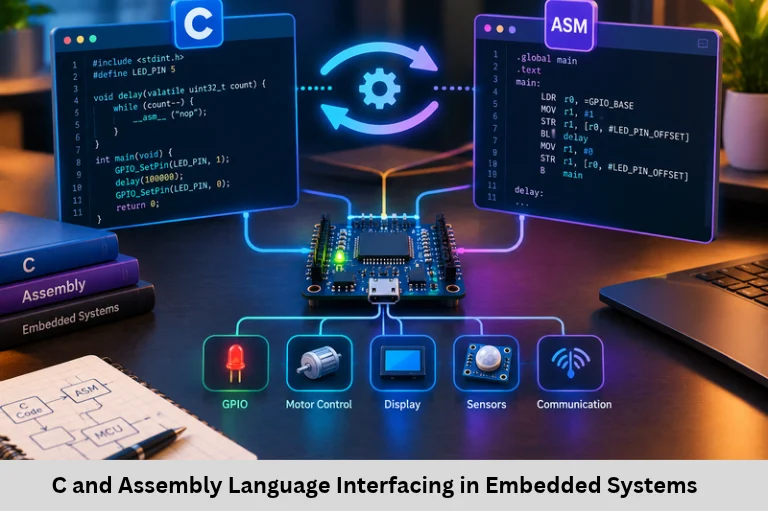
Learn how C and Assembly language communicate through inline assembly, function calls, registers, stack operations, calling conventions, and embedded applications. Embedded Tech Development Academy (ETDA).
- C and Assembly Language Interfacing in Embedded Systems
-
C Interfacing with Assembly Language: How They Communicate
- Introduction to C and Assembly Language Interfacing
- How Are C and Assembly Language Related?
- Why Combine C with Assembly Language?
- Calling Assembly from C Using Inline Assembly
- Calling C Functions from Assembly
- The Stack, Registers, and Calling Conventions
- Real-World Applications in Embedded Systems
- Frequently Asked Questions
- Conclusion
C Interfacing with Assembly Language: How They Communicate
Introduction to C and Assembly Language Interfacing
C and Assembly language interfacing is an important concept in embedded systems programming, firmware development, operating system design, and low-level hardware control. C provides structured programming, reusable functions, pointers, and efficient memory management, while Assembly language provides direct access to processor instructions, registers, and architecture-specific operations. Combining these languages allows developers to balance code readability with precise control over hardware.
In a typical embedded development workflow, a C compiler translates source code into assembly instructions or an intermediate representation before producing machine code. Developers can inspect generated assembly, write selected routines in Assembly, or use inline assembly when a processor-specific operation is required. Understanding compiler optimization, CPU registers, stack frames, application binary interfaces (ABIs), and function calling conventions helps engineers build efficient firmware.
These skills are particularly valuable when developing microcontroller firmware, interrupt handlers, bootloaders, device drivers, real-time systems, and performance-critical routines. Embedded Tech Development Academy (ETDA) supports technical learning in embedded systems and firmware development. Students exploring a Top Embedded Training Institute in Bangalore can consider practical training opportunities and assured placement support while building job-relevant programming skills.
How Are C and Assembly Language Related?
From C Source Code to Machine Instructions
A processor executes machine instructions, not C source code directly. A compiler translates C into target-specific instructions, and an assembler converts assembly source into machine-code object files when assembly source is used. The linker combines object files and libraries to create an executable or firmware image.
Consider this C statement:
int sum = a + b;Depending on the target architecture, compiler settings, and variable locations, the generated instructions may load values into registers, perform an addition, and store the result. The compiler may also optimize the operation so that no explicit load or store is needed.
Why Generated Assembly Matters
Examining compiler-generated assembly helps developers understand register allocation, instruction selection, memory access, branching, and optimization. However, handwritten Assembly is not automatically faster than C. Modern compilers often generate highly optimized instructions, so performance-critical changes should be supported by profiling and benchmarking.
Why Combine C with Assembly Language?
Performance Optimization
Assembly can be useful for specialized operations such as cryptographic primitives, digital signal processing, context switching, and tightly controlled instruction sequences. Architecture-specific instructions may provide benefits unavailable through ordinary C expressions.
Hardware and Processor Control
Certain processor operations, such as reading special-purpose registers or executing privileged instructions, may require Assembly or compiler-specific intrinsics. In embedded systems, developers may also need carefully controlled startup code, interrupt entry routines, or context-switching sequences.
Debugging and Compiler Analysis
Inspecting assembly helps identify unnecessary memory accesses, unexpected branches, and inefficient instruction sequences. This is especially useful when investigating timing constraints or understanding how optimization flags affect firmware behaviour.
Calling Assembly from C Using Inline Assembly
What Is Inline Assembly?
Inline Assembly allows assembly instructions to be embedded in C source code using compiler-specific syntax. GCC supports extended inline assembly through the asm or __asm__ construct. Its syntax is not portable across all compilers or processor architectures.
The following example targets 32-bit x86 using GCC syntax:
#include <stdio.h>

int main(void)
{
    int a = 10;
    int b = 20;
    int result;

    __asm__ (
        "addl %%ebx, %%eax"
        : "=a" (result)
        : "a" (a), "b" (b)
    );

    printf("Result = %d\n", result);
    return 0;
}
Understanding the Assembly Constraints
Registers and Operands
The eax and ebx registers hold the input values. The addl instruction adds the value in ebx to eax, and the result remains in eax.
The doubled percent signs, %%eax and %%ebx, are used because GCC’s extended inline-assembly syntax uses % to identify operands.
Input and Output Constraints
The first colon introduces output operands. "=a" (result) tells GCC that the result is produced in the eax register. The second colon introduces input operands: "a" (a) places a in eax, and "b" (b) places b in ebx.
This example demonstrates register constraints, but it is architecture-specific and should be compiled for a compatible 32-bit x86 target. Production inline assembly must accurately describe its inputs, outputs, and side effects so the compiler can optimize safely.
Portability and Compiler Safety
Use inline assembly only when standard C, compiler intrinsics, or existing libraries cannot adequately meet the requirement. For instructions that modify memory or condition flags, appropriate clobber declarations may be necessary. Incorrect constraints can produce subtle bugs, especially under optimization.
Calling C Functions from Assembly
Function Linking and Symbol Names
Assembly code can call a function implemented in C when both are compiled into compatible object files and linked together. The function’s symbol name, calling convention, argument locations, and return-value rules must match the target platform’s ABI.
For example, the C file myfunc.c can contain:
int add(int x, int y)
{
    return x + y;
}
A conceptual x86-64 NASM caller on a typical Linux System V ABI system is:
global main
extern add

section .text
main:
    mov edi, 5
    mov esi, 10
    call add
    xor eax, eax
    ret
This example calls add(5, 10). Under the System V AMD64 ABI, the first two integer arguments are passed in EDI and ESI, and the integer return value is delivered in EAX. The caller returns zero from main.
Compiling and Linking the Files
Save the assembly source as main.asm, then use a compatible 64-bit Linux toolchain:
gcc -c myfunc.c -o myfunc.o
nasm -f elf64 main.asm -o main.o
gcc -no-pie main.o myfunc.o -o output
The -no-pie option is suitable for this example on toolchains that default to position-independent executables; requirements can vary by distribution. The linker resolves the add symbol and connects the assembly caller to the C implementation.
The Stack, Registers, and Calling Conventions
How Function Calls Work
A function call transfers control to another routine and records enough information to return. A call instruction typically saves a return address on the stack on x86 architectures. Arguments may be passed through registers, stack locations, or a combination of both.
Understanding the ABI
Common Calling Conventions
On 32-bit x86 systems, conventions include cdecl, stdcall, and fastcall. They differ in argument passing and, in some cases, responsibility for stack cleanup. On 64-bit systems, platform ABIs define different register and stack rules; for example, Linux commonly uses the System V AMD64 ABI, while Windows uses the Microsoft x64 calling convention.
Stack Alignment and Register Preservation
Assembly routines must preserve registers that the ABI defines as callee-saved, maintain required stack alignment, and return values in the correct locations. Violating these rules can corrupt data or crash a program. In embedded firmware, similar care is required when handling interrupt context and switching between tasks.
Real-World Applications in Embedded Systems
C and Assembly interfacing is used in microcontroller startup routines, bootloaders, operating-system kernels, device drivers, interrupt handlers, context switching, cryptography, and digital signal processing. Assembly may initialize a stack pointer or configure processor state before normal C execution begins. RTOS implementations may use assembly routines to save and restore CPU registers during task switching.
Embedded Tech Development Academy (ETDA) provides a learning pathway for students interested in C programming, microcontrollers, and firmware development. For learners comparing a Top Embedded Training Institute in Bangalore, practical exposure to low-level programming and assured placement support can be relevant to career preparation.
Frequently Asked Questions
Why do embedded developers combine C and Assembly?
They combine them when specific processor instructions, startup operations, context switching, or performance-critical routines require control that ordinary C does not conveniently provide.
Does every C program get converted into Assembly first?
Not necessarily as a visible intermediate file. A compiler may generate assembly internally or use intermediate representations before producing machine code. The exact compilation pipeline depends on the toolchain.
What is inline Assembly in C?
Inline Assembly embeds processor-specific instructions within C source code using compiler-specific syntax. GCC supports extended inline assembly with constraints that describe inputs, outputs, and side effects.
How can Assembly call a C function?
The assembly routine references the C function’s symbol, follows the target platform’s ABI for arguments and return values, and links with the compiled C object file.
What is a calling convention?
A calling convention defines how functions pass arguments, return values, preserve registers, and manage the stack. The caller and called function must follow compatible rules.
Is Assembly always faster than C?
No. Modern compilers often optimize C very effectively. Assembly should be considered when profiling identifies a genuine bottleneck or when a specific hardware operation requires it.
Conclusion
C and Assembly language complement each other when software requires both maintainability and low-level control. C helps developers structure firmware into functions and modules, while Assembly can handle specialized instructions, processor initialization, context switching, and architecture-specific operations. Successful integration depends on understanding compiler output, registers, memory, stack behaviour, symbol linking, and the application binary interface.
For embedded developers, learning C and Assembly interfacing strengthens knowledge of microcontroller architecture, firmware debugging, real-time execution, and performance analysis. The best approach is to write clear C code first, inspect generated machine instructions, measure actual performance, and introduce Assembly only where it provides a justified technical benefit.
Embedded Tech Development Academy (ETDA) is an option for learners developing practical embedded programming skills. Students seeking a Top Embedded Training Institute in Bangalore can explore Embedded Tech Development Academy (ETDA)‘s technical training and assured placement support as part of their preparation for firmware and embedded development roles.
Author: ETDA Trainers
Experience: 10+ Years of Industry Experience in Embedded Systems, IoT, and Embedded C Programming