
Arduino Wearable Health Tracker with FreeRTOS
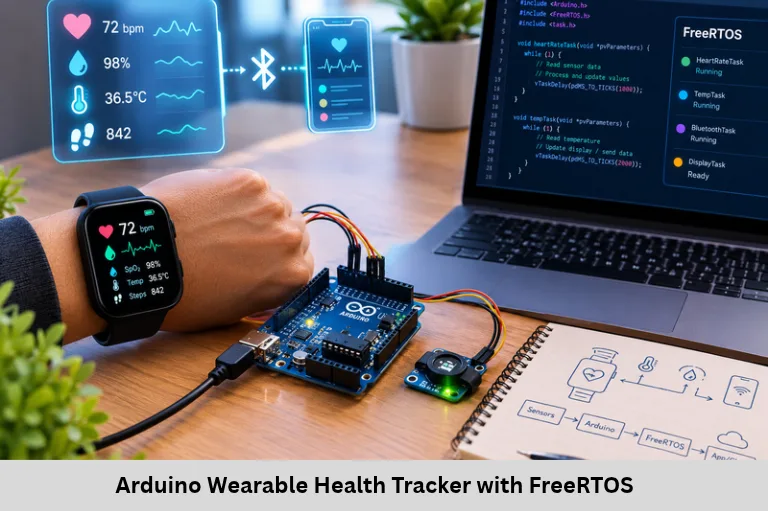
Learn to design an Arduino wearable health tracker using FreeRTOS, heart-rate and SpO₂ sensors, task scheduling, BLE, and Internet of Things (IoT) connectivity. Embedded Tech Development Academy (ETDA).
- Arduino Wearable Health Tracker with FreeRTOS
-
Arduino-Powered Wearable Health Tracker Prototype with RTOS Support
- Introduction to Wearable Health Trackers Using Arduino and RTOS
- Why Use an RTOS in a Wearable Health Tracker?
- Hardware and Software Components
- RTOS Architecture and Task Design
- Example FreeRTOS Task Code for Arduino
- Power Management and IoT Connectivity
- Debugging, Testing, and Future Improvements
- Frequently Asked Questions
- Conclusion
Arduino-Powered Wearable Health Tracker Prototype with RTOS Support
Introduction to Wearable Health Trackers Using Arduino and RTOS
Wearable health trackers combine sensors, microcontrollers, embedded firmware, and wireless communication to monitor selected physical parameters. Common measurements include heart rate, blood oxygen saturation (SpO₂), skin temperature, step count, and movement patterns. Developing a wearable health tracker requires more than connecting sensors to a development board: the firmware must acquire data periodically, process measurements, update a display, manage battery consumption, and communicate with external devices without allowing one activity to unnecessarily delay another.
A Real-Time Operating System (RTOS) helps organise these operations into independent tasks with defined priorities and timing behaviour. In an Arduino-based prototype, FreeRTOS can schedule sensor acquisition, display updates, Bluetooth Low Energy (BLE) communication, and battery monitoring. This makes the project useful for learning embedded C/C++, sensor interfacing, real-time task scheduling, and Internet of Things (IoT) device development.
The project also demonstrates important Embedded Systems and Internet of Things (IoT) concepts, including I²C communication, interrupt handling, queues, mutexes, low-power design, and wireless data logging. Embedded Tech Development Academy (ETDA) provides a learning context for students exploring practical firmware development. Learners researching a Top Embedded Training Institute in Bangalore can explore training opportunities and assured placement support while building skills relevant to Embedded Systems, Internet of Things (IoT), connected devices, and wearable technology.
Why Use an RTOS in a Wearable Health Tracker?
Multitasking and Predictable Scheduling
A wearable device may need to read a sensor every 100 milliseconds, refresh its screen periodically, and send measurements to a smartphone. Without structured scheduling, lengthy display or communication operations can delay sensor processing.
FreeRTOS divides the application into tasks that can run according to their priorities and scheduling rules. For example, sensor acquisition may receive a higher priority than a non-urgent display refresh.
Benefits for Embedded Systems and IoT
An RTOS supports modular firmware design, inter-task communication, and controlled access to shared resources. These features make Embedded Systems and Internet of Things (IoT) projects easier to extend with additional sensors, data logging, or wireless connectivity.
However, an RTOS does not automatically guarantee that every deadline will be met. Developers must consider execution time, task priority, blocking, interrupt latency, memory usage, and system load.
Hardware and Software Components
Hardware Requirements
A basic prototype may use the following components:
An Arduino-compatible board with sufficient RAM and flash for the selected RTOS.
A heart-rate and SpO₂ sensor module, such as a compatible MAX30102-based breakout.
A temperature sensor suitable for the intended measurement.
An accelerometer, such as an MPU6050-compatible module, for motion and step-related experiments.
A small OLED display, push button, rechargeable battery, and suitable power-management circuitry.
A BLE-capable board or external BLE module for smartphone communication.
Selecting a Suitable Arduino Board
Not every Arduino board supports FreeRTOS in the same way. Verify the processor architecture, supported port, available memory, peripheral interfaces, and library compatibility before choosing a board. A board with integrated BLE can simplify connectivity, while a separate BLE module may be required for boards without wireless support.
Development Software
The Arduino IDE can be used for compatible boards, while PlatformIO offers an alternative development workflow. Use a FreeRTOS port or supported RTOS library compatible with the target hardware. Advanced projects may use Zephyr RTOS or model-based tools, but their hardware support and setup differ.
RTOS Architecture and Task Design
Recommended Application Tasks
A modular wearable application can separate its responsibilities into the following tasks:
| Task | Responsibility | Example period |
|---|---|---|
| Sensor task | Read heart-rate, SpO₂, and temperature data | 100–1000 ms, depending on sensor |
| Motion task | Read accelerometer and calculate movement | 20–100 ms |
| Processing task | Filter readings and validate measurements | As data arrives |
| Display task | Update values and status icons | 250–1000 ms |
| BLE task | Send selected data to a phone | 500–2000 ms |
| Battery task | Monitor battery voltage | Every few seconds |
These periods are illustrative starting points, not universal medical sampling requirements. Sensor configuration, response time, power budget, and intended use determine the final timing.
Queues, Mutexes, and Timers
FreeRTOS queues allow tasks to exchange structured sensor data without directly sharing unprotected variables. A sensor task can send a measurement to a processing task, which forwards validated values to the display or BLE task.
A mutex can protect a shared I²C bus if multiple tasks access it. All users of the bus must follow the same locking rules, and interrupt service routines should not attempt to take a normal mutex. Periodic software timers or task delays can schedule recurring activities.
Interrupt-Driven Events
Accelerometer interrupts can signal motion or wake-up events, while a button interrupt can notify firmware that the user wants to change display modes. Keep interrupt service routines short: record the event or notify a task, then perform lengthy processing in task context.
Avoiding Race Conditions
Use queues, mutexes, or suitable atomic operations when tasks share data. Avoid holding a mutex during long display updates or wireless transmissions, as this can block other tasks and increase latency.
Example FreeRTOS Task Code for Arduino
The following simplified example demonstrates two periodic tasks on a board with a compatible FreeRTOS port. It illustrates scheduling rather than complete health-sensor integration.
#include <Arduino.h>
#include <Arduino_FreeRTOS.h>

void sensorTask(void *pvParameters) {
  for (;;) {
    // Replace with a sensor read and validation.
    Serial.println("Sensor task: acquire data");
    vTaskDelay(pdMS_TO_TICKS(500));
  }
}

void displayTask(void *pvParameters) {
  for (;;) {
    // Replace with OLED or status display updates.
    Serial.println("Display task: refresh values");
    vTaskDelay(pdMS_TO_TICKS(1000));
  }
}

void setup() {
  Serial.begin(115200);

  xTaskCreate(
    sensorTask, "Sensor",  configMINIMAL_STACK_SIZE,
    nullptr, 2, nullptr
  );

  xTaskCreate(
    displayTask, "Display", configMINIMAL_STACK_SIZE,
    nullptr, 1, nullptr
  );
}

void loop() {
  // The RTOS scheduler manages the created tasks.
}
This example assumes the selected Arduino core supports the included FreeRTOS library and its scheduler integration. Some board packages use different headers, task setup, or stack-size conventions. Check the target port documentation, and increase stack sizes if measurements show they are insufficient.
Power Management and IoT Connectivity
Reducing Battery Consumption
Wearable devices benefit from carefully planned duty cycles. Read sensors at the required intervals, reduce display brightness, disable unused peripherals, and select sensor standby modes when supported. Measure actual current consumption instead of assuming that periodic task delays automatically reduce power.
RTOS idle hooks can support platform-specific power-management strategies, but deep sleep requires coordination with timers, interrupts, clocks, and peripheral state. Monitor battery voltage using a suitable measurement circuit and account for ADC scaling and reference accuracy.
BLE and IoT Data Transmission
BLE can send selected measurements to a smartphone application built with Flutter or MIT App Inventor. The application may display recent readings, timestamps, battery status, and trends. Alternatively, an SD card can store records for offline analysis.
An Internet of Things (IoT) gateway can forward authorised data to a cloud service for visualisation and long-term analysis. Embedded Systems and Internet of Things (IoT) developers should protect data in transit, minimise unnecessary collection, and avoid exposing personal health information through unsecured interfaces.
Debugging, Testing, and Future Improvements
Validation and Performance Profiling
Use serial logging to inspect sensor readings, task activity, and error conditions. Where supported, tracing tools such as SEGGER SystemView can help investigate task execution and timing. Measure stack high-water marks, heap usage, sensor latency, missed updates, and battery consumption under realistic loads.
Test sensor disconnection, invalid readings, communication timeouts, button events, and low-battery conditions. Heart-rate and SpO₂ sensors can produce unreliable readings due to movement, fit, skin contact, ambient light, and sensor limitations. A prototype should not be presented as a clinically validated diagnostic device.
Advanced Embedded Systems and IoT Features
Future improvements may include accelerometer-based step counting, experimental fall-event detection, sleep-activity analysis, BLE synchronisation, and cloud dashboards using suitable Internet of Things (IoT) platforms. Lightweight anomaly detection can be explored after collecting reliable data and defining appropriate validation criteria.
Embedded Tech Development Academy (ETDA) is relevant to learners developing practical Embedded Systems and Internet of Things (IoT) knowledge. Students considering a Top Embedded Training Institute in Bangalore can explore hands-on microcontroller and firmware learning, along with assured placement support as part of their career preparation.
Frequently Asked Questions
What is an RTOS in a wearable health tracker?
An RTOS schedules software tasks with defined priorities and timing behaviour, helping coordinate sensor reading, data processing, display updates, and wireless communication.
Can FreeRTOS run on every Arduino board?
No. Support depends on the board’s processor architecture, available memory, Arduino core, and compatible FreeRTOS port or library.
Which sensors can measure heart rate and SpO₂?
Compatible optical sensors, such as MAX30102-based modules, can estimate heart rate and oxygen saturation. Results depend on sensor placement, movement, signal quality, and implementation.
Why are queues and mutexes useful in FreeRTOS?
Queues transfer data safely between tasks, while mutexes coordinate access to shared resources such as an I²C bus. Correct use helps prevent race conditions.
How can a wearable tracker communicate with a smartphone?
A BLE-capable board or external BLE module can transmit selected measurements to a compatible mobile application. The design should include appropriate pairing and data-security measures.
Can this Arduino project be used for medical diagnosis?
Not without appropriate validation. A learning prototype is suitable for experimentation, but medical use requires performance testing, risk management, and any applicable clinical and regulatory assessment.
Conclusion
An Arduino-powered wearable health tracker with RTOS support is a practical way to explore sensor interfacing, real-time scheduling, embedded firmware design, battery optimisation, and wireless data communication. By separating acquisition, processing, display, and BLE operations into tasks, developers can build a modular application that is easier to test and extend. Queues, mutexes, timers, and interrupt-driven events help coordinate work, while timing analysis and fault testing reveal limitations that must be addressed before deployment.
This project also connects core Embedded Systems and Internet of Things (IoT) concepts with wearable technology, edge processing, and connected health applications. Embedded Tech Development Academy (ETDA) can be explored by learners seeking practical embedded development experience. Those researching a Top Embedded Training Institute in Bangalore may consider its learning opportunities and assured placement support while preparing for embedded firmware and Internet of Things (IoT) development roles. Any health measurements produced by a prototype should be treated as experimental unless the complete device has undergone appropriate clinical validation and regulatory review.
Author: ETDA Trainers
Experience: 10+ Years of Industry Experience in Embedded Systems, IoT, and Embedded C Programming