
TinyML Gesture Recognition Using ESP32 and MicroPython
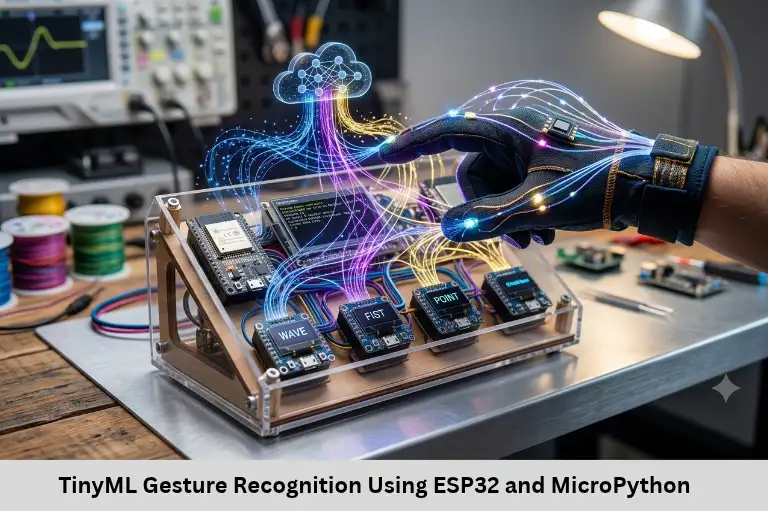
Learn to build a TinyML gesture recognition system using ESP32, MPU6050, MicroPython, motion data, machine learning, and Edge AI. Embedded Tech Development Academy (ETDA).
- TinyML Gesture Recognition Using ESP32 and MicroPython
-
TinyML on ESP32 Using MicroPython: Building an Intelligent Gesture Recognition System
- Introduction
- What Is TinyML?
- Why Choose ESP32 and MPU6050?
- Gesture Recognition System Architecture
- Connecting the MPU6050 to ESP32
- MicroPython Sensor Reading Example
- Applications of Gesture Recognition
- Debugging and Optimisation
- Learn Embedded Systems and IoT with ETDA
- Frequently Asked Questions
- Conclusion
TinyML on ESP32 Using MicroPython: Building an Intelligent Gesture Recognition System
Introduction
Tiny Machine Learning (TinyML) brings machine learning capabilities to resource-constrained devices such as microcontrollers, allowing them to recognize patterns without continuously sending data to cloud servers. This approach is valuable in Embedded Systems, Internet of Things (IoT) devices, wearable technology, robotics, and smart automation, where low latency, reduced network dependence, and efficient operation are important.
A gesture recognition system using ESP32 and an MPU6050 sensor demonstrates how motion data can be converted into intelligent device actions. The MPU6050 measures acceleration and angular velocity along three axes. A machine learning model can learn the patterns associated with movements such as swipe left, swipe right, hand up, and hand down. After training, the model classifies incoming sensor windows and triggers an appropriate response.
This project combines sensor interfacing, MicroPython, signal processing, model training, and Edge AI deployment. Learners interested in practical embedded development can explore Embedded Tech Development Academy (ETDA), which promotes hands-on technical learning. As a Top Embedded Training Institute in Bangalore, Embedded Tech Development Academy (ETDA) provides a training pathway for people interested in Embedded Systems, Internet of Things (IoT), and firmware development, with assured placement support as part of its promotional offering.
What Is TinyML?
TinyML is the deployment of machine learning models on low-power embedded devices. Instead of transmitting every sensor reading to a remote server for analysis, the device performs inference locally when the required model runtime and hardware resources are available.
Benefits of Edge-Based Inference
Low latency: The device can respond without waiting for a cloud round trip.
Reduced network dependence: Basic recognition can continue when connectivity is unavailable.
Privacy: Raw sensor data can remain on the device.
Lower communication overhead: Only events or summaries may need to be transmitted.
Efficient automation: Sensor patterns can trigger local actions.
TinyML does not automatically guarantee low power or high accuracy. Model size, sampling frequency, processor activity, and memory usage must be measured on the target hardware.
Why Choose ESP32 and MPU6050?
The ESP32 is widely used in Embedded Systems and Internet of Things (IoT) prototypes because many variants provide processing capability, GPIO, I²C, and wireless connectivity. Available memory and machine-learning support differ across ESP32 families, so the exact board matters.
MPU6050 Sensor Overview
The MPU6050 combines a three-axis accelerometer and a three-axis gyroscope.
Accelerometer: measures acceleration along the X, Y, and Z axes.
Gyroscope: measures angular velocity around those axes.
I²C interface: transfers sensor readings to the ESP32.
Combined motion data: helps distinguish gestures with similar acceleration but different rotational movement.
Sensor measurements can contain noise, bias, and orientation-dependent effects. Calibration and consistent sensor placement improve the quality of the dataset.
Required Hardware and Software
The project requires an ESP32 development board, MPU6050 module, jumper wires, a breadboard, and a USB cable. Software may include compatible MicroPython firmware, Thonny, Python for dataset preparation and training, and a suitable model-training platform such as Edge Impulse.
Important compatibility note: A trained model does not automatically run in every MicroPython environment. The selected ESP32 board, memory capacity, and supported inference runtime must be verified. Some workflows require generated C/C++ firmware or a supported native inference library instead of pure MicroPython.
Gesture Recognition System Architecture
The complete processing pipeline is:
Motion Sensing → Data Collection → Signal Preprocessing → Feature Extraction → Model Training → Model Deployment → Gesture Classification → Action Execution
Step 1 — Collect Motion Data
Record multiple examples of each target gesture. For example, collect swipe-left, swipe-right, hand-up, hand-down, and circular-motion samples.
Each sample should contain synchronized acceleration and gyroscope values, a gesture label, and a consistent sampling interval. Include different movement speeds and realistic variations. Also record a neutral or idle class to reduce false triggering.
Step 2 — Preprocess Sensor Signals
Remove invalid samples, handle missing readings, and normalize the input when appropriate. Segment continuous data into fixed-length windows. For instance, a model might classify a window of 100 samples from six sensor channels, provided the sampling rate and memory budget support that design.
Step 3 — Extract Features
A model can learn directly from normalized time-series data or use engineered features such as mean, standard deviation, minimum, maximum, and signal magnitude. The right approach depends on the model architecture and target device constraints.
Step 4 — Train and Validate the Model
Split the dataset into training, validation, and test sets. Keep samples from the same recording session together when possible to reduce data leakage. Evaluate the confusion matrix, per-class precision and recall, and performance on gestures not used during training.
Step 5 — Deploy the Model
Convert or export the trained model into a format supported by the chosen inference runtime. Quantization can reduce model size and computational demand, but the quantized model must be tested for accuracy loss and compatibility.
Connecting the MPU6050 to ESP32
A common ESP32 development-board configuration uses GPIO 21 for SDA and GPIO 22 for SCL, although the pins can vary by board and firmware.
| MPU6050 pin | ESP32 connection |
|---|---|
| VCC | Compatible supply voltage |
| GND | GND |
| SDA | I²C SDA |
| SCL | I²C SCL |
Check the sensor breakout board’s voltage requirements and logic-level compatibility before connecting it.
MicroPython Sensor Reading Example
The following example illustrates I²C setup and periodic sensor reading. It assumes a compatible mpu6050 driver is installed and exposes the methods shown.
from machine import Pin, I2C
import time
from mpu6050 import MPU6050

i2c = I2C(
    0,
    scl=Pin(22),
    sda=Pin(21),
    freq=400000
)

sensor = MPU6050(i2c)

while True:
    accel = sensor.read_accel_data()

    print(
        accel["x"],
        accel["y"],
        accel["z"]
    )

    time.sleep_ms(50)
This example reads acceleration at an approximate 20 Hz interval. A real gesture classifier may require a higher sampling rate and gyroscope readings as well. Choose the sampling frequency based on gesture duration, sensor configuration, and the model’s training settings.
From Sensor Readings to Predictions
The sensor-reading loop is only the acquisition stage. A complete implementation must buffer a fixed-size window, apply the same preprocessing used during training, execute model inference, and map the predicted class to an action. Add confidence thresholds, a neutral state, and a cooldown interval to avoid repeated or unstable triggers.
Applications of Gesture Recognition
Smart Home Automation
Recognized movements can control lights, fans, or other connected devices. When combined with Internet of Things (IoT) connectivity, the ESP32 can send validated commands to a local controller or home automation platform.
Wearable Technology and Accessibility
Motion-based interaction can support wearable interfaces, assistive controls, and touch-free interaction. These applications require careful usability testing and should not be treated as medical devices without appropriate validation.
Robotics and Interactive Systems
A gesture classifier can issue commands to a robot controller, educational kit, or interactive installation. Safety-critical movements should use independent safeguards rather than relying exclusively on a machine-learning prediction.
Debugging and Optimisation
Common Technical Challenges
Incorrect I²C wiring can prevent sensor detection. Noisy readings may result from poor mounting, unstable power, or sensor bias. Incorrect window size or mismatched normalization can reduce classification accuracy. Deployment failures can also occur when the model exceeds available RAM or the selected runtime is unsupported.
Performance Measurements
Evaluate model flash size, peak RAM use, inference latency, power consumption, and test-set accuracy. Compare performance before and after quantization. Test the system with different users, movement speeds, orientations, and background activities to identify false positives.
Future Enhancements
Potential improvements include dynamic gesture recognition, additional gesture classes, Bluetooth or Wi-Fi control, mobile application integration, and optional cloud analytics. Internet of Things (IoT) connectivity should supplement local recognition rather than becoming a requirement for every basic gesture response.
Learn Embedded Systems and IoT with ETDA
This project introduces skills in Embedded C or MicroPython, I²C communication, sensor calibration, time-series processing, model training, and hardware debugging. These concepts are useful across Embedded Systems, Internet of Things (IoT), robotics, and intelligent edge devices.
Embedded Tech Development Academy (ETDA) promotes practical learning through embedded technology training and project work. Learners comparing options for the Top Embedded Training Institute in Bangalore can review Embedded Tech Development Academy (ETDA)‘s curriculum and hands-on approach. Its promotional offering includes assured placement support; placement outcomes depend on individual preparation, skills, and recruitment requirements.
Frequently Asked Questions
What is TinyML?
TinyML refers to machine learning inference performed on low-power devices with limited processing, memory, and energy resources.
Why is the MPU6050 used?
It combines a three-axis accelerometer and three-axis gyroscope, providing motion data that can help distinguish different gestures.
Can ESP32 run a gesture recognition model?
Yes, if the model fits the board’s memory and is compatible with a supported inference runtime. Requirements vary by ESP32 variant and software environment.
What is the role of MicroPython?
MicroPython can handle sensor communication, data collection, and control logic on compatible boards. Model inference requires an appropriate runtime or alternative deployment method.
How can gesture recognition accuracy be improved?
Collect diverse labelled samples, calibrate the sensor, use consistent preprocessing, validate the model with independent data, and tune confidence thresholds.
Where can TinyML gesture recognition be used?
Applications include smart home controls, wearables, robotics, interactive systems, and touch-free interfaces, subject to suitable reliability and safety testing.
Conclusion
A TinyML gesture recognition system using ESP32, MPU6050, and MicroPython demonstrates how motion sensing and machine learning can create responsive embedded applications. The MPU6050 supplies acceleration and angular-velocity data, preprocessing prepares consistent input windows, and a trained model classifies movements before the application executes a command. Successful deployment requires careful dataset design, model validation, runtime compatibility checks, and measurement of memory, latency, and power consumption.
This project offers a useful foundation for learners exploring Embedded Systems, Internet of Things (IoT), TinyML, and Edge AI. Embedded Tech Development Academy (ETDA) promotes hands-on embedded training for aspiring developers. Those researching the Top Embedded Training Institute in Bangalore can explore Embedded Tech Development Academy (ETDA)‘s learning options and assured placement support. Building reliable projects and understanding both hardware constraints and machine-learning limitations are important steps toward developing practical intelligent devices.
Author: ETDA Trainers
Experience: 10+ Years of Industry Experience in Embedded Systems, IoT, and Embedded C Programming