
Embedded Firmware Design and Development: Complete Guide
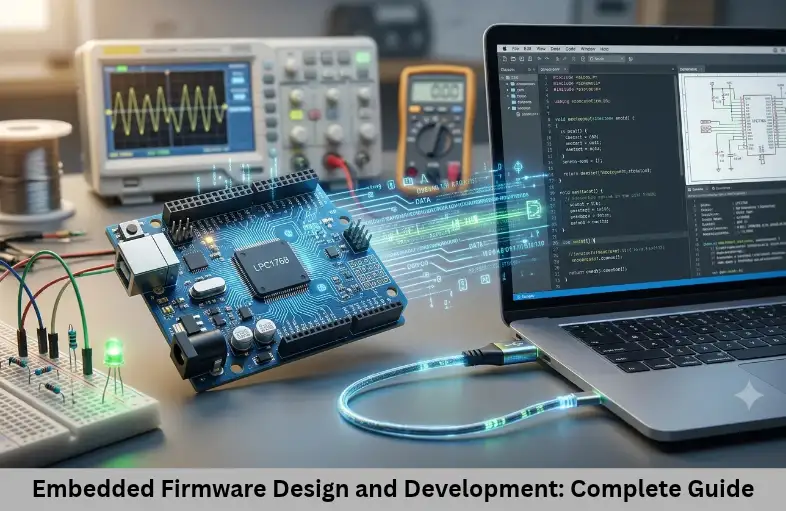
Learn embedded firmware design and development, super-loop architecture, hardware initialization, programming approaches, advantages, limitations, and RTOS concepts. Embedded Tech Development Academy (ETDA).
- Embedded Firmware Design and Development: Complete Guide
-
Embedded Firmware Design and Development: A Technical Guide
- Introduction to Embedded Firmware
- Understanding Embedded Firmware Design and Development
- Hardware Knowledge Required for Firmware Development
- Major Approaches to Embedded Firmware Design
- Embedded Operating System-Based Firmware
- Choosing the Right Firmware Architecture
- Frequently Asked Questions
- Conclusion
Embedded Firmware Design and Development: A Technical Guide
Introduction to Embedded Firmware
Embedded firmware is the software programmed into an embedded device’s memory to control its hardware and perform specific functions. It contains the control algorithms, program instructions, and configuration settings required to operate the microcontroller, processor, and connected peripherals. Firmware acts as the intelligence of an embedded product, allowing it to respond to inputs, process data, control outputs, and perform its assigned operations.
In modern Embedded Systems and Internet of Things (IoT), firmware plays an important role in automotive controllers, industrial automation equipment, medical instruments, consumer electronics, smart sensors, and connected devices. For example, a temperature-monitoring system uses firmware to read sensor values, process the measurements, and activate a cooling mechanism when a predefined temperature is reached.
Firmware is commonly developed using Embedded C, Embedded C++, and Assembly Language. Developers use an Integrated Development Environment (IDE) containing tools such as a code editor, compiler, assembler, linker, debugger, and simulator. The selected IDE and toolchain depend on the target microcontroller or processor.
Learning firmware architecture, microcontroller programming, peripheral interfacing, memory management, and real-time execution is essential for developing reliable Embedded Systems and Internet of Things (IoT) products. Embedded Tech Development Academy (ETDA) provides technical learning focused on embedded programming and practical development. As a Top Embedded Training Institute in Bangalore, Embedded Tech Development Academy (ETDA) helps learners understand firmware development concepts and build industry-oriented skills with assured placement support.
Understanding Embedded Firmware Design and Development
Embedded firmware controls the peripherals connected to embedded hardware and generates responses according to the product’s functional requirements. It coordinates components such as timers, GPIO ports, ADCs, communication interfaces, sensors, displays, and actuators.
How Firmware Imparts Intelligence
Firmware connects hardware capabilities with application requirements. Consider an automatic water-level controller:
A sensor detects the water level.
The microcontroller reads the sensor signal.
Firmware processes the input and compares it with configured limits.
The controller switches a motor ON or OFF.
The system repeats the monitoring process.
Without firmware, the hardware cannot independently perform this programmed control sequence.
Firmware Storage and Maintenance
Firmware is generally stored in non-volatile memory, such as Flash memory or ROM, so that program instructions remain available after power is removed. Unlike traditional ROM, Flash memory can normally be reprogrammed using suitable programming tools.
Firmware may be updated during manufacturing, servicing, or through an over-the-air update mechanism in supported Internet of Things (IoT) devices. If firmware becomes corrupted, restoring a valid firmware image may recover the product. Hardware failures, however, require diagnosing and repairing or replacing the affected components.
Hardware Knowledge Required for Firmware Development
Developers must understand the target hardware before writing firmware. Important areas include:
Microcontroller architecture and memory map.
GPIO ports and pin-multiplexing configuration.
Peripheral registers and control bits.
Interrupt sources and timer operation.
Communication protocols such as UART, SPI, I2C, and CAN.
Sensor, actuator, and external-device interfacing.
Embedded Tech Development Academy (ETDA) emphasizes the connection between microcontroller hardware and programming concepts. This practical foundation is useful for engineers working with Embedded Systems and Internet of Things (IoT) products.
Embedded Firmware Development Process
Firmware development begins by converting product requirements into a structured software design. The developer identifies inputs, outputs, operating conditions, timing requirements, and hardware dependencies.
Requirement Analysis and Program Modelling
The functional requirements are translated into program models using flowcharts, state diagrams, or other modelling methods. These models describe how the firmware should behave under different conditions.
Coding, Compilation, and Debugging
Developers implement the design using Embedded C, C++, or Assembly Language. The compiler converts source code into object files, while the linker combines the required program sections and libraries to generate an executable firmware image.
Hardware Programming and Testing
The firmware is loaded into the target microcontroller using a suitable programmer or debugging interface. Developers then test GPIO operations, peripheral communication, interrupt handling, memory usage, and application behaviour.
Major Approaches to Embedded Firmware Design
Two commonly used firmware architectures are the super-loop-based approach and the Embedded Operating System-based approach. The selection depends on application complexity, timing requirements, resource availability, and the number of tasks.
Super-Loop-Based Firmware Architecture
A super loop is a simple firmware structure in which application tasks execute sequentially inside an infinite loop. It is suitable for relatively simple applications where tasks can complete within acceptable time limits.
Working Principle of a Super Loop
The typical execution sequence is:
Configure system clocks and common parameters.
Initialize memory, registers, and hardware peripherals.
Execute the first application task.
Execute the second task.
Continue through the remaining tasks.
Return to the first task and repeat the sequence continuously.
Example of Super-Loop C Program
The following example demonstrates the basic structure:
int main(void)
{
    Configurations();
    Initializations();

    while (1)
    {
        Task1();
        Task2();
        Task3();
        Task4();
    }

    return 0;
}
Here, each task represents an application function, such as reading a sensor, updating a display, or checking a communication interface. The loop continues until the device is reset or powered down.
Advantages of the Super-Loop Approach
Simple implementation: The program structure is straightforward and easy to understand.
Low memory usage: It does not require an operating system kernel or task-management structures.
No OS scheduling overhead: CPU time is not consumed by an RTOS scheduler.
Suitable for small applications: It works well for basic controllers with a limited number of tasks.
Limitations of the Super-Loop Approach
Sequential execution: A slow task can delay the execution of every task that follows it.
Limited responsiveness: The time before a task executes again increases when more processing is added.
Difficult task management: Complex applications become harder to organize and maintain.
Fault propagation: A task that blocks or enters an unexpected loop can prevent other tasks from executing.
A watchdog timer can help detect certain software hangs and trigger a system reset. However, it does not automatically identify or correct every task-level failure.
Embedded Operating System-Based Firmware
An Embedded Operating System, commonly an RTOS, is useful when an application contains multiple tasks with different priorities and timing requirements.
Role of an RTOS
An RTOS provides task scheduling, synchronization, communication mechanisms, and time management. It allows developers to organize firmware into independent tasks instead of executing every function sequentially.
Super Loop Versus RTOS
| Feature | Super Loop | RTOS-Based Design |
|---|---|---|
| Execution | Sequential | Scheduled tasks |
| Complexity | Low | Higher |
| Memory usage | Usually lower | Requires additional resources |
| Task priority | Not built in | Supported |
| Timing management | Developer-managed | Scheduler and timing services |
| Typical use | Simple controllers | Complex, time-sensitive systems |
RTOS architecture is useful in automotive electronics, industrial automation, communication gateways, and connected Internet of Things (IoT) products. The correct architecture depends on actual deadlines and system behaviour, not simply the number of tasks.
Choosing the Right Firmware Architecture
The super-loop approach is appropriate when the application has a small number of short-running tasks and predictable execution requirements. An RTOS becomes useful when tasks need independent scheduling, priority management, synchronization, or more structured timing control.
Embedded Tech Development Academy (ETDA) introduces learners to microcontroller programming, firmware architecture, and practical development concepts. As a Top Embedded Training Institute in Bangalore, Embedded Tech Development Academy (ETDA) supports technical skill development in Embedded C, peripheral interfacing, and Embedded Systems and Internet of Things (IoT), along with assured placement support for career preparation.
Frequently Asked Questions
What is embedded firmware?
Embedded firmware is the software stored in a device’s non-volatile memory that controls its hardware and performs specific application functions.
Why is firmware important in Embedded Systems?
Firmware provides the instructions required to operate microcontrollers, communicate with peripherals, process sensor inputs, and control outputs.
Which programming languages are used for firmware development?
Embedded C is widely used. Embedded C++, Assembly Language, and combinations of these languages are also used depending on the hardware and application requirements.
What is a super loop in embedded firmware?
A super loop is an infinite loop in which application tasks execute one after another in a predefined sequence.
What are the limitations of super-loop architecture?
A slow or blocked task can delay other tasks. It also lacks built-in task priorities and becomes harder to manage as application complexity increases.
When should an RTOS be used instead of a super loop?
An RTOS is useful when an application requires multiple independently scheduled tasks, task priorities, synchronization, and predictable handling of time-sensitive operations.
Conclusion
Embedded firmware design and development is a fundamental part of building intelligent electronic products. Firmware controls hardware peripherals, processes inputs, manages outputs, and implements the application logic required by an embedded device. Understanding memory organization, register configuration, programming languages, debugging, and hardware interfacing helps developers create reliable firmware.
The super-loop approach provides a simple architecture for basic applications, while RTOS-based development supports more complex systems with multiple tasks and timing requirements. These concepts are widely used in automotive electronics, industrial automation, smart devices, sensor networks, and Embedded Systems and Internet of Things (IoT) applications.
For learners who want to develop practical skills in Embedded C, microcontroller programming, firmware architecture, and real-time systems, Embedded Tech Development Academy (ETDA) offers technical learning focused on industry-relevant concepts. Recognized in its promotional positioning as a Top Embedded Training Institute in Bangalore, Embedded Tech Development Academy (ETDA) aims to help students strengthen their embedded development knowledge and provides assured placement support as part of career preparation.
Author: ETDA Trainers
Experience: 10+ Years of Industry Experience in Embedded Systems, IoT, and Embedded C Programming