
C++ Constructors Explained: Types, Examples and Benefits
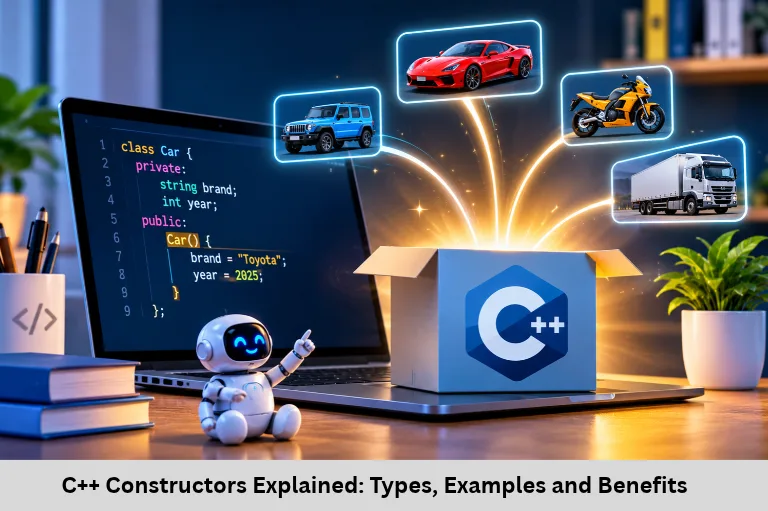
Learn C++ constructors, default, parameterized, and copy constructors, constructor overloading, initialization lists, object creation, and practical programming applications. Embedded Tech Development Academy (ETDA).
- C++ Constructors Explained: Types, Examples and Benefits
-
Constructors in C++: Types, Examples, and Object Initialization
- Introduction
- What Is a Constructor in C++?
- Why Do We Need Constructors?
- How Does a Constructor Work?
- Types of Constructors in C++
- Default Constructor in C++
- Parameterized Constructor in C++
- Copy Constructor in C++
- Constructor Overloading
- Constructors in Embedded Systems and IoT
- Advantages of Constructors
- Frequently Asked Questions
- Conclusion
Constructors in C++: Types, Examples, and Object Initialization
Introduction
C++ is an object-oriented programming language that provides powerful features such as classes, objects, inheritance, polymorphism, encapsulation, and constructors. Among these features, constructors in C++ play an essential role in initializing objects and ensuring that class members contain valid values before an object is used. Constructors automatically execute during object creation, making initialization a fundamental part of object-oriented programming.
Understanding constructors is important for writing structured, reliable, and maintainable C++ applications. They help developers initialize variables, validate input parameters, manage resources, and establish the initial state of objects. Default constructors, parameterized constructors, copy constructors, constructor overloading, and member initialization lists are important concepts in modern C++ development.
Constructors are also relevant in Embedded Systems, Internet of Things (IoT) applications, firmware development, device drivers, and hardware abstraction layers, where C++ classes may represent sensors, communication modules, peripherals, and controllers. Proper initialization prevents unexpected behavior and improves software reliability.
Embedded Tech Development Academy (ETDA), positioned as a Top Embedded Training Institute in Bangalore, helps learners develop programming knowledge relevant to Embedded Systems and Internet of Things (IoT) development, with assured placement support. Learning C++ constructors alongside classes, objects, memory management, and resource handling provides a strong foundation for technical programming.
What Is a Constructor in C++?
A constructor is a special member function of a class that executes automatically when an object is created. Its primary purpose is to initialize the object’s data members and establish a valid initial state.
Characteristics of Constructors
Constructor name must match the class name.
Constructors do not have a return type, including
void.They execute automatically during object initialization.
A class can contain multiple constructors.
Constructors can accept parameters.
Constructors can be overloaded.
Simple Example
#include <iostream>
using namespace std;

class Student {
public:
    Student() {
        cout << "Constructor called!" << endl;
    }
};

int main() {
    Student s1;
    return 0;
}
When s1 is created, the constructor executes automatically.
Real-World Analogy
A constructor is similar to initializing a smartphone when it is powered on. Basic settings and system components are configured before the device becomes ready for use. Similarly, constructors initialize class objects before their normal operations begin.
Why Do We Need Constructors?
Constructors provide several important advantages in C++ programming.
Guaranteed Initialization
Constructors help initialize data members with predictable values, reducing the risk of using uninitialized variables.
Object Initialization and Encapsulation
A constructor combines object creation and initialization into a single operation. It can also validate input values and enforce class-specific rules.
Resource Management
Constructors can initialize resources such as dynamically allocated memory, file handles, communication interfaces, and device objects.
In Embedded Systems, constructors may initialize software state associated with UART, SPI, I2C, or sensor drivers. Hardware initialization itself may require additional explicit operations depending on the system startup sequence.
How Does a Constructor Work?
When an object is created, C++ performs initialization according to the object’s declaration and constructor selection.
Constructor Execution Process
Storage is provided for the object.
Base classes and data members are initialized in the required order.
The matching constructor is selected.
The constructor body executes.
The object becomes ready for use if construction completes successfully.
Member Initialization List
C++ supports member initialization lists, which initialize data members before the constructor body executes.
class Student {
    int age;

public:
    Student(int a) : age(a) {
    }
};
Member initialization lists are preferred for many initialization tasks because they directly initialize members instead of assigning values afterward.
Types of Constructors in C++
C++ supports several constructor forms, each serving a different initialization requirement.
| Constructor Type | Purpose |
|---|---|
| Default constructor | Initializes objects without arguments |
| Parameterized constructor | Initializes objects using supplied values |
| Copy constructor | Creates an object from another object |
| Move constructor | Transfers resources from another object |
Default Constructor in C++
A default constructor is a constructor that can be called without arguments. If a class declares no constructors, the compiler may implicitly generate a default constructor.
Example
#include <iostream>
#include <string>
using namespace std;

class Student {
public:
    string name;
    int age;

    Student() {
        name = "Unknown";
        age = 0;
    }
};

int main() {
    Student s1;

    cout << s1.name << " " << s1.age;
    return 0;
}
The output is:
Unknown 0Here, the default constructor initializes the student’s name and age.
Parameterized Constructor in C++
A parameterized constructor accepts arguments to initialize an object with specific values.
Example
#include <iostream>
#include <string>
using namespace std;

class Student {
public:
    string name;
    int age;

    Student(string n, int a)
        : name(n), age(a) {
    }
};

int main() {
    Student s1("Aditi", 20);

    cout << s1.name << " is "
         << s1.age << " years old.";
    return 0;
}
The constructor receives "Aditi" and 20, initializing the object’s data members directly.
Advantages
Supports customized object creation.
Reduces separate assignment statements.
Improves initialization consistency.
Allows validation of constructor arguments.
Copy Constructor in C++
A copy constructor creates a new object using an existing object of the same class.
Syntax and Example
class Student {
public:
    string name;
    int age;

    Student(string n, int a)
        : name(n), age(a) {
    }

    Student(const Student& s)
        : name(s.name), age(s.age) {
    }
};

int main() {
    Student s1("Aditi", 20);
    Student s2(s1);
}
The copy constructor initializes s2 using the values stored in s1.
Shallow Copy and Deep Copy
When a class contains pointers or dynamically allocated resources, copying requires special attention.
A shallow copy duplicates pointer values, potentially causing multiple objects to access the same resource. A deep copy creates independent resource storage when appropriate.
In Embedded Systems and Internet of Things (IoT) software, correct copying is important for buffers, communication objects, and resource-owning classes.
Constructor Overloading
Constructor overloading allows a class to provide multiple constructors with different parameter lists.
Example
class Device {
public:
    int id;

    Device() : id(0) {
    }

    Device(int value) : id(value) {
    }
};
The first constructor initializes id to zero, while the second accepts a custom identifier.
Constructors in Embedded Systems and IoT
C++ constructors are useful for representing hardware components and software modules.
Sensor Object Initialization
class TemperatureSensor {
public:
    int sensorId;

    TemperatureSensor(int id)
        : sensorId(id) {
    }
};
This example initializes the software identity of a sensor object. Actual sensor communication and hardware configuration may be implemented separately.
Technical Applications
UART communication classes.
SPI and I2C driver objects.
Sensor abstraction classes.
Embedded device configuration.
RTOS task-related software objects.
Internet of Things (IoT) communication modules.
Learning constructors, pointers, and class initialization helps engineers develop organized firmware architectures.
Advantages of Constructors
Constructors provide reliable initialization, cleaner code, improved encapsulation, flexible object creation, and better resource management.
When combined with destructors and RAII techniques, constructors help manage resources safely throughout an object’s lifetime.
Assured placement support can complement technical training by helping learners prepare for programming interviews involving classes, constructors, object initialization, and Embedded Systems fundamentals.
Frequently Asked Questions
What is a constructor in C++?
A constructor is a special class member function that executes automatically when an object is created to initialize its data members.
What are the main types of constructors in C++?
The commonly discussed types include default constructors, parameterized constructors, copy constructors, and move constructors.
What is a default constructor?
A default constructor is a constructor that can be called without arguments and initializes an object without requiring external parameter values.
What is a parameterized constructor?
A parameterized constructor accepts arguments and uses them to initialize an object’s data members.
What is a copy constructor?
A copy constructor creates a new object using an existing object of the same class. It is especially important when classes manage dynamically allocated resources.
Why are constructors important in Embedded Systems?
Constructors initialize software objects representing hardware peripherals, sensors, communication interfaces, and device configurations, supporting organized and maintainable firmware development.
Conclusion
Constructors are fundamental components of C++ object-oriented programming because they initialize objects automatically and establish their initial state. Default constructors, parameterized constructors, copy constructors, move constructors, and constructor overloading support different object creation requirements.
Understanding constructors improves code organization, initialization safety, resource management, and software maintainability. These concepts are particularly useful in Embedded Systems and Internet of Things (IoT) development, where C++ classes represent sensors, peripherals, communication modules, and hardware abstraction layers.
Embedded Tech Development Academy (ETDA), positioned as a Top Embedded Training Institute in Bangalore, supports learners in developing practical programming knowledge through Embedded Systems-oriented learning. Understanding C++ constructors, classes, pointers, memory management, and firmware architecture can strengthen technical preparation, supported by assured placement support. Constructor fundamentals remain an important step toward developing reliable and maintainable embedded software.
Author: ETDA Trainers
Experience: 10+ Years of Industry Experience in Embedded Systems, IoT, and Embedded C Programming