
C++ Destructors Explained: Syntax, Examples and Virtual Destructors
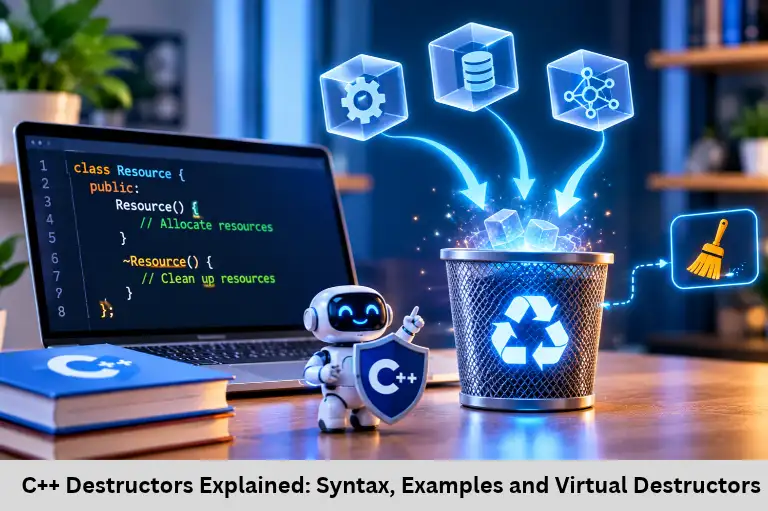
Learn C++ destructors, automatic cleanup, destructor execution order, virtual destructors, resource management, RAII, and practical Embedded Systems applications. Embedded Tech Development Academy (ETDA).
- C++ Destructors Explained: Syntax, Examples and Virtual Destructors
-
Destructors in C++: Complete Guide to Object Cleanup and Resource Management
- Introduction
- What Is a Destructor in C++?
- Why Do We Need Destructors?
- How Does a Destructor Work?
- Destructor in Action: A Simple Example
- Order of Constructor and Destructor Calls
- What Is a Virtual Destructor in C++?
- Constructor vs Destructor in C++
- Destructors in Embedded Systems and IoT
- Frequently Asked Questions
- Conclusion
Destructors in C++: Complete Guide to Object Cleanup and Resource Management
Introduction
C++ is a powerful programming language that provides direct control over memory, object lifetimes, and system resources. While constructors initialize objects during creation, destructors in C++ perform cleanup operations when objects reach the end of their lifetime. Understanding destructors is essential for developing reliable software, preventing memory leaks, managing dynamically allocated memory, and maintaining resource safety.
A destructor is particularly important when a class owns resources such as heap memory, file handles, communication interfaces, or dynamically created objects. Without proper cleanup, programs may experience memory leaks, resource exhaustion, and unexpected behavior. C++ automatically invokes destructors at appropriate lifetime boundaries, making resource management more systematic.
Destructors are also valuable in Embedded Systems, Internet of Things (IoT) applications, firmware development, device drivers, and real-time software, where limited RAM, hardware interfaces, and long-running applications require careful resource management. Engineers must understand object destruction, stack unwinding, virtual destructors, inheritance, and Resource Acquisition Is Initialization (RAII).
Embedded Tech Development Academy (ETDA), positioned as a Top Embedded Training Institute in Bangalore, supports learners in developing programming fundamentals relevant to Embedded Systems andInternet of Things (IoT) development with assured placement support. Learning constructors, destructors, memory management, pointers, and object-oriented programming helps aspiring engineers build reliable software.
What Is a Destructor in C++?
A destructor is a special member function automatically called when an object is destroyed. Its primary purpose is to release resources or perform cleanup operations before the object’s lifetime ends.
Characteristics of Destructors
A destructor has the same name as its class, preceded by a tilde (
~).It does not have a return type.
It cannot accept parameters.
It cannot be overloaded.
A class has one destructor declaration, although it may be implicitly generated.
It executes automatically when an object’s lifetime ends.
Destructor Syntax
class Student {
public:
    ~Student() {
        // Cleanup operations
    }
};
Constructor and Destructor Relationship
A constructor initializes an object, while a destructor handles cleanup. Together, they define important stages of an object’s lifecycle in C++.
Why Do We Need Destructors?
Destructors provide reliable resource management and help maintain program stability.
Resource Release
Destructors can release dynamically allocated memory, close files, and release resources owned by an object.
Memory Leak Prevention
When dynamically allocated memory is no longer required, it must be released. A destructor can automatically perform this cleanup when the owning object is destroyed.
Exception Safety
When a function exits because of an exception, automatic objects are destroyed during stack unwinding. Their destructors can release resources safely.
Object Lifecycle Management
Destructors allow classes to perform final operations, such as logging, cleanup, or releasing resources before object destruction.
For Embedded Systems and Internet of Things (IoT) applications, this is useful when software modules manage buffers, communication resources, and hardware-related objects.
How Does a Destructor Work?
A destructor executes automatically when an object’s lifetime ends.
Destructor Execution Process
An object reaches the end of its scope or is destroyed explicitly.
C++ invokes the object’s destructor.
The destructor performs its cleanup operations.
The object’s storage is released or reused according to its allocation mechanism.
For dynamically allocated objects, the destructor executes when delete is applied correctly. The memory is then deallocated.
Destructor in Action: A Simple Example
Example Program
#include <iostream>
#include <string>
using namespace std;

class Student {
public:
    string name;

    Student(string n) : name(n) {
        cout << name << " object created." << endl;
    }

    ~Student() {
        cout << name << " object destroyed." << endl;
    }
};

int main() {
    Student s1("Aditi");

    cout << "Inside main..." << endl;
    return 0;
}
Output
Aditi object created.
Inside main...
Aditi object destroyed.
The destructor executes automatically when s1 reaches the end of its lifetime.
Technical Observation
The destructor is not explicitly called inside main(). The compiler-generated lifecycle operations ensure that the automatic object is destroyed correctly.
Order of Constructor and Destructor Calls
C++ follows predictable object lifetime rules. Objects constructed in the same scope are generally destroyed in reverse construction order.
Example
#include <iostream>
using namespace std;

class Demo {
public:
    int id;

    Demo(int i) : id(i) {
        cout << "Constructing " << id << endl;
    }

    ~Demo() {
        cout << "Destroying " << id << endl;
    }
};

int main() {
    Demo a(1);
    Demo b(2);
    Demo c(3);
}
Output
Constructing 1
Constructing 2
Constructing 3
Destroying 3
Destroying 2
Destroying 1
Why Reverse Order Matters
Reverse destruction order helps maintain dependencies between objects. If one object depends on another object created earlier, the dependent object is normally destroyed first.
This behavior is particularly useful when managing Embedded Systems software modules and Internet of Things (IoT) communication components.
What Is a Virtual Destructor in C++?
A virtual destructor is a destructor declared with the virtual keyword in a base class. It ensures correct destruction when a derived object is deleted through a base-class pointer.
Example
#include <iostream>
using namespace std;

class Base {
public:
    virtual ~Base() {
        cout << "Base destructor called" << endl;
    }
};

class Derived : public Base {
public:
    ~Derived() {
        cout << "Derived destructor called" << endl;
    }
};

int main() {
    Base* b = new Derived();
    delete b;
}
Output
Derived destructor called
Base destructor called
Importance of Virtual Destructors
If a derived object is deleted through a base pointer and the base destructor is non-virtual, the behavior is undefined in standard C++. Declaring a virtual destructor prevents this problem in polymorphic resource-owning classes.
Constructor vs Destructor in C++
| Constructor | Destructor |
|---|---|
| Initializes an object | Cleans up an object |
| Same class name | Class name preceded by ~ |
| Can accept parameters | Cannot accept parameters |
| Can be overloaded | Cannot be overloaded |
| Called during initialization | Called at the end of lifetime |
Destructors in Embedded Systems and IoT
Destructors help manage resources in software components used for embedded development.
Technical Applications
Memory buffer management.
Communication interface objects.
Sensor driver resource cleanup.
File and storage management.
Dynamic object management.
Hardware abstraction layer components.
RAII and Modern C++
Resource Acquisition Is Initialization (RAII) connects resource ownership with object lifetime. Resources are acquired during initialization and released automatically during destruction.
Smart pointers such as std::unique_ptr help manage dynamically allocated objects without manually calling delete.
Assured placement support in technical training can complement practical knowledge of C++ resource management, object-oriented programming, and Embedded Systems development.
Advantages of Destructors
Destructors provide automatic cleanup, resource safety, memory leak prevention, predictable object lifetimes, and improved exception handling.
In Embedded Systems and Internet of Things (IoT) applications, understanding destructors helps developers manage memory and software resources efficiently. Combined with RAII, smart pointers, and virtual destructors, they support maintainable and reliable C++ applications.
Frequently Asked Questions
What is a destructor in C++?
A destructor is a special member function automatically called when an object is destroyed. It performs cleanup operations and releases resources owned by the object.
What is the syntax of a destructor?
A destructor uses the class name preceded by a tilde, such as ~Student(). It has no return type and cannot accept arguments.
Can a destructor be overloaded in C++?
No. A class can have only one destructor because destructors cannot accept parameters or be overloaded.
What is a virtual destructor?
A virtual destructor ensures that the correct derived-class destructor executes when a derived object is deleted through a base-class pointer.
What is the difference between a constructor and a destructor?
A constructor initializes an object during creation, while a destructor performs cleanup when the object’s lifetime ends.
Why are destructors important in Embedded Systems?
Destructors help manage memory, buffers, communication resources, and software objects, supporting reliable resource management in embedded firmware.
Conclusion
Destructors are essential components of C++ programming because they perform cleanup operations when objects reach the end of their lifetime. They help release dynamically allocated memory, manage resources, support exception safety, and maintain predictable object lifecycle behavior.
Understanding destructor execution order, virtual destructors, inheritance, RAII, and resource ownership is particularly valuable in Embedded Systems, Internet of Things (IoT) firmware, device drivers, and long-running applications. These concepts help engineers develop memory-efficient, reliable, and maintainable software.
Embedded Tech Development Academy (ETDA), positioned as a Top Embedded Training Institute in Bangalore, helps learners strengthen programming fundamentals and technical knowledge relevant to Embedded Systems and Internet of Things (IoT) development. Learning constructors, destructors, pointers, memory management, and object-oriented programming provides a strong foundation for firmware engineering, supported by assured placement support. Mastering destructors is an important step toward developing robust C++ applications.
Author: ETDA Trainers
Experience: 10+ Years of Industry Experience in Embedded Systems, IoT, and Embedded C Programming